The belated arrival of winter weather this year has allowed us all to enjoy the grounds of Cranbrook House far later into the year than is usually possible. However, the time has finally come to shroud our exterior sculptures and fountains in protective tarps for the season. This process is an annual reminder to our staff – and to the Brookside students who come to sing the statues to sleep – of just how numerous and varied the outdoor art collection at the house is. One part of the gardens is particularly rich in art and history: the north staircase.
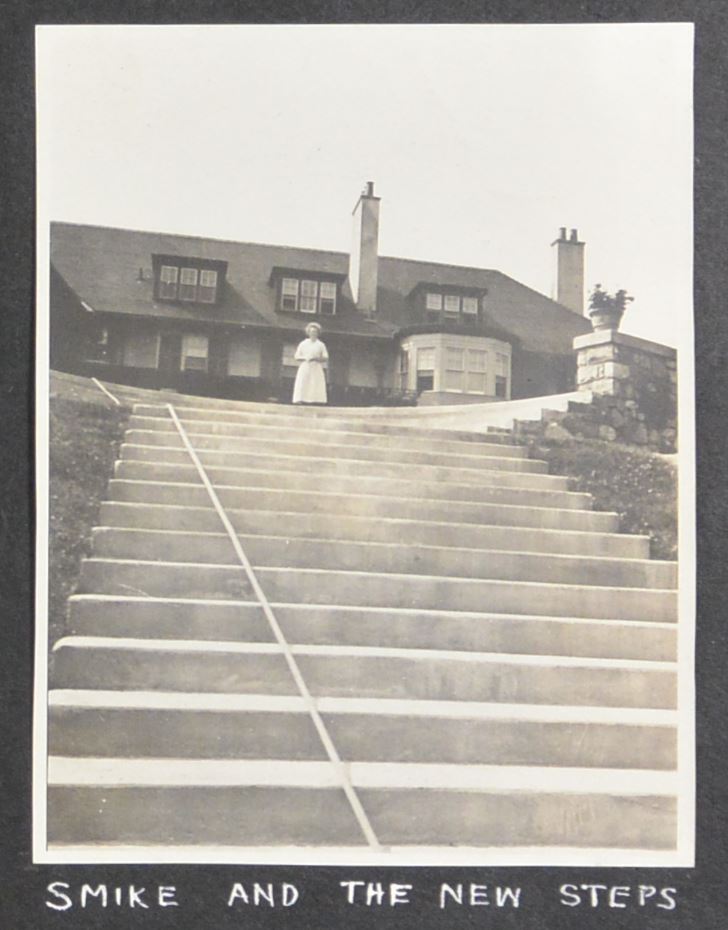
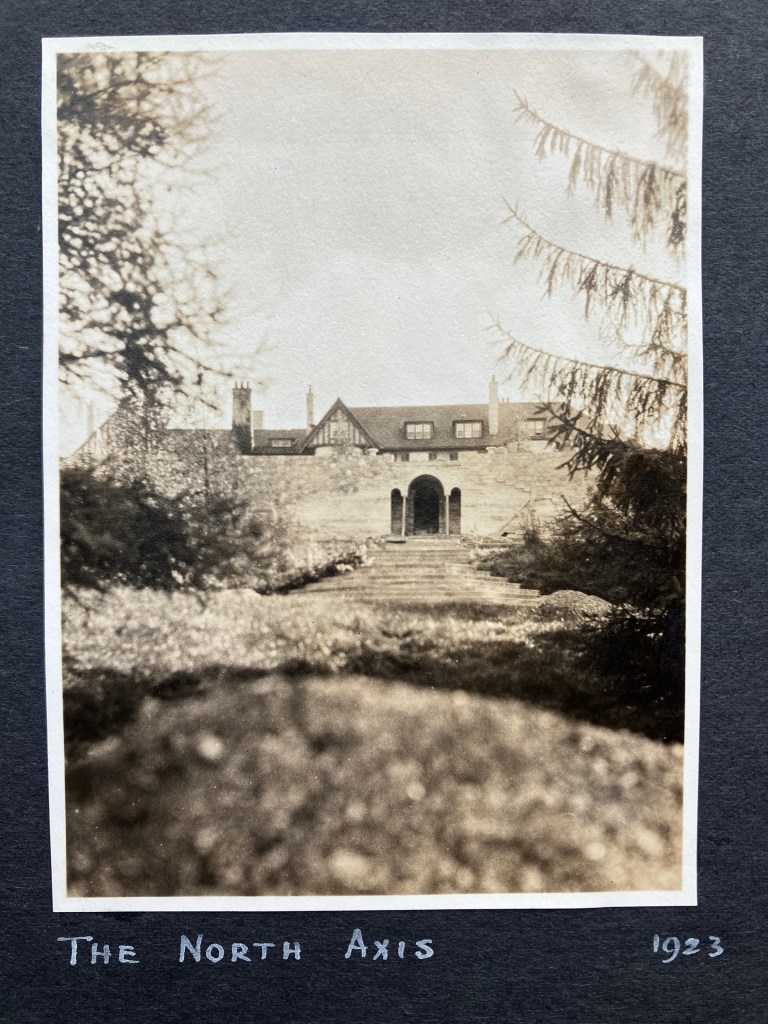
Stretching from the lakeside path at its base to the uppermost lawn outside Cranbrook House’s North Porch at its apex, the eighty concrete steps are lined with artworks, transforming the stairs into an open-air museum gallery. The stairs themselves were first built in the summer of 1921, as part of a spur-of-the-moment project to improve the view from the North Porch undertaken by James and Henry Scripps Booth. As their grandfather, Henry Wood Booth, recalled,
After ten years of sitting on the north porch and looking at a blank terrace wall, and talking about creating a vista through it, James and Henry got busy one May day with sledge hammers, and beside raising many blisters, razed about ten feet of wall the first day. Immediately a view of the lake came into being, and plans were made for a stairway down the hill.
Whether or not James and Henry had permission to make this change is contested; their grandfather’s account frames it as a collective impulse, while Henry remembers being disciplined for their impetuous action:
After construction of the curved steps, masons started building a series of flights which headed for a large wild cherry tree almost on axis along side rue Gagnier. According to one account, James and I were required to cut that tree down as a penalty for our reputed vandalism. While neither of us had a guilty conscience, we went to work sawing very hard wood and eventually (a full day later, I believe) the tree fell.
The concrete staircase was poured in July of 1921. The hillside around the new staircase was improved with new trees and paths under the oversight of O. C. Simonds, the landscape architect responsible for much of the re-foresting of the estate. After these changes, Henry Wood Booth noted with satisfaction that “[t]his hill, which for so many years had been an object of regret, was at last to be something really fine.”

Further improvements were still in store, in the form of a dozen sculptural embellishments.
Walkers along the lakeside path today are met by two stone lions on pedestals flanking the base of the stairs. Carved from travertine and purchased by George Booth from the Galleria Sangiorgi in Rome in 1924, the lions are copies of works by the Italian neoclassical sculptor Antonio Canova, best known for his Cupid and Psyche, now in the Louvre, Paris. Canova sculpted the original lions in 1774 for the tomb of Pope Clement XIII in St Peter’s Basilica, in Rome. On Pope Clement’s tomb, the lions, one sleeping, one waking, face one another, symbolizing the confrontation of life and the long sleep of death. Here at Cranbrook, the lions face out toward the lake, one on guard, one enjoying a nap in the shade of the hill.
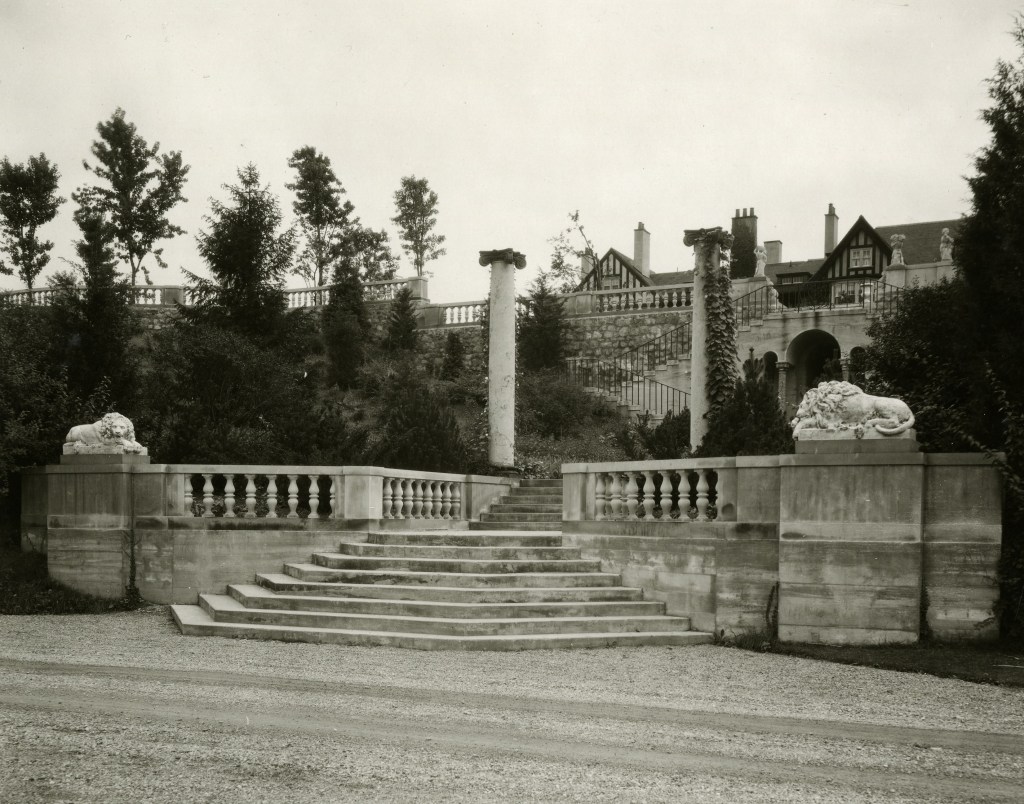
Stairway to Lower Terrace at Cranbrook House and Gardens, circa 1924. Photograph by George W. Hance. Courtesy Cranbrook Archives.
Although George Booth’s letters home from Italy in 1924 do not say as much, he and Ellen probably saw the original lions in the Vatican on their visit to Rome in 1922. In the intervening year, George Booth had considered buying copies of the Canova lions in cast stone, a form of concrete, from an American garden sculpture company, Howard Studios.
Just a few steps up, the stairway is flanked by concrete columns, topped with red stone Corinthian capitals. Their origins have not yet been traced, but George Booth purchased many marble capitals in Italy, most of them Roman or early medieval, for the Cranbrook Academy of Art. It would have been characteristic for the Booths to have retained a few Italian finds to ornament Cranbrook House as well.

From the lower landing of the staircase, its centerpiece is already visible – a fountain niche, added in 1923, requiring considerable reconstruction of this section of the stairs. At the back of the niche, now forming the fountain cascade, are a few of the original 1921 stairs.
The niche houses Mario Korbel’s Dawn, a near life-size female figure holding an apple. The symbolism of the figure is ambiguous. The apple may refer to Eve, the “dawn” of womanhood. It may also associate the figure with the goddess Aphrodite, who was awarded a golden apple as the prize in a divine beauty contest, and is associated with the planet Venus, sometimes called the morning star.

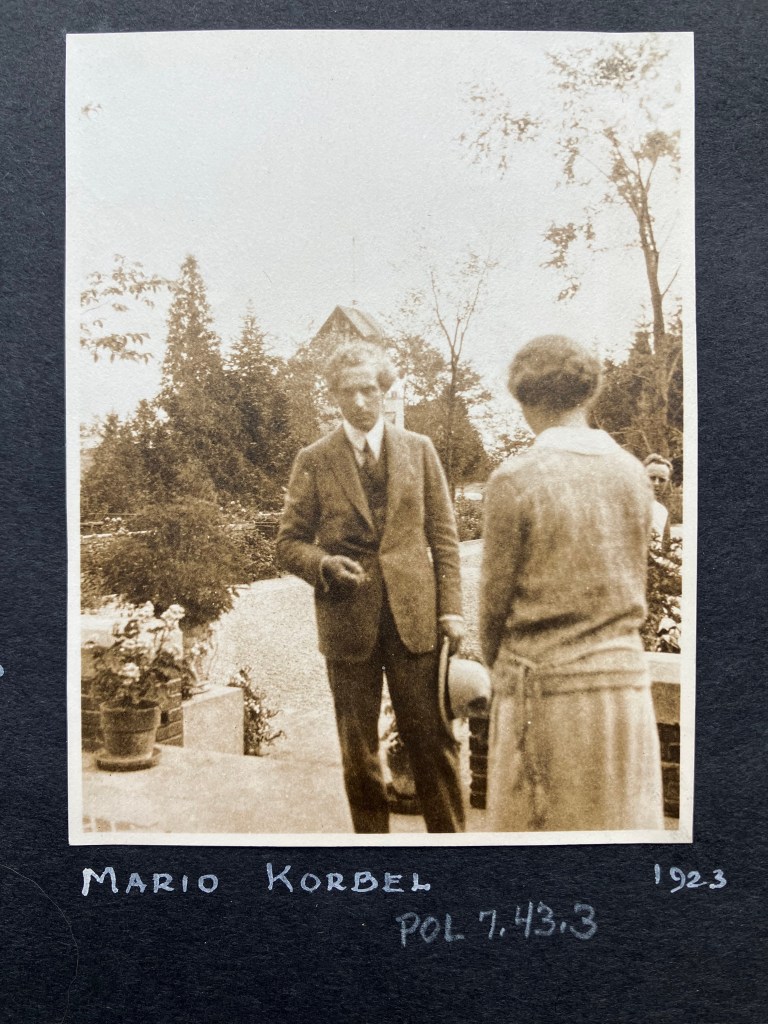
Korbel visited the grounds in 1923 and contributed ideas to the design of the niche for his sculpture. Cranbrook once also boasted a figurine version of Dawn, offered to George Booth by Korbel during the planning process for the full-size version, until it was stolen in 1926. George Booth did his best to soften the blow when informing Korbel of the loss, framing the theft as a compliment to the artist’s skill:
…you may feel flattered to learn that only a few nights ago some expert burglars after rifling the safe at the Cranbrook Office, ran off with your small figure of “Dawn”, taking along with her a supply of rugs and other articles so as to surround her with suitable luxury.
The Booths’ small Dawn was never recovered.
The columns that flank Dawn’s niche are the work of an unknown Italian artist, and probably purchased by George Booth in the early or mid 1920s. Their design is based on twelfth-century examples from the Benedictine cloister at Monreale Cathedral, in Sicily. The courtyard fountain at Cranbrook School is a replica of a fountain from the same cathedral complex. First spotted by Henry Scripps Booth in 1922, George Booth later ordered a replica fountain from the Chiurazzi Foundry, who also carved the Canova lions at the base of the stairs. As evidenced by the blend of geometric, botanical, and animal ornament on this pair of columns, the architecture of medieval Sicily blended classical, Gothic, and Islamic influences, a reflection of the cultural diversity of the Norman Kingdom of Sicily. Their stylistic syncretism aptly complements the polysemy of Korbel’s figure of Dawn-Eve-Aphrodite.
The columns are not wrapped in the wintertime, allowing visitors to enjoy this feature of the staircase year-round.
The topmost landing of the stairs is ornamented with a curling iron railing, quite possibly designed by George Booth and executed at the Cranbrook metalsmithing workshop. To either side of the landing stand four cast stone cherubs, replacements for the original quartet of cherubic representations of the four seasons, which fell to pieces within fifty years of their purchase. One was already missing a head by 1949. The originals were purchased in Italy in 1924. Their replacements were donated by the Cranbrook House and Gardens Auxiliary in 1974.
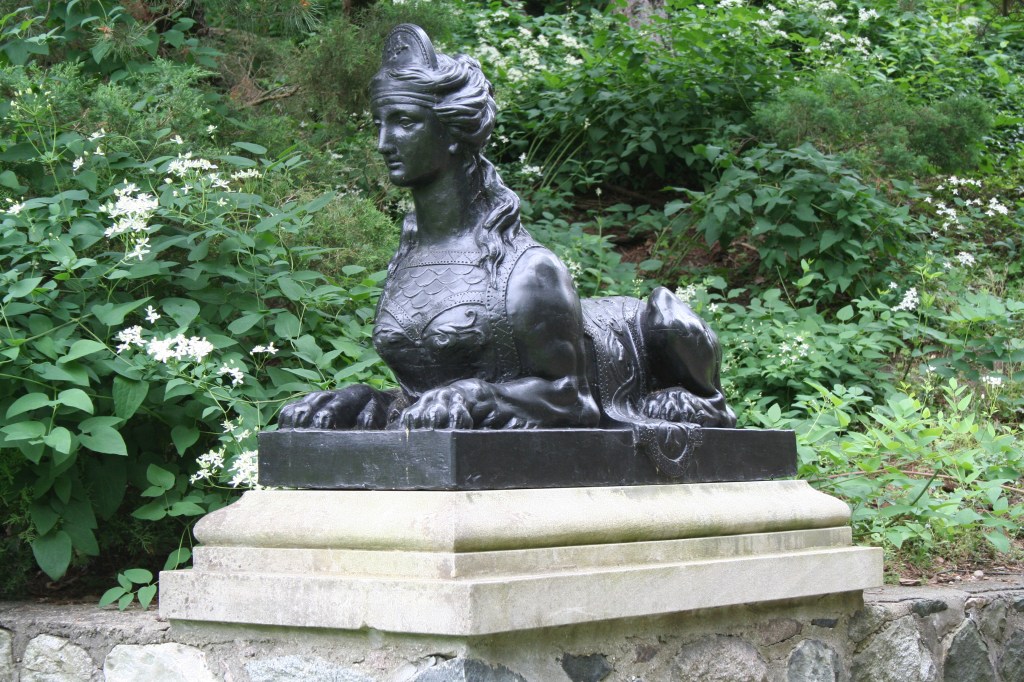
Although the original cherub statues brought an end to the staircase’s parade of sculptures in George and Ellen Booth’s day, Henry Scripps Booth added a final flourish to the ascent in 1963. Two sphinxes, cast bronze copies of sculptures by the English artist John Cheere, bought at auction in England, keep watchful guard over the middle north terrace from either side of the wide upper stair. These bronzes, like so many other features of the staircase, are copies of European artworks. In this case, the eighteenth-century originals were created for Chiswick House, the Greater London home of Earls of Burlington, a Palladian style villa renowned for its refined neoclassical air.
As we set forth into the darkest season of the year, with all the familiar sculpted denizens of the gardens hidden beneath their winter coats, the grounds might start to feel a little lonely. Recalling the history of their making, from the reshaping of the hillsides to the final placing of statuary in their niches or atop their pedestals, can re-animate the familiar byways of Cranbrook, even on the coldest and greyest days. The Booths’ tribulations – a statuette stolen, others shattered by cold – remind us of the evolving nature of even a historic and well-preserved garden, and of the many winters that have passed over these grounds and left them largely unharmed.

The north staircase, a project begun in 1921 and completed more than forty years later, is still “something really fine,” with or without its sculptures and fountain. And the view from the top, which inspired the project, is even finer in winter, when frosty, leafless branches part to reveal a sparkling view of the frozen surface of Kingswood Lake and the snowy hills beyond.
— Mariam Hale, 2023-2025 Collections Fellow, Cranbrook Center for Collections and Research
Discover more from Cranbrook Kitchen Sink
Subscribe to get the latest posts sent to your email.
 Cranbrook Kitchen Sink
Dear Meriam Hale,
This is an excellent piece and i love your writing style and sensitivity to the beauty of Cranbrook. I look forward to more insights from you during your fellowship. Thank you, martha cross neumann KSC ’65
LikeLike
This is a wonderful article in the Cranbrook grounds.
In the photo of Mr. Korbel , I believe he is speaking with Ellen Booth and James is in the background listening in.
LikeLike