Eat, Greek, and Be Merry: the Greek Theatre Turns 100!

Drama and arts and crafts have been intertwined in Detroit history for more than 100 years. Under the auspices of the Detroit Society of Arts and Crafts (DSAC), on January 19th 1910, May Morris (daughter of William Morris) captivated a capacity crowd at the Detroit Museum of Art with her illustrated lecture “Pageantry and the Mask.” Morris’s presentation helped mark a turning point in propelling Detroit onto the national stage as an arts and crafts center. Almost immediately after May Morris left Detroit, Alexandrine McEwen, a bookplate artist and founding member of the DSAC, penned what was termed a “modern immorality play” called Everywoman with characters named “Suffrage” and “Art.” Less than a month later, she wrote The Masque of Arcadia, another outdoor play held on the grounds of Clairview, J.L. Hudson’s Grosse Pointe estate. These performances led to the DSAC being the first to foster a little theatre as part of their program.

By 1914, George Booth (the first president of the DSAC) already had plans in mind for a bathing pavilion and a theatre on the hill overlooking Cranbrook House. (My own suspicion is that he did not like the fact that the DSAC performances were not held on HIS estate!) In early 1915, Booth commissioned Canadian architect Marcus Burrowes to draw up the plans for an outdoor Greek Theatre. The open-air amphitheater, constructed of stone, seats nearly 300 people and was described in contemporary news articles as a “gem of architecture” and a “temple of art.” By May 1916, landscaping was underway and red tulips graced the front of the bathing pavilion.

Invitation Card, The Cranbrook Masque, June 1916. George Gough Booth Papers.

Invitation Card, The Cranbrook Masque, June 1916. George Gough Booth Papers.

Meanwhile, the DSAC was planning the production of The Cranbrook Masque which would also serve as the public dedication for the new Greek Theatre. The play showed the development of drama from ancient to modern times in five episodes, emulating May Morris’s lecture theme from 1910. For more on the play, see an earlier blog post.

Greek Theater masque, 1916

The Cranbrook Masque at the Greek Theatre, 1916. Hand-tinted glass slide.

Fast forward to 1991 and the 75th anniversary of the Greek Theatre. A team of dedicated Cranbrook staff, historians, and theater enthusiasts initiated the restoration of the Greek Theatre and a contemporary production, using the script from the original Masque, this time with cast members from St. Dunstan’s Guild and dancers from Jessie Sinclair’s Cranbrook Kingswood Dancers.

E465

Cranbrook House sunken garden (originally called the kitchen garden) with staked tomato plants, ca 1915.

This year marks the 100th anniversary of the Greek Theatre and a long-standing tradition of theater programs at Cranbrook. In honor of this memorable event, the Cranbrook Center for Collections and Research will be presenting “Edible Landscapes: A Midsummer Night’s Dinner.”

Leslie S. Edwards, Head Archivist

A Portrait Comes Home to Cranbrook House

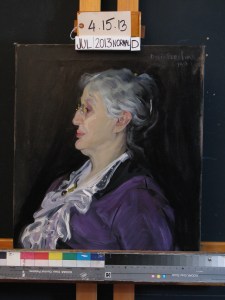
The portrait of Clara Gagnier Booth, mother of Cranbrook founder George Gough Booth, has been mounted in the Oak Room at Cranbrook House. This painting is on long-term loan to Cranbrook from the Saginaw Art Museum, which acquired the painting through a donation from Clara Booth’s grandson, John Lord Booth I.

Perelma_Image

Conservation in-progress, April 2013 by Kenneth B. Katz, Conservation and Museum Services.

After receiving conservation treatment and a new frame, this painting of Clara Booth will accompany that of her husband, Henry Wood Booth, as well as their son George, his wife Ellen Scripps Booth, and Ellen’s father James Edmund Scripps. Financial support from John Lord Booth II affords this opportunity to join the painting of the Booth family matriarch with those of her relatives at Cranbrook House.

The artwork was painted in 1918 by Russian-born artist Ossip Perelma, known particularly for his portraits of men of stature such as President Woodrow Wilson, King Albert I of Belgium, and several Russian and French political officials. Perelma also executed the stately portrait of Henry Wood Booth, currently on view in the Oak Room.

Demure in size and executed with soft and fluid brush strokes, Clara Booth’s portrait contrasts with that of her husband. While Henry is depicted in full length in an outdoor background, his wife is shown only by profile, with just the upper half of her torso included in the composition. The stylistic distinction between Clara’s portrait and that of her husband—and indeed many of Perelma’s other subjects—emphasizes the differing approach Perelma took to depicting a woman.

In the early twentieth century, even women of position, beauty, and culture were often removed from public view after their role as wife and mother was fulfilled, and their youth had faded. This portrait was painted when Clara Booth was 79, and it is notable that Perelma chose not to conceal his subject’s age. Indeed, the portrait is a rare and significant example of art providing legitimacy and prestige to a woman who remained elegant and strong as she reached an age when most women no longer had a public presence or were being immortalized by artists.

Both portraits, Clara Gagnier Booth and Henry Wood Booth, will be available for viewing when Cranbrook House opens for public tours on Sunday June 14th! For more information on the tours check out the Cranbrook House & Gardens Auxillary website.

Stefanie Dlugosz-Acton, Collections Fellow, Center for Collections and Research

Lighting Up Cranbrook House: Edward F. Caldwell & Co.

HT_2014_1

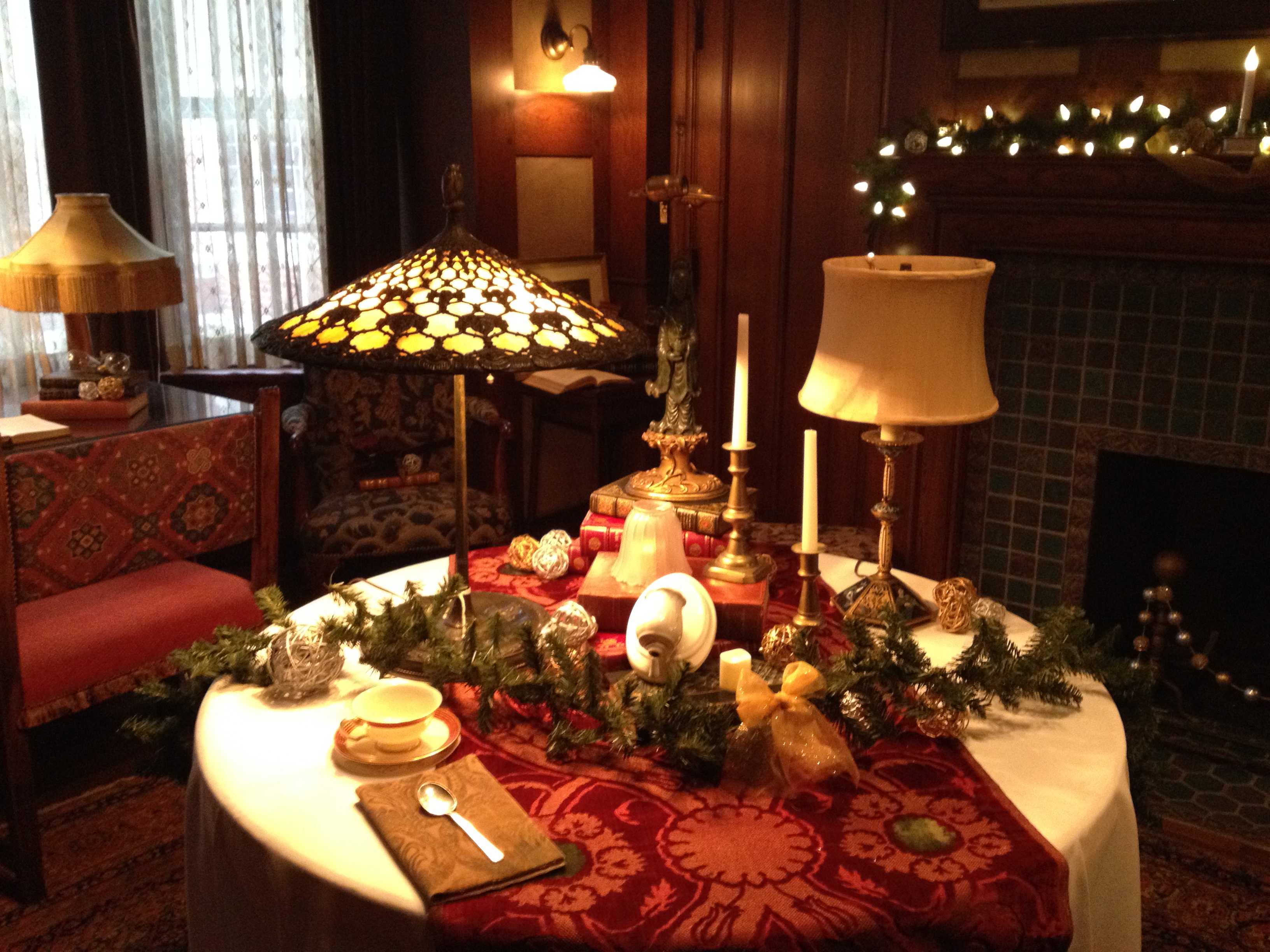
Holiday Tables, 2014. Stefanie Dlugosz, photographer.

This past weekend the Center for Collections and Research put on a display for Holiday Tables at Cranbrook House, organized by the Cranbrook House and Gardens Auxiliary.  Associate Registrar Gretchen Sawatzki and I put together a display highlighting the electric lighting original to the home, focused on lamps and lighting by the Edward F. Caldwell & Company.

Cranbrook House was designed and built in 1908, and George Gough Booth always had the intention of having electric lighting throughout the home. Within the city of Detroit there had been an interest in electricity, and by 1906 there were two power plants on the Detroit River owned and operated by the Detroit Edison Company. However, with Cranbrook House being roughly 20 miles to downtown Detroit, this was an achievement. The Booth’s interest in innovation propelled them to always be ahead of their time by investing in the newly available widespread utility for their home.

HT_2014_2

Holiday Tables, 2014. Stefanie Dlugosz, photographer.

HT_2014_3

Holiday Tables, 2014. Stefanie Dlugosz, photographer.

In the first half of the twentieth century Edward F. Caldwell & Company was America’s premier design and manufacturer for electric light fixtures. The New York firm founded in 1895 created designed and works with several prominent clients at the time including the Frick, Morgan, and Carnegie families. Much of their work was done in tandem with architectural commissions, and therefore clients like Booth were able to provide input and alter details to customize their lighting choices. Booth provided his own ideas about a few pieces for the home, but overall selected most of the pieces directly from their catalogues. During the construction and design of Cranbrook House, George G. Booth was actively involved in conversations with Albert Kahn, the architect, and many of the vendors providing goods and products for the home. Booth was enthusiastically involved in providing input on the design elements of the home, and the lighting was no different. Many of the Edward F. Caldwell & Co. catalogues can be found online through the Cooper-Hewitt Museum Library, Smithsonian Institution Libraries

Stefanie Dlugosz, Collections Fellow, Center for Collections and Research


Create a website or blog at WordPress.com