Happy Birthday Milles!

Any chance you have a trip planned to Europe this summer? If so, your itinerary really must include Stockholm. Not only is it a beautiful city—one of my favorites—but it also was home to one of Cranbrook’s most celebrated artists, Carl Milles. Long before he took up residence at Cranbrook, the Swedish sculptor started to plan and build his home and studio, Millesgården. Built high on a cliff overlooking Stockholm’s harbor, Millesgården now is a magical museum and sculpture park and the site of this year’s summer-long birthday party, The Sculptor Carl Milles at 150. Yes, if Carl Milles had lived to be the world’s oldest man, he would have turned 150 this Monday, June 23.

Carl Milles working in his Cranbrook Academy of Art studio, circa 1950. Margueritte Kimball, photographer. Courtesy of Cranbrook Archives.

While anyone taking the time to read this blog no doubt has an image in mind of one of Milles’s works at Cranbrook (there are no fewer than 45 outdoors on our campus and another 52 in the Art Museum or other buildings), my guess is that the story of the twenty years he spent working in America are a little foggy (unless, of course, you attended our 2021 virtual fundraiser, A Global House Party at Cranbrook and Millesgården, and watched the film, Carl Milles: Beauty in Bronze, we produced for the occasion). As a refresher course, or even a primer, I thought I would take you on a journey, one that starts in America and ends, twenty-two years later, back in Sweden (and Italy, as the case may be).

Milles arrived in the United States for the first time in October 1929. With the stated purpose of attending the opening of his second group exhibition in New York City, he took advantage of the trip to sell work to collectors, negotiate a commission in Chicago for his Diana Fountain, present the concept for the monumental doors he would create for the Pennsylvania State Capitol, and meet with Tage Palm, the President of the Chicago-based Swedish Arts and Crafts Company who would become his business manager. Most important for this next chapter of his career, he also traveled by train to Michigan where he met with George Booth who asked him to teach at the art school he was building north of Detroit, Cranbrook Academy of Art.
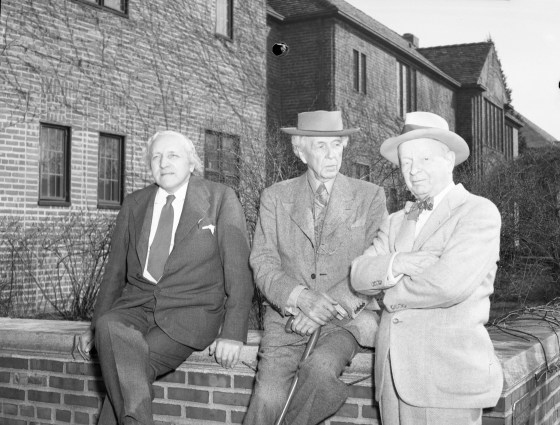
Carl Milles, Frank Lloyd Wright, and Eliel Saarinen (l to r) outside Saarinen House, March 1945. Harvey Croze, photographer. Courtesy of Cranbrook Archives.

George Booth and his wife Ellen Scripps Booth, as most Cranbrook Kitchen Sink blog readers know, were wealthy newspaper publishers and philanthropists. Although their flagship paper, the Detroit News, was based in Detroit, their home was in the countryside of Bloomfield Hills. By the late 1920s, they had begun to work with the Finnish architect Eliel Saarinen to transform their private estate into an educational community that eventually included an Episcopal church, boys and girls schools, an art academy and museum, and an institute of science (and, even later, a center for collections and research). Although the archival record is a little murky, Saarinen and Milles were at least acquaintances long before the sculptor met with his future patron at Cranbrook.

As Milles contemplated moving to Cranbrook to direct the Academy’s Sculpture Department, there was one small problem: he had no desire to teach. Two years and many conversations later, Booth and Milles came to an agreement: the sculptor would not need to “teach” but simply “mentor” students in his studio. (Not a bad deal!)
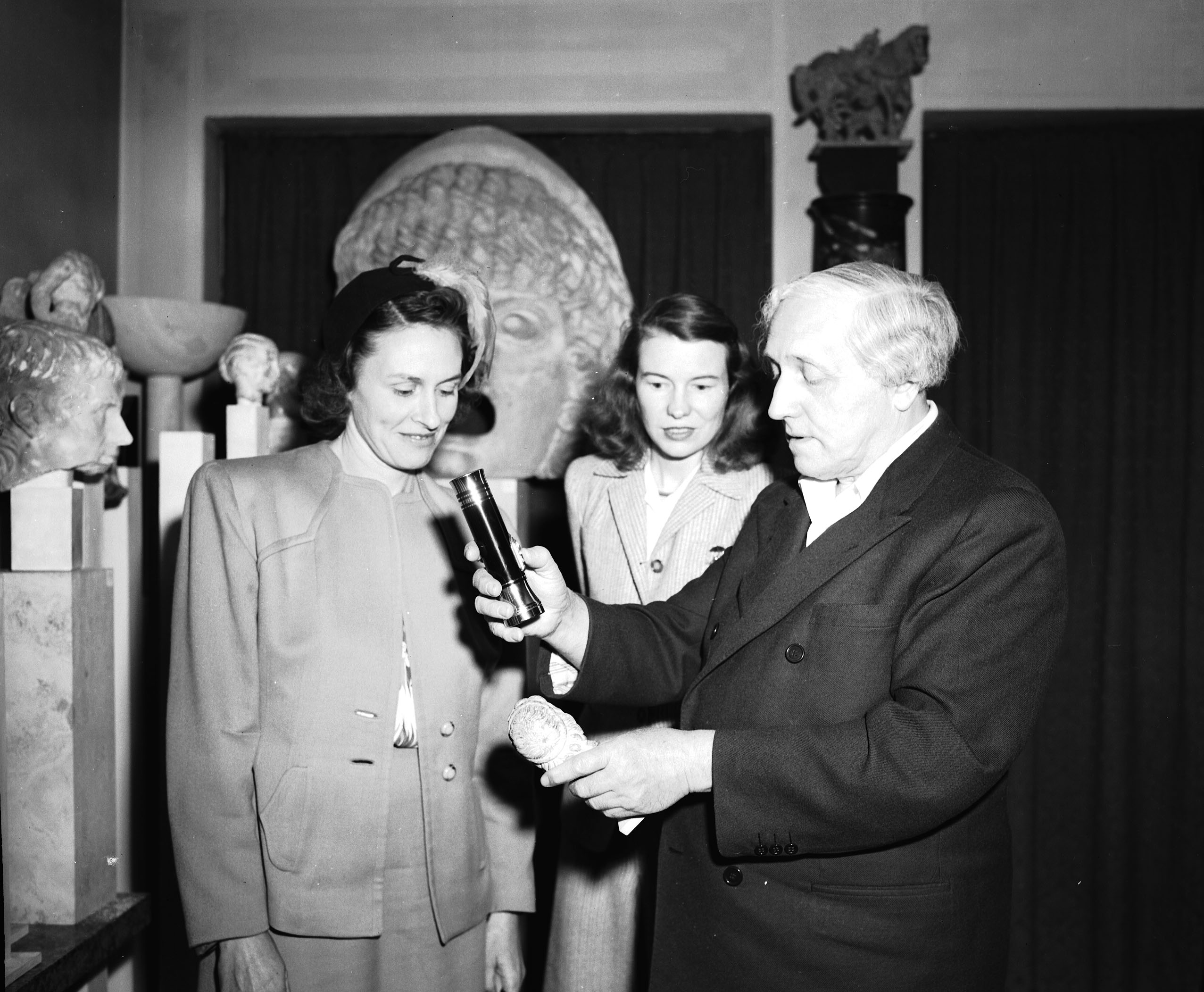
Carl Milles discusses details of a sculpture during an open house, 10 May 1947. Courtesy of Cranbrook Archives.

In January 1931, Carl and his wife Olga Milles arrived at Cranbrook where they lived for the next twenty years. Their home, where they displayed Milles’s collection of ancient sculpture, was designed by Saarinen, as were his three studios—including the grand thirty-foot-tall studio Milles used for his largest commissions such as the Orpheus Fountain for the National Concert Hall in Stockholm.

Carl Milles in his studio at Cranbrook Academy of Art, sculpting the figure of Orpheus for the Orpheus Fountain, 1934. Richard G. Askew, photographer. Courtesy of Cranbrook Archives.

But Milles was not satisfied. He wanted to be surrounded by his sculpture just as he was at Millesgården. The four works Booth had acquired—including the only work Milles made at Cranbrook for Cranbrook, the playful Jonah Fountain—were not enough. In 1934, in the middle of the Great Depression, Booth agreed to pay Milles a princely sum—$120,000 and change—for sixty-three of his sculptures. This purchase not only included most of the works that had been part of a traveling exhibition that opened in St. Louis in 1931, but also casts of the eight figures from the Orpheus Fountain and his monumental Europa and the Bull from the fountain in Halmstad.

Milles’s Triton Pools, looking north towards Europa and the Bull, and beyond that, the future site of Cranbrook Art Museum, circa 1934. Richard G. Askew, photographer. Courtesy of Cranbrook Archives.

The decision, one that would come to define Cranbrook’s campus, was supported by Milles’s fellow Scandinavian and friend Eliel Saarinen, who Booth had named the President of Cranbrook Academy of Art in 1932. Indeed, there was a feeling of mutual respect between the architect and the sculptor, with Saarinen realizing that Milles’s work would enhance the buildings and Milles realizing that Saarinen’s architecture provided the perfect context.

Continue reading

Discovering Turtle Fountain

The collections at Cranbrook Archives are used by a wide population of researchers and have a broad reach academically and internationally. The collections are also used internally for diverse purposes, including historic preservation, education, program development, and fact-checking. A recent research request related to the original installation of Turtle Fountain on the circular terrace at Cranbrook House.

E396.jpg

Turtle Fountain, 1925. K. Hance, photographer. Copyright Cranbrook Archives.

In the late winter of 1924, George and Ellen Booth took a trip to Europe. In a letter dated February 15, 1924, to Cecil Billington, George explains,

“We stopped in Rome to see if by chance I could find a fountain for the new circular terrace basin – and I did – at first it seemed quite out of reach, but some favorable circumstances helped a lot…”

He goes on to discuss the agreements for packaging and shipping the fountain, which is no less than 10 tons of Verona marble. Similar information is found in a letter from George to Henry Scripps Booth, which also describes their experience of staying in Paris and Rome:

Letter from George G. Booth to Henry S. Booth, February 15, 1924. Copyright Cranbrook Archives.

While Florence and Carol [Farr Booth] went to see the sights and do a little shopping, George writes,

“I at once went to the Galerie Sangiorgi where I bought the last fountain – and at first was disappointed as I had a mind picture which could not be realized there. There was one fountain which they had when I was there last – a replica of one in Rome often regarded as the best if not, as some say, “the most beautiful”…”

The letter is very informative about the materials from which the fountain is made, what they weigh, and how he envisions it on the circular terrace, even including a small drawing of the base of the fountain (top of page 2).

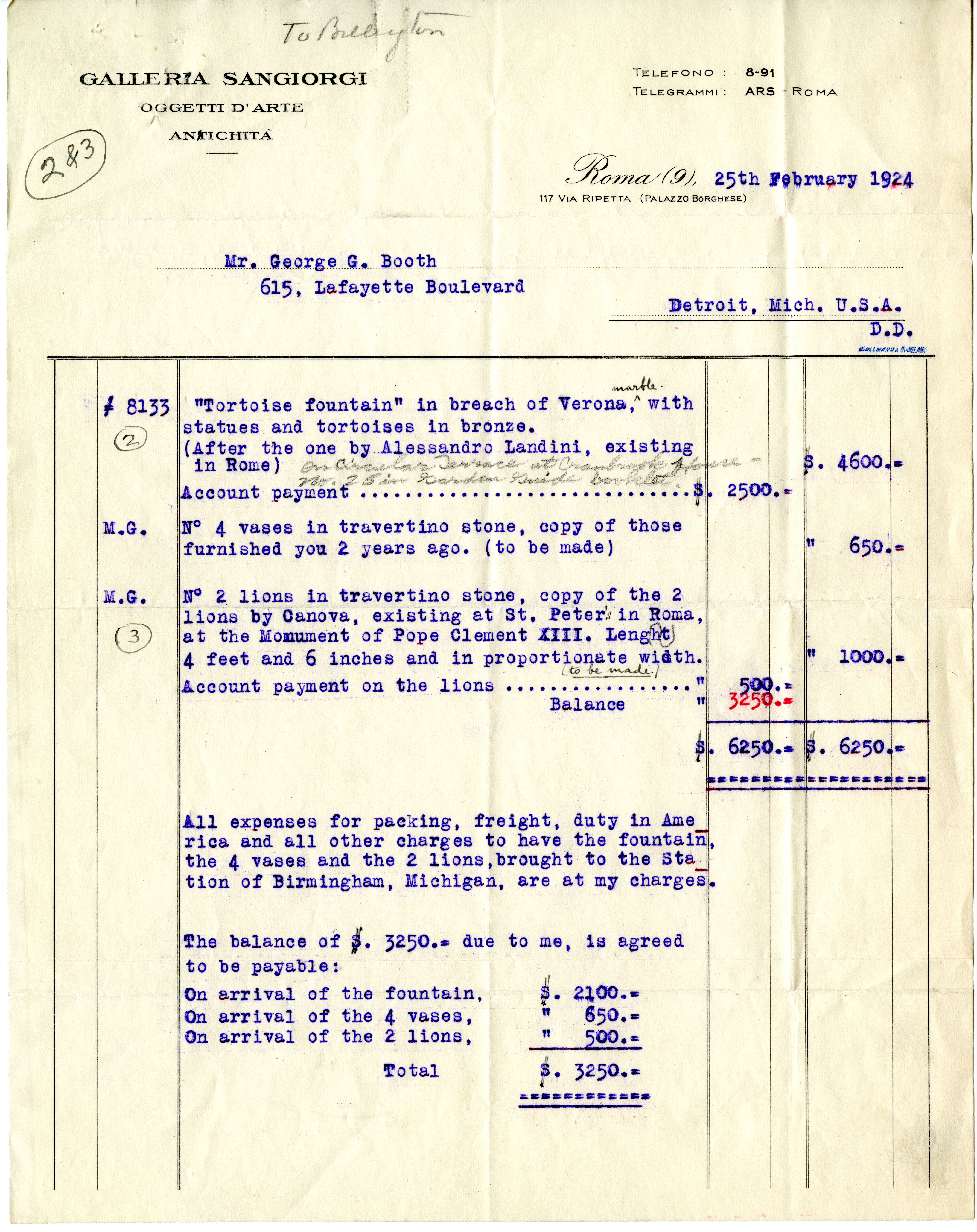
Invoice, Galleria Sangiorgi, February 25, 1924. Copyright Cranbrook Archives.

The fountain was cast by Chiurazzi Foundry in Naples, whose works were often sold by the Galerie Sangiorgi. The design of the fountain was inspired by the Fontana delle Tartarughe, which stands in the Piazza Mattei in Rome. The original was designed by Giacomo della Porta and Taddeo Landini in 1581, which featured dolphins instead of turtles. During restoration in 1658, the dolphins were removed due to their weight and replaced by bronze turtles, which were sculpted by Giovanni Lorenzo Bernini. Cranbrook’s Turtle Fountain was restored in September 1980 through the Gardens Auxiliary. Visit the fountain this spring on your own or on a tour with Cranbrook House and Gardens Auxiliary.

– Laura MacNewman, Associate Archivist


Christmas in San Remo

Henry and Carolyn Booth spent the Christmas of 1933 at the Villa Eveline in San Remo, Italy with their children Stephen (8), David (6) and Cynthia (10 months). In Henry’s letters home he writes about the traditions he and Carolyn tried to maintain while spending Christmas away from home. He also writes about the “rustle of palm trees” in their garden and the crowds of people gathering at the churches on St. Stephen’s Day – a national holiday in Italy.

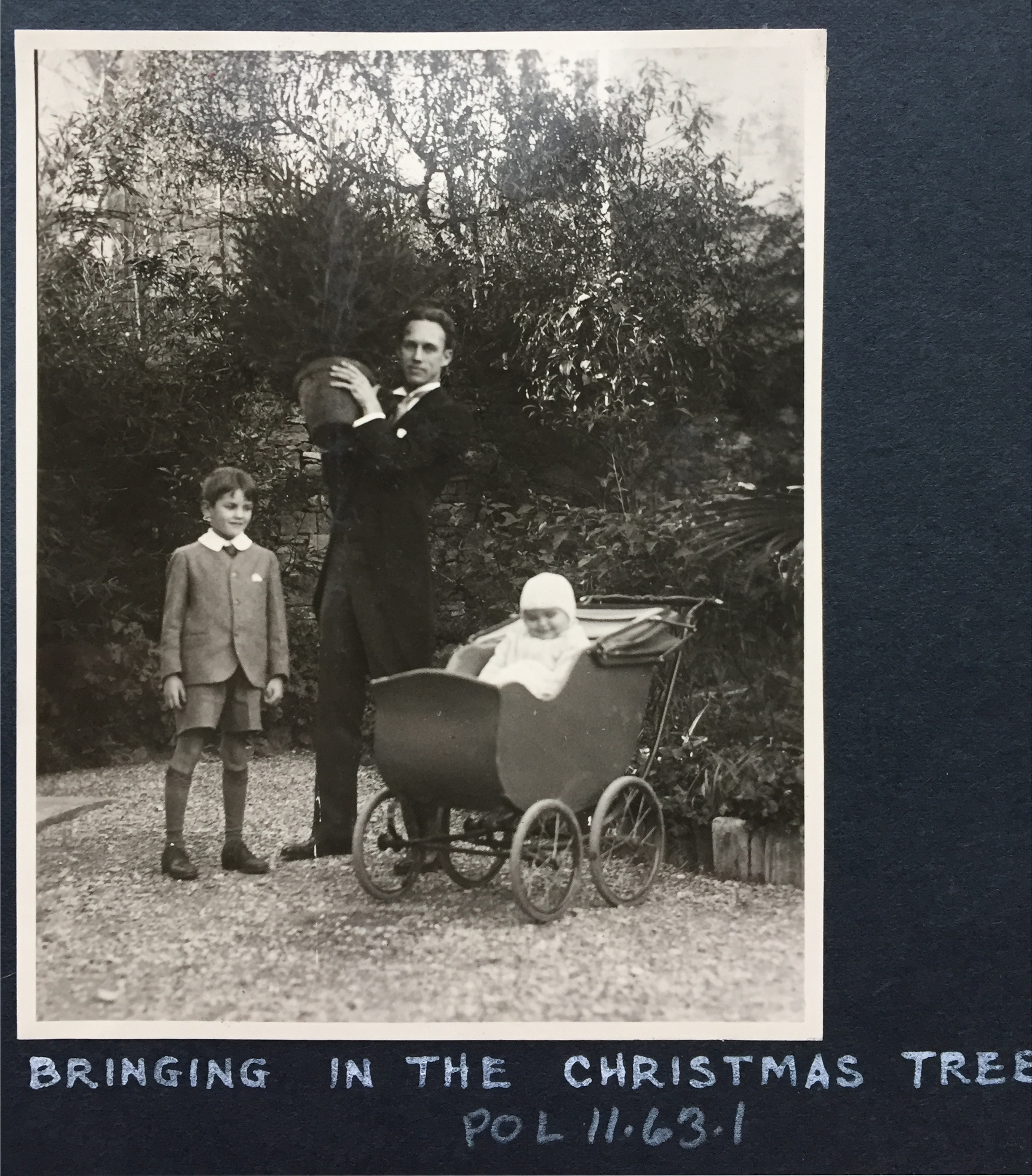
Henry Scripps Booth carrying the Christmas tree with Stephen and Cynthia (in stroller), 1933.

In one of Henry’s letters to his parents, he writes, “greetings from our Christmas tree and it’s real candles, to yours of the electric bulbs.” He later describes the event of Christmas night as lighting the candles and sparklers on the tree, “I never expected to see that kind of illumination again, and probably the children never will in future.”

Holiday wishes from Henry Scripps Booth to his parents, Ellen and George Gough Booth, 1933.

The photos sent home are both formal and candid – very much like posed photos captured on photo cards today, as well as informal images of families and friends enjoying time together at the holidays. My favorite shows a very happy Cynthia following Christmas dinner!

Cynthia and Carolyn Booth, Dec 1933.

Gina Tecos, Archivist


Create a website or blog at WordPress.com