In 1759, British forces led by General James Wolfe defeated the French in a pivotal battle outside besieged Quebec. General Wolfe’s death from injuries sustained on the battlefield, just moments after victory was declared, made him a hero to the British public. The victory at Quebec turned the tide in the Seven Years War for the British, securing Britain’s rule of their new North American territories and paving the way for the eventual creation of Canada and the USA. But what does the Battle of Quebec have to do with Cranbrook?
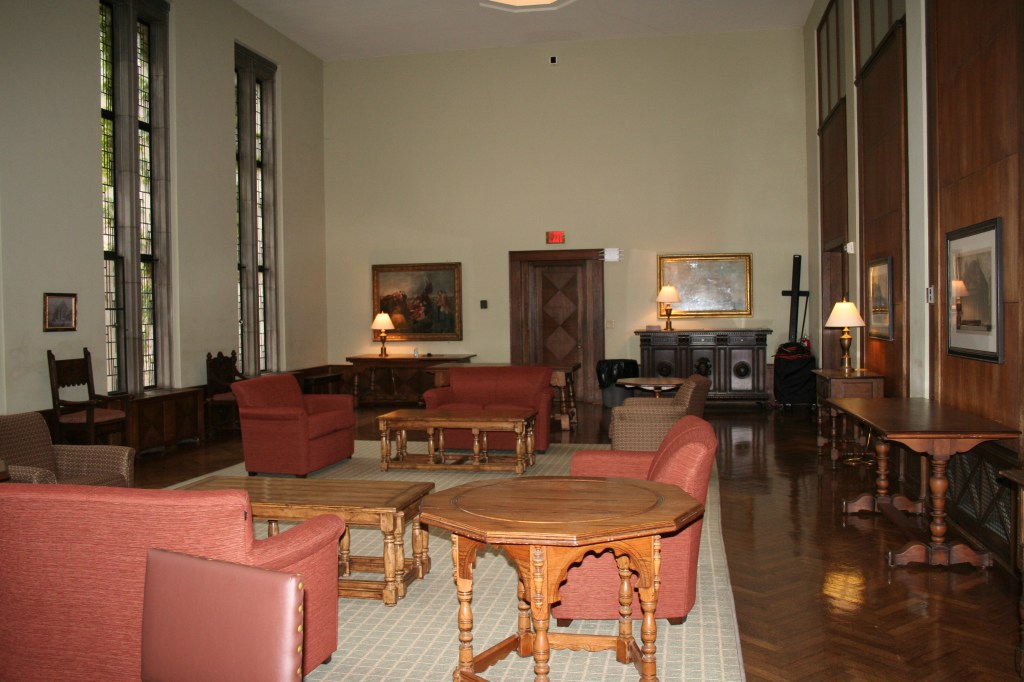
In October 1928, George Booth bought three paintings from a Boston gallery, including one depicting the battle, The Death of General Wolfe, attributed to Benjamin West. He gave all three paintings to Cranbrook School for Boys, where they still hang today, on the walls of Page Hall Commons. Cranbrook’s The Death of General Wolfe is a studio copy of a famous work depicting the end of the Battle of Quebec. The painting represents a turning point both in American history, and in the history of art.

The artist, Benjamin West, was born in Springfield, Pennsylvania, in 1732. Like many artists living in the North American colonies, he was acutely conscious of the shortage of opportunities for training and patronage on this side of the Atlantic. At 31, he left America for Europe, where he embarked on a study tour of Italy, before settling in England. There, he quickly established himself as an artist of skill and imagination. West attracted clients to his studio by deliberately playing up his background as an émigré from the still largely unknown North American continent, even claiming to have had his first lessons in painting from Native American artists. His talent and social charms quickly won him support from colleagues and patrons alike, but it was the triumph of The Death of General Wolfe that made him a national celebrity.

In 1771, twelve years after the Battle of Quebec, West exhibited a monumental canvas depicting Wolfe’s death on the battlefield at the Royal Academy of Art’s summer exhibition in London. At its debut, West’s painting was lambasted by critics for his then unconventional choice to portray all the subjects of his work in accurate, contemporary dress, rather than classical draperies. However, critical disputes were drowned by popular acclaim.
The painting’s dramatization of an already thrilling moment in recent British history captured the public’s sentiments, while fellow artists praised West’s dynamic composition, effective use of classic postures and gestures, and brilliant color. Joshua Reynolds, the first President of the Royal Academy, who had advised West against his choice to include contemporary dress, confessed that he had been wrong. West’s balance of realistic costumes and props with compositional techniques borrowed from the Italian Renaissance set a new standard for verisimilitude and expressiveness in British history painting.

At the center of the eight foot wide canvas, General Wolfe lies dying in the arms of his officers. From the far left, a messenger approaches bearing news of the French surrender, while in the background, windblown clouds and smoke open up to reveal a patch of blue sky, signaling the imminent arrival of good news. Though all accounts of the general’s death place just three men with him, West has ringed Wolfe with fellow soldiers, whose gestures direct our attention to the dying man, and express mingled grief and awe. Wolfe’s own pose echoes that of the dead Christ in the Virgin Mary’s lap in Michaelangelo’s Pieta (1499). His upturned face is illuminated by the sun breaking through the clouds. It is a profoundly unsubtle portrait of a patriotic martyr.
At the left of the group, two figures speak to the specifically North American character of the battlefield. The figure in the green coat, who points over his shoulder at the approaching messenger, is Sir William Johnson, an English immigrant to the North American colonies who established close personal relationships with the Mohawk, and was appointed by their leadership to represent their interests to the British government. Johnson’s negotiations were critical to the British alliance with four Iroquois peoples, who fought alongside the British against the French in the Seven Years War. The unknown Native American man who sits beside Johnson represents the Iroquois contribution to the British war effort. His pensive posture as he watches the dying general is based on two major art historical precedents; the “Belvedere Torso”, a fragment of Roman sculpture at the Vatican Museums in Rome, and Melancholia, an allegorical depiction of melancholy, by Albrecht Dürer. The pose reflects two of the many views of Native American people then current in British society – they were both recognized as valiant military allies, and romanticized as tragic representatives of a culture fated to disappear in the face of inevitable British conquest and the expansion of their colonized territories.

The triumph of The Death of General Wolfe, like the real victory it depicts, is a watershed moment in history – that is, in the history of British historical subject art. Over the next hundred years, history painting would evolve from a genre reserved for the walls of palaces, and confined by the conventions royal aggrandizement and allegory, to a popular genre of narrative art, characterized by dual commitments to historical accuracy and psychological drama. Though West was not the first to introduce modern dress into historical scenes (nor even the first to portray the death of Wolfe in this manner), the extraordinary merits of his work turned the tide in favor of realism and emotionally driven narrative for the genre as a whole.

West went on to be appointed court historical painter under George III, and became the second president of the Royal Academy of Art, succeeding Joshua Reynolds in 1792. Though he never resettled in America, West lent his support to many young American artists visiting England, fostering the growth of American art up to the Revolution and beyond.
The Death of General Wolfe Comes to Cranbrook
The version of The Death of General Wolfe at Cranbrook is one of at least seven copies of the painting produced in West’s lifetime. Several were painted by West himself, others by studio assistants. We do not know the exact provenance of this painting. The technique reveals it to be the work of a less experienced artist, perhaps a junior studio assistant. The painting lacks the exacting finish that characterized West’s work and was demanded of all artists at this period. In the original work, not a single brushstroke is visible, while in the Cranbrook copy, the artist has not learned to conceal the work of their brush.

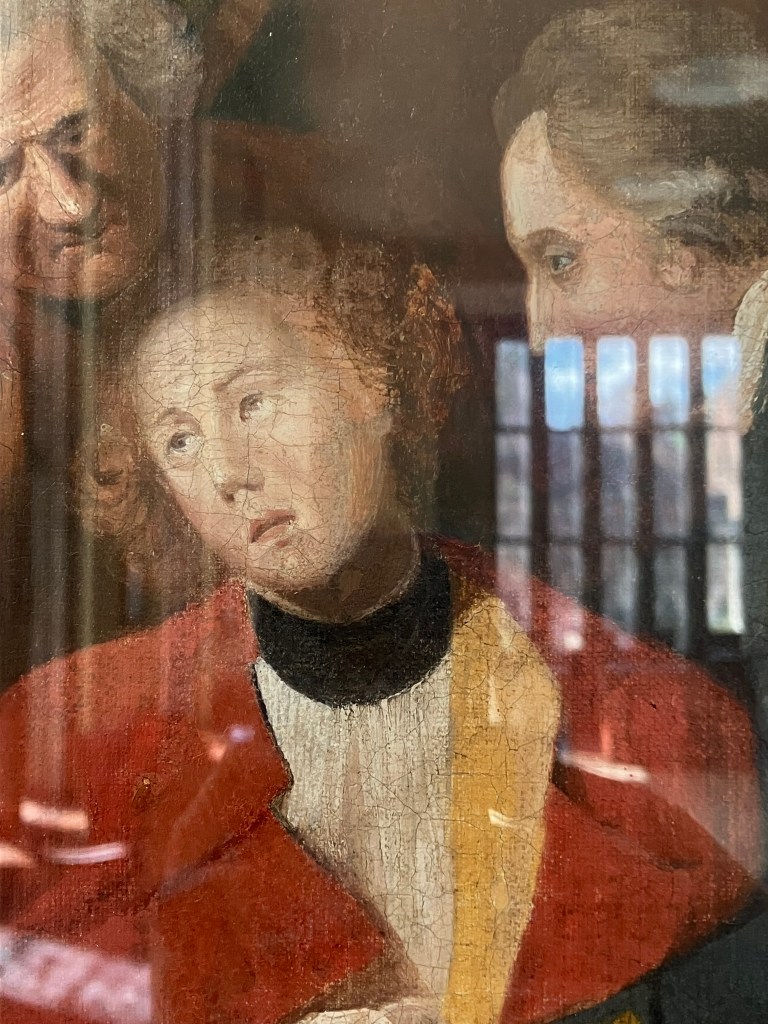
The panel is about half as large as the original, slightly taller and narrower in its dimensions. To adapt the painting to a differently proportioned canvas, the artist was forced to compress the space between some of its figures. Many features of the battle in the background, such as press of boats along the river’s edge on the right of the canvas, were omitted altogether. A key figure, the messenger bearing news of victory, is crammed into the left-hand margin, and partially cut off by the frame. The missing details raise the possibility that this work was painted from a print, rather than from close study of the original or a copy by West himself.

Print of The Death of General Wolfe, William Boydell and Rowlands Woollett, after Benjamin West, 1 January 1776. National Maritime Museum, Greenwich, London.
George Booth paid the Vose Gallery $3,000 for this painting – twice as much as he paid for either of the other two paintings, and a remarkable price for a work that is almost certainly not from the artist’s own hand. (The other works were The Clipper Midnight, by Samuel Walters, and a portrait of Washington Irving by John Vanderlyn.) Why was it so important to the Booths that Cranbrook have some version of West’s masterpiece?
Six months before George Booth bought the painting, another version of The Death of General Wolfe was presented to the University of Michigan at Ann Arbor, by William L. Clements. Clements, a noted collector of American artifacts and documents, bought the painting to ornament the library of Americana that he had just given to the university, the William L. Clements library. The painting at Ann Arbor is a full-scale replica of the original work, painted by Benjamin West in 1775 for the Prince Regent of Waldeck, a region in Germany. The library, with its new painting in place, opened to the public in June of 1928, when visitors packed the rooms to see the collection. The Booths may well have been in attendance, and would certainly have been aware of the well-publicized gift. Perhaps it was Clements’s generosity that inspired George Booth to seek out a Death of General Wolfe for the Cranbrook campus as well.

By giving the painting to the school, George Booth probably hoped that it would add something to the students’ education there. In the most straightforward sense, the painting depicts a critical moment in the history of the United States, Canada, Great Britain, and the First Nations. It also represents a turning point in the history of art, and in the life of one artist in particular. Benjamin West rose from American obscurity to the highest eminence in British art, thanks to his talent, effort, and amiable personality, but it was this painting that secured him national recognition. Throughout his career, he sought to help younger artists to success, teaching many American artists in his own studio. General Wolfe was a hero of his own nation and time, but to an art lover and sometime pacifist like George Booth, Benjamin West may well have seemed like the true exemplar of a life well spent, and an ideal role model for the students of Cranbrook School.
— Mariam Hale, 2023-2025 Collections Fellow, Cranbrook Center for Collections and Research
Discover more from Cranbrook Kitchen Sink
Subscribe to get the latest posts sent to your email.
 Cranbrook Kitchen Sink
fantastic article, thank you. Rob
>
LikeLike
What I appreciate so much from Cranbrook – how they remind us about the definitions of history.
LikeLike