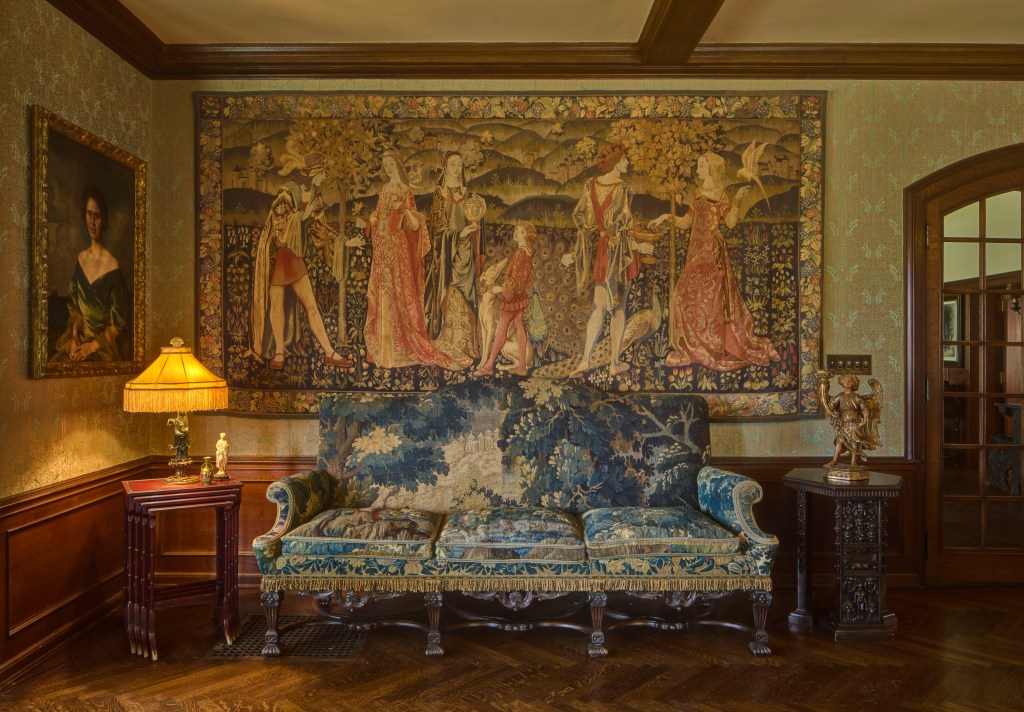
The tapestry that now hangs on the east wall of the living room at Cranbrook House fools the eye of many visitors; far from the medieval masterpiece it appears to be, it was in fact woven in the early twentieth century by Herter Looms in New York. George Booth purchased the untitled tapestry in 1919; from that date until at least 1937 it hung in the living room of Cranbrook House, before the Booths gave it to Cranbrook Art Museum in 1943.
Tapestry-making is an ancient art form, which peaked in the medieval period, but by the nineteenth century had declined until only a few government-run workshops remained in Europe. In 1881, William Morris, England’s leading Arts and Crafts designer, founded a new tapestry workshop at the historic Merton Abbey, on the river Wandle, a tributary of the Thames. Morris began by teaching himself to weave, before recruiting others to work at the looms. He hired his close friend, Edward Burne-Jones, to create new designs rooted in the medieval tradition for the tapestry works. Through a year of experimentation, Morris also re-discovered the correct use of the traditional natural dyes that had been abandoned by manufacturers in favor of lurid, but fugitive, chemical-based colors. George Booth would purchase four tapestries from the Merton Abbey works; three he gave to Christ Church Cranbrook, and the fourth to the Detroit Institute of Arts.
Albert Herter, the designer of this tapestry, was a painter and, like William Morris, an enthusiast of traditional crafts. He was one of a number of American artists who sought to revive tapestries for the modern home, following William Morris’s inspiring example. Because of the specialized nature of the work, Herter employed weavers trained at Gobelins and Aubusson, who immigrated to America following his offer of employment at his workshop. Though he sought to train American workers at his factory as well, Herter always relied primarily on weavers already expert in the craft, and often sent designs overseas to be completed in France.
This tapestry depicts a festive scene in a medieval garden, but it does not pretend to be truly medieval: the poses of the figures, their costumes, and the fairytale landscape behind them all speak to a late-nineteenth-century aesthetic, influenced by the paintings of the Pre-Raphaelite movement, and particularly the work of Morris’s friend, Burne-Jones. Today, it remains a highlight of Cranbrook House, speaking to the Booth’s longstanding love of all things medieval.
To learn more about William Morris, Edward Burne-Jones, and the medieval revival, as well as their connection to Cranbrook, join us next week for a lecture and one-night-only exhibition at Cranbrook House!
Camelot to Cranbrook: King Arthur and the Arts & Crafts Movement
Wednesday, June 24th, 6:00pm
To learn more about the event and to book your seat, please visit the event webpage: From Camelot to Cranbrook: King Arthur and the Arts & Crafts Movement.
— Mariam Hale, 2025-2026 Martha J. Fleischman Collections Fellow
(This week’s Photo Friday is coming to you one day early, as the Cranbrook Center for Collections and Research will be closed tomorrow in honor of Juneteenth.)
Discover more from Cranbrook Kitchen Sink
Subscribe to get the latest posts sent to your email.

