George Booth and Palermo: the Paschal Candelabrum

Christ Church Cranbrook Candelabra

Stone carvers at the Chiurazzi Foundry, 1929. Cranbrook Archives.

Even though Christ Church Cranbrook has not officially been a part of the Cranbrook Educational Community since 1973, our staff is often asked to give presentations or tours relevant to the church and the objects that George Booth purchased to adorn it. Gothic in architecture, and a showplace for the Arts and Crafts movement, Christ Church Cranbrook also features objects from the 12th century. One of these is a reproduction of the original Paschal Candelabrum located within the Cappella Palatina (1130-1140) in the Palazzo dei Normanni (Palace of the Normans) in Palermo, Sicily.

It appears as if Booth first became aware of the medieval sculpture in Sicily through his son, Henry, who traveled on a European trip in 1922 with his close friend, Bob Swanson. Henry wrote several letters home to his father describing his visits to Monreale and Palermo, and the artistic and architectural wonders he saw there. Records in the Cranbrook Archives show that in 1929, George and Ellen Booth traveled to Italy where they made several purchases, including a faithful reproduction of the candelabrum. George and Ellen discussed where to place the candelabrum in the church and George wrote Henry: “Now as for use–I thought if at the chancel we could establish a custom of lighting the big candle for weddings or at Easter and Christmas and if in the Narthex when a baptism was to occur. There is plenty of time to think it over as I have yet to place the order and they estimate it will take one year to complete.” The candelabrum was installed in the Christ Church Cranbrook Narthex in March 1931.

Surely Shirley: an Early Knoll Textile

Architect Ralph Rapson may be a household word, especially among aficionados of mid-century modern architecture.  But few likely know of the creative talents of his first wife, Shirley Fletcher.  Just out of high school in 1941, Shirley enrolled in the Intermediate School at Cranbrook Academy of Art.  Like many other students of the day, she spent time in various departments, but found her niche in the weaving department under Marianne Strengell.  While here, she developed a series of block-printed textile designs.  Though she did not continue past her first year (she left to marry Ralph!), Shirley continued to design textiles after she left Cranbrook.

In 1944, Hans Knoll and Ralph Rapson (who was designing furniture at the time for Knoll) discussed the formation of a textile division within Knoll.  Their idea was to introduce contemporary textiles that would complement the modern furniture being produced by the company.  The following year, Rapson brought  Shirley’s designs to the attention of Hans Knoll and her textile “Isles” became one of the earliest printed fabrics at Knoll.  Marianne Strengell may also have contributed to Knoll’s decision to feature “Isles” which was published as part of an assemblage of Academy of Art student “textile studies” in the July 1945 issue of Arts and Architecture.

IMG_1571

“Isles” by Shirley Fletcher Rapson in Arts and Architecture, July 1945.

In October, Hans Knoll wrote Rapson that even though they were “very anxious to do something with Shirley’s fabrics,” due to the shortage of materials during the war, they had to wait until adequate supplies of cloth could be acquired.  The pattern was slightly altered (notice the solid in-fill blocks) when Florence Schust Knoll used “Isles” for drapery in the Rockefeller family offices at Rockefeller Center in 1946.

"Furniture by H.G. Knoll & Associates," Arts & Architecture, September 1947, p. 24. Cranbrook Academy of Art Library.

“Furniture by H.G. Knoll & Associates,” Arts & Architecture, September 1947, p. 24. Cranbrook Academy of Art Library.

The Knoll Textile Division debuted in February 1947 in a new Knoll showroom in New York.  Shirley Rapson textiles were part of the collection (a slightly different version of “Isles” was offered in four different color ways), along with designs by Cranbrook’s Marianne Strengell and Antoinette “Toni” Webster Prestini.

Image

Shirley Rapson’s”Isles” at the Rockefeller Center family office building, 1946.

Leslie S. Edwards, Head Archivist

Finland Visited: Part One

I’m recently back from a fantastic vacation to Helsinki, Finland with my daughter.  We took a boat tour around the archipelago (did you know there are 315 islands surrounding the Helsinki harbor?), swam in the 1952 Olympics swimming stadium (where we had our first sauna experience), and visited the famed Temppeliaukio Church (rock church), a Lutheran church in the Töölö neighborhood of Helsinki.

Temppeliaukio Church

Temppeliaukio Church

Designed by brothers Timo and Tuomo Suomalainen, the church, which was carved out of the granite bedrock, has a strong connection with nature – exactly what the brothers intended.  When you walk through the door, the cool air of the belowground atmosphere wraps around you.  The interior walls were left rough-hewn, and metal and glass were chosen carefully to complement the rock.  The interior is lit by natural light streaming through 180 vertical window panes that connect the dome and the wall. Quite astounding was the copper dome ceiling – a Google search tells me that it is over 13 miles of copper strips!

And how could an inquisitive archivist from Cranbrook go to Finland without doing a little research relative to the Saarinens?  Naturally we visited the Saarinen’s home, Hvittrask, where we were warmly welcomed by the curator, Pepita Ehrnrooth-Jokinen, who showed us around the current exhibition, “Home as a Work of Art,” by Sirkkaliisa and Jari Jetsonen.  (By the way, the Jetsonens visited Cranbrook and the Archives a couple of summers ago on their research tour of U.S. homes designed by Eliel and/or Eero Saarinen.)

For me, however, one of the highlights of my trip was visiting Bobäcks skola (elementary school), not far from Hvittrask.  What’s so great about visiting a school you might ask? Well, it just so happens that in the 1930s, when Studio Loja Saarinen was weaving the famed May Queen Tapestry for Kingswood School for Girls, they also wove a smaller sample.  In 1952, Loja Saarienn donated this piece to Bobäcks.  And there it hung for nearly sixty years without anyone realizing the importance of it.  Fast forward to 2010, when the nearby village association determined to save the faded and worn tapestry by having it restored.  However, they also felt a responsibility to give the school a replacement in order to continue to provide students, teachers and parents alike the opportunity to experience such a fantastic tapestry.

Enter artist Ann (known as Annsi) Jonasson who had been teaching woodworking classes to adults in the school for years.  Annsi, a weaver with her own home studio in the community, was commissioned to undertake the monumental task of creating a replica of the Saarinen tapestry!  Annsi took on the responsibility and dedicated many months to studying the tapestry, meticulously counting threads and spaces in order to plot the pattern on graph paper for the copy to be as accurate as possible.  The original fabric was made of linen, wool, and silk threads in a variety of shades- nearly 170 different colors.  Annsi studied the colors from the backside which were less faded, and then tried to replicate the threads.
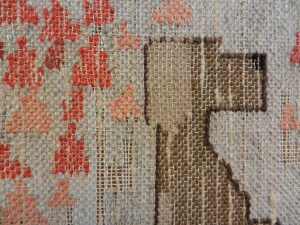
May Queen tapestry sample

A detail of the May Queen tapestry sample showing the dog’s head. Note the spaces that were not woven, and the combinations of thread colors – sometimes a linen yarn twisted with a thread from embroidery yarn – that were used to match the original colors.

Fortunately, Annsi said she has never thrown away anything useful, so she used her own personal collection to match the colors and textures.  Over the years, her collection had grown thanks to the transfer of yarns and threads from friends, acquaintances, and the inheritance of yarns from her mother and grandmother.

Annsi, a most kind and welcoming woman, is proud of her work and rightly so – though you probably can’t tell from the photographs here, the replica is stunning.
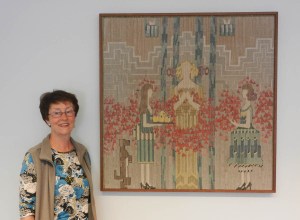
Annsi and the replica

Annsi and the May Queen tapestry sample replica.

We have to give thanks that a contemporary weaver cared enough to dedicate many months of her life and literally weave part of herself into a tapestry that connects to us here at Cranbrook.  Soon she will donate to the Cranbrook Archives a copy of her research, which will help keep the Finnish-Cranbrook connection alive.

Oh, and by the way, did you know that the May Queen tapestry sample is the only known Studio Loja Saarinen work in Finland?

~Leslie S. Edwards, Head Archivist

Photo Friday: Who’s That Man?

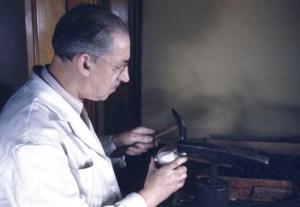
It’s Arthur Nevill Kirk! Wooed by George Booth, the famed silversmith arrived at Cranbrook in 1927 to head the metals department at the Academy of Art. Kirk also taught at the Art School of the Detroit Society of Arts and Crafts and Cranbrook School for Boys. His specialty was the design and execution of ecclesiastical silver, of which Cranbrook still has many pieces in its collection.  During the Great Depression, lack of funds curtailed the use of precious metals and the department closed in 1933. Kirk went on the help establish the Artisans’ Guild, and organized the metal department at Wayne State University in Detroit, where he taught until his retirement in 1957.

~Robbie Terman, archivist

Arthur Nevill Kirk. Cranbrook Archives.

Arthur Nevill Kirk at work. Cranbrook Archives

Create a website or blog at WordPress.com