Not-Quite Photo Friday: Happy Halloween!

Halloween at Brookside.  Cranbrook Archives, 1935.

Halloween at Brookside. Cranbrook Archives, 1935.

Please excuse the not-quite Photo Friday post – we couldn’t resist!  Brookside students have long enjoyed celebrating Halloween.  Here, three students and stuffed animal guests enjoy a ghoulish meal in the dining room.  Especially charming?  The jack-o-lantern with a top hat, because only the classiest of pumpkins dress for mealtime.

Photo Friday: Dinner at the Saarinens’

Loja Saarinen sets the table for guests.  Saarinen House, 1930-1940.  Cranbrook Archives.

Loja Saarinen sets the table for guests. Saarinen House, 1935-1940. Cranbrook Archives.

Loja and Eliel Saarinen were masterful entertainers.  That tradition continues every spring, when Cranbrook Art Museum opens up the house for tours.  Though the museum avoids serving food or drinks in the house (it is accessioned into the museum’s collection as a single historical object, after all), visitors get to experience the house as the Saarinens designed it between 1935 and 1940.  Every autumn the tour season ends and we pack up the house to hibernate for winter, opening it up again come spring.  To celebrate the closing of another great tour season (it finishes at the end of October, so get in while you can!), we wanted to showcase one of the most social environments in the house—the dining room.

Here, Loja Saarinen prepares the table for guests.  The round placemats were decorated by the Saarinen’s son, Eero Saarinen, when he was just a boy.  The table is at its smallest size—the outer rim of the table actually pulls out, allowing donut-shaped leaves to expand the table yet retain its circular shape. The swing door to the butler’s pantry is open, showing off the home’s state-of-the-art Frigidaire icebox.  Truly a modern home for a modern family!

Architecture in Detail

It’s always a great day when a new discovery is made. Yesterday Craig, one of our campus architects and project managers, asked me if I knew anything about a pixie-like relief that is located on a Mankato stone column at Kingswood School.  I remember seeing a photo of it years ago but never had reason to look into its origin until now.  As luck would have it, I was able to use my super-sleuthing skills to locate the original drawing of the figure by none other than Eliel Saarinen!  The full-scale detail drawing illustrates the whimsical quality of the figure and even shows the level of intended relief–note the red lines across the figure.  Breen Stone and Marble Company of Kasota, Minnesota was awarded the contract for the stonework at Kingswood School.

IMG_1310

Detail of stone column, Kingswood School. Rendered by Eliel Saarinen, March 1931.

~Leslie S. Edwards, Head Archivist

Photo Friday: Spot the Schust

Kingswood graduation, class of 1934.  Cranbrook Archives.

Kingswood graduation, class of 1934. Cranbrook Archives.

Graduating from Kingswood required a very different sort of dress code in 1934.  Glamorous to modern eyes, these matching outfits were probably just as irritating to the senior girls as polyester caps and gowns are for Cranbrook seniors today.   Bonus: somewhere in this photo is a young Florence Schust.  Schust became better known as Florence Knoll after her marriage to Hans Knoll, and it was through her husband’s furniture company that she revolutionized modern interiors and furnishings.  Can you spot her?  The Center for Collections and Research staff votes for the serious-faced young woman in the front row, four in from the left.

Shoshana Resnikoff, Collections Fellow

Rocks That Teach: Cranbrook Institute of Science and the Sanilac Petroglyphs

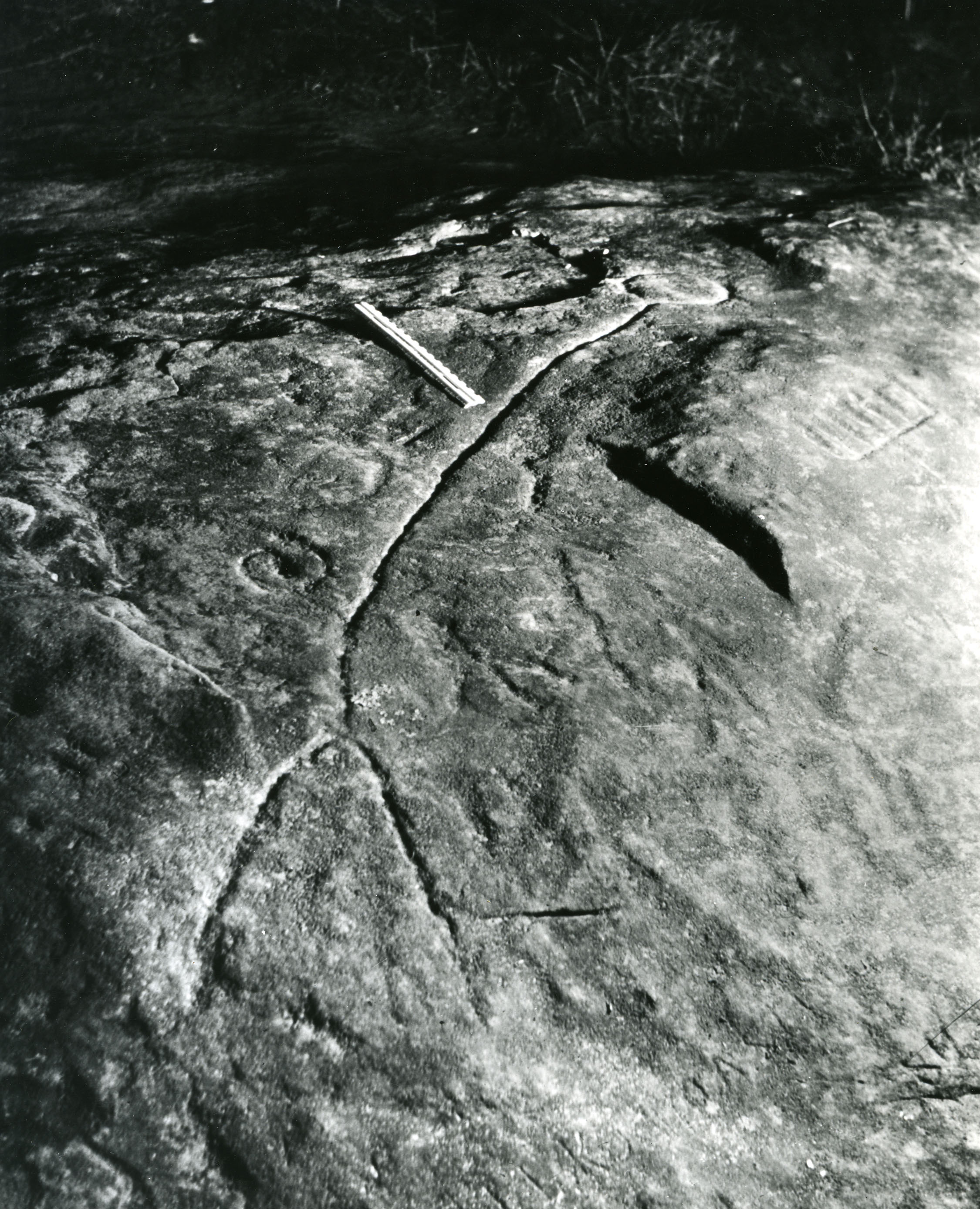
Some say there are no coincidences in life, and in my many years of genealogical and historical research, I have found that perhaps a better word for these types of experiences is serendipity.  Often I find myself researching a certain topic and “by chance” I run into an expert standing next to me in line at the grocery store.  The other day just such a happenstance occurred.  I was invited to a lunch and who should sit next to me but Stacy Tchorzynski, an Archaeologist for Michigan’s State Historic Preservation Office and Department of Natural Resources.  She asked me if the Cranbrook Archives had any materials on the Sanilac Petroglyphs and we launched into a discussion about the importance of documenting and preserving Michigan’s only known prehistoric rock carvings.  Located in an historic state park covering 240 acres, the petroglyphs, which were carved into very soft sandstone, have eroded over time and weather exposure.   In addition, 19th and 20th century vandalism and graffiti have further degraded the carvings.

SanilacPetroglyphs_01

Sanilac Petroglyphs, Cass City, MI, 1945. Cranbrook Archives.

Cranbrook has had a long interest in the petroglyphs—in the 1940s, the director of Cranbrook Institute of Science (Dr. Robert Hatt) worked with the DNR and University of Michigan’s Museum of Anthropology to develop a preservation plan for the rock carvings.  In fact, Hatt’s 1942 report even suggested that the site would make an “excellent State Park” and that the main group of petroglyphs should be fenced off.  In 1958, the Institute of Science published a monograph on the petroglyphs followed in 1965 by a collaborative meeting between the Institute, the Michigan Archeological Society, and the Sanilac County Historical Society.   This meeting resulted in the acquisition of the 80-acre site by the Michigan Archeological Society.

SanilacPetroglyphs_02

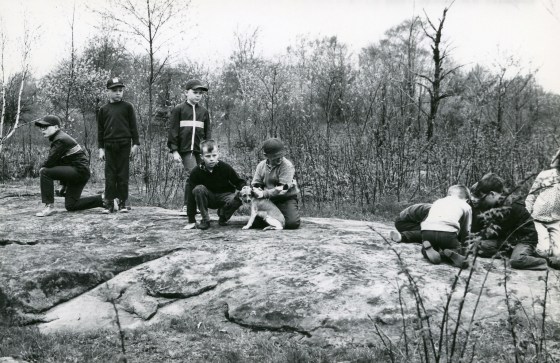
Cranbrook Institute of Science Educational Field Trip at the Sanilac Petroglyphs in Cass City, MI, circa 1968. Cranbrook Archives.

The site of the Sanilac Petroglyphs is also an important ceremonial site for the Anishinabek – the petroglyphs are very powerful places of learning and spirituality for them and are referred to as “rocks that teach.” 

Through the 1960s and 1970s, Cranbrook Institute of Science sponsored field trips to the site for its members.   Drawings of the petroglyphs, part of the collection of the Institute of Science, will soon be on display as part of the exhibition My Brain Is in My Inkstand: Drawing as Thinking and Process at the Cranbrook Art Museum.

~Leslie S. Edwards, Head Archivist

Photo Friday: Cranbrook’s Contractor

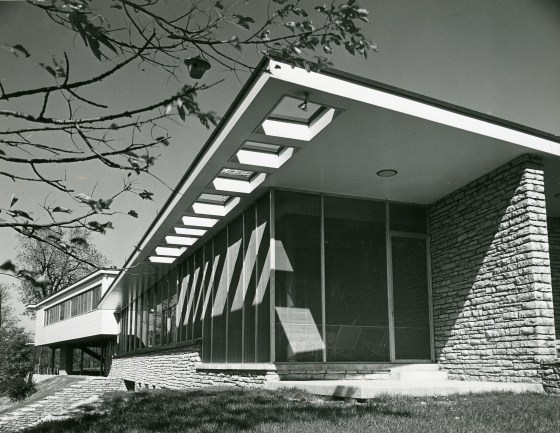
Wermuth House, Fort Wayne, Indiana.  Designed by Eliel and Eero Saarinen, 1941. Cranbrook Archives.

Wermuth House, Fort Wayne, Indiana. Designed by Eliel and Eero Saarinen, 1941. Cranbrook Archives.

This distinctly modern house was designed by the architecture firm Saarinen, Swanson & Saarinen for a man whose introduction to Cranbrook happened in a somewhat old-fashioned way—the construction of Christ Church Cranbrook, George Booth’s ecclesiastical ode to the British Arts and Crafts Movement.

In 1923, Albert Charles (A.C.) Wermuth was contracted by the architect Bertram Goodhue to oversee construction of the Trinity English Lutheran Church in Fort Wayne, Indiana.  Goodhue was so impressed with his construction work that he contracted with Wermuth again for the upcoming Christ Church Cranbrook commission in 1924.  Goodhue died before construction on the church could begin in 1925, but the firm Goodhue & Associates retained Wermuth as general contractor for the project.

When Christ Church Cranbrook was completed in 1927, the Booths immediately snatched up A.C. Wermuth for more Cranbrook projects—the building of the Cranbrook School campus and an addition to Brookside.  Thus began a decades-long professional relationship between Wermuth and Cranbrook, with Wermuth serving as general contractor for Kingswood, the Cranbrook Academy of Art, and the Cranbrook Institute of Science.  Wermuth also did private work for the Booth children as they built their own homes in the area.  Eliel and Eero Saarinen used Wermuth for their non-Cranbrook projects as well; he served as contractor on the First Christian Church in Columbus, Indiana, as well as on other Saarinen buildings.

With professional connections like these, it seems only fitting that Wermuth turned to the Saarinens when it was time for him to build his own house in Fort Wayne. While the Wermuth House, which was completed in 1941, was built under the names of both Eliel and Eero, the design of the house speaks a bit more to the son than the father.  A Saarinen, Swanson, & Saarinen project, however, Wermuth ended up with a home for his family that expressed many of the same modernist ideals that he himself helped bring to life as the general contractor for Cranbrook.

Shoshana Resnikoff, Collections Fellow, and Robbie Terman, Archivist

Photo Friday: Cranbrook’s Gatescape

Image

Close-up of the peacock for which Cranbrook School’s Peacock Gates are named. Designed and installed in 1927, restored in 2013. Cranbrook Archives.

Doors, entryways, gates – Cranbrook’s campus was designed with an eye towards points of transition.  Since its foundation 108 years ago, Cranbrook has maintained a long tradition of gate design and fabrication.  This close-up of a stylized peacock comes from Cranbrook School’s famous Peacock Gates; designed by Eliel Saarinen, they were produced by the metalsmith Oscar Bach in 1927.  Recently, a long restoration process culminated with their re-installation on the Cranbrook School campus.   This gate and many others are the subject of the second exhibition in the From the Archives series.  Drawing from the rich collection of the Cranbrook Archives, From the Archives: Forging Cranbrook’s Gatescape explores the history, design, and formation of Cranbrook’s historic and contemporary “gatescape.”

Experiencing the gates from within the walls of the Art Museum is nothing compared to seeing them in person.  With that in mind, Leslie S. Edwards, Head Archivist and exhibition curator, will be leading a walking and bus tour of the gates on Sunday, October 5.   The tour will take participants  to some of Leslie’s favorite gates, from beloved classics to the newest installations on campus.   More information on the exhibition and walking tour is available here.  Be sure to check it out, and get ready to see Cranbrook’s gates in a whole new light!

Photo Friday: Swedish Weavers, All in a Row

Studio Loja Saarinen weavers seated at one of the larger looms.  L to R: Elizabeth Edmark, Marie Bexell, Peggy Broberg, Gerda Nyberg.  May, 1935.  Cranbrook Archives.

Studio Loja Saarinen weavers seated at one of the larger looms. L to R: Elizabeth Edmark, Marie Bexell, Peggy Broberg, Gerda Nyberg. May, 1935. Cranbrook Archives.

Founded in 1928, Studio Loja Saarinen served as a commercial weaving studio at Cranbrook, producing rugs, curtains, table textiles, and tapestries for both the growing Cranbrook campus and outside clients.  Though it bore her name, Loja Saarinen was not the sole weaver at Studio Loja Saarinen—instead, the studio employed a staff of primarily Swedish women who immigrated to the United States during the 1920s and 30s.  At its largest size, the studio had 30 looms in use to keep up with production demands.  Here four of Studio Loja Saarinen’s Swedish weavers are posed at one of the large looms housed in the lower level of the studio.   From left, they are: Elizabeth Edmark, Marie Bexell, Peggy Broberg, and Gerda Nyberg.   Displayed before them is one of the giant rugs produced by the weavers.  Still in use, this rug is on view in Saarinen House today.

– Shoshana Resnikoff, Collections Fellow

Photo Friday: Twisted Sister

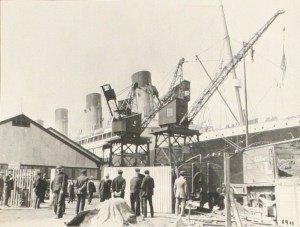
In the summer of 1911, the Booth clan left Cranbrook, headed for a European vacation.  The family traveled via New York, where they boarded the RMS Olympic, part of the White Star Line and sister ship to the Titanic. Designed as a luxury ship, many of the features on the Olympic were identical to the more famous Titanic The Olympic had its maiden voyage on June 14, 1911, arriving in New York on June 21, 1911.  The captain of its first voyage was none other than Edward Smith, who would lose his life aboard the Titanic one year later.  The ship’s return trip to England left June 28, 1911, carrying the Booths.  Another famous passenger on board was ship designer Thomas Andrews, who would also later perish on Titanic.

RMS Olympic

The RMS Olympic arrives in Southampton on July 5, 1911. Cranbrook Archives

In April of 1912, the Olympic was one of the ships that received the distress call from Titanic, but it was too far to help in the rescue.  The Olympic offered to take on survivors, but was turned down, as it was thought that passengers would panic at having to board a ship that was a mirror-image to the Titanic.

After the Titanic disaster, the Olympic had to be refitted, as it, too, did not carry enough life boats for all the passengers.

~Robbie Terman, Archivist

Photo Friday: Back to School

As the schools are busy preparing for the return of students to campus next week, we thought it would be fun to post a student-related photo.  This one, taken in May 1959, shows girls from Kingswood School about to board the bus.  Today, buses are used to transport students between the campuses, but in 1959, the boys (Cranbrook) and girls (Kingswood) schools were not co-ed.  So, what were the buses used for?  Turns out that Kingswood owned two buses that made transportation “possible for day students not only from the north end of Detroit, but also from Birmingham, Pontiac, and Bloomfield Hills.”  Who knew?

~Leslie S. Edwards, Head Archivist

Kingswood students board the bus. Cranbrook Archives.

Kingswood students board the bus. Cranbrook Archives.

Create a website or blog at WordPress.com