“Grace, Elegance, and Pizazz” – Fifties Fashion in a Nutshell

For this May’s upcoming A House Party at Cranbrook: Celebrating the Legacy of Music, we are celebrating the music and spirit of the 1950s. Naturally, that means digging into our closets for our best mid-century modern outfits, and more importantly, our dancing shoes. Seventy-five years ago, guests invited to a Cranbrook party could head down to Hudson’s department store on Woodward Avenue for a full evening’s attire. That is, unless they, like Loja Saarinen, preferred to design and sew their own clothes! This year, we may be deprived of Hudson’s and its record-breaking 705 changing rooms, but we do not lack sources of inspiration for a fifties night at Cranbrook.

Cranbrook Academy of Art: Packard Motor Competition, 1950. Cranbrook Archives, Cranbrook Center for Collections and Research.
Eliel and Loja Saarinen at the front entrance of Saarinen House, Cranbrook Academy of Art, circa 1950. Cranbrook Archives, Cranbrook Center for Collections and Research.

The 1950s was an exciting time for snappy dressers, even those not as artistically gifted as Loja Saarinen. While Cranbrook-trained designers like Ruth Adler Schnee and Florence Knoll were transforming the look of the modern American interior, American clothing was undergoing a revolution of its own. The 1950s can be seen as the dawn of the modern fashion era, defined by an extraordinarily diverse range of stylish modes of dress, and a new emphasis on comfort and adaptability. The introduction of novel synthetic fabrics like orlon and spandex, and a new prominence for sports and lounge wear anticipated the rise of current athleisure apparel. The cocktail dress reached its zenith in this decade, as did the requisite accessories: shoes, handbag, and a trunkful of costume jewelry.

Many designers, including Christian Dior himself, continued to embrace the sloping shoulders and hourglass shapes of the “New Look,” inaugurated in the late forties. However, no single silhouette dominated the womenswear scene. Waistlines and hemlines rose and fell according to the whims of individual designers, dresses and coats billowed outward or narrowed to follow the line of the body, and the range of possibilities for fashionable dressers expanded rapidly in all directions.

The one common and consistent demand for women’s clothing then was elegance; truly casual clothing was not yet a part of the upper or middle-class woman’s wardrobe. Whether in a cocktail dress, playsuit, full-skirted evening gown, or daring slacks, women were still expected to present a polished exterior. Menswear, on the other hand, trended towards greater informality and comfort across the decade.

Attendees at a Cranbrook Academy of Art weavers’ party, 1959. Cranbrook Archives, Cranbrook Center for Collections and Research.

The structure of the modern suit gradually loosened, while ties, worn short and wide at the start of the decade, narrowed and lengthened, and soft knit ties became an accepted part of a business wardrobe. Boxy, straight cut and swing jackets, for men and women alike, allowed for complete freedom of movement, and leant a jaunty sway to an outfit’s profile. A new pop of color enlivened men’s suits, in the form of a bright shirt, tie, belt, or a contrasting waistcoat. For the more daring, a colorful velvet smoking jacket might be just the thing for an evening party.

Youth culture drove much of the sartorial transformation, particularly in casual dress; Elvis Presley, Marlon Brando, and James Dean modelled the classic white t-shirt and jeans for the first time on the big screen in this decade, and James Dean’s short career in Hollywood left a lasting fashion legacy in the form of his distinctive red nylon golf jacket, in Rebel Without a Cause.

Theatrical poster for Rebel Without a Cause, 1955. Warner Brothers Pictures Distributing Corporation. Image via Wikimedia Commons.

In fact, it would be hard to find better – or more entertaining – fashion inspiration than in the films of the 1950s. Throughout the decade, star actresses like Audrey Hepburn, Grace Kelly, and Dorothy Dandridge modelled iconic looks, both onscreen and off.

Dorothy Dandridge photographed for LIFE Magazine in 1955. Image via Harper’s Bazaar.

Eight-time Oscar-winning costume designer Edith Head (the inspiration for superhero costumier Edna “E” Mode in The Incredibles (2004)), created some of the 1950’s most iconic looks, for men and women alike. Her designs reflect the breadth of possibilities for glamorous women’s dress in the period, from Grace Kelly’s full tulle skirts, inspired by ballet tutus, to Kim Novak’s sleekly severe suits in Vertigo (1958). True couture also made appearances on screen, as Hepburn was dressed by M. Hubert de Givenchy himself for Sabrina (1954) and Funny Face (1957), the latter a cinematic send-up of the fashion industry itself.

Menswear in these classic films receives less attention on Pinterest boards today, but it too evinced a witty, modern spirit and a widening range of options. There’s a new, comfort driven sensibility behind Gregory Peck’s lightweight, loosely-cut suits in Roman Holiday, joy and humor in Fred Astaire’s dance number in Funny Face, in which his white duster coat’s scarlet lining transforms it into a matador’s cape, and there is nothing uptight or understated about Cary Grant’s polka-dotted scarf and striped sweater in To Catch a Thief.

The glamorous costumes of the big screen set a high bar for fifties fashion, but even Audrey Hepburn had a more ordinary go-to look: the capris, sweater, and ballet flats ensemble that she was photographed in time and time again.  The ease with which the stars of the fifties wore their exquisite clothes reminds us, in our own era, not to take our own wardrobe too seriously. Not even for A House Party at Cranbrook!

Join the Center in your 1950s-inspired finery on May 18 to help us celebrate the legacy of music at Cranbrook with a garden gala at Thornlea House and enjoy musical stylings from the era. Head to our website to learn more and purchase your tickets to A House Party at Cranbrook: Celebrating the Legacy of Music!

Mariam Hale, 2023-2025 Collections Fellow, Cranbrook Center for Collections and Research

What Can a Tea Kettle Teach Us? A Tale of Two Cranbrooks

The Center has made a new film! As part of our recent gala fundraiser, A House Party at Two Cranbrooks, we worked with Elkhorn Entertainment & Media to produce a short documentary about the Booth family’s connections between England and Michigan. Today, we are excited to share the film with the wider world! Watch the film below, or here.

A Tale of Two Cranbrooks

Now that you’ve seen the new documentary, I thought I’d invite you “behind-the-scenes” into how A Tale of Two Cranbrooks came together.

Cinematographer Josh Samson and producer Vince Chavez film the Booth-made tea kettle in Cranbrook House. April 6, 2023. Photograph by Nina Blomfield.

As with all Center projects, I started work on the film in Cranbrook Archives. The Booth family records are extensive, and with our archivists Deborah Rice and Laura MacNewman, I spent several afternoons consulting documents (letters, photographs, manuscripts, scrapbooks, etc.) assembled by many generations of Booths to learn the family story. Henry Wood Booth’s handwritten The Annals of Cranbrook were especially helpful.

Detail of a postcard of Cranbrook, Kent with handwritten notes by Henry Wood Booth, from The Annals of Cranbrook manuscript, 1914. Cranbrook Archives.

Then, through the support of Bobbi and Stephen Polk and Ryan Polk, I travelled to England! I visited Cranbrook, Kent, spending time at Cranbrook Museum and Archives and at Cranbrook School. (You can watch a walking history tour I did in Cranbrook, Kent, here and learn more about the Booth family and my trip to England in my virtual lecture, Uncovering Cranbrook: Two Pilgrimages to Kentish Cranbrook.)

Continue reading

Beginning the Beguine

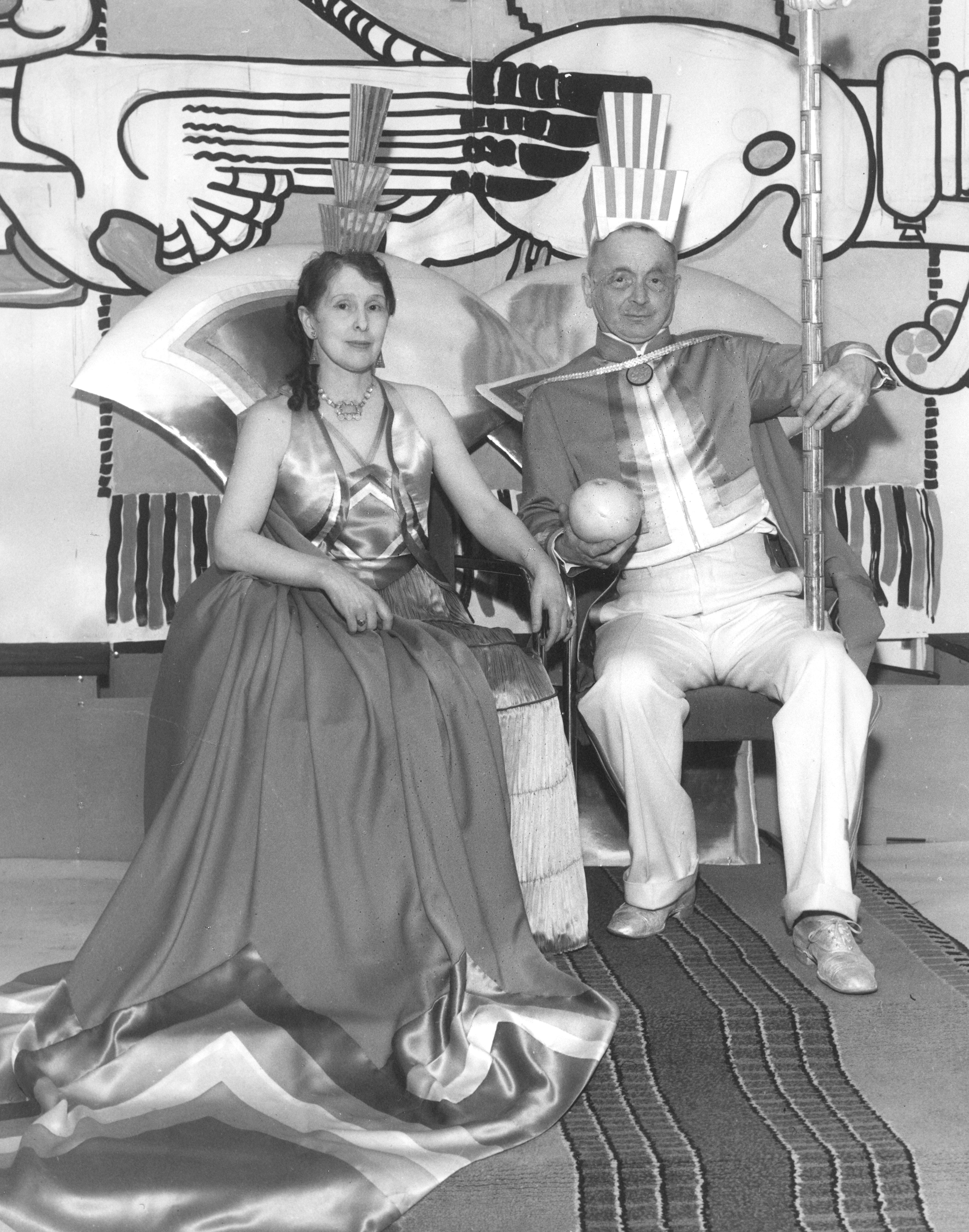
Before everybody buys, borrows, or burrows in a closet for something to wear for Cranbrook Center’s annual House Party, let us consider the fashions of the times. We’re going back to the 1930s, to celebrate the heyday of Loja Saarinen, doyenne of the Cranbrook art scene as designer of interiors, weaver, fashionista, textile designer, businesswoman, landscaper, and modelmaker. Between husband Eliel, daughter Pipsan, and son Eero, the Saarinen family had inventiveness, imagination, skill, and audacity all sewn up. With the Saarinens’ extensive network of friends, colleagues, and students, the atmosphere at the Art Academy must have been rarified indeed.

Small wonder, then, that when it came time for parties, Loja Saarinen could craft her own iconic evening attire for the Art Academy’s Crandemonium Ball of February 1934, including that of her consort, as you can find in the photograph on the flyer for the event of May 21, 2022.

Eliel and Loja Saarinen at the Cranbrook Academy of Art “Crandemonium Ball,” February 1934. Photography by Richard G. Askew, Copyright Cranbrook Archives.

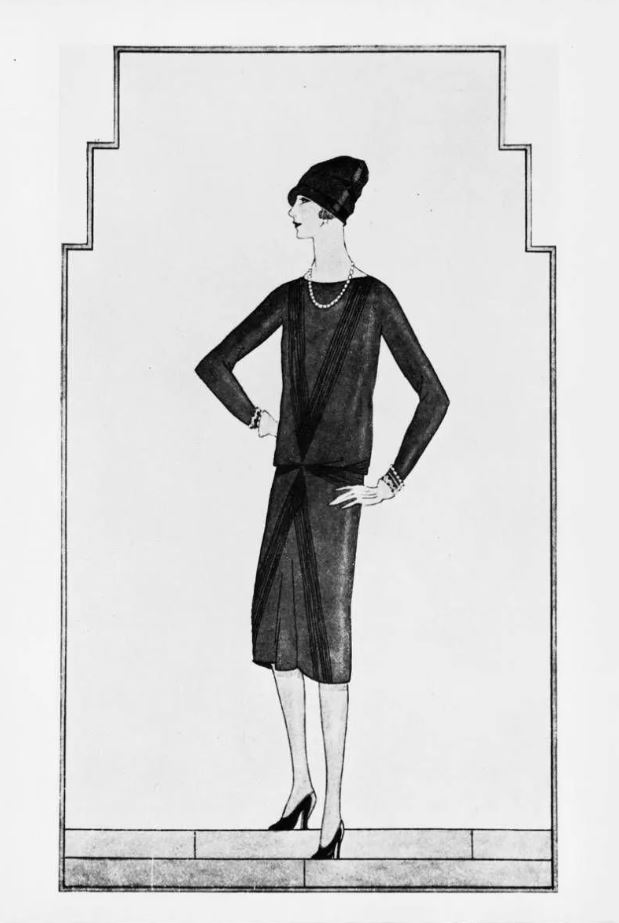
Four our House Party, if you were thinking of the little black dress, Coco Chanel brought this simple concept to the public eye in 1926, with Vogue Magazine proclaiming it “Chanel’s Ford” in homage to the Model T which famously came in any color you wanted as long as it was black. Do note the chevrons (just visible in the Chanel dress) on the Saarinen dress also.

Coco Chanel–the Little Black Dress, as illustrated in American Vogue, October 1926. Source: Vogue.

Post WWI 1920s design was the big break away from the 19th century drapery which required all kinds of padding and corsetry. Chanel prided herself on getting women out of corsets, and they never went back into them. The fashions were shapeless, short, and sack-like at their extreme, with lots of embellishment for evening dresses to make up for their lack of pizazz. Think Fitzgerald and Gatsby.

At this time too, the tuxedo or dinner jacket was becoming acceptable for ordinary men who were not English royalty or American billionaires.

Continue reading

Photographing the Rugs of Studio Loja Saarinen

In 2021, the home of Loja Saarinen at Cranbrook Academy of Art, which she shared with her husband Eliel, was designated as a site in the Historic Artists’ Homes & Studios program. As the team at the Center were going through the process of researching Loja, the too-often-overlooked designer of textiles, gardens, and clothing, we were constantly reminded that the rugs created by Loja and her professional weaving studio, Studio Loja Saarinen, were poorly documented in our records.

Studio Loja Saarinen made rugs, window treatments, wall hangings, upholstery fabrics, and more at Cranbrook between 1928 and 1942. Many of the Studio’s largest rugs were made for Kingswood School for Girls between 1930 and 1932. Because of the fragility of the rugs, and through natural wear-and-tear, almost all of the original Studio Loja Saarinen rugs were put in storage at Cranbrook Art Museum in the 1970s and 1980s.

Loja Saarinen, circa 1934. Courtesy Cranbrook Archives.

We have excellent archival records about the operation of the studio, including records of yarn orders and charts of the time spent weaving rugs (it was a lot!). But the rugs are very large, and often, we only had black-and-white photographs of the rugs on the floor in the 1930s. Color photographs were limited to poorly distorted slides, or photographs of portions of the rugs taken on early digital cameras while the rugs were half-rolled-up in storage.

We had almost no ‘born digital’ high-resolution photographs of Loja’s work–these are the best kind of photographs for sharing her work in slides, online, or in print. The lack of excellent, high quality images limited not only how we at Cranbrook understood and shared Loja’s legacy, but also made it difficult for students or scholars researching Loja Saarinen to get a complete sense of her artistic output.

This winter, as the Center prepares for our next fundraiser, A House Party at Cranbrook Celebrating Loja Saarinen on May 21, 2022, it has become mission-critical to get better documentation of Studio Loja Saarinen’s rugs.

Enter in our latest project!

On January 7, 2022, photographer James Haefner and his assistant Erik Henderson, with the help of Center Curator Kevin Adkisson, Center Associate Registrar Leslie Mio, Cranbrook Art Museum Registrar Corey Gross, Cranbrook Art Museum Head Preparator Jon Geiger, and Jon’s installation crew embarked on a very ambitious project: documenting all the Studio Loja Saarinen rugs in the Cranbrook collections.

First, we had to take the several-hundred-pound rugs down from racks where they are stored, rolled. Then, we covered the floor in clean plastic drop cloths. With a camera bolted via a vise-grip to the ceiling of the Cranbrook Art Museum Collections Wing, and controlled via computer from a remote workstation, we unrolled, photographed, and rerolled over forty works of Studio Loja Saarinen’s functional art.

No detail went undocumented, from weaver’s signatures knotted into the face of a rug, to maker’s labels written and sewn on by Loja herself.

Below is just a fraction of the forty-plus pieces photographed:

It was a joy to unroll and see these pieces up close after knowing many of them for years through black-and-white images. While even these photographs do not do justice to seeing their beauty in person, having such high-resolution photography of Studio Loja Saarinen’s rugs means that future scholars and fans of Loja Saarinen will be able to have a richer understanding of her, and Cranbrook’s, remarkable legacy.

For even more Loja Saarinen, join the Center in person or online on May 21, 2022 for A House Party at Cranbrook Celebrating Loja Saarinen. We’ll be premiering a new, thirty-minute documentary about Loja, produced by the Center, at the event–you don’t want to miss it!

Leslie S. Mio, Associate Registrar, and Kevin Adkisson, Curator, Cranbrook Center for Collections and Research

Create a website or blog at WordPress.com