Object in Focus: Gone but Not Forgotten

Buddy_blog

Grave of Buddy. Photo taken by Cheri Gay.

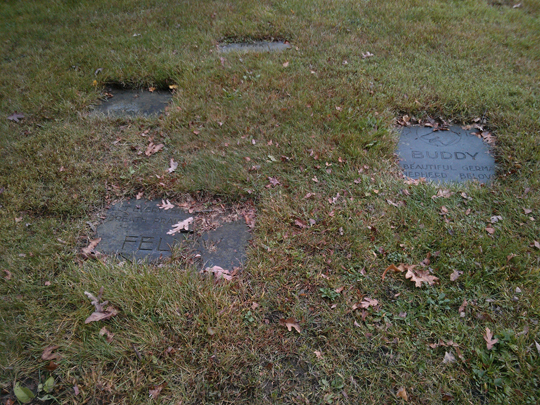
Taking a stroll one day on the grounds of the Thornlea Studio (where Cranbrook Archives was previously housed) I was startled to come across small tombstones, almost buried in the grass. What were these, I wondered? Seeing the names, I immediately understood: Buddy, Homer, Perky, Heinie, Fellow, Ricky, Zorah—a pet cemetery, which had seen better days.

Thornlea Studio was the artistic lair of Henry Scripps Booth, who designed and placed the building across the wide expanse of lawn from his home Thornlea. The family actually lived in the studio in 1949 when “… our daughter Melinda was a student at Kingswood. She was embarrassed by our living in “such a big house” and prevailed on her mother to close the house and move across the lawn to the Studio.”

The Henry Scripps Booth and Carolyn Farr Booth Papers document six dogs, almost all black and tan German shepherds. Receipts from Sheldon Granite Co. in Detroit reveal they made the monuments for Heinie, Perky and the lyrically named, Homer the Wanderer. A 1961 notebook paper receipt identifies Albert Leipold, of Birmingham, as the stone carver for Fellow’s monument for $40.
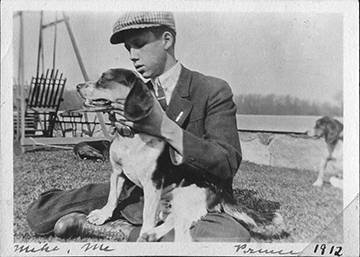
Mike

Henry Scripps Booth with Mike, 1912. Cranbrook Archives.

Buddy 1929

Buddy at Thornlea, 1929. Cranbrook Archives.

When Henry was growing up, the Booth family had beagles, Prince and Mike, and a great Dane, Ginger. Mike, according to Henry, “ … loved having a fuss made over him, one time going so far as being pushed around in a doll carriage while wearing a canvas hat.” Oh to have a photograph of that! When Henry had his own family, black and tan German shepherds predominated.

Henry’s photo albums, called Pleasures of Life, include 17 different dogs, though not all are his. His hand-written captions under the photographs always give the dog’s name followed by (dog) in case there’s any doubt, for example, in a photo of Cynthia and Curlytail, who is who.

Though the grounds and building of the Thornlea Studio are maintained, unfortunately that care doesn’t extend to Henry Booth’s lovingly buried companions. It’s a project waiting to happen.
Dog Graveyard_Blog

Thornlea Studio pet cemetery. Photo by Cheri Gay.

–Cheri Gay, Archivist
Booth House + Scripps Land = Library

The Detroit connections of James E. Scripps and George G. Booth are well-documented: Scripps as founder of the Detroit News and founding member of what is today the Detroit Institute of Arts, and Booth as a founder of the Detroit Society of Arts and Crafts.  Less known, perhaps, is a venture near the end of Scripps’s life that helped create the Scripps Branch of the Detroit Public Library at Trumbull and Myrtle. The library was actually George Booth’s former home, renovated to accommodate library services. It stood in Scripps Park though a different library (the Frederick Douglass branch) sits there now.

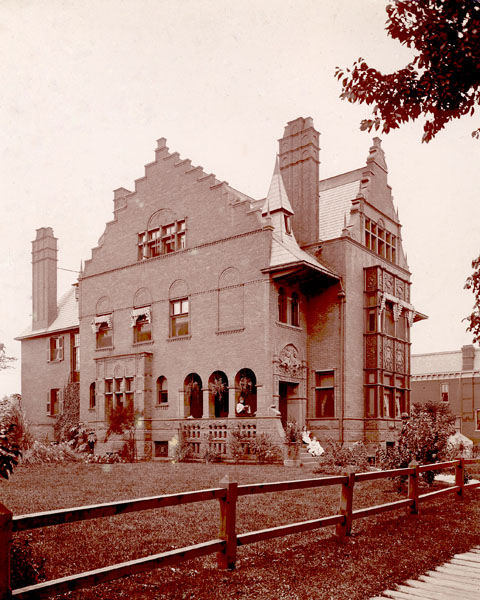
Here’s the story. When George Gough Booth and Ellen Warren Scripps married in 1887, James Scripps built a house for them, designed by Mason & Rice, across the street from his own on Trumbull Ave. Fast forward to 1905. James Scripps donated 15 lots of property, on Grand River between Trumbull and Commonwealth, to the city of Detroit as a site for a park and branch library. He included $50,000 to be used for city beautification.

Booth Family Home, 605 Trumbull Avenue, 1898

Booth Family Home, 605 Trumbull Avenue, 1898

The Library Commission, on which Scripps served for five years, was already thinking of putting a branch in this area (no doubt influenced by Scripps), so the city gave the Commission the land. Now things get more confusing. Upon the death of James Scripps in 1906, the estate purchased the George Booth home (located next door to Scripps’s donated property; by this time the Booths had moved to Cranbrook) and included that in the gift. So the Library Commission didn’t have to build a new branch and used the $14,000 designated for that purpose to renovate Booth’s house as a library.

Scripps Park

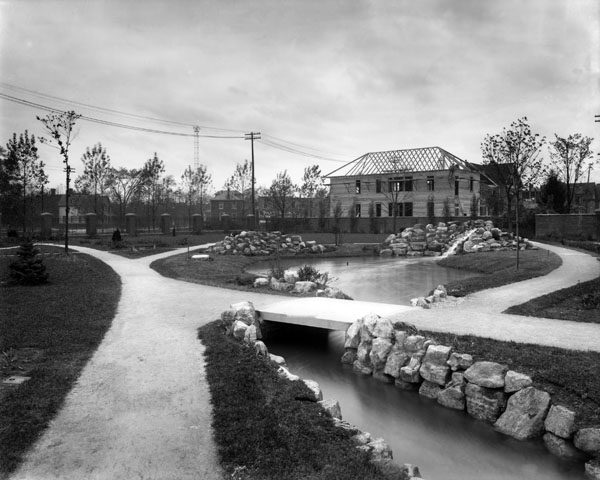
Early landscape, Scripps Park, ca 1908

In fulfilling Scripps’s intent for a park, Booth hired H.J. Corfield, landscape gardener who designed the basic landscape for Booth’s Cranbrook estate.  Booth wrote to Corfield “I feel quite sure that we can carry through a nice piece of work and will be able to pay the foundation for a small park of unusual attractiveness in this city.”  Corfield transformed land that was “little better than a city dump …  into one of the prettiest parks in the city of Detroit.”

Entrance to Scripps Park

Entrance to Scripps Park

The former Booth home was almost doubled in size and opened on July 3, 1909 as Scripps Branch Library.

There’s another interesting twist to the story. In 1898, James Scripps added an 800-ton octagonal chapter house, modeled after the one in Westminster Abbey, to his own home on Trumbull across the street from the Booth’s. It contained his book and art collection. In 1927, James’s son, William E. Scripps, made a gift of the tower to the Library, along with its collections, it was moved across the street and attached to the Scripps Branch Library!

The sad ending is that the branch closed in 1959, and was demolished in 1966. The Gothic tower was razed sometime later, after a valiant attempt to save structure, by George Booth’s youngest son, Henry Scripps Booth, failed.

~Cheri Gay, Archivist

Create a website or blog at WordPress.com