Cartoons and Crusades: Booth, Herter, and the Making of a Tapestry

If you’ve ever visited the Cranbrook House library, you’ve probably noticed The Great Crusade, a large tapestry hanging on the south wall.  Many people associate tapestries with medieval times, when they were used to keep drafty castles warm in winter.  Woven wall hangings were also popular as decorations, especially as a sign of wealth since the extensive labor and pricy materials made tapestries more expensive to produce than paintings.  While most of the tapestries that adorn Cranbrook House are fifteenth-century Flemish, The Great Crusade is a toddler; though it utilizes a historic technique, it was designed and produced in the early twentieth century.
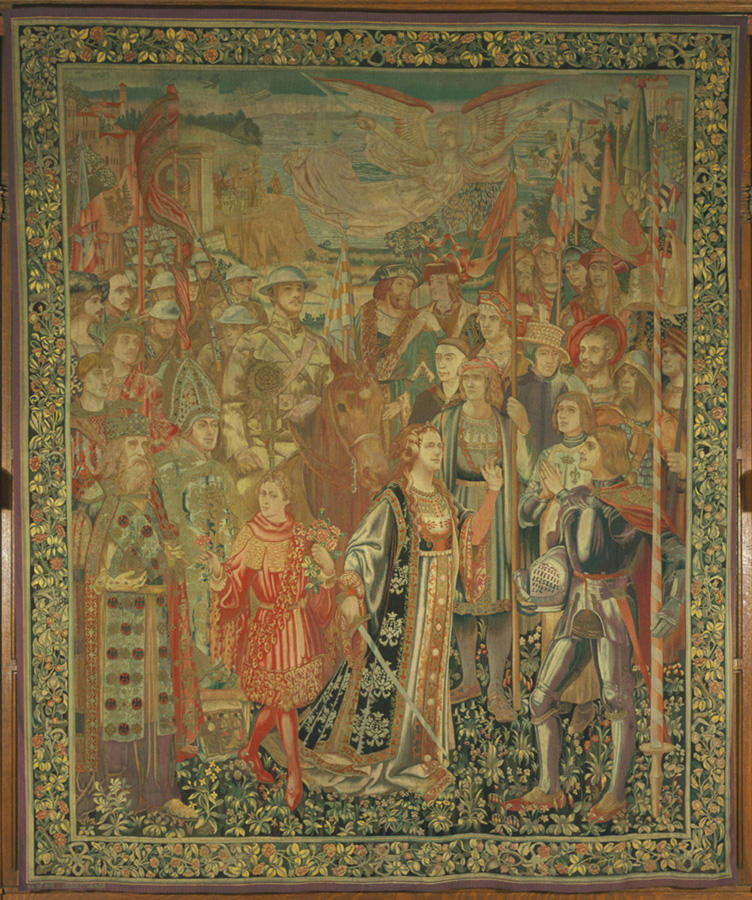
Herter Looms, The Great Crusade, 1920.  Cranbrook Art Museum.
Herter Looms, The Great Crusade, 1920. Cranbrook Art Museum.

Continue reading

Photo Friday: Who’s That Man?

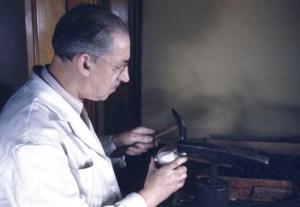
It’s Arthur Nevill Kirk! Wooed by George Booth, the famed silversmith arrived at Cranbrook in 1927 to head the metals department at the Academy of Art. Kirk also taught at the Art School of the Detroit Society of Arts and Crafts and Cranbrook School for Boys. His specialty was the design and execution of ecclesiastical silver, of which Cranbrook still has many pieces in its collection.  During the Great Depression, lack of funds curtailed the use of precious metals and the department closed in 1933. Kirk went on the help establish the Artisans’ Guild, and organized the metal department at Wayne State University in Detroit, where he taught until his retirement in 1957.

~Robbie Terman, archivist

Arthur Nevill Kirk. Cranbrook Archives.

Arthur Nevill Kirk at work. Cranbrook Archives

Create a website or blog at WordPress.com