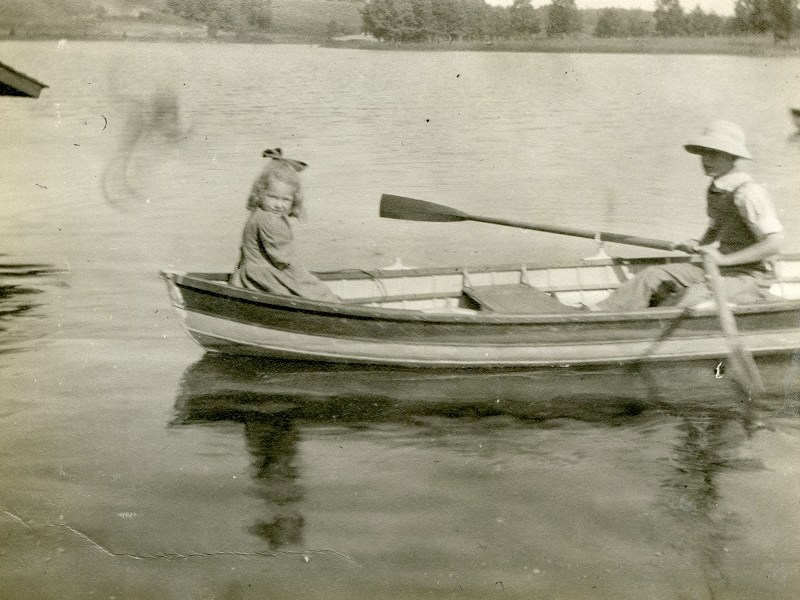
The Name Game
From the beginning of Cranbrook’s history in 1904, place names at Cranbrook have evolved and changed. Once the Booths turned the original mill pond into a lake,…
Read moreNothing at Cranbrook is just one thing. Every tree, garden, rock, and railing has a story–and often times, a name.
In 2022, with the help of an anonymous donor and our friends at RE-TREE, a Camperdown elm (Ulmus glabra ‘Camperdownii’) was transplanted from a local garden to the Meadow in Cranbrook House Gardens, where it joined another established Camperdown elm. Since RE-TREE names all of the trees they relocate, I decided our Camperdown elms needed names, too. I started to refer to the larger tree as Thistle and the smaller tree as Smike to honor the two youngest Booth children, who grew up primarily on the Cranbrook Estate.

In 1908, George and Ellen Booth and their children, James, Grace, Warren, Harry, and Florence, moved from their home on Trumbull Avenue in Detroit to their new home Cranbrook, in the “wilds” of Bloomfield Township. At the time of the move, James was twenty, only two years away from marriage; Grace was eighteen; and Warren, fourteen, was already in boarding school. Youngest siblings Harry (eleven) and Florence (six) pretty much had the run of the grounds, exploring every nook and cranny (pun intended).
As the family explored and improved their country estate, they also took to naming significant features: every pond, hill, tree, and drive would be christened with its own name. Some names stuck (Angley Woods), others changed (Glassenbury Lake became Kingswood Lake), and others have been forgotten.
From the beginning of Cranbrook’s history in 1904, place names at Cranbrook have evolved and changed. Once the Booths turned the original mill pond into a lake,…
Read moreHarry and Florence were no exception; they had pet names for each other. Harry, known as Thistle, received his nickname during an illness. He did not shave for days, and someone said kissing his cheek was like kissing a thistle. We don’t have a record of the origin of Florence’s nickname, but friends and family called her Smike her whole life.

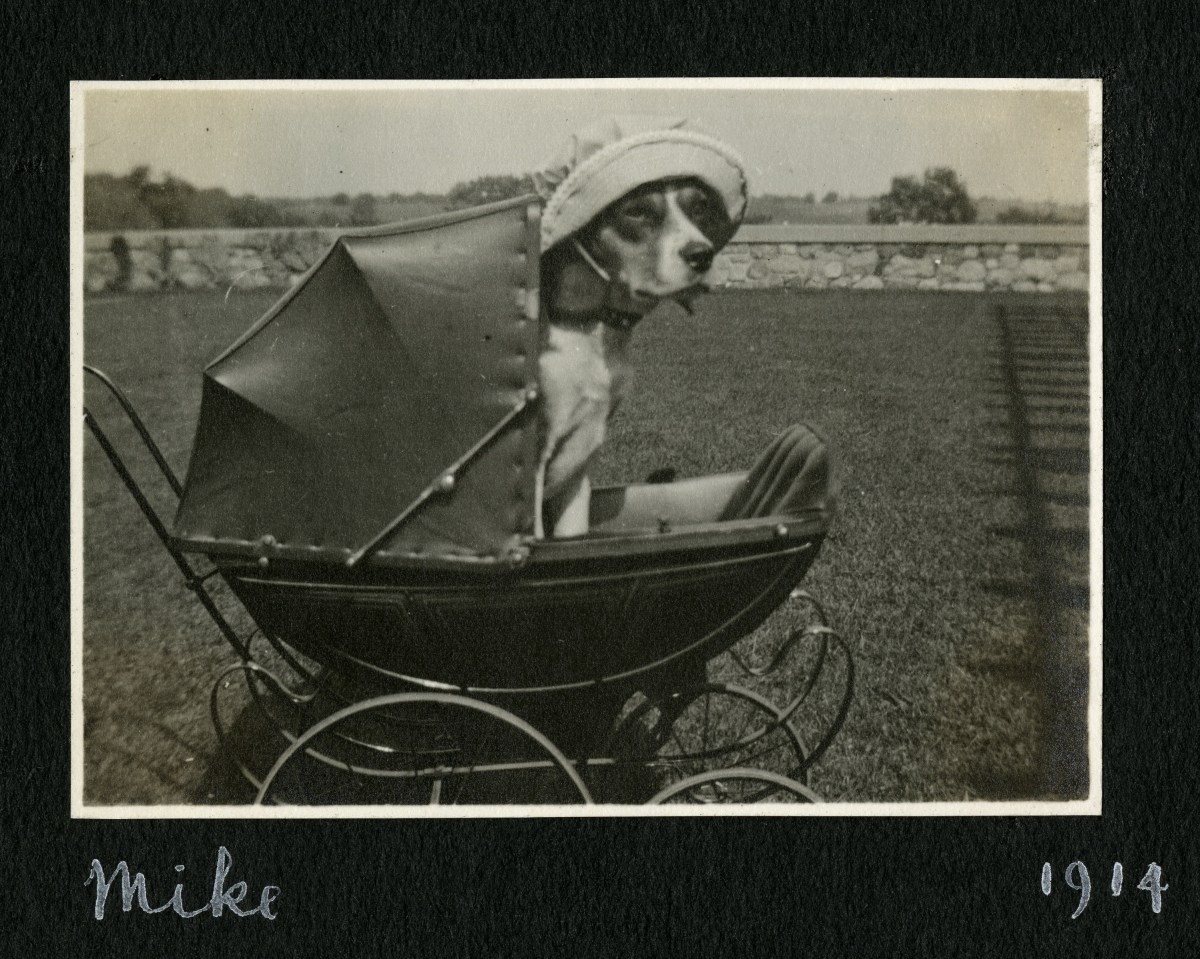
The Camperdown elms’ location below the West Terrace are also significant to Smike’s story. The Booths (especially Florence) loved animals. Family dogs Bud, Sandy, Spot, Prince, Larkspur, and Craig were well cared for and loved. The family beagle Mike was so beloved as to be made to wear a bonnet as he travelled around in a baby carriage!
The biggest canine event at Cranbrook came in 1914. As Harry Booth later wrote, “On June 20, 1914, the Booth family celebrated the 70th anniversary of the family’s landing on North America from England. After a picnic, everyone attended a dog show Florence Booth organized on the new West Terrace.”


So, when I look at the two Camperdown elms below the West Terrace–one slightly bigger than the other–I think of all the stories the grounds of Cranbrook hold, and of the happy days Thistle and Smike spent growing, adventuring, and imagining around campus.
Perhaps you’ll agree with my names for the trees, and next time you are strolling in the Meadow at Cranbrook House Gardens, just below the West Terrace, say hello to Thistle and Smike.
– Leslie Mio, Associate Registrar, Cranbrook Center for Collections and Research
Ed. note: Special thanks to Paul Nelson, one of the arborists for Cranbrook House and Gardens Auxiliary. He has been a champion for Thistle and Smike, making sure they are trimmed, watered, fertilized, and kept looking their best.
With Laura MacNewman’s Kitchen Sink blog entry of May 2019 serving as an excellent guide to the Women’s Window of Christ Church, Cranbrook, it seems worthwhile to take a more detailed look at the individual panels.
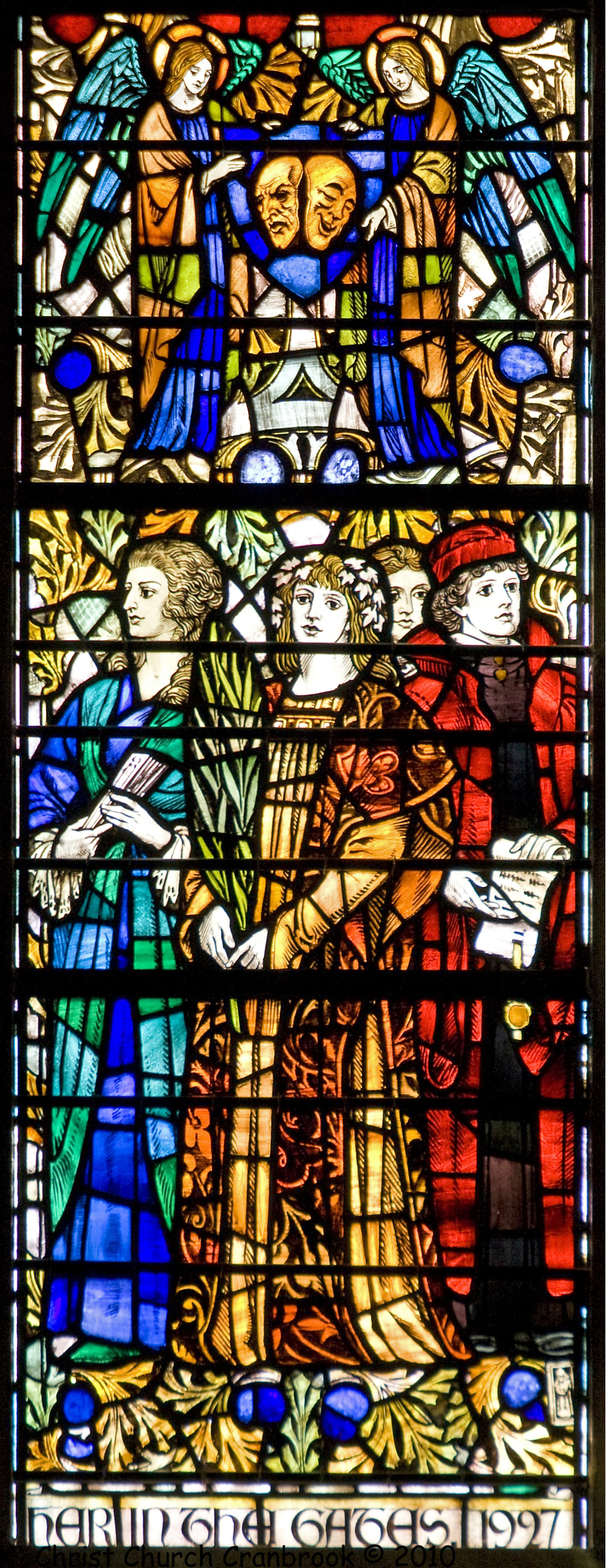
Though the window was the gift of Florence Booth Beresford and her husband James, the choice of women to be included was made by the Reverend Samuel S. Marquis, the first rector of the church. What is intriguing is how or why the Rev. Marquis chose the women who appear. Since no documentation has yet come to light, we can only look at who the women are as well as how they are depicted. Marquis aimed to cover mostly western culture through the ages up to his present day, the 1920s, and clearly was choosing exemplary members of the categories. Thus, we find that the actresses under study here, except for one, are well-known to this day in the French and English-speaking world.
The profession of actress almost until the present has had a bad reputation. A woman was not supposed to put herself on display or seek approval. Odd then that the quotation from Proverbs 31:28, 31 enters the window as the dedication to women: Her children rise up and call her blessed … and her works praise her in the gates. These works would not include appearing on stage or screen.
Shakespeare’s women were played by young men who aged out of the roles into male leads if they were lucky. The comedic role where the young female lead must disguise herself as a man then becomes an interesting part to watch, especially if the young actor, appearing as a young woman, must pretend to be man playing a woman as in As You Like It.
The first woman to appear on the English stage in her own right was reputedly Margaret Hughes in the role of Desdemona in 1660 after the restoration of Charles II. Our window’s first actress (from the left) is the Welsh actress Sarah Siddons, born 1755, older sister of the great John Kemble and aunt of also great Fanny Kemble. Siddons was a tragic actress, scorning comedy as buffoonery beneath her talents. Her great roles were Lady Macbeth and Volumnia from Coriolanus. These are two of Shakespeare’s nastiest ladies, beloved of actresses everywhere. As critic William Hazlitt said of Siddons, “Passion emanated from her breast.”

She was possibly the first actress superstar of the modern world, so famous she was painted by all the great portraitists including Gainsborough and our own Gilbert Stuart. All the paintings, even the stained-glass version, show off her famous Kemble nose.
The next actress is Sarah Bernhardt born in 1844 in Paris to the Dutch mistress of an aristocratic lover who sent young Sarah off to the Paris Conservatoire, then a partly government-sponsored school of acting. Bernhardt graduated into becoming a member of the Comédie-Française, where she found the techniques old-fashioned. Always a tearaway, she was dismissed for slapping a senior actress.
Bernhardt did not need the national theater to become one of the most famous actresses of all time. She was an exceptional self-promoter and entertained all the society men of her age, numbering the future Edward VII of England and Victor Hugo amongst her lovers. She had a mass of wild hair, big blue eyes, perfect teeth, and with her good looks and purity of diction and a voice variously described as silvery or golden she attracted enormous crowds to any theater. She made Victor Hugo cry in a performance of one of his own plays.

Her roles were again mostly tragic playing Cordelia in Le Roi Lear, Hamlet, Desdemona, Joan of Arc, Racine’s Phèdre. Her offstage behavior was just as spirited; she slept in a coffin to prepare for roles and abandoned the corset.
She founded her own theaters, toured the United States nine times, toured the world, built and worked in a hospital in World War I, played a young man of twenty when she was fifty-five, took on all the great tragic roles, faced, fought and surmounted anti-Semitic slurs all her life, appeared in silent films and melodramas. She lost a lung, a kidney, a leg but still trod the boards.
Bernhardt incarnated the French wife of an English artist in Detroit in the play The False Model on November 25, 1916, but there is no record of any Booths attending.
Next is English actress Ellen Terry, born in 1847, contemporaneous with Sarah Bernhardt, but not the quite the world player. Beautiful Terry, teenage actress and the artist’s model, married pre-Raphaelite painter G.F. Watts but went off to live with architect-designer Edward William Godwin where she caught the eye of renowned actor Henry Irving. Irving sought luxurious stage settings and a beautiful actress to complement his own great talent. In addition to appearing in all the great female roles of Shakespeare and more humble parts, Terry entered into a lively correspondence with George Bernard Shaw who cast her in roles he had written for her.

The unrivaled team of Irving and Terry lasted 24 years. Even today, to be able to say that your great-great grand relatives had seen them onstage together is still impressive. Terry and Irving appeared in Detroit 25 through 27 January 1900. We find in Ellen Scripps Booth’s diary for Friday, January 26: “I went to see Irving and Terry tonight in Robespierre.” Mrs. Booth makes no comment on Terry’s performance of loving wife Clarisse, but the Detroit Free Press of the next day praised Terry for her “characteristic grace” and “personal charm” in a not very demanding role. There were many curtain calls.
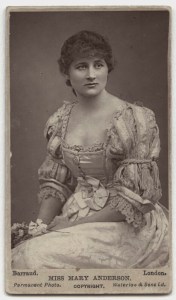
The “half” actress who owns the little face inserted between Bernhardt and Terry is Mary Anderson, born 1859, the American tragedian here, who also took on comedic roles. Her claim to fame was playing two parts (Perdita and Hermione) in Shakespeare’s The Winter’s Tale which bought her great acclaim. Audiences raved over her, while critics appreciated her beauty but found her lacking in feeling. By contrast with the others her star burned for a much shorter time. She toured extensively but withdrew from the public eye in 1889 due to exhaustion and the offer of marriage and a home in England.
Stained-glass artist James Hogan’s pre-Raphaelite influence can be seen in the depictions in the window, but he is not copying from any standard image. Siddons appears in one of her classical roles, Bernhardt as Phèdre, and Terry in her signature red lawyer’s robes as Portia from the Merchant of Venice playing a man.
What unites these women is their ability to stand up and be counted as women of talent at a time when they were more regarded as curiosities. Of the three greats, not one of them had a happy love life. Two of them famously had children out of wedlock and all three were regarded as unworthy by the men who should have revered them. All three nineteenth-century actresses played the roles of men. Considering their unconventional lives, it is surprising perhaps that Rector Marquis chose them, but then all the women in the window were unusual because they stood out as pioneers in some way. Who was the most famous? From the 1870s on there were two well-known women: Queen Victoria and Sarah Bernhardt, in no particular order.
– Lynette Mayman, Collections Interpreter, Cranbrook Center for Collections and Research
 Cranbrook Kitchen Sink