Photo Friday: Europa and the Bull

The year 1975 marked the centennial of the birth of Swedish sculptor, Carl Milles. In honor of this event, the Swedish Council Detroit held a reception at Cranbrook Art Museum on June 12, 1975. Those in attendance included the Swedish Counsel General, Karl Henrick Andersson, and Count Wilhelm Wachtmeister, Swedish Ambassador to the United States (1974-1989).
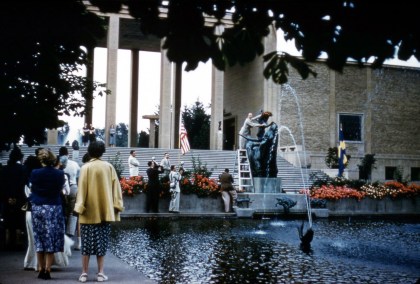
The Swedish Council Detroit places a wreath atop Milles' sculpture, Europa and the Bull. Henry Scripps Booth is holding the ladder and Cranbrook photographer, Harvey Croze, is in the foreground, to the left of the ladder. Courtesy Cranbrook Archives.

The Swedish Council Detroit places a wreath atop Milles’ sculpture, Europa and the Bull. Henry Scripps Booth is holding the ladder and Cranbrook photographer, Harvey Croze, is in the foreground, to the left of the ladder. Courtesy Cranbrook Archives.

In conjunction with the Jenny Lind Club of Detroit, they presented the Academy of Art with $1500 in support of the Carl and Olga Milles Scholarship Fund (which is still in existence today). It was part of $75,000 raised by Cranbrook as part of a Ford Foundation matching grant.

Dedicated to the preservation of Swedish cultural heritage, the Jenny Lind Club also participated in Cranbrook’s celebration of Carl Milles’s 75th birthday in 1945. The first vice-president at that time was Ingrid Koebel. The Koebel House, located in Grosse Pointe, was designed by J. Robert F. Swanson with interior decorations by Pipsan Saarinen Swanson.

Leslie S. Edwards, Head Archivist

The Fascinating Notebooks of John Buckberrough

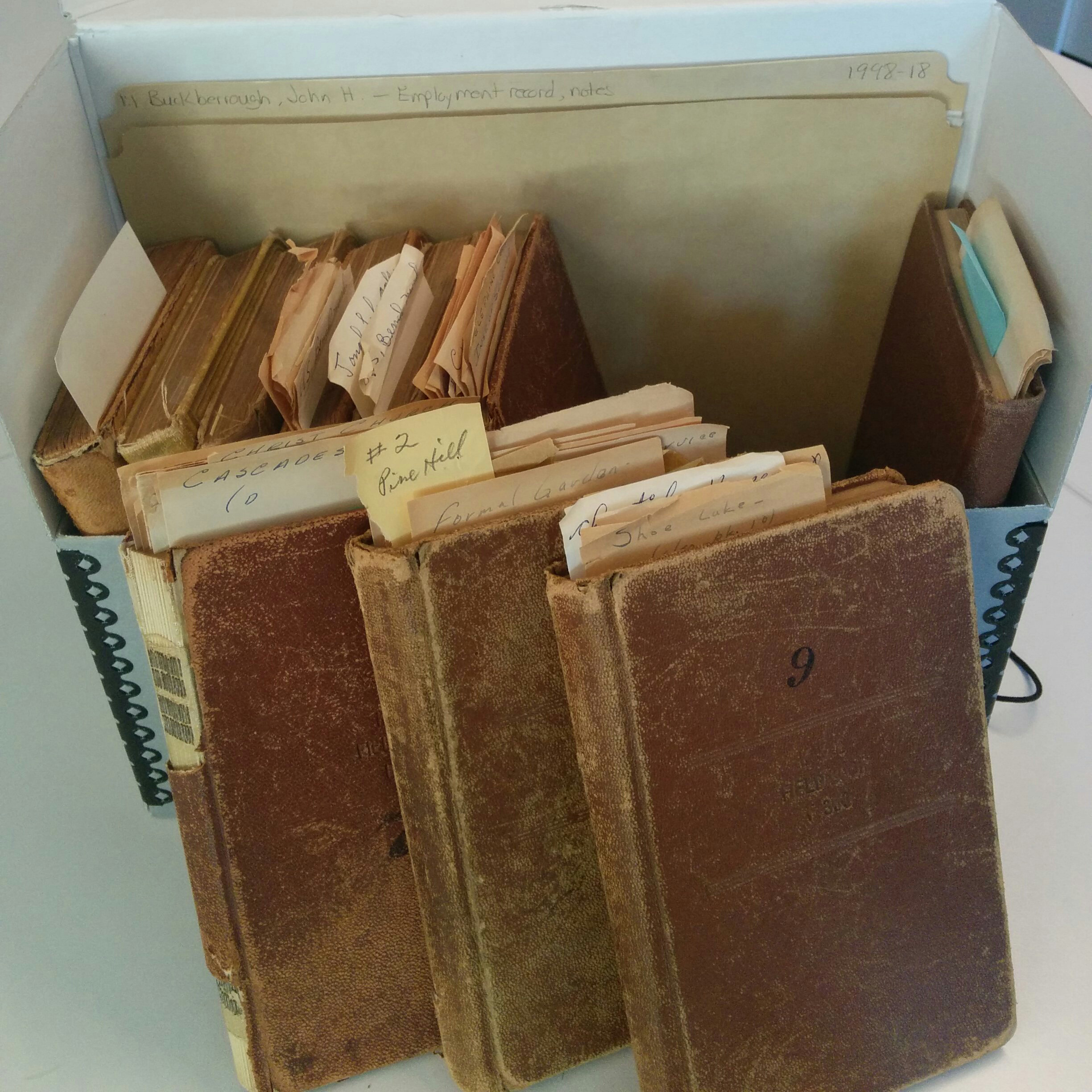
John H. Buckberrough (1874-1955), an immigrant from Ontario, Canada, was a civil engineer for the Cranbrook Foundation from 1927 until he retired in 1955. As described by Henry Scripps Booth:

Buckberrough, a slight man of medium height, started working for Swanson and Booth as that firm’s sole employee two years before Cranbrook officially employed him. That was in the firm’s tiny architectural office located in the below-road-level room of the Ram House section of Brookside’s buildings. … He became one of the first employees of what was known as the Cranbrook Architectural Office in January 1927. … Over the years he was chief surveyor, planned most of the pump rooms, transformer vaults and underground systems, kept copious notes and made detailed plans regarding changes which not only proved increasingly valuable in solving complicated problems but put to shame those who were later supposed to fill his shoes.

In addition to numerous architectural drawings that bear his signature, Buckberrough’s legacy in the Cranbrook Archives is 10 calfskin engineers’ field books, chock full of drawings and notations, covering 1926-1955.

Courtesy Cranbrook Archives

Courtesy Cranbrook Archives

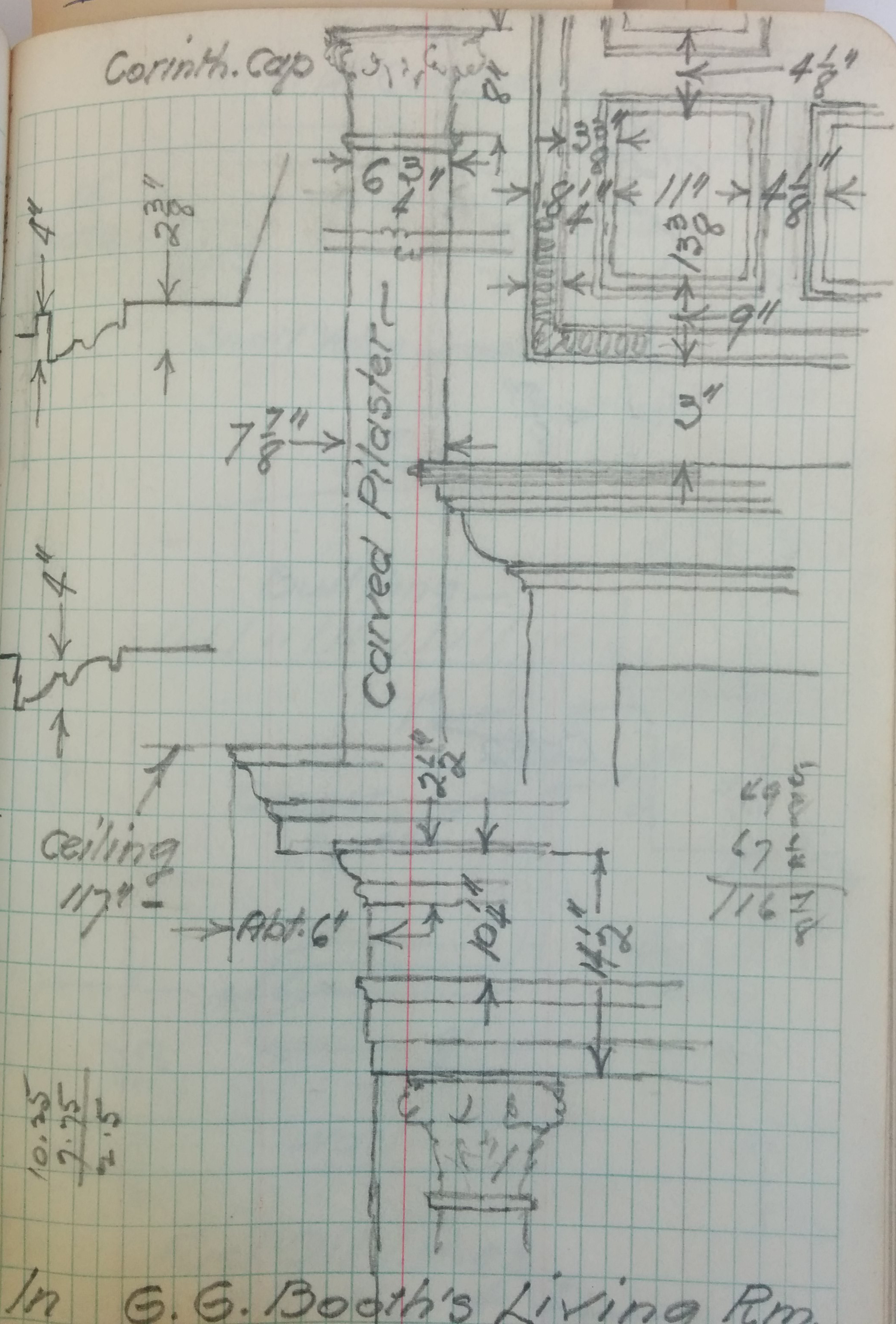
Descriptions and diagrams of Cranbrook property, heating and plumbing data for Cranbrook buildings, data on Cranbrook roads and lakes, drawings of pump houses, sidewalks, lighting layouts and water lines can be found in the notebooks. Here are some examples:

Design of a bridge.

Bridge at Kingswood Lake, 1938.

Column design for fireplace in Cranbrook House living room.

Column design for fireplace in Cranbrook House living room.

The Archives’ staff often finds valuable information in the notebooks, which is used for campus restoration and renovation projects including the recent restoration of Cranbrook School Quad. Little did Buckberrough know how valuable his meticulous note-taking would prove to be. Though a search for information requires a careful page-by-page hunt, it’s a pleasant change from the impersonality of electronic resources.

Cheri Y. Gay, Archivist

Dispatch for the Archives: the Joys of Processing

Although we live in an age of technology, databases, and the digital representation of collections, one of the most interesting and rewarding jobs for an archivist (at least this one!) is still the processing of a collection.  What does this encompass? It is the way in which an archivist takes the paper records of an individual, group, or institution and sifts through them, weeding out duplicates, sorting, organizing, and  rehousing in acid-free folders and boxes, all to make it accessible for you, the user!.  To some this may seem a tedious task (and it certainly can be depending on the nature of the collection) but the rewards are usually worth it.  Finding that one gem that tells a new story, or that group of documents that sheds new light on an old story—this is the stuff archivists dream of!

I am currently processing the Swanson Associates Records that document the partnership between architect J. Robert F. Swanson and interior designer and textile artist Pipsan Saarinen Swanson.  Right now I am looking at the project files that relate to the firm’s architectural commissions from 1926 to 1977.  So, as a sneak preview (the collection is not yet open for research), here a couple of interesting discoveries:


Continue reading

Create a website or blog at WordPress.com