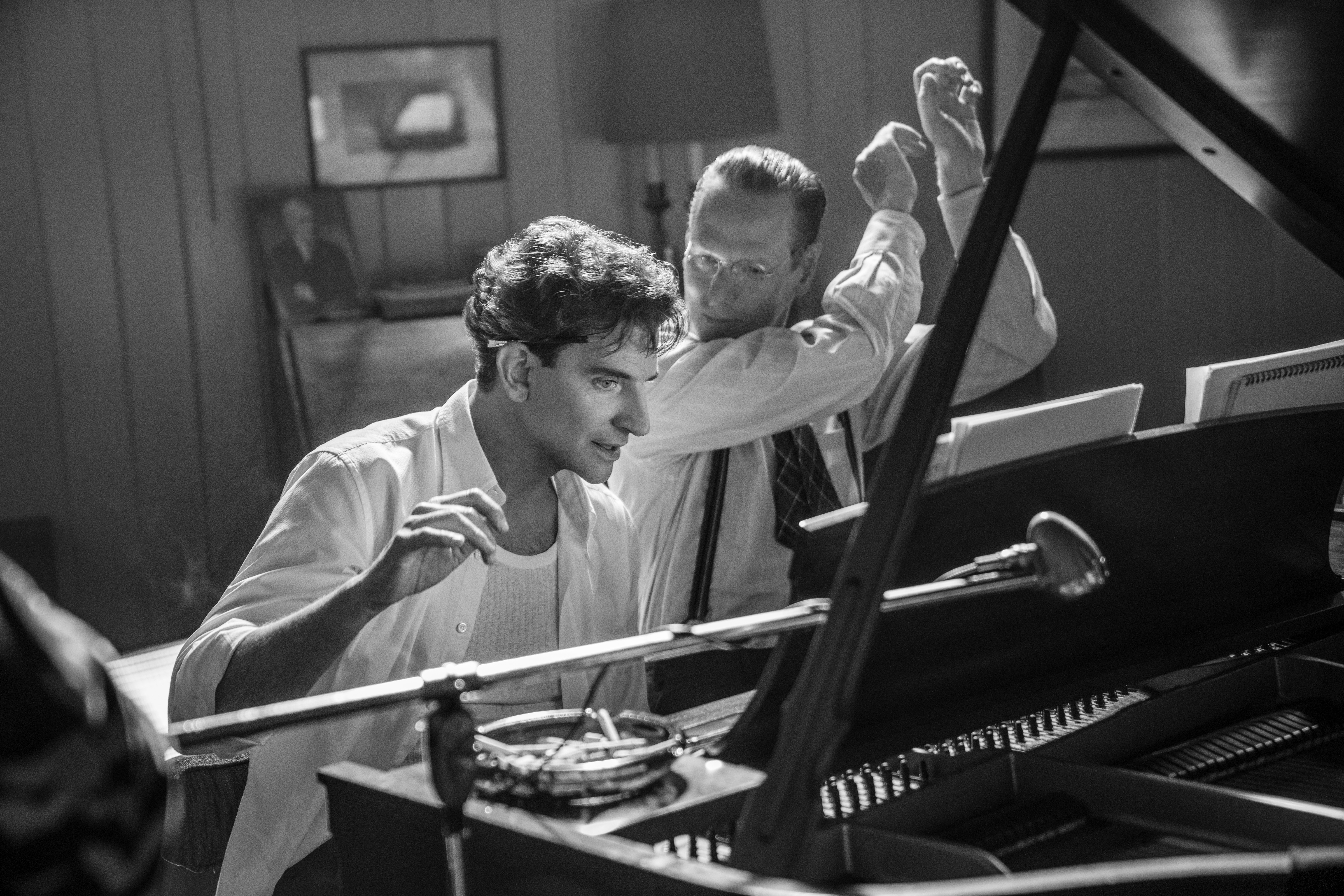
With Maestro now streaming on Netflix—and nominated for four Golden Globe Awards—it’s high time I set the record straight about the Cranbrook House Steinway Grand and its most famous pianist, Leonard Bernstein. It is a legendary story, told and retold for decades, that places Bernstein composing none other than his most famous work, West Side Story, here, at Cranbrook.
It is a story, however, that is hard to unravel fact from fiction. So, like all Center historians and archivists, I started by doing some digging in Cranbrook Archives. This is the story I uncovered.
First, the Piano
Cranbrook has several Steinway grand pianos, including two of the grandest: a Model D concert grand in Page Hall on the original School for Boys campus, and a second Model D in the Cranbrook House Library. The Cranbrook House concert grand piano was manufactured by Steinway & Sons of New York City and completed a little more than eighty-five years ago on December 18, 1929. It was purchased by Grinnell Brothers of Detroit in January 1930 and, later that year, sold to the Colony Town Club, a women’s club located on East Jefferson Avenue in Detroit.

Enter, George Booth
The black concert grand piano was to have a short life at the Colony Town Club. Within a few years, its members sold it back to Grinnell Brothers where, in February 1935, it was purchased by George Booth. I remain intrigued by the fact that Booth purchased a “pre-owned” piano. While America was in the throes of the Great Depression, I think it was more than a simple cost-saving measure; it was a decision warranted by the piano’s intended use.
The piano did not begin its life at Cranbrook in the Booths’ Library, the center of their social life after it was completed in 1919. Rather, Booth first placed the piano in the main hall of the Cranbrook Pavilion on Lone Pine Road. Known today as St. Dunstan’s Playhouse, in 1935 the recently renovated pavilion was being used as an exhibition gallery and event space for the Academy of Art and its nascent Art Museum. The piano was played at exhibition openings and for preludes before lectures, including at least one by Frank Lloyd Wright. Although St. Dunstan’s Guild began using the pavilion in 1937 for rehearsals and storage, Cranbrook Academy of Art continued to hold exhibitions there until 1942, when the new Eliel Saarinen-designed museum opened.

Sometime between 1942 and the summer of 1946, when the pavilion was cleared out and rented by the Cranbrook Foundation to St. Dunstan’s Guild, George Booth moved the Steinway down the road to Christ Church Cranbrook “to protect the instrument from damage by dampness or other causes and to give it the benefit of expert use.” It was also during this period, in March 1944, that George and Ellen Booth formally deeded to the Cranbrook Foundation the Homestead Property, which encompassed not only Cranbrook House but also the forty acres adjacent to the house, including the Cranbrook Pavilion and its Steinway.
 Cranbrook Kitchen Sink