Photo Friday: Cranbrook’s Contractor

Wermuth House, Fort Wayne, Indiana.  Designed by Eliel and Eero Saarinen, 1941. Cranbrook Archives.

Wermuth House, Fort Wayne, Indiana. Designed by Eliel and Eero Saarinen, 1941. Cranbrook Archives.

This distinctly modern house was designed by the architecture firm Saarinen, Swanson & Saarinen for a man whose introduction to Cranbrook happened in a somewhat old-fashioned way—the construction of Christ Church Cranbrook, George Booth’s ecclesiastical ode to the British Arts and Crafts Movement.

In 1923, Albert Charles (A.C.) Wermuth was contracted by the architect Bertram Goodhue to oversee construction of the Trinity English Lutheran Church in Fort Wayne, Indiana.  Goodhue was so impressed with his construction work that he contracted with Wermuth again for the upcoming Christ Church Cranbrook commission in 1924.  Goodhue died before construction on the church could begin in 1925, but the firm Goodhue & Associates retained Wermuth as general contractor for the project.

When Christ Church Cranbrook was completed in 1927, the Booths immediately snatched up A.C. Wermuth for more Cranbrook projects—the building of the Cranbrook School campus and an addition to Brookside.  Thus began a decades-long professional relationship between Wermuth and Cranbrook, with Wermuth serving as general contractor for Kingswood, the Cranbrook Academy of Art, and the Cranbrook Institute of Science.  Wermuth also did private work for the Booth children as they built their own homes in the area.  Eliel and Eero Saarinen used Wermuth for their non-Cranbrook projects as well; he served as contractor on the First Christian Church in Columbus, Indiana, as well as on other Saarinen buildings.

With professional connections like these, it seems only fitting that Wermuth turned to the Saarinens when it was time for him to build his own house in Fort Wayne. While the Wermuth House, which was completed in 1941, was built under the names of both Eliel and Eero, the design of the house speaks a bit more to the son than the father.  A Saarinen, Swanson, & Saarinen project, however, Wermuth ended up with a home for his family that expressed many of the same modernist ideals that he himself helped bring to life as the general contractor for Cranbrook.

Shoshana Resnikoff, Collections Fellow, and Robbie Terman, Archivist

Photo Friday: Cranbrook’s Gatescape

Image

Close-up of the peacock for which Cranbrook School’s Peacock Gates are named. Designed and installed in 1927, restored in 2013. Cranbrook Archives.

Doors, entryways, gates – Cranbrook’s campus was designed with an eye towards points of transition.  Since its foundation 108 years ago, Cranbrook has maintained a long tradition of gate design and fabrication.  This close-up of a stylized peacock comes from Cranbrook School’s famous Peacock Gates; designed by Eliel Saarinen, they were produced by the metalsmith Oscar Bach in 1927.  Recently, a long restoration process culminated with their re-installation on the Cranbrook School campus.   This gate and many others are the subject of the second exhibition in the From the Archives series.  Drawing from the rich collection of the Cranbrook Archives, From the Archives: Forging Cranbrook’s Gatescape explores the history, design, and formation of Cranbrook’s historic and contemporary “gatescape.”

Experiencing the gates from within the walls of the Art Museum is nothing compared to seeing them in person.  With that in mind, Leslie S. Edwards, Head Archivist and exhibition curator, will be leading a walking and bus tour of the gates on Sunday, October 5.   The tour will take participants  to some of Leslie’s favorite gates, from beloved classics to the newest installations on campus.   More information on the exhibition and walking tour is available here.  Be sure to check it out, and get ready to see Cranbrook’s gates in a whole new light!

Photo Friday: Swedish Weavers, All in a Row

Studio Loja Saarinen weavers seated at one of the larger looms.  L to R: Elizabeth Edmark, Marie Bexell, Peggy Broberg, Gerda Nyberg.  May, 1935.  Cranbrook Archives.

Studio Loja Saarinen weavers seated at one of the larger looms. L to R: Elizabeth Edmark, Marie Bexell, Peggy Broberg, Gerda Nyberg. May, 1935. Cranbrook Archives.

Founded in 1928, Studio Loja Saarinen served as a commercial weaving studio at Cranbrook, producing rugs, curtains, table textiles, and tapestries for both the growing Cranbrook campus and outside clients.  Though it bore her name, Loja Saarinen was not the sole weaver at Studio Loja Saarinen—instead, the studio employed a staff of primarily Swedish women who immigrated to the United States during the 1920s and 30s.  At its largest size, the studio had 30 looms in use to keep up with production demands.  Here four of Studio Loja Saarinen’s Swedish weavers are posed at one of the large looms housed in the lower level of the studio.   From left, they are: Elizabeth Edmark, Marie Bexell, Peggy Broberg, and Gerda Nyberg.   Displayed before them is one of the giant rugs produced by the weavers.  Still in use, this rug is on view in Saarinen House today.

– Shoshana Resnikoff, Collections Fellow

Photo Friday: Modern, Inside and Out

Image

Edwin O. George (left) of the Detroit Edison Company and others study a model of the Edison House. Harvey Croze/Cranbrook Archives.

Nestled into a hillside across from the Cranbrook Institute of Science is the Edison House, a low-profile modernist structure that blends in with its surroundings.  In 1965, however, that structure was a pretty big deal.  Conceived of as a partnership between the Institute of Science and the power company Detroit Edison, Edison House served as a spacious and elegant residence for visiting scientists and luminaries while also showcasing the cutting edge in electrical appliances at the time.   Detroit Edison’s influence was felt throughout the house, from heaters in the garage to help drivers warm up their cars on a cold winter’s day to an intercom system that could double as a microphone to pick up the sounds of wildlife outside.  Used primarily as temporary housing for scholars visiting CIS, Edison House became home to CIS director Daniel E. Appleman in the 1990s.  Appleman and his family left the house in 1998, and CIS has since used it for various administrative purposes.

-Shoshana Resnikoff, Collections Fellow

Photo Friday: Twisted Sister

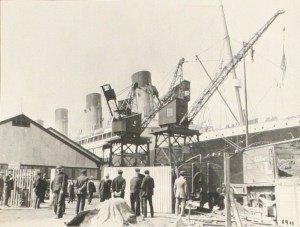
In the summer of 1911, the Booth clan left Cranbrook, headed for a European vacation.  The family traveled via New York, where they boarded the RMS Olympic, part of the White Star Line and sister ship to the Titanic. Designed as a luxury ship, many of the features on the Olympic were identical to the more famous Titanic The Olympic had its maiden voyage on June 14, 1911, arriving in New York on June 21, 1911.  The captain of its first voyage was none other than Edward Smith, who would lose his life aboard the Titanic one year later.  The ship’s return trip to England left June 28, 1911, carrying the Booths.  Another famous passenger on board was ship designer Thomas Andrews, who would also later perish on Titanic.

RMS Olympic

The RMS Olympic arrives in Southampton on July 5, 1911. Cranbrook Archives

In April of 1912, the Olympic was one of the ships that received the distress call from Titanic, but it was too far to help in the rescue.  The Olympic offered to take on survivors, but was turned down, as it was thought that passengers would panic at having to board a ship that was a mirror-image to the Titanic.

After the Titanic disaster, the Olympic had to be refitted, as it, too, did not carry enough life boats for all the passengers.

~Robbie Terman, Archivist

Photo Friday: Back to School

As the schools are busy preparing for the return of students to campus next week, we thought it would be fun to post a student-related photo.  This one, taken in May 1959, shows girls from Kingswood School about to board the bus.  Today, buses are used to transport students between the campuses, but in 1959, the boys (Cranbrook) and girls (Kingswood) schools were not co-ed.  So, what were the buses used for?  Turns out that Kingswood owned two buses that made transportation “possible for day students not only from the north end of Detroit, but also from Birmingham, Pontiac, and Bloomfield Hills.”  Who knew?

~Leslie S. Edwards, Head Archivist

Kingswood students board the bus. Cranbrook Archives.

Kingswood students board the bus. Cranbrook Archives.

Photo Friday: Detroit Society of Arts & Crafts

George Booth’s devotion to the ideals of the Arts & Crafts Movement was evident in the early buildings of Cranbrook (Cranbrook House, the Greek Theatre, Brookside, Christ Christ Church Cranbrook). One of the hallmarks of the movement was to support living, working artists.  Enter the Detroit Society of Arts & Crafts (DSAC). Founded in 1906, the DSAC provided an environment where artists, craftsmen, architects, and designers could share ideas and coordinate activities to raise the level of American craftsmanship. Out of their showroom, works by nearly every major craftsman active in Europe and America were exhibited and sold. George Booth was not only one of the founders of the DSAC, but also its first president.

Watson Street Showroom

Detroit Society of Arts & Crafts Watson Street Showroom. Cranbrook Archives

George Booth was also a great supporter of the DSAC and filled his home with items he purchased or commissioned.  A collection of those objects is currently on display at Cranbrook House in an exhibit titled, “Crafting a Life: George Gough Booth and the Detroit Society of Arts & Crafts.

~Robbie Terman, Archivist

Photo Friday: Who’s That Man?

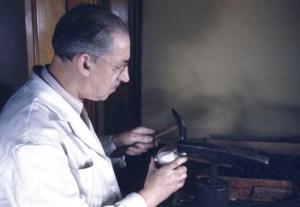
It’s Arthur Nevill Kirk! Wooed by George Booth, the famed silversmith arrived at Cranbrook in 1927 to head the metals department at the Academy of Art. Kirk also taught at the Art School of the Detroit Society of Arts and Crafts and Cranbrook School for Boys. His specialty was the design and execution of ecclesiastical silver, of which Cranbrook still has many pieces in its collection.  During the Great Depression, lack of funds curtailed the use of precious metals and the department closed in 1933. Kirk went on the help establish the Artisans’ Guild, and organized the metal department at Wayne State University in Detroit, where he taught until his retirement in 1957.

~Robbie Terman, archivist

Arthur Nevill Kirk. Cranbrook Archives.

Arthur Nevill Kirk at work. Cranbrook Archives

Photo Friday: Before Booths

Did you know that Bloomfield is one of the oldest townships in Michigan?  Originally part of a larger piece of land known as Oakland, in 1820 the southern portion was designated as Bloomfield. Long before George and Ellen Booth purchased the property known as Cranbrook, Amasa Bagley was already on the scene.  Arriving to the area in 1819 (when Woodward Avenue was still known as an Indian passage called Saginaw Trail!), Bagley quickly became a community leader. A farmer by trade, he was appointed the first judge of Oakland County, and helped to establish the area’s first bank. Perhaps his most significant contribution of the time – opening the town tavern! Built in 1833, the Bagley Inn was used not only to quench the thirst of locals, but also as a public house for political gatherings. Located at the corner of Long Lake and Woodward, the building still exists today.

~Robbie Terman, archivist

Portrait of Amasa Bagley. Cranbrook Archives.

Portrait of Amasa Bagley. Cranbrook Archives.

Photo Friday: A Quiet Force

She was petite and reserved, the constant helpmate of her husband George Booth, but Ellen Scripps Booth (1863-1948) was a powerhouse in her own right. It was Ellen who insisted that a girl’s school be built so that her granddaughters could get a good education. In January 1928, Ellen gifted $200,000 to the Cranbrook Foundation for the building of Kingswood School for Girls. She would later contribute more to ensure the project reached completion.

Known for her modesty, strong religious values, and devotion to her family, Ellen was a steadfast force in the Cranbrook community, and beyond.

~Robbie Terman, archivist

Ellen Scripps Booth, c.1914. Cranbrook Archives

Ellen Scripps Booth, c.1914. Cranbrook Archives

Create a website or blog at WordPress.com