The Name Game
From the beginning of Cranbrook’s history in 1904, place names at Cranbrook have evolved and changed. Once the Booths turned the original mill pond into a lake,…
Read moreNothing at Cranbrook is just one thing. Every tree, garden, rock, and railing has a story–and often times, a name.
In 2022, with the help of an anonymous donor and our friends at RE-TREE, a Camperdown elm (Ulmus glabra ‘Camperdownii’) was transplanted from a local garden to the Meadow in Cranbrook House Gardens, where it joined another established Camperdown elm. Since RE-TREE names all of the trees they relocate, I decided our Camperdown elms needed names, too. I started to refer to the larger tree as Thistle and the smaller tree as Smike to honor the two youngest Booth children, who grew up primarily on the Cranbrook Estate.

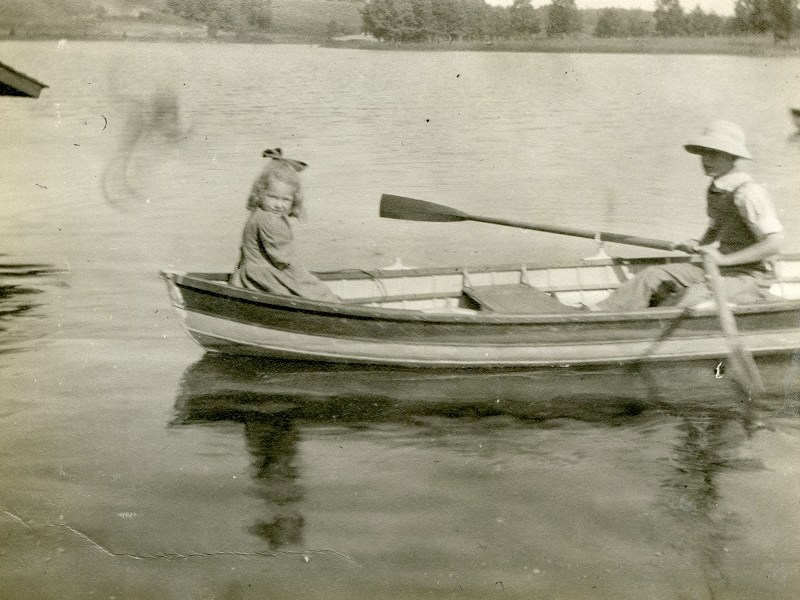
In 1908, George and Ellen Booth and their children, James, Grace, Warren, Harry, and Florence, moved from their home on Trumbull Avenue in Detroit to their new home Cranbrook, in the “wilds” of Bloomfield Township. At the time of the move, James was twenty, only two years away from marriage; Grace was eighteen; and Warren, fourteen, was already in boarding school. Youngest siblings Harry (eleven) and Florence (six) pretty much had the run of the grounds, exploring every nook and cranny (pun intended).
As the family explored and improved their country estate, they also took to naming significant features: every pond, hill, tree, and drive would be christened with its own name. Some names stuck (Angley Woods), others changed (Glassenbury Lake became Kingswood Lake), and others have been forgotten.
From the beginning of Cranbrook’s history in 1904, place names at Cranbrook have evolved and changed. Once the Booths turned the original mill pond into a lake,…
Read moreHarry and Florence were no exception; they had pet names for each other. Harry, known as Thistle, received his nickname during an illness. He did not shave for days, and someone said kissing his cheek was like kissing a thistle. We don’t have a record of the origin of Florence’s nickname, but friends and family called her Smike her whole life.

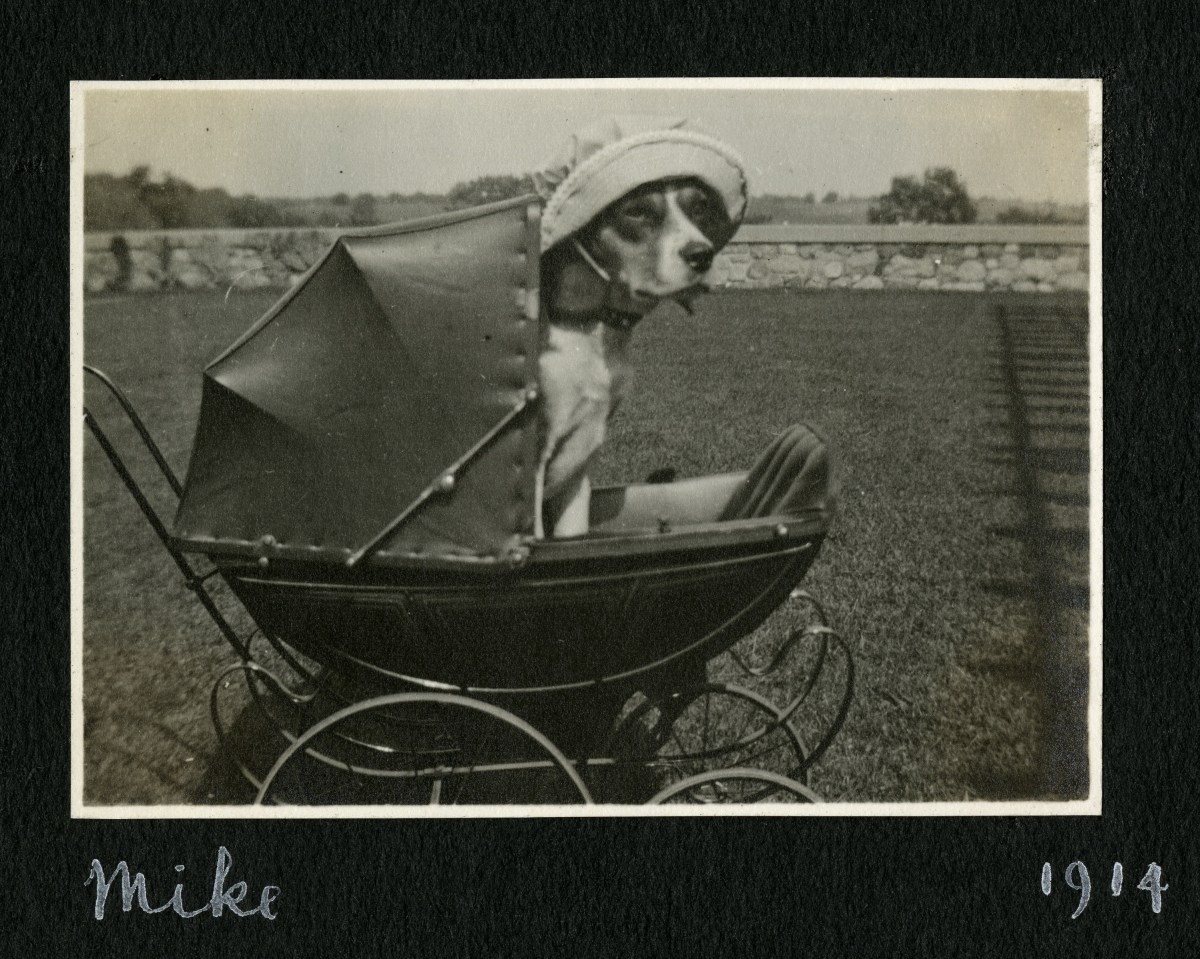
The Camperdown elms’ location below the West Terrace are also significant to Smike’s story. The Booths (especially Florence) loved animals. Family dogs Bud, Sandy, Spot, Prince, Larkspur, and Craig were well cared for and loved. The family beagle Mike was so beloved as to be made to wear a bonnet as he travelled around in a baby carriage!
The biggest canine event at Cranbrook came in 1914. As Harry Booth later wrote, “On June 20, 1914, the Booth family celebrated the 70th anniversary of the family’s landing on North America from England. After a picnic, everyone attended a dog show Florence Booth organized on the new West Terrace.”


So, when I look at the two Camperdown elms below the West Terrace–one slightly bigger than the other–I think of all the stories the grounds of Cranbrook hold, and of the happy days Thistle and Smike spent growing, adventuring, and imagining around campus.
Perhaps you’ll agree with my names for the trees, and next time you are strolling in the Meadow at Cranbrook House Gardens, just below the West Terrace, say hello to Thistle and Smike.
– Leslie Mio, Associate Registrar, Cranbrook Center for Collections and Research
Ed. note: Special thanks to Paul Nelson, one of the arborists for Cranbrook House and Gardens Auxiliary. He has been a champion for Thistle and Smike, making sure they are trimmed, watered, fertilized, and kept looking their best.
The dichotomy of reading is much like the daily work undertaken in the archives. Reading, like research, can feel private, almost sacrosanct, something to escape to; on the other hand, there is a great draw to share the stories and information one discovers, seek commentary and comparison, enlighten someone’s thought process. As archivists, it is our job to assist researchers on their paths to discovery. Often times this direction and assistance leads us to insights as well. In fact, I have yet to assist a researcher along their path of inquiry without further developing my own along the way.
This was very much the case last week while I was scouring our collections for autumnal ephemera to add color to our Facebook followers’ harvest season. In my seasonally focused search I was delighted to come across Cranbrook’s very own ghost story—Cranbrook Boasts a Ghost; or, The Skeptics Tale, by Henry Scripps Booth (Thistle, as he was commonly known). I was intrigued and excited — what a timely discovery, what with Halloween just around the corner! And while I was enticed by the mystery, and enjoyed reading the descriptions of the vaulted spaces of St. Dunstan’s chapel [editor’s note: St. Dunstan’s is at Christ Church Cranbrook] filled with apparitions (a place I was lucky enough to tour, and you can too!) The Skeptics Tale, more importantly, reiterated an intrinsic truth about Cranbrook – that it is a space imagined and created by many minds and hands.

Christ Church Cranbrook, from “Highlights of Detroit”. Cut by Eugene Reeber, Jefferson Intermediate School, 1932.
Throughout the tale, I gained a sense of workmanship and craft, two features indicative of most spaces on Cranbrook’s sprawling campus. The characters in the tale pined over the construction of the brilliant structure, venerating its beauty as a testament to their commitment to their craft. It is, however, only near the end of the short story where I began to feel (if not see) the intentions of individuals who worked throughout the years to craft Cranbrook into the sprawling idyllic landscape of natural and man-made elements we know today.
“He discovered familiar faces in that strange assembly—faces of men who had lived and worked at Cranbrook. There before him was Tony by the column which bears his name; Mike Vettraino; Henry Booth, the coppersmith; his distinguished-looking father with the sideburns who brought the craftsman’s tradition from the ancient Cranbrook to this continent. There in the fourth chair of the fifth row: Milles, famed for his sculpture; a row or two behind, Saarinen, famed for his buildings; and nearby, Kirk, the silversmith.”
Though only apparitions in The Skeptics Tale, these individuals’ real accomplishments and contributions to Cranbrook, along with those of countless other influential men, women, and students, can be discovered through our collections. In the spirit of the season, we invite you to journey into our crypt and discover some of their stories yourself.
– Belinda Krencicki, Associate Archivist
 Cranbrook Kitchen Sink