Cranbrook House was originally built by Albert Kahn in 1908, with additions in 1918 and 1920. Designed with an English Art and Crafts inspired motif, one of the most defining features of Cranbrook House is its clay tile roof and copper gutters, downspouts, and flashing. The color, texture, and decorative pieces all contribute to the beauty of a clay tile roofing system, but it’s also incredibly functional: the original roof lasted over 100 years.

Cranbrook House under construction, c. 1907. James Scripps Booth, photographer. Copyright Cranbrook Archives.
Roofing is typically called the “first line of defense” for a building. The roof takes the brunt of weather exposure and any falling trees, branches, or debris. Even with all of these factors working against the roof, a clay tile roof is expected to last 100 years! Yet over the course of their lifespan and after many years of exposure, the tiles become brittle and eventually break. Broken tiles decrease protection against weather and are at risk of falling from the building. The original tiles on the Cranbrook House roof had become weak and broken tiles were increasingly becoming an issue.
Further, the original underlayment materials (layers of weather and water proofing on top of the wooden roof deck but below the clay tiles) were failing. Issues with original underlayments are common in older buildings as historically, underlayments were made of felt coated in asphalt. Since the materials used were organic, they breakdown overtime and eventually disintegrate. It’s important to note that 100% waterproofing of a roof is achieved by the underlayments, not the clay tiles. The clay tiles deflect and shed a large amount of water, but it is normal for some moisture to accumulate beneath them. The underlayments must create a fully waterproof barrier, or else water will get onto the roof deck and leaks will appear in the building.
At Cranbrook House, the sheer size of the roof made it necessary for us to divide the project into a multi-year series of phases. Cranbrook completed the first roof replacement phase over the Library Wing from 2003 to 2004. The second phase, above the Oak Room and east wing, was completed in 2015 and Phase 3, the northeast wing, was completed in 2016. Phase 2A covered the north half of main house last summer and the final phase, the south (front) half of the main house is currently in progress. It will be completed this fall.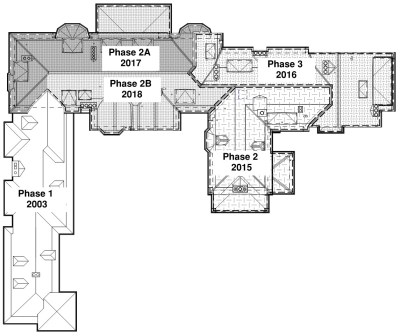
Clay tile can come in an endless variety of colors, shapes and sizes, and our replacement tile had to be carefully vetted in order to maintain a historically correct appearance. Cranbrook worked with Ludowici of New Lexington, Ohio, the same manufacturer who provided the original roof tiles. The manufacturer’s proper name for the tiles are Interlocking Combination Shingle Tile. In 1907, the Interlocking Combination Shingle Tile was a newer product for Ludowici (founded in 1888). With some help from Ludowici, we were able to find the first appearance of this specific tile in a catalog, the 1909 Sweet’s Indexed Catalogue of Building Construction:


While the Interlocking Combination Shingle Tile had long since been discontinued, Ludowici was able to recreate the same field tiles so that our restoration would be as accurate as possible. In addition, there were many specialty pieces that were made custom for the roof in 1908. These pieces had to be removed from Cranbrook House and sent to Ludowici so they could take molds and produce exact replicas. Ludowici produced all of our new tiles at the same time so that the color and finish would be consistent across the entire roof.
The Interlocking Combination Shingle system was designed to improve the way water is repelled, featuring a raised edge on the upper half of each tile.

Cranbrook House roofing tiles. Courtesy Cranbrook Capital Projects.
Each row of tile is offset so that any water that falls through the void between the tiles would flow onto the tile below. The raised edge funnels water downward so it doesn’t have a path to run onto the roof deck. Part of the project scope was to install two new synthetic underlayment products. The underlayment attached directly to the roof deck is the Grace Ice and Water Shield. Between the ice and water shield and the tile is a blue material called Deck Armor. This provides some weatherproofing but more importantly, it protects the ice and water shield from sharp edges on the clay tiles–if the ice and water shield gets punctured, the roof will leak.
Because of all the intricacies on a historic roof replacement project, it is very important to have an experienced team of architects, contractors, subcontractors, and suppliers working together for success. We have had a great team out here, so thank you to all who have been involved in the project over the years.
–Ryan Pfeifer, Project Manager II, Cranbrook Capital Projects




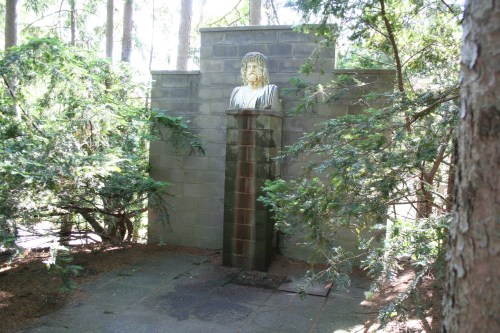 Weeping Zeus (or more formally Zeus of Otricoli [Roman copy of Greek original]) is a marble bust comprised of the shoulders, chest, and head of the Greek god, Zeus. The chest is carved to resemble draped cloth. The curly hair has a wreath in it, and the beard is curly with a full mustache. The bust is set on top of a concrete block column.
 Here at Cranbrook, it would seem the father of the Greek gods finds the peace of this Michigan mountain dull in comparison with the revelries of either Mt. Olympus or his later home in the Scottish Highlands. It is reported tears well up in his eyes and sometimes gush forth. The sculpture became a folly (and why we call him Weeping Zeus) after Henry had holes drilled through the eyes to allow water to flow (squirt, really) out.


 Cranbrook Kitchen Sink