When you take the time to look, the windows of Cranbrook House are surprisingly varied. Some are leaded casement windows straight out of an Elizabethan manor house, others are modern sash windows, fitted with plate glass. A few rooms in the house enjoy a special distinction – their windows are fitted with inset panels of stained glass.
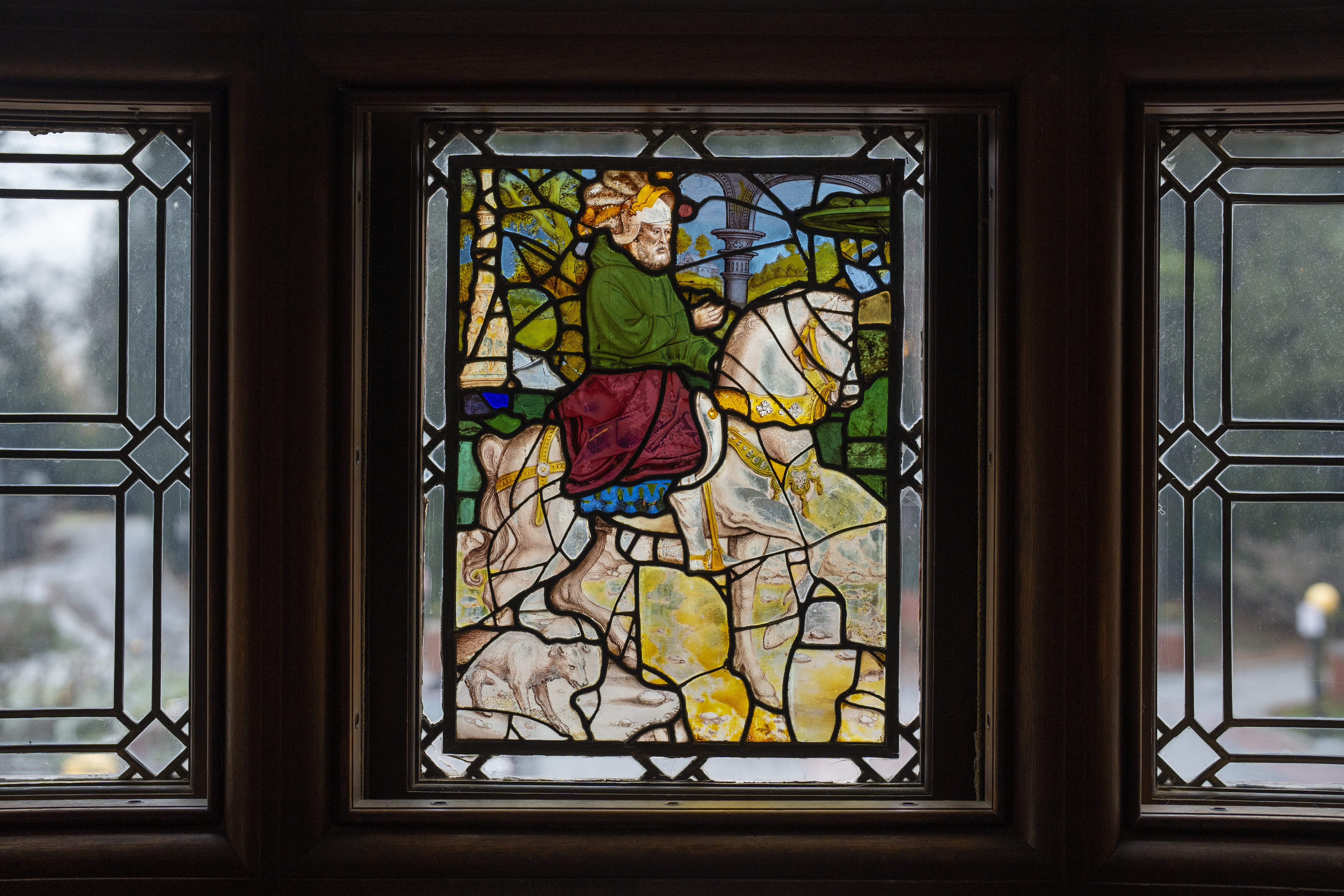
These stained-glass panels were a later addition to Cranbrook House. When first completed in 1908, the windows were all clear glass. It was only while pondering extending the house, in the latter half of the 1910s, that George Booth began purchasing stained-glass panels for his home. The most prominent stained-glass work in Cranbrook House is the 16th-century Flemish panel, depicting a man on horseback, placed in the main window over the staircase in the Reception Hall.
It was not part of the original design for the window, but added in 1922. That panel, and several others scattered throughout the house, were purchased from Thomas & Drake, an English firm specializing in historic glass.

Others, like the heraldic roundel in the library’s east window, were purchased by the Booths in Lucerne, Switzerland. There was some debate as to their final destination. George Booth wrote, in a letter to his son Henry, in March 1922:
They do not make an imposing collection but I think they are good and that everyone will like them – I did think I would let the [Detroit] museum [of Art] buy them at cost if they wished to begin to accumulate some historical glass, but your mother and Florence say no – they are to be put into the windows at Cranbrook but we will see.
(George Gough Booth to Henry Scripps Booth, 26 March 1922. Cranbrook Archives, George Gough Booth Papers.)
In the event, Ellen and Florence won out, and at least a few of the Swiss purchases made their way into the windows of Cranbrook House.
Most of the stained glass in the house is concentrated in the new west wing, built and outfitted between 1917 and 1920. Six of the stained glass panels in the west wing came from W. & J. Sloane, the prestigious American decorating firm which also supplied much of the furniture in the house.
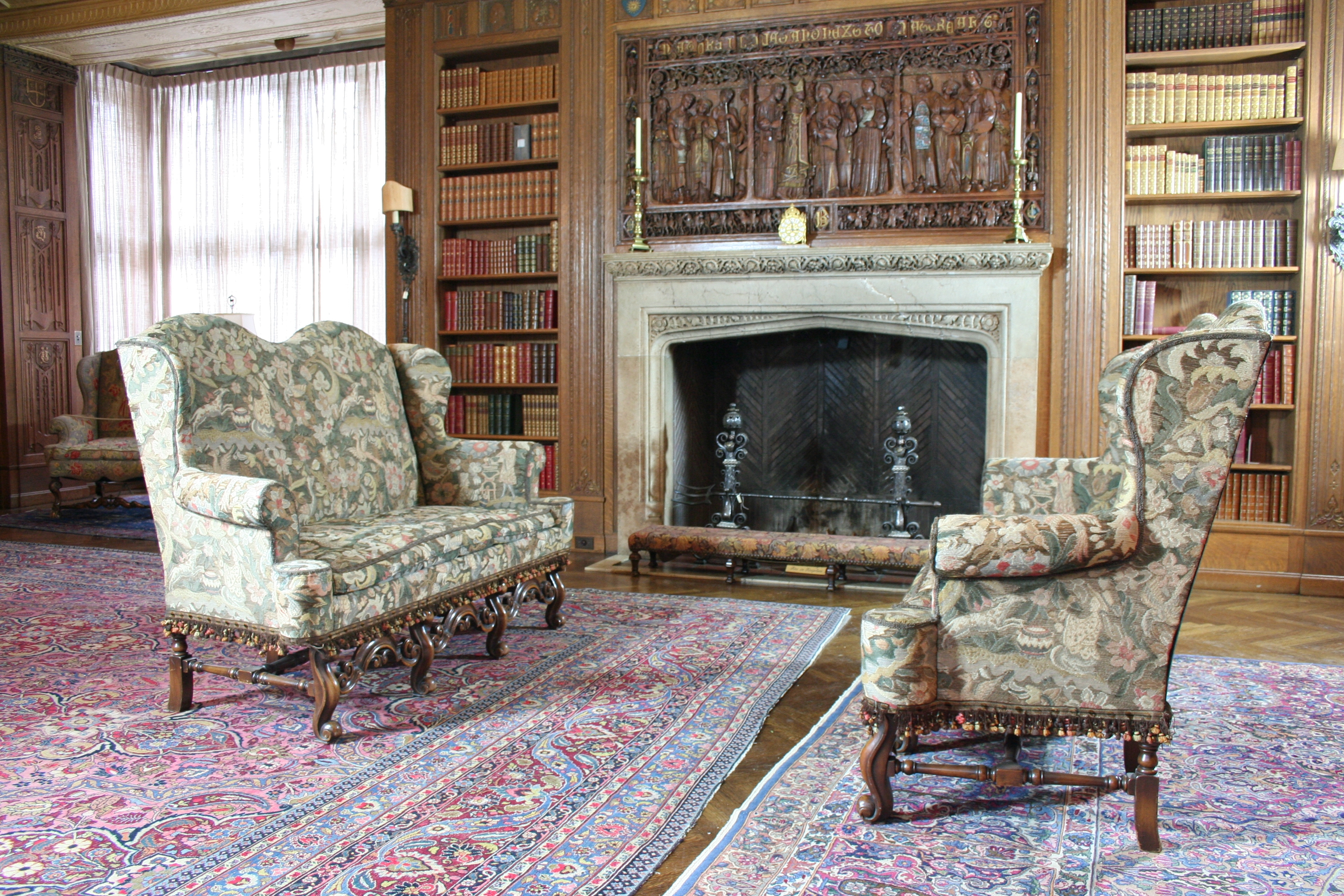
Founded in New York in 1843 by the Scottish immigrant William Sloane, and renamed W. & J. Sloane when his younger brother John joined the firm in 1852, the company quickly rose to prominence as a supplier of luxury home goods, especially Oriental rugs, European tapestries, and fine furniture. After branching out into manufacturing and design work, W. & J. Sloane produced a wide range of furnishings that mimicked historical styles. These met a growing demand for sophisticated decorative schemes reflecting the conventions of past eras of European design. Late 19th-century America’s wealthiest families sought to legitimize their social status by emulating the lifestyles of aristocratic Europeans, building elaborate chateaux which they filled with a mix of genuine and imitation antique furnishings, drapes, and stained glass.
George and Ellen Booth behaved similarly in the building and furnishing of Cranbrook House, though they were motivated not only by the cultural insecurities of turn-of-the-century America but also by a genuine passion for the work of American craftsmen and artists, and an interest in old English architecture and design. As collectors, they discriminated primarily on the basis of quality, rather than antiquity or authenticity. A modern work that exhibited skill, care and individuality was of more value to them than a historical work from a famous maker of a previous century. All of which helps to explain the Booths’ purchase, between 1916 and 1920, of six panels of stained glass from W. & J. Sloane that are not nearly as old as they appear.


In 1916, George Booth purchased a set of two glass panels from W. & J. Sloane, each depicting a tall ship sailing on the ocean. Though just over a foot in height, the panels are replete with detail. Sails, shrouds, rigging, and even the sailors themselves are all meticulously delineated in minute strokes of enamel paint. Each panel is ringed in a painted frame of decorative strapwork. Unlike medieval stained glass, which usually employed multiple pieces of differently colored glass, as well as paint, to form its pictures, these panels each consist of a single pane of clear or “white” glass, painted with a combination of enamel paint and silver stain, which turns yellow when fired.
They appear to have been painted in the late fifteenth or sixteenth centuries, but appearances are deceiving.
In 1919, though the first two panels had not yet been installed in the library, George Booth wrote to W. & J. Sloane to ask if they had any additional stained glass panels of the same kind in stock. That letter has been lost, but something about his request prompted a somewhat anxious reply from Wilson Hungate, the director of the decorating department:
I fear that you may have the wrong impression regarding the panels which were sold you. These were not genuine antiques but excellent fac-similes made by the most clever counterfeiter of antique glass in Europe. I could have more made for you of the same general character, effect of design and color to sizes stipulated by you…
Wilson Hungate to George Gough Booth, 29 September 1919. Cranbrook Archives
Mr. Hungate was needlessly worried – either George Booth was already aware of the true nature of the panels he had purchased or was unbothered by the news that they were not antiquities. That December, after being offered a range of examples, he ordered four more facsimile panels. Three were installed in his new office suite, while the fourth was inserted in the door leading from the Sunset Porch to the staircase that led directly to Ellen Booth’s bedroom.
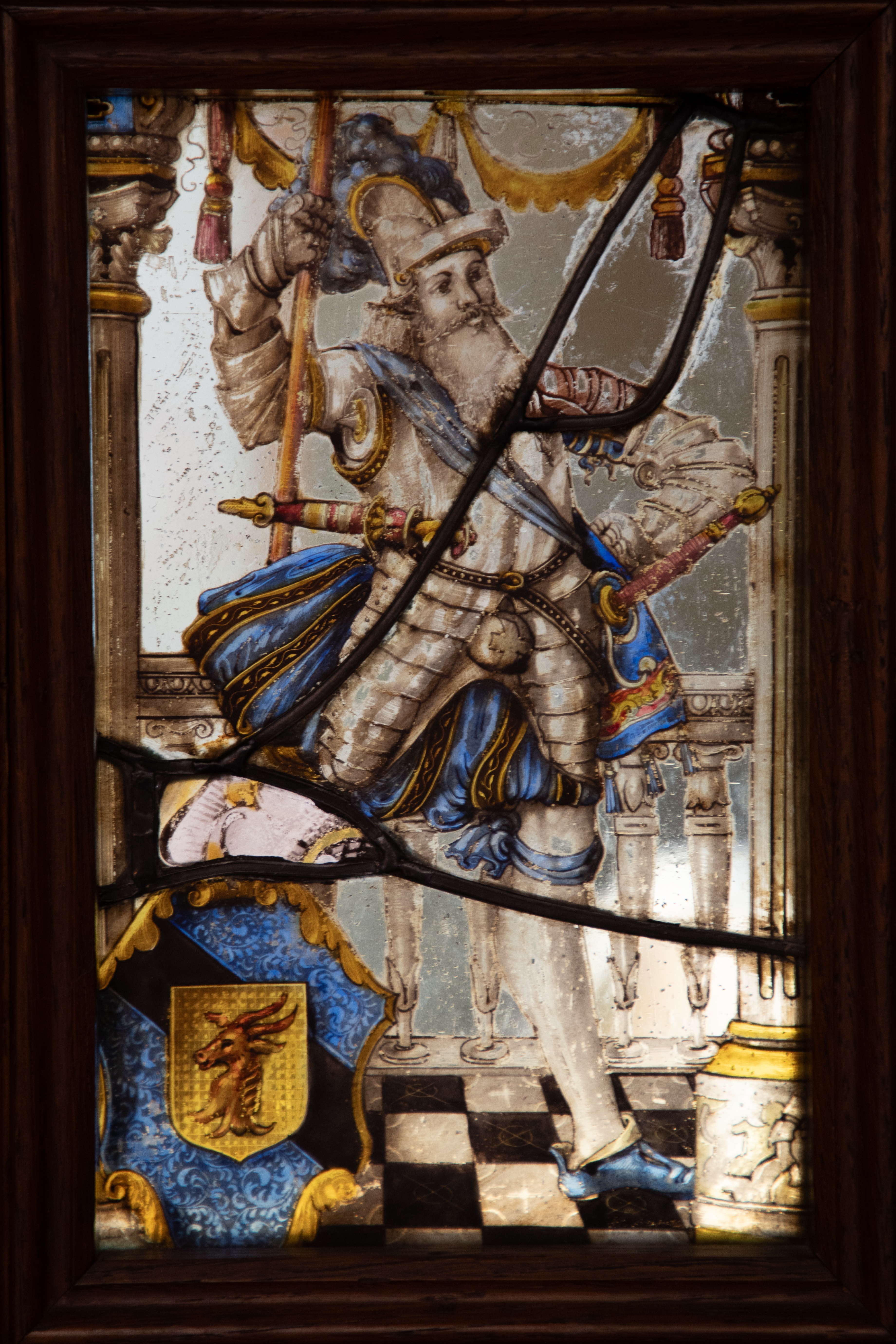
It is unfortunate that we do not know the name of the “clever counterfeiter” who made the panels, as each is a marvelous example of glass painting in an antique style. In addition, deliberate breaks repaired with lead cames, and stopgaps, pieces of colored glass inserted in a panel to fill holes left by past damage, enhance their appearance of antiquity, without obscuring their content.
The small roundel in the Sunset Porch depicts an undecipherable allegorical subject. Numerous symbolic elements – an enthroned queen, a tower struck by lightning, tragedy and comedy masks, and a crescent moon – are ringed by a Latin inscription, a somewhat garbled rendition of a passage from the Bible: “Ah, Lord God! surely thou hast greatly deceived this people and Jerusalem, saying: Ye shall have peace; whereas the sword reacheth unto the soul” (Jeremiah 4:10).

A slightly larger roundel, in the courtyard-facing window of George Booth’s new office, also includes two Latin tags, which are conventionally translated as “they can because they think they can,” and “esteem is the reward of virtue.” The two exhortations to effort and excellence frame a heroic image of knight in 15th century armor, charging into battle.
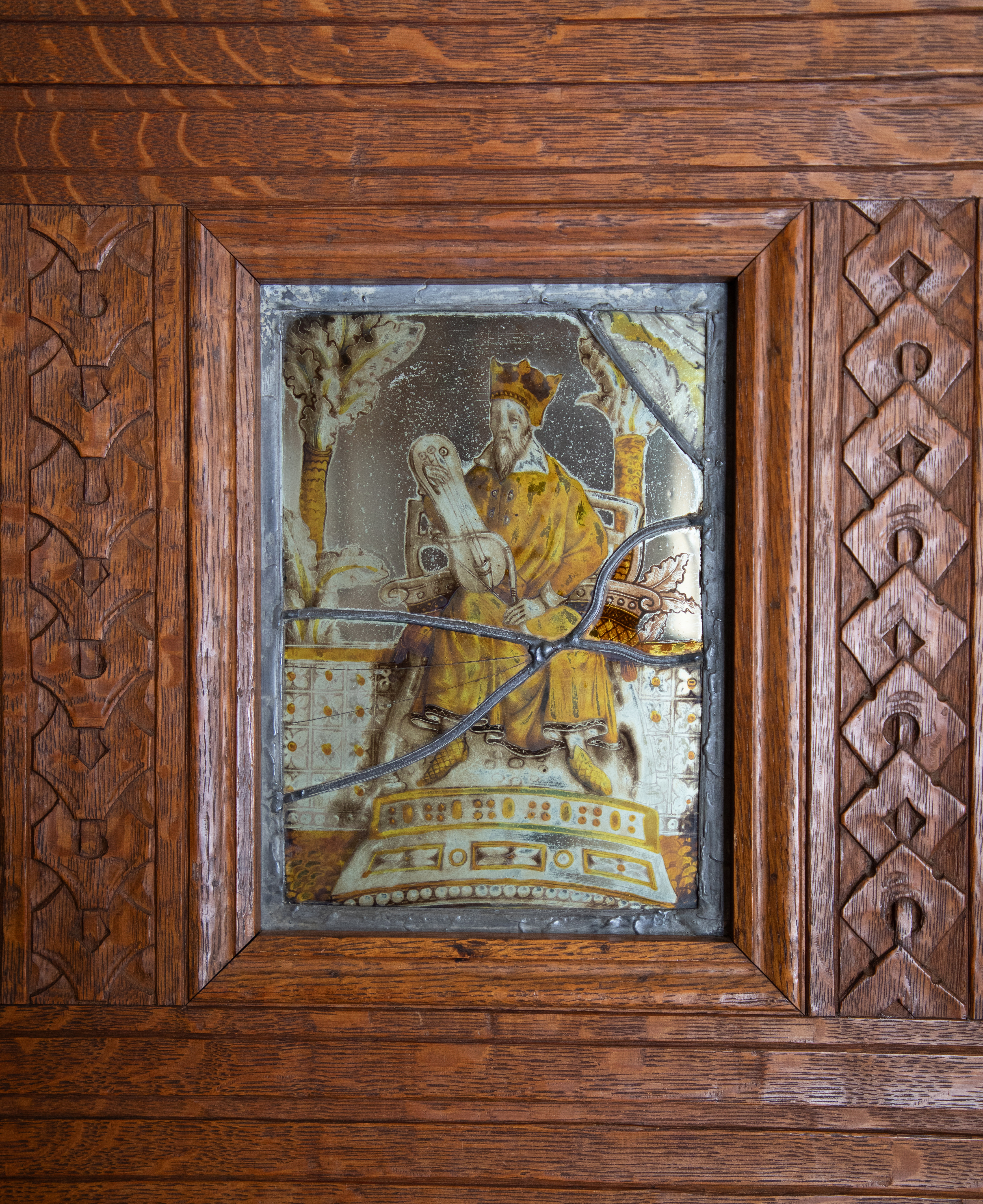
The other two facsimile panels were set into the doors connecting George Booth’s office to the library and his architectural drafting room. One, a small rectangular panel painted in silver stain and brown paint, depicts a king on a throne, playing a harp. It is probably intended to depict the Biblical King David, a harpist traditionally identified as the author of many of the Psalms. Though a religious subject, such an image might have been found in many contexts, were it as old as it appears. Though the majority of medieval stained glass works were created for churches and cathedrals, some secular public buildings and even private homes also contained stained glass windows.
In fact, the final panel in the group is based on a genre of stained glass that was made in Switzerland, specifically for installation in public or domestic spaces. These were “welcome panels,” strictly conventional portraits of a husband and wife, often commissioned to commemorate milestones in a family’s life. Several genuine welcome panels, part of the set purchased in Switzerland, are scattered throughout the house. The imitation produced by W. & J. Sloane’s artist reproduces only half of the usual composition, showing a man in armor accompanied by his coat of arms.
Cranbrook House is an amalgamation of many different types and eras of design. The house itself was inspired equally by medieval English manor homes and Arts and Crafts country houses, while its interior furnishings are a jumble of antiques, modern manufactured objects, and the unique products of fine craftsmen and artists. In the library, a four hundred year-old heraldic panel sits in one casement, while on either side shimmer medievalesque roundels by the 20th-century glass artist George Owen Bonawit. In a context shaped by both modern ideals and the reverberations of past centuries of design, a half-dozen facsimiles of medieval stained glass seem right at home.
—Mariam Hale, 2023-2025 Collections Fellow, Cranbrook Center for Collections and Research
Discover more from Cranbrook Kitchen Sink
Subscribe to get the latest posts sent to your email.
 Cranbrook Kitchen Sink
Miriam, it has been a long time since I read previous reports on many of the stained glass panels at Cranbrook House. This is a great report that is easy to read, something I can refer to and something that I will share with others.
Thank you, Randy
LikeLike
Thank you! It is always a pleasure to share some new research about the house, and I am glad to know it will be useful in future. – Mariam
LikeLike