The Horizons-Upward Bound program celebrated its 30th anniversary with the theme, “Inheriting the Legacy” during the 1994–1995 academic year. Like other anniversaries I’ve viewed during the HUB digitization project, HUB’s 30th year involved informal and formal events like banquets, cocktail receptions, and picnics.
Thirty years later, HUB has expanded this legacy—celebrating 60 years with micro events to incorporate “aspects of storytelling, history, fun, and fellowship” throughout the year. As HUB enters its 60th year, I thought it would be fun to look back at the ’90s and share a few images from HUB’s 30th anniversary.
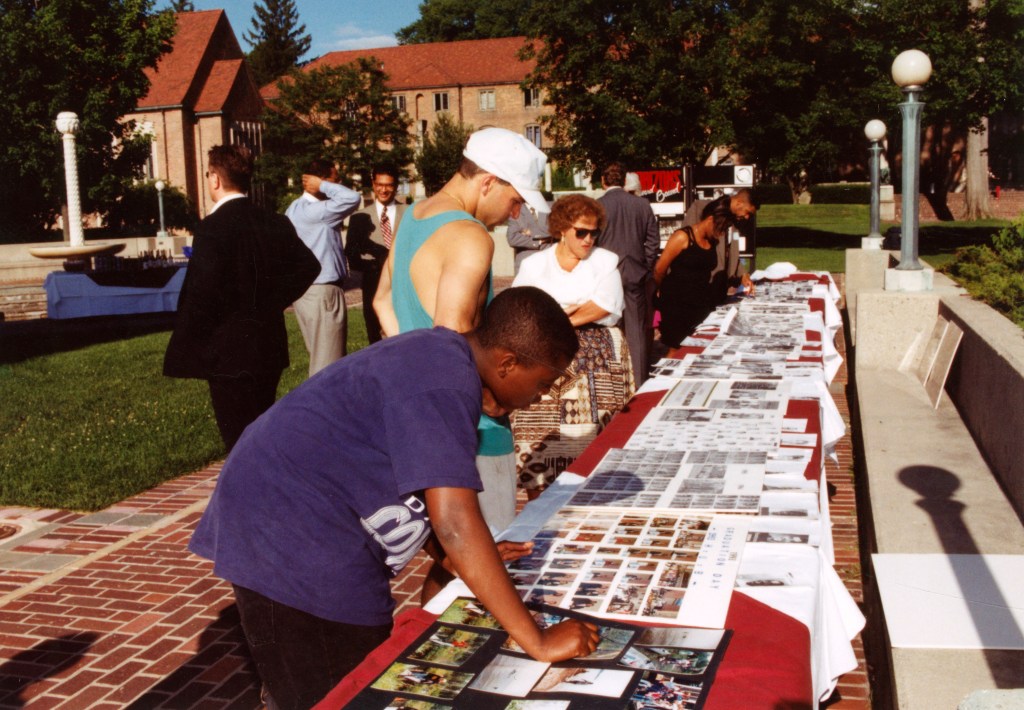
Members from the HUB community review photographs of the program on the Quad during HUB’s 30th anniversary celebration, August 1994. Courtesy of Cranbrook Archives.
Alumni, students, staff, and donors with family and friends exchanged memories and ideas about the HUB program. They listened to various speakers, enjoyed food with live music, and sorted through pictorial displays.
Jenny Hutchinson (HUB ’90) welcomes visitors during HUB’s 30th anniversary, including Hassan Miah (HUB ’73) on right, August 1994. Courtesy of Cranbrook Archives.
HUB alumni are honored during HUB’s 30th anniversary banquet, August 6, 1994. Courtesy of Cranbrook Archives.
HUB’s alumni have historically contributed to the program, especially during anniversary events when members serve as speakers, sponsors, greeters, recruiters, and other roles to foster community relationships and growth of the program.
Student saxophone ensemble provides music for guests on the Quad during HUB’s 30th anniversary, August 1994. Courtesy of Cranbrook Archives.
Join us as we continue to celebrate HUB’s sixtieth anniversary this year, and remember to check back each month to our virtual photo exhibition of HUB’s history, Sixty Years of Horizons-Upward Bound, 1965-2025!
—Courtney Richardson, Project Archivist, Cranbrook Center for Collections and Research
HUB digitization is funded by a NHPRC Archival Projects Grant for projects that ensure online public discovery and use of historical records collections. The NHPRC was established by Congress in 1934 as a statutory body affiliated with the National Archives and Records Administration and chaired by the Archivist of the United States.
Do you love sharing great stories? Are you the person who says “Did you know…?” at parties? When you discover something wonderful, do you instantly need to share it with friends? Do you love art, architecture, and design, and, have you ever mused to yourself, “‘Life without beauty is only half lived,’ and I want to be fully living!“?
Collections Interpreter Diane VanderBeke Mager welcoming guests to the Center’s gala fundraiser, A House Party at Cranbrook Celebrating Loja Saarinen, May 2022. Collections Interpreters are storytellers, teachers, hosts, and style icons! Photography by PD Rearick.
If you answered “yes!” to any of the above, the Cranbrook Center for Collections and Research has a place for you on our Collections Interpreter team! As tourism to Detroit grows—and with Cranbrook recently earning a three-star Michelin Guide rating—we are looking for more great storytellers to help us share the magic of Cranbrook’s art, architecture, and design. Read on to learn more, or go ahead and sign up for a Collections Interpreter information session with me (curator Kevin Adkisson) here!
Kevin Adkisson, then the Center Collections Fellow, learning the joy of teaching during a Summer Camp tour of Saarinen House, June 2017. Photography by Cranbrook Art Museum.
Each year from May to November, Collections Interpreters (CIs) lead public and private tours through Cranbrook’s architectural gems. Regularly scheduled public tours focus on two of our historic houses.
First is Saarinen House, the jewel-box Art Deco home of architect Eliel Saarinen and textile designer Loja Saarinen, filled with furniture, fabrics, and works of art made at Cranbrook to the Saarinen family’s own design. As you walk with visitors past the dancing fountains and verdant grounds, tours of Saarinen House also touch on the history of Cranbrook Academy of Art.
Just a short drive away, CI’s lead tours of the Frank Lloyd Wright-designed Smith House, a 1950 Usonian treasure tucked into the neighborhood. Built for two Detroit public school teachers, it is a masterpiece of modesty—proving that great architecture is not just for the wealthy. Tours talk about Wright’s architecture and its quirks, share the story of how the Smiths’ manifested their remarkable dream, and highlight objects of your choosing from the inspiring (and vast) collection of midcentury studio craft.
Collections Interpreter Lynette Mayman shares one of many tumultuous tales around cooking and dining with Sara Smith, October 2017. Photography by Kevin Adkisson.
Collections Interpreters also lead monthly Japanese Garden Tours, helping guests explore one of North America’s oldest Japanese-style gardens, and the Three Visions of Home Tour. A fascinating look at three famed architects ways of shaping home, this tour connects Cranbrook’s founders’ Albert Kahn-designed home, Saarinen House, and Smith House. The CI’s also help guide and share stories during other Center Behind-the-Scenes Tours or special events.
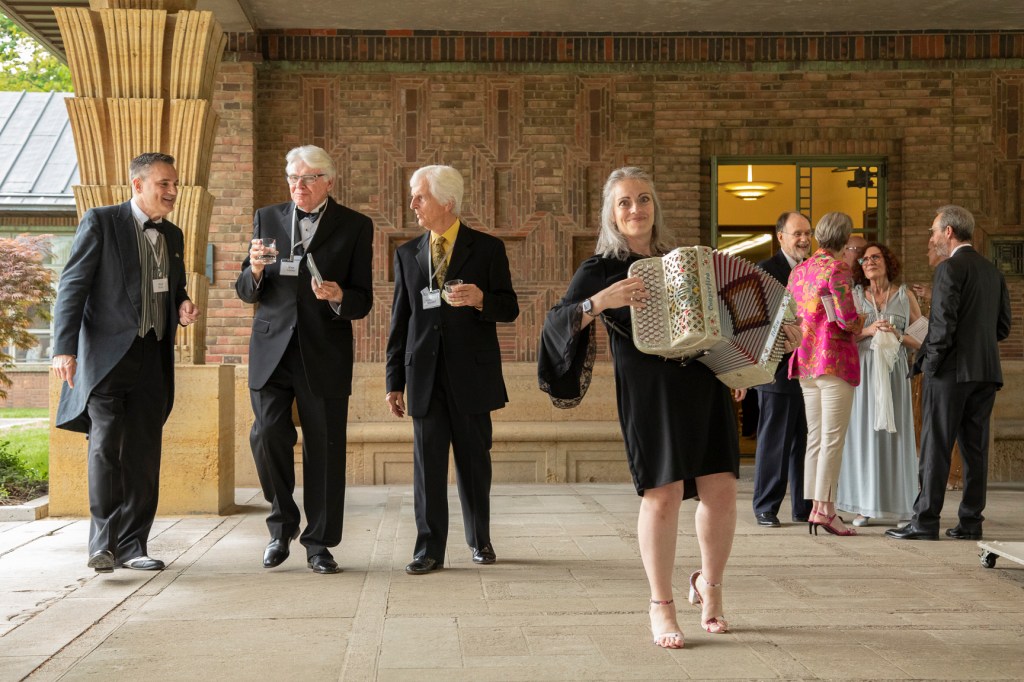
At A House Party Celebrating Loja Saarinen, Collections Interpreter Matt Horn shares stories of weaving at Kingswood School with Ken Gross and Academy Director Emeritus Gerhardt Knodel, while being serenaded from the accordion of Brookside music teacher Rosalia Schultz, May 2022. Photography by PD Rearick.
CIs may also help lead tours for Cranbrook Schools classes; Academy of Art students, artists-in-residence, and visiting artists; Horizons-Upward Bound scholars; and student groups of all ages and interests.
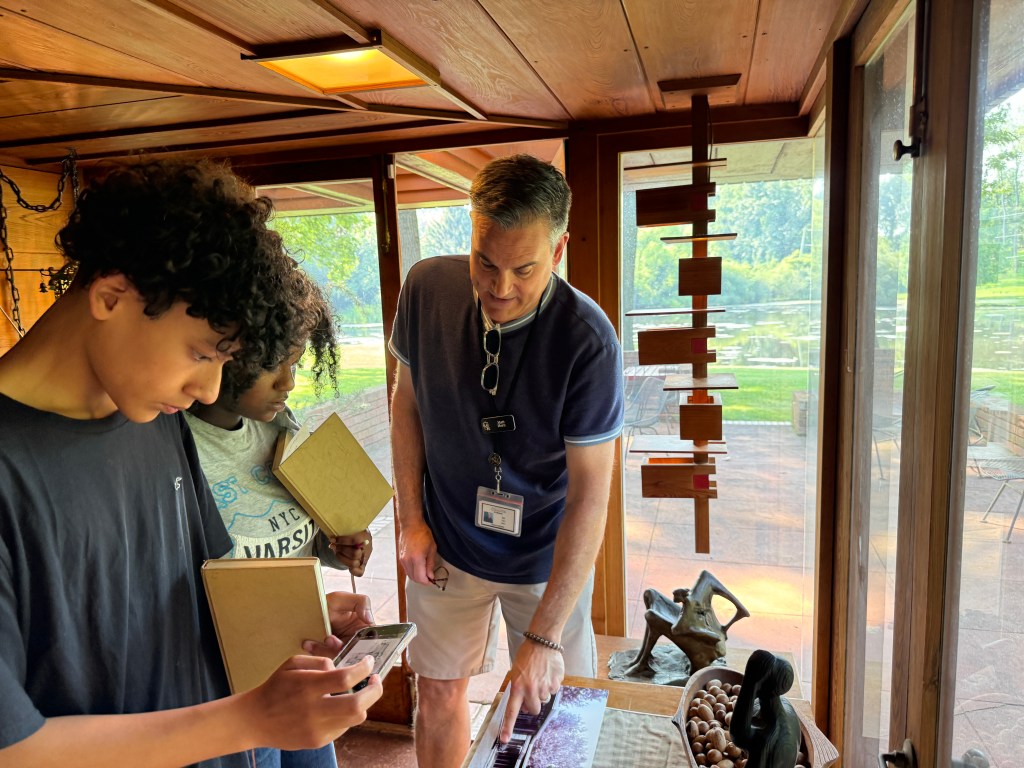
Matt Horn taught elementary music before retiring and joining the Center as a Collections Interpreter. Here, he teaches our summer Horizons-Upward Bound architecture elective in Smith House, July 2024. Photography by Kevin Adkisson.
You might be wondering: who comes to Cranbrook? People from Birmingham, Baltimore, Bangkok—and just about everywhere in between. As a Collections Interpreter, you help to welcome them all. It’s easy when your setting is Cranbrook, a place The New York Times Magazine famously called “the most enchanted and enchanting setting in America.”
No two tours—and no two visitors—are ever the same. It’s exciting!
What would you want for your 75th birthday? If you were painter Robert Hopkin, it would be an artists’ club named in your honor. The Hopkin Club, formed in 1907, had no rules, officers, or dues. The members wanted to get together occasionally, to talk about art or host artists visiting Detroit. Hopkin passed away in 1909, but the club continued. In 1913, The Hopkin Club established by-laws and was renamed the Scarab Club–the name it continues under today.
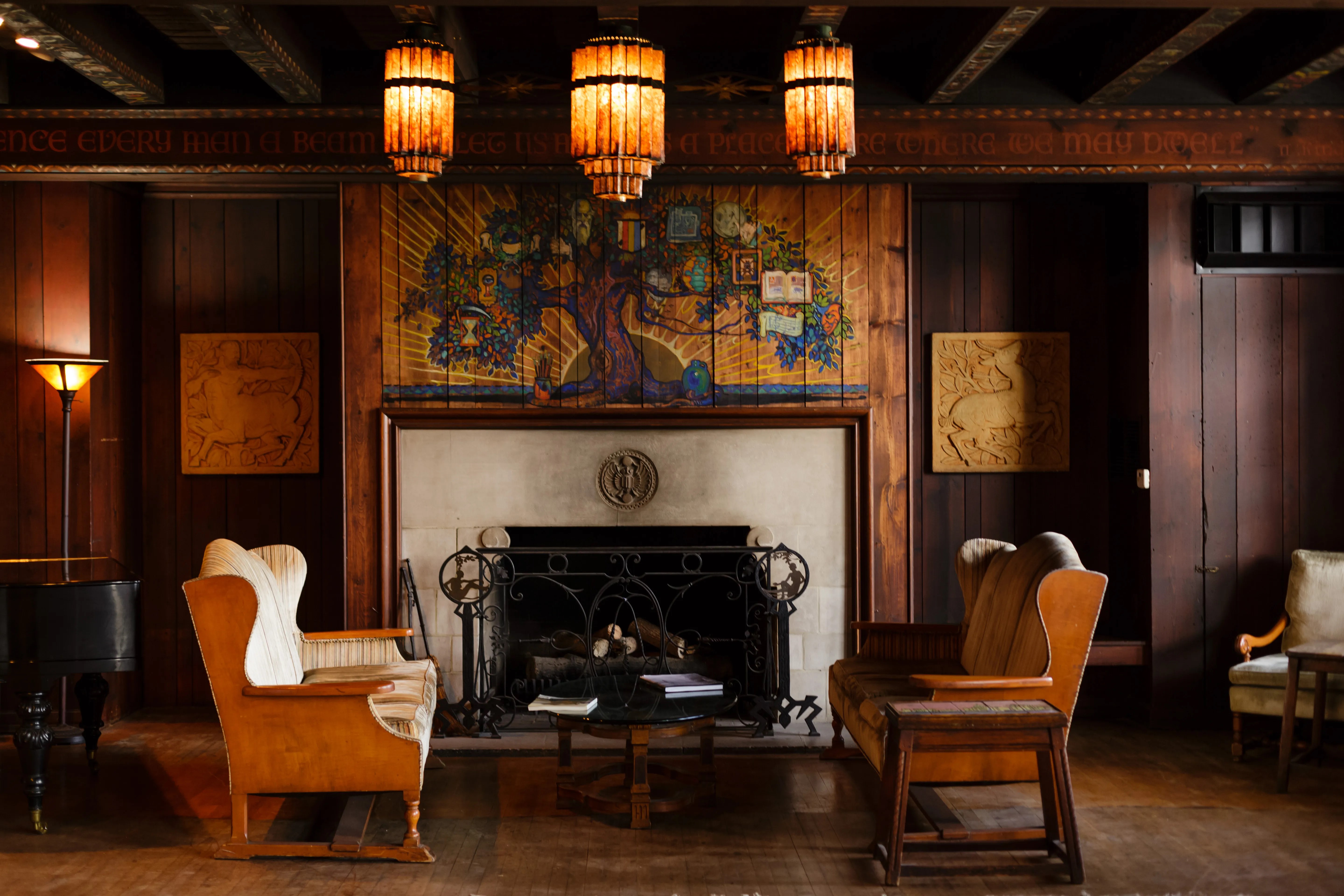
Scarab Club Room. Photography courtesy of Scarab Club.
But who was the man the club was originally named after?
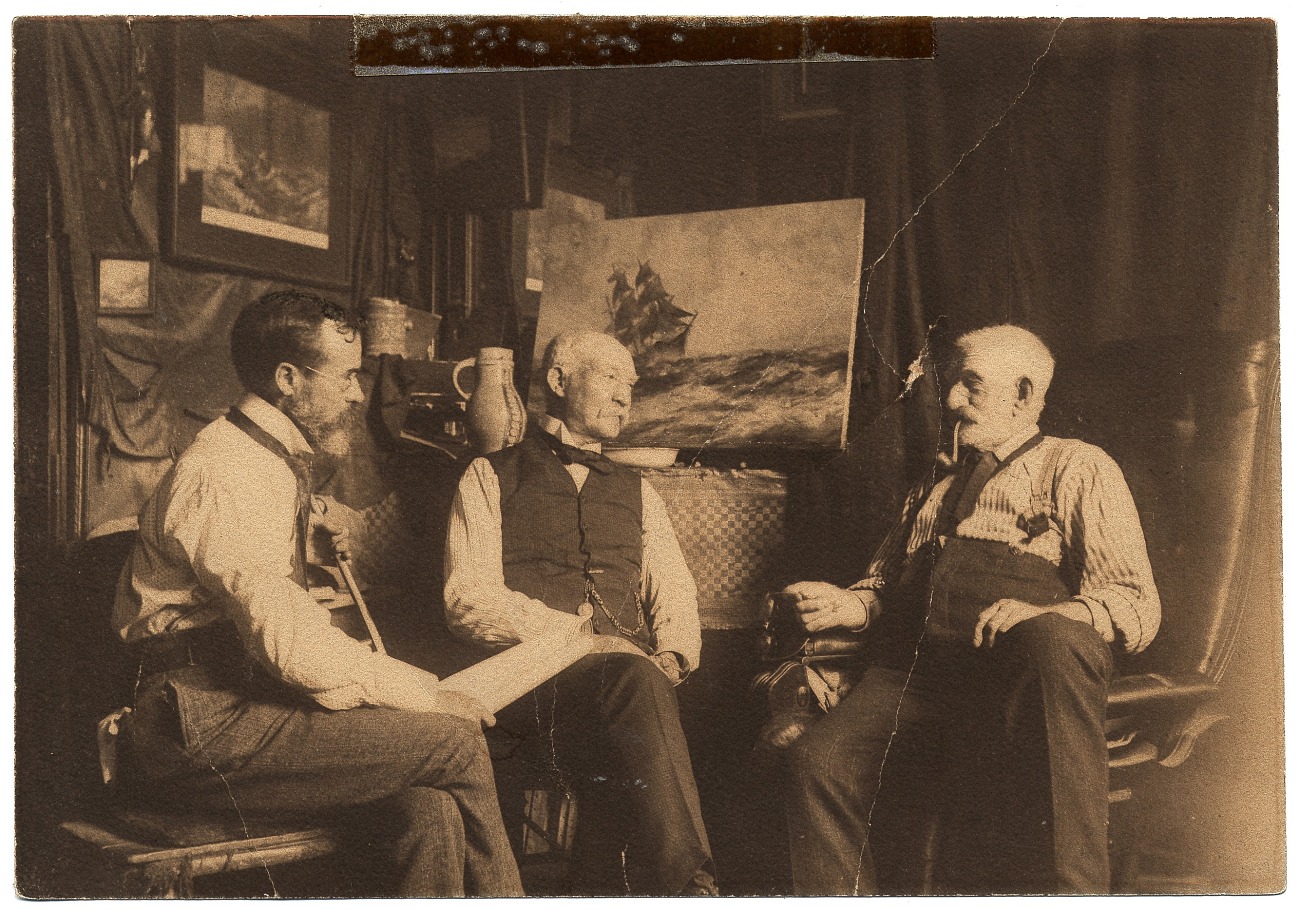
Robert Hopkin was a maritime/marine artist born in Glasgow, Scotland, in 1832. He learned to paint and draw from his father. The family emigrated to Detroit in 1842. His grandfather was a sea captain which drew Hopkin to work on the wharves in Detroit and inspired his art. Though chiefly known as a painter of marine scenes and seascapes, Hopkin made frequent trips throughout the American west from 1860 to 1885, painting murals for public buildings and drop curtains and scenery for theaters, including the Tabor Grand Opera House in Denver.
Robert Hopkin (right) and others in studio, ca. 1900. William H. Thomson papers, 1912-1950. Archives of American Art, Smithsonian Institution
In the latter half of the 19th century, Hopkins was considered the dean of Detroit artists; he decorated the interior (as well as the stage curtain) for the original Detroit Opera House (1868), painted murals in Detroit’s Fort Street Presbyterian and Ste. Anne’s churches, as well as the Cotton Exchange in New Orleans (1883). By April 1900, the Detroit Free Press wrote, “Many of the art lovers of this city possess one or more of [Hopkin’s] splendid marines, and they have been reproduced and published until everyone is familiar with his work.”
When Mr. Robert Hopkin’s Collection of Paintings opened at the Detroit Museum of Art in May 1901, “There was a large attendance of art-loving Detroiters” (Detroit Free Press, May 16, 1901).
Robert Hopkin (Scottish American, 1832 – 1909), Marine,Oil on Canvas. Cranbrook Center for Collections and Research.
George and Ellen Booth were no exception. Art lovers with many Detroit-based and self-taught artists in their growing collection, the first inventory of Cranbrook House in 1914 lists two Hopkin “Marine” paintings. The Booths gifted the larger of the two paintings to their daughter Grace Ellen Booth and her husband Harold L. Wallace. The painting returned to Cranbrook House about 1955, when Grace Booth Wallace’s collection was donated to the Cranbrook Foundation.
Cranbrook House Living Room, circa 1909, with Marine visible on the left. Cranbrook Archives, Cranbrook Center for Collections and Research.
The Detroit Historical Society has a copy of the Souvenir Catalogue of Mr. Robert Hopkin’s Collection of Paintings in its collection. The 85 exhibited paintings are listed, with several black and white images of them. “Price List” is written on the cover, and notes have been made indicating which have been sold and who purchased them. (Sadly, the name “Booth” does not appear.)
Another art-loving Detroiter was Merton E. Farr president of the American Shipbuilding Company and owner of a number of freighters on the Great Lakes. His daughter, Carolyn, married George and Ellen Booth’s youngest son, Henry.
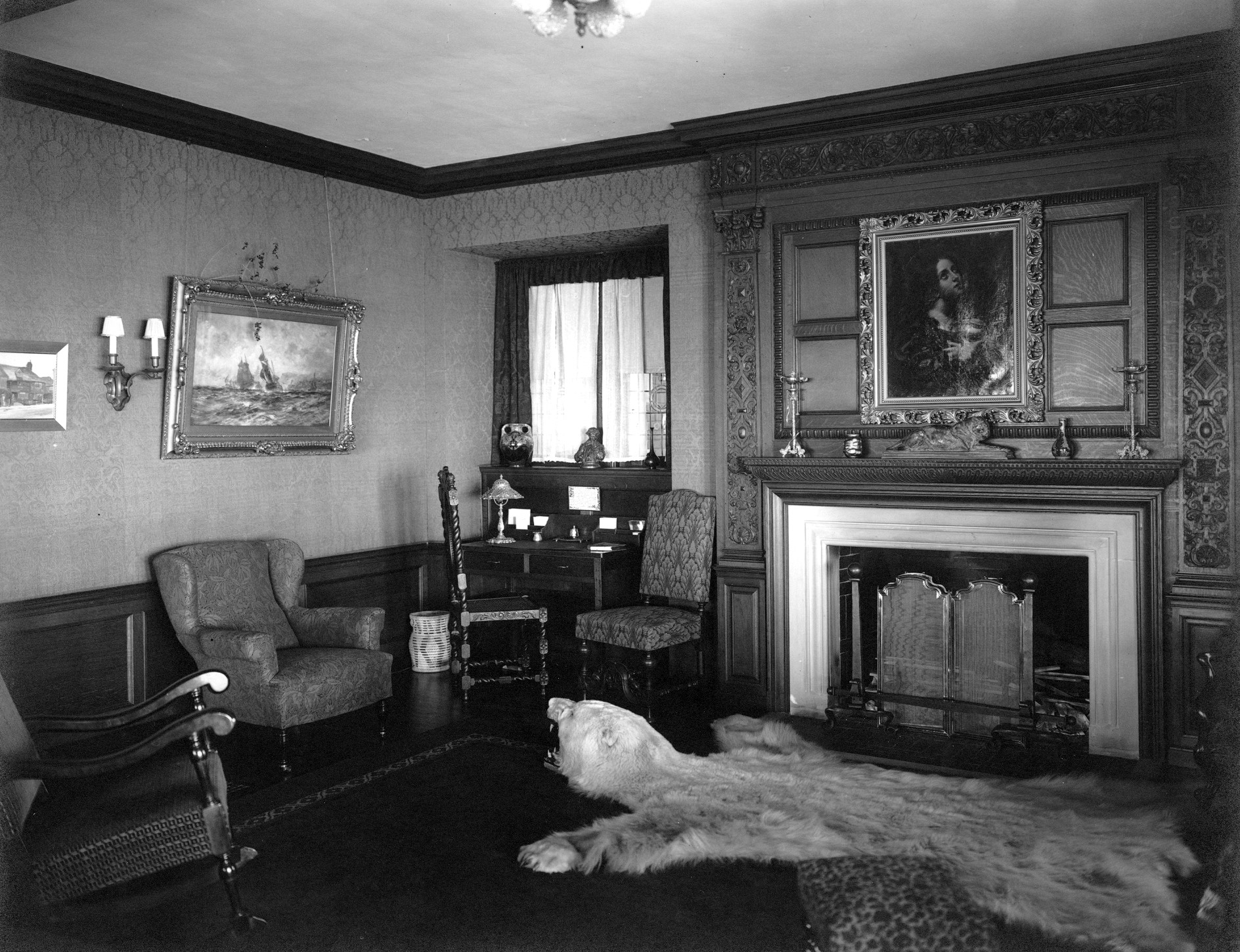
The Hopkin painting in the Thornlea collection. Cranbrook Center for Collections and Research.
In 1927, Farr gifted the couple a Hopkin “Marine.” The painting hung in Thornlea, home to Harry and Carol Booth, from 1927.
The painting’s official title is not noted. The Thornlea painting is interchangeably referred to as Homeward Bound, Schooner on a Stormy Sea, Sailing Ship at Sea, and Marine. However, the 1901 Hopkin exhibition catalog does not list any paintings with those titles.
– Leslie Mio, Associate Registrar, Cranbrook Center for Collections and Research




 Cranbrook Kitchen Sink