The Ramp of the Chinese Dog

For George Gough Booth, the vista from Cranbrook House to the Ramp of the Chinese Dog was a crucial one – he could see the Cranbrook Art Museum from his west wing office at Cranbrook House and the Chinese Dog guarding the entrance.

Though Cranbrook’s sculpture is commonly referred to as the “Chinese Dog”, the sculpture is actually a stone lion. In October 1940, George Booth purchased the lion from S. & G. Gump Co. in San Francisco and it is considered to be from the Wei Dynasty (386-557). A buyer for Gumps had acquired it in Beijing, China in 1938 where he was told that the lion came from the “Ta Fo Tze Temple in Chien Ting Fu Prefecture in Hopei.” Hebei (Hopei) Province is known for its stone and iron lions, and lion sculptures similar to the one at Cranbrook are still located at the entrance to the Ta Fo Tze Temple, now known as the Longxing Temple.

lion096

“Sacred Lion-Dog,” S. & G. Gump Co.’s showroom, San Francisco, ca 1940. Courtesy Cranbrook Art Museum.

During the Ming Dynasty, sacred guardian lions were placed in front of palaces, government buildings and temples as a symbol of bravery, power and good luck. In Western countries, the lions are often referred to as “Fu Dogs” as the word “fu” means Buddha or prosperity. George Booth placed another pair of Chinese stone lions at Cranbrook House, as well as several other stone lion sculptures around the grounds. In addition, he purchased two terracotta lions for the quadrangle at Cranbrook School, and numerous other objects with representations of lions in them including stained glass medallions, stone panels, and a gilt bronze lion sculpture by Carl Milles. As I write this, I am thinking that it would be an interesting project to research just what Booth’s interest or fascination (obsession?) with lions truly was.

CR4066

One of two terracotta lions at Cranbrook School. Filmmaker Brad Mitzelfeld behind the camera, 1970. Harvey Croze, photographer. Courtesy Cranbrook Archives.

Leslie S. Edwards, Head Archivist

Photo Friday: Viva Mexico!

With Cinco de Mayo quickly approaching, we are thinking about Mexico. George and Ellen Booth visited Mexico for two months in 1939. The image below was taken by their travel companion, Nellie Beveridge. The Booths traveled by rail and visited Chichen-Itza,Vera Cruz, Merida, and the ruins of Uxmal.

Temple of Quetzalcoatl

Temple of Quetzalcoatl, 1939. George Gough Booth Papers, Cranbrook Archives.

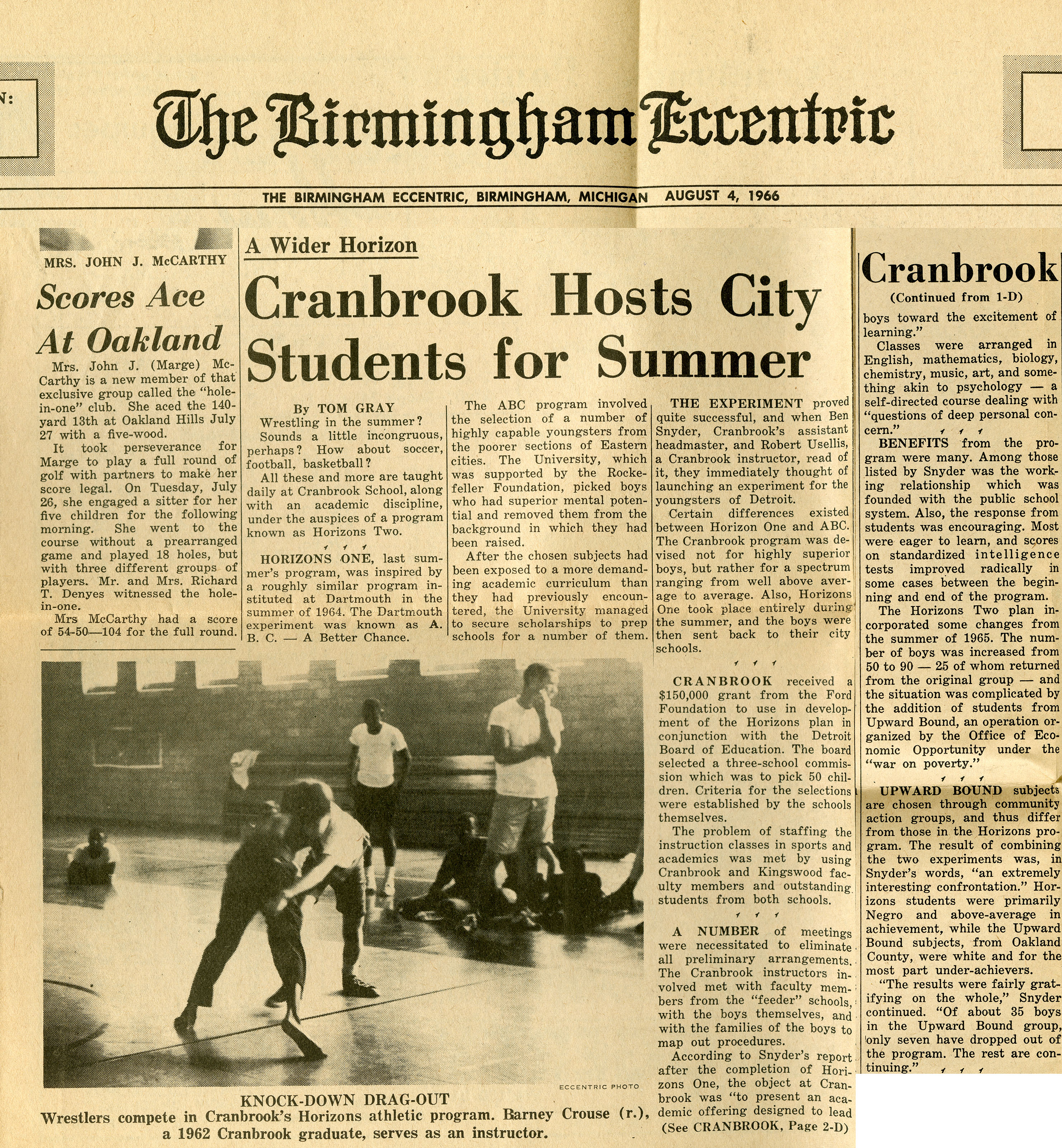
The Golden Anniversary of Horizons-Upward Bound at Cranbrook

The Archives new exhibition, “50 Years Strong: The Evolution of HUB at Cranbrook,” opens this Saturday, April 25th, in the lower level of Cranbrook Art Museum. Horizons-Upward Bound, known as HUB, has its roots in a partnership with Cranbrook Schools that began in 1965. Over the past fifty years, HUB has evolved into a year-round program which prepares both boys and girls with limited financial opportunities to enter and succeed in post-secondary education.

HUB Theme Day, 1971

Horizons-Upward Bound Theme Day, 1971. Photographer, Jack Kausch. Cranbrook Archives.

The exhibition sheds light on the history of the program and its continued affiliation with Cranbrook Schools and highlights key individuals and events that have helped make it the successful legacy it is today. Through news clippings, program invitations, brochures and newsletters, student publications, and historic photographs, the exhibition presents a chronological history of the multi-faceted academic enrichment program known as HUB.

News Clipping, 1966.

News clipping, The Birmingham Eccentric, 1966. Cranbrook Archives.

Happy Earth Day!

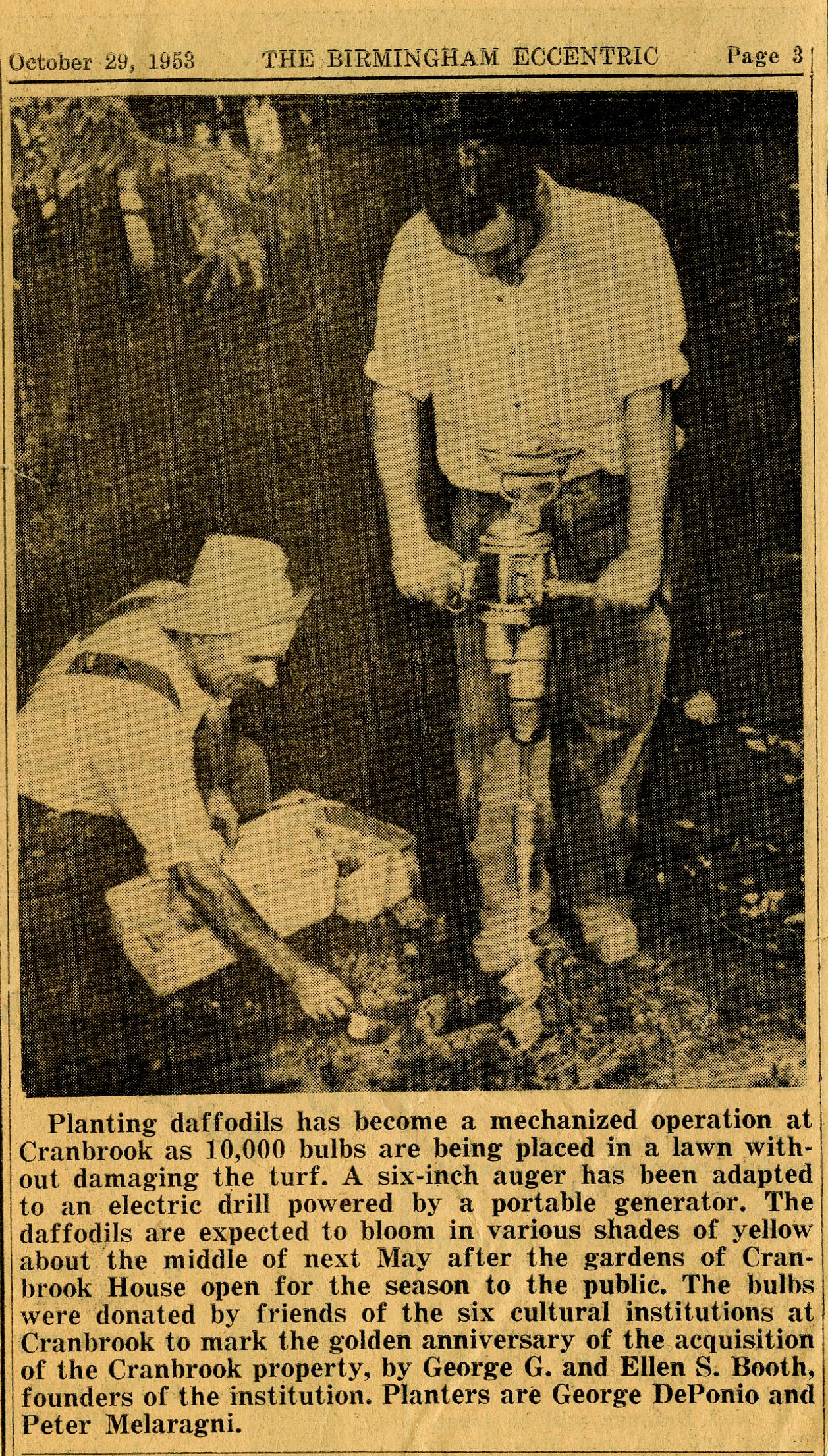
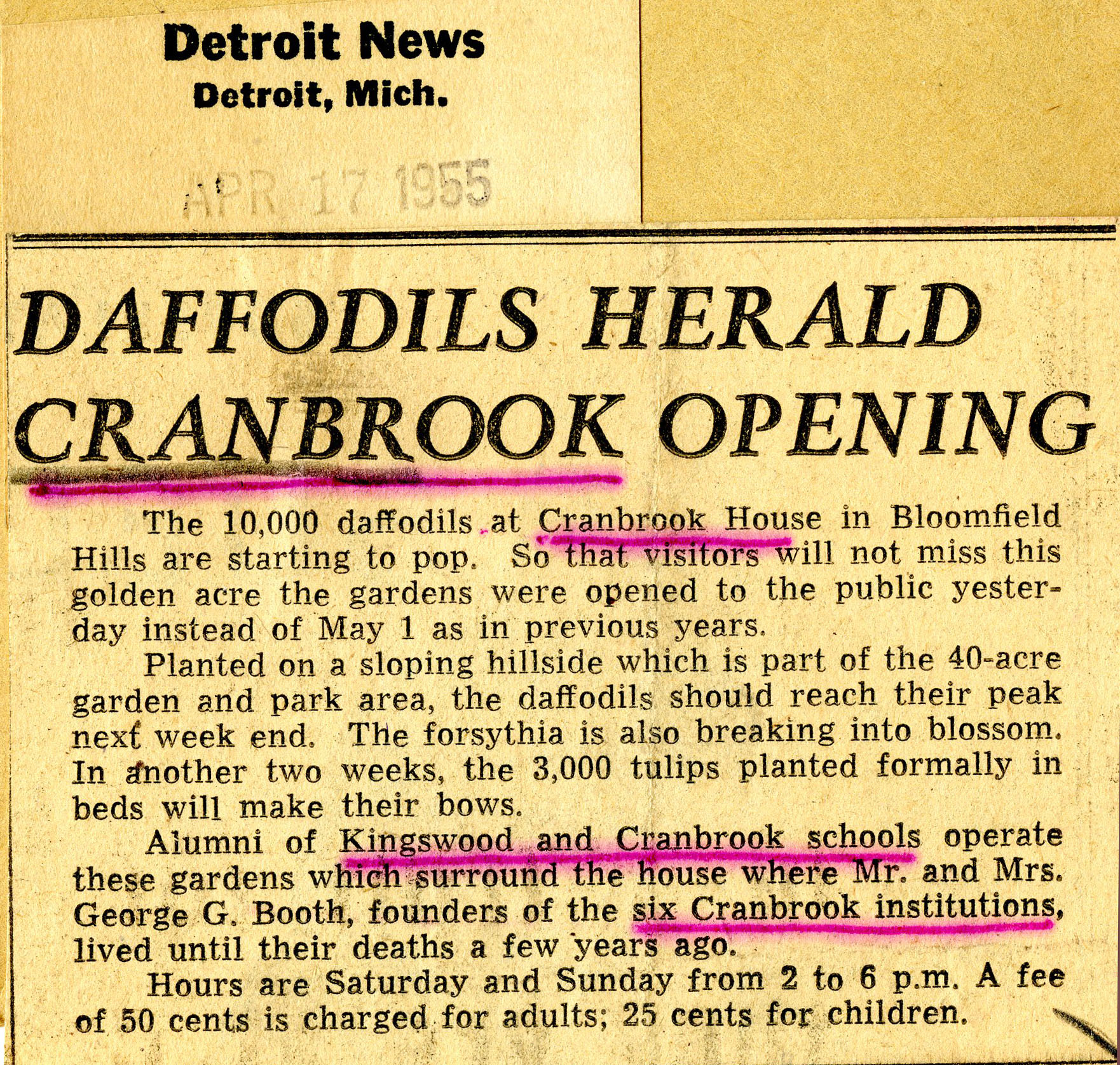
Even though Cranbrook experienced a few snow flurries today, the campus daffodils are also in bloom. It reminds me of what was known as “Daffodil Hill.” In 1953, in anticipation of Cranbrook’s Golden Jubilee celebration (the 50th anniversary of the year the Booths purchased the original 175 acres), Henry Scripps Booth led an effort to raise funds to plant daffodils at Cranbrook House.

The Cranbrook Foundation Daffodil Fund was established and enough money was raised to plant 10,000 daffodils in the fall. By 1955, visitors were flocking to the campus just to see them.

Birmingham Eccentric newsclipping, 1953

News clipping, The Birmingham Eccentric, 1953. Cranbrook Archives.

Detroit News, 1955

News clipping, The Detroit News, 1955. Cranbrook Archives.

Middle School girls planting daffodils for Earth Day, 1990

Middle School girls planting daffodils for Earth Day, 1990. Cranbrook Archives.

Daffodil Hill, 1985

Originally known as “Golden Glade,” the area soon became known as Daffodil Hill, Spring 1985. Ralph Mize, photographer. Cranbrook Archives.

Leslie S. Edwards, Head Archivist

Photo Friday: In the Shadow of Man

Photo courtesy National Geographic Society, photographer Hugo van Lawick.

Photo courtesy National Geographic Society, photographer Hugo van Lawick.

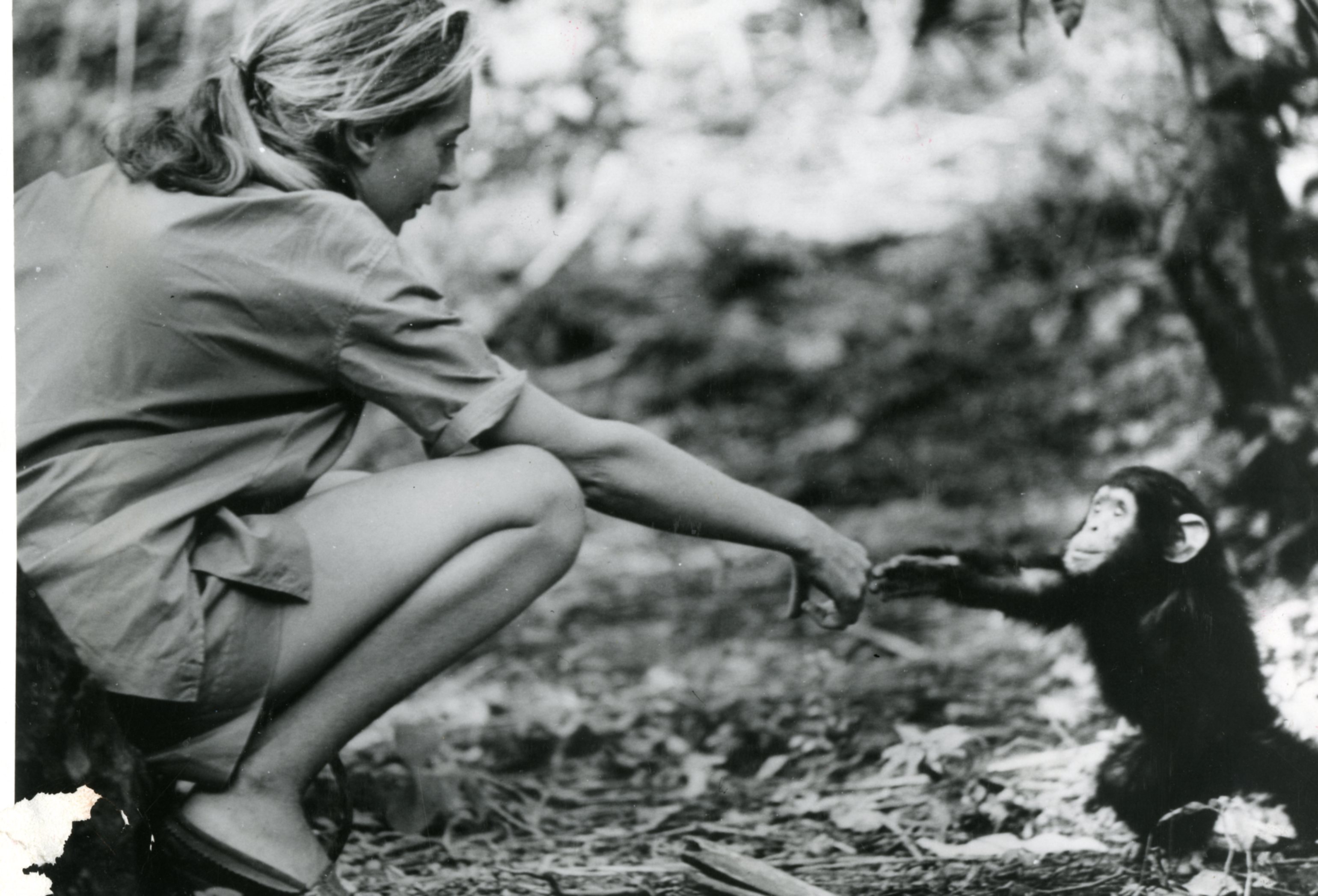
Fascinating and talented people visit the Cranbrook campus each year, including artists, educators, politicians, and scientists. Every so often, I come across something in the Archives which makes me think I wish I had been here then! This is one of those times – an illustrated lecture sponsored by Cranbrook Institute of Science, “In the Shadow of Man,” by Dr. Jane Goodall. Due to an anticipated large crowd, the April 1978 event was held off-campus in Birmingham Seaholm High School’s auditorium.

Gina Tecos, Archivist

Six Degrees of Separation, Again

Every Sunday night I look forward to watching “Who Do You Think You Are?” A show that combines historical research, genealogy, and archives all in one? Perfect for a research geek like me. This past Sunday, actor Tony Goldwyn was the featured celebrity seeking to uncover his roots. I never realized that his paternal grandfather is THE Samuel Goldwyn! And even more surprisingly is that his maternal grandfather is Sidney Coe Howard. I bolted upright in my chair when I heard that name as, of course, Howard has a Cranbrook connection!

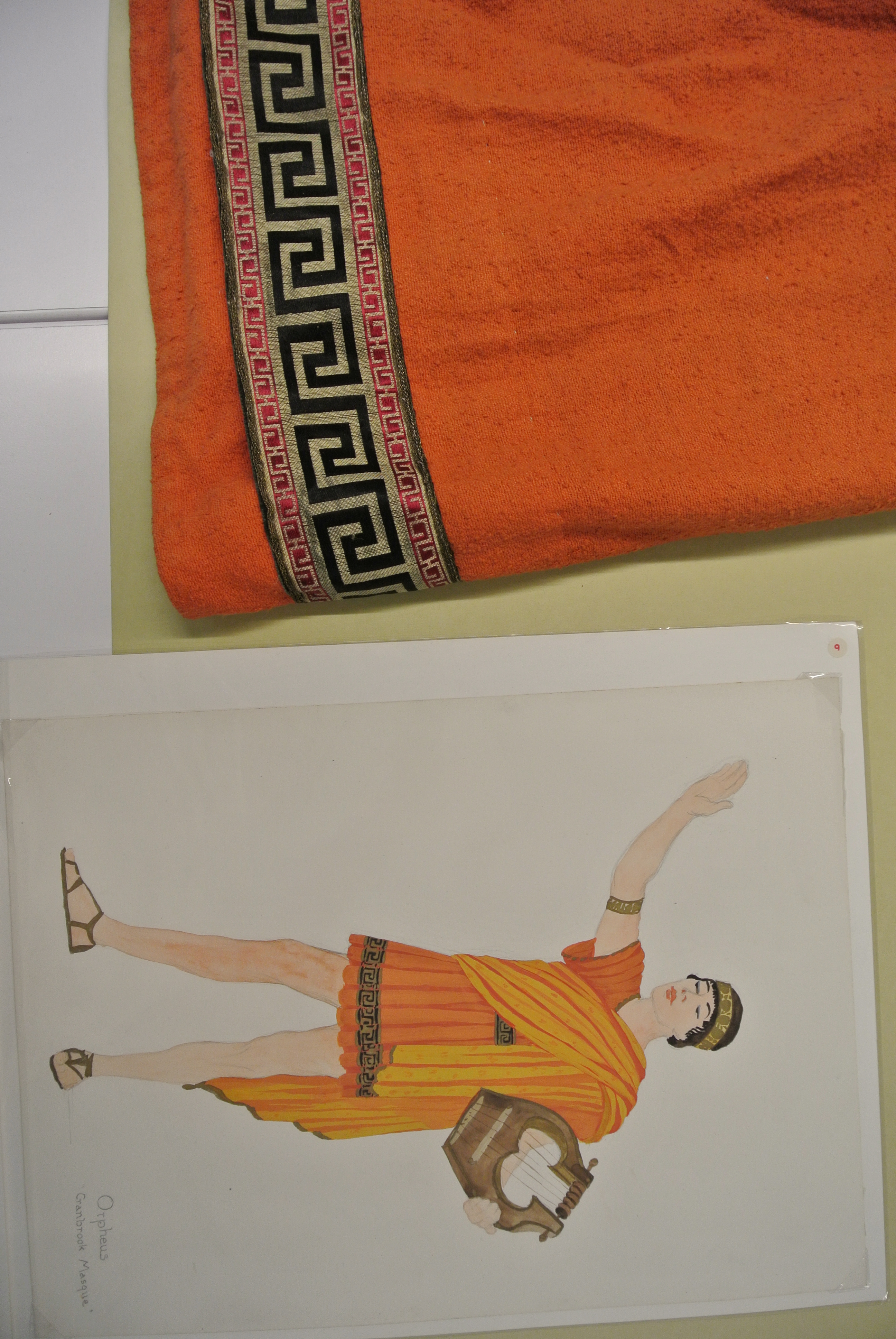
Howard (1891-1939) was the American playwright and screenwriter best known as the posthumous winner of the 1939 Academy of Award for adaptation of the screen play for Gone with the Wind. However, 23 years earlier, Howard penned the script for the Detroit Society of Arts and Crafts (DSAC) production, The Cranbrook Masque. Commissioned by George Booth at the suggestion of director Sam Hume, Howard wrote the Masque as the dedication program for Booth’s new Greek Theatre at Cranbrook. Howard and Hume sought to utilize every part of the theatre in order to demonstrate its possibilities. Costumes were designed and made at Cranbrook by the costume department of the DSAC, led by Katherine McEwen, and were fitted to the actors onsite.

The Costume for Orpheus is part of Cranbrook's Cultural Properties collection.

The Costume for Orpheus is part of Cranbrook’s Cultural Properties collection.

The Cranbrook Masque tells the story of the conflict between romance and materialism, and was expressed through five episodes showing the development of drama throughout the ages – ancient Greece, medieval Europe, Elizabethan England, and 17th century Italy. Through research and travel in Europe, Howard was able to gather material to ensure the historical accuracy of both the scenes and the dialogue. A contemporary news critic wrote “the use of archaic words and the introduction of long-forgotten customs are said by experts to be flawless.” Howard also made use of the natural outdoor setting of the Greek Theatre for special effects. In the first episode, timed at sunset, Pan made his appearance silhouetted against the backdrop of the setting sun. As the light faded, a sophisticated artificial lighting system, designed by Hume, was gradually introduced.

Correspondence to Frederick Alexander

Correspondence to Frederick Alexander, music director of the Cranbrook Masque. Cranbrook Archives.

The performance ran for two consecutive nights in June 1916, and the theatre was filled to capacity with more than 500 guests. The Cranbrook Masque was the first public production of Sidney Coe Howard’s, yet he did not attend the performance. Though the Booths invited Howard to visit Cranbrook, he sailed for France in early June to serve as an ambulance driver for the duration of WWI.

  • Leslie S. Edwards, Head Archivist
The Kingswood Riding Club (1939-1943)

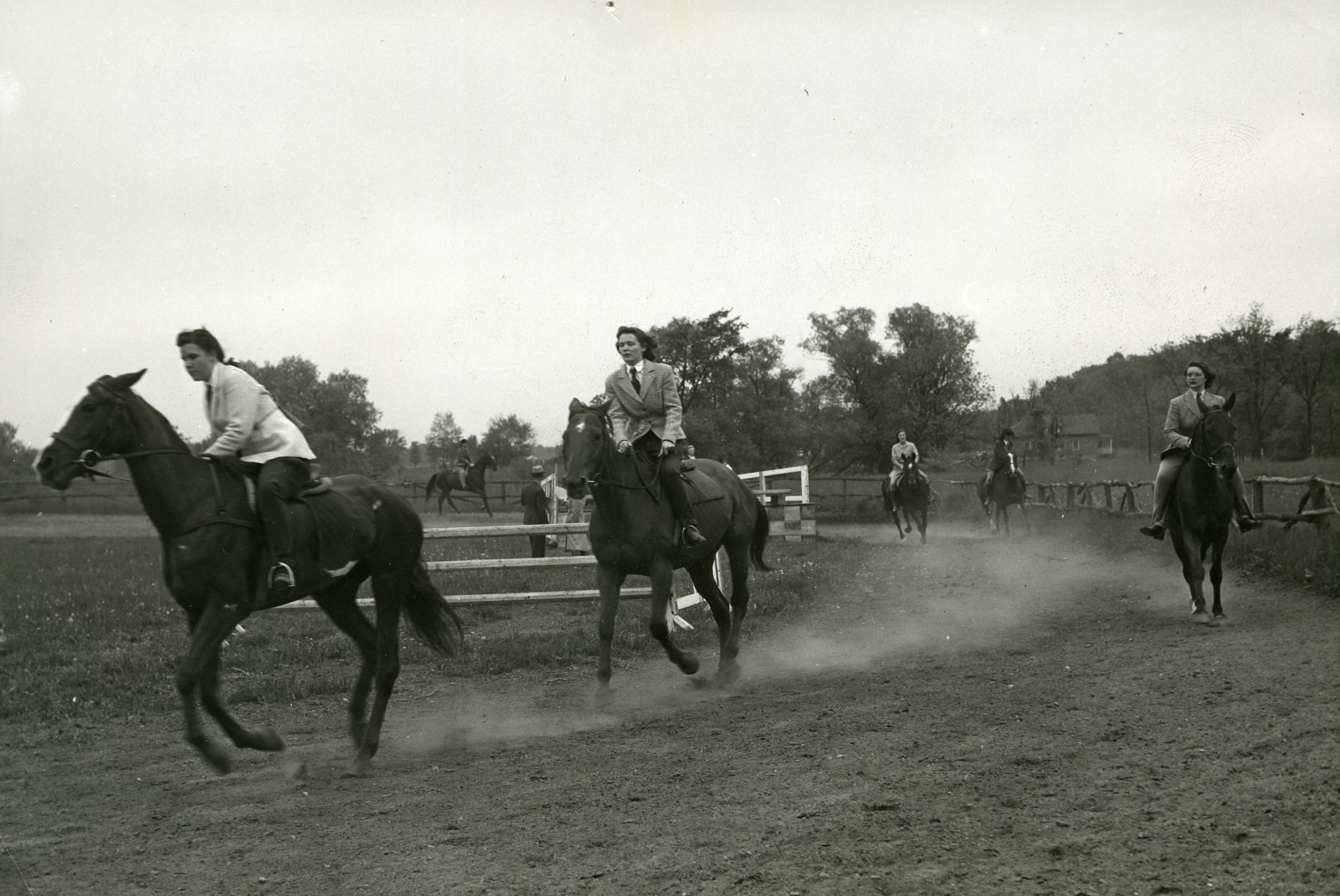
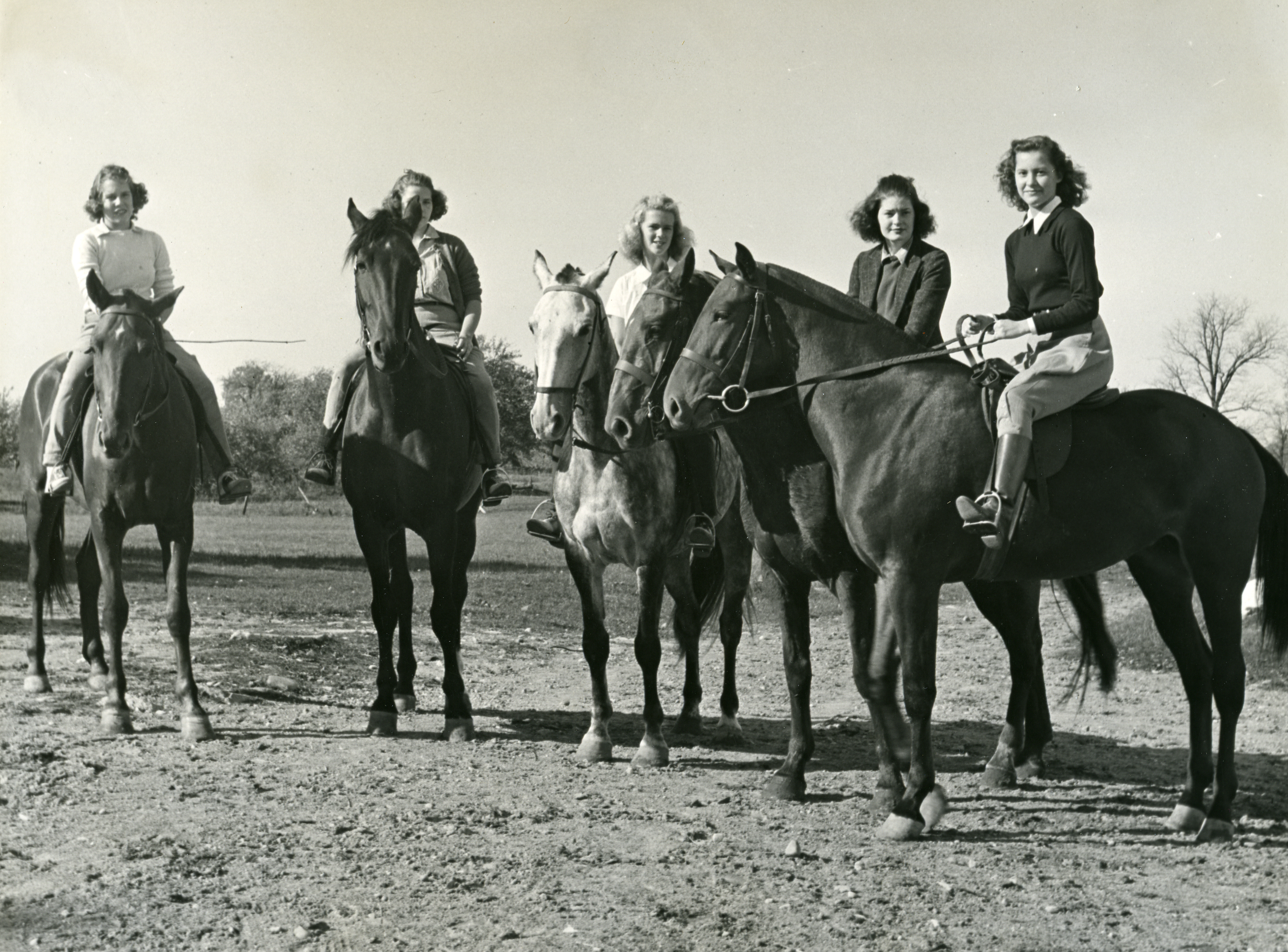
Shortly after the opening of Kingswood School for Girls in the fall of 1931, headmistress Katherine Adams reported that horseback riding would be a part of the physical education program, due in large part to the cooperation of nearby Bloomfield Open Hunt Club.  Several of the girls already boarded horses in nearby stables, including the Hunt Club. The Kingswood Riding Club was officially established in 1939 and the school catalog outlined that girls would ride on the Hunt Club’s bridle paths in spring and fall, and in the covered ring during winter months.  Girls rode on Wednesday afternoons as part of “club day” but the sport quickly became so popular that they also rode on Sunday mornings.  In the spring of 1940, Cranbrook School boys joined the girls for the Sunday morning rides, during which they enjoyed breakfast at the Club House.

Kingswood Riding Club

Kingswood Riding Club, 11 Oct 1939. Cranbrook Archives.

By the fall of 1940, the club had grown to 26 members and met on Mondays and Wednesdays.  Katherine Unger, of Walled Lake, was hired to “teach the riding club the fine points of riding and horsemanship”, and in the spring of 1941, the Kingswood Riding Club held its first horse show.  Riding took place at nearby Bloomfield Hunt Club and at the Outland Riding Stables (located on 14 Mile Road) where there was an inside ring. The following spring, the Kingswood Riding Club held its first horse show.

In September 1941, Unger expressed hope that 1-2 indoor shows would be held during the winter, and that more girls would own horses. “The school horses are all right for beginners but as was so apparent at the show the girls who had their own mounts made the best showing.”  Headmistress Margaret Augur felt the school could not encourage horse ownership (due to the added expense for the girls) and worried that competitions would become a “rich girl’s sport” and thus, a bad tendency for the school.

Horse Show

The 2nd annual Kingswood Horse Show, 20 May 1942. Cranbrook Archives.

The second annual Kingswood Horse Show was held on May 20, 1942 at Outland Riding Stable with judged competitions and an awards presentation.  Virginia McCullough won first place in all of the classes she entered – Hunters Class, 3 Foot Jump, Horsemanship for Owners, Open Jumping 3’6” and Hunter Hacks. Phyllis Klinger took first in the Three-gaited Class and Anita Bray for Horsemanship for Non-Owners.  During the fall of 1942, the girls planned a spring horse show but by December, gas rationing due to World War II meant that the girls were unable to secure taxis to the stables.  By March 1943, taxi service was discontinued and even though riding continued to appear as a sport in the school catalog until 1947, the club was never reinstated.

Leslie S. Edwards, Head Archivist and Gina Tecos, Archivist
Ways of the Designer: Betty Odle and the Wayanas

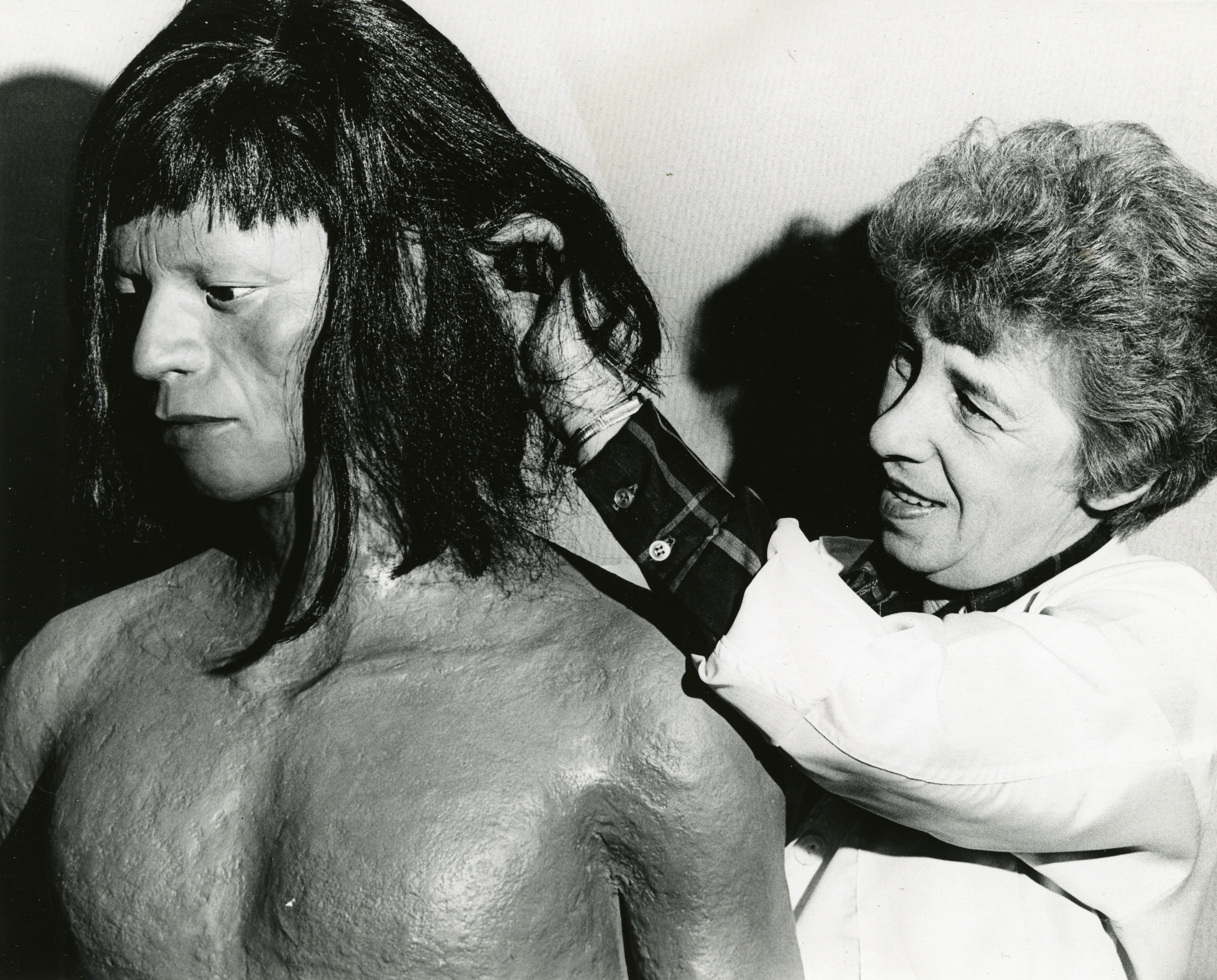
Early in 1969 then Cranbrook Institute of Science Director Warren Wittry gave exhibits designer, Betty Odle, an assignment to “design and build an exhibit on the Wayana Indian tribe of French Guiana and Suriname of northeast South America.” Odle and assistant Stella Toland worked over seven months to transform Caucasian store mannequins into the native Wayana people. Odle created the facial features, coloring, and anatomy from studies of photographs taken by explorer Art Erickson who lived with the Wayanas during his expedition to French Guiana.

Betty Odle adjusts a wig on a Wayana figure, Aug 1969. Cranbrook Archives.

Betty Odle adjusts a wig on a Wayana figure, 12 Aug 1969. Cranbrook Archives.

Creative modifications were necessary to create an accurate depiction of the Wayanas. Odle and Toland spent hours applying paper mache and plasticine to the bodies of the mannequins. Modeling clay was used to shape the faces before oil paint was applied to complete the finest details. The exhibit, “Ways of the Wayana,” opened in October 1969 and included a recreation of the “Wasp Mat Ceremony” with Odle’s life-size figures.

Betty Odle sits with the Wayanas she created, Sep 1969. Cranbrook Archives.

Betty Odle sits with the Wayanas she created, 10 Sep 1969. Cranbrook Archives.

Odle received high praise for the accuracy in her work by Erickson. Her work as the exhibits designer at the Institute spanned from 1959-1985. In 1984 she received Cranbrook’s Founder’s Medal for her many contributions to Cranbrook Educational Community.

Gina Tecos, Archivist

Anne Morrow Lindbergh: The Cranbrook Connection

The Archives has in its collection photographs of a sculpture modeled by Anne Morrow Lindbergh. How did Lindbergh come to study at Cranbrook? In April 1942, Charles Lindbergh, at the invitation of Henry Ford, came to metro-Detroit as a technical consultant to assist with retrofitting the Willow Run plant from auto manufacturing to bomber production. In July, the Lindberghs moved to Bloomfield Hills and signed a one-year lease for a furnished home then owned by Kathleen Belknap. Originally known as “Stonelea,” the home, designed by Albert Kahn in 1923, is located at the corner of Cranbrook Road and Woodward Avenue and is now known as Lyon House. The Lindberghs were quickly welcomed to the neighborhood by Carolyn Farr Booth (wife of Henry Scripps Booth). During the summer of 1943, Anne enrolled at the Cranbrook Academy of Art where she studied modeling and sculpture with sculptor Janet DeCoux, and art history with Ernst Scheyer. Since Charles was away much of the time, Anne asked Janet and her partner, Eliza Miller, to move in with her to help raise her four children. Thus began a friendship among the three women that lasted until the end of Mrs. Lindbergh’s life. (Approximately fifty letters, 1944-1952, from Anne Morrow Lindbergh to DeCoux can be found in the Janet De Coux Papers at the Smithsonian’s Archives of American Art.)

Anne Morrow Lindbergh

Anne Morrow Lindbergh, 1943. Cranbrook Archives.

At the Academy, Anne was treated not as the wife of a celebrity or even as a grieving mother, but as any other student. In her diaries (published in “War Within and Without”) Anne wrote of the freedom she experienced at Cranbrook “where people take me on faith.” Work in the studio, exhibitions at the Art Museum, and parties with music and conversation about art, books, and writing allowed Anne the freedom to “give my true self as I have never done in a group of people before.” She developed social courage and friendships with Janet and Eliza, Carl and Olga Milles, Ernst Scheyer, and neighbors like Kate Thompson Bromley. Her work as a sculptor taught her to see the world through a different lens – she learned how to sketch the human figure and transpose her ideas into her sculpture and it both surprised and excited her that she could actually see beauty in a sculpture, especially one made of her own hands. She was inspired by the natural beauty of Cranbrook, cross-country skiing on the grounds, and writing in her brown trailer in the woods. (Anne wrote her novella “The Steep Ascent” while at Cranbrook.) She relished the time with her children, and often walked them down the hill to Brookside School. Dinners with the Saarinens were exhilarating where they talked of “cities of the future.”

AnneLindbergh021

Anne Morrow Lindbergh picnicking at the Greek Theatre at Cranbrook, Jun 1944. Copyright The Detroit News.

In August 1943, Kathleen Belknap decided to sell the home, then known as Belwood, and the Lindberghs moved into a home at 411 Goodhue Road, behind Christ Church Cranbrook, for the next year. The two years spent at Cranbrook forever changed Anne spiritually. She discovered self-confidence, and that people liked her for who she was. After the Lindberghs returned to the east coast in 1944, Anne missed her Cranbrook friends and the life she had discovered here and wrote that she felt “only half alive since I left Cranbrook.” The Lindbergh family continued to return to the Detroit area to visit Charles’ mother Evangeline at her Grosse Pointe residence until she passed away in 1954. In January 1974, at the request of the Class of 1974, Kingswood School headmaster Wilfred Hemmer invited Anne to be the school’s forty-fourth commencement speaker.

Leslie S. Edwards, Head Archivist

Discoveries Around Campus

The dormers at Cranbrook House. Cranbrook Archives.

The dormers at Cranbrook House. Cranbrook Archives.

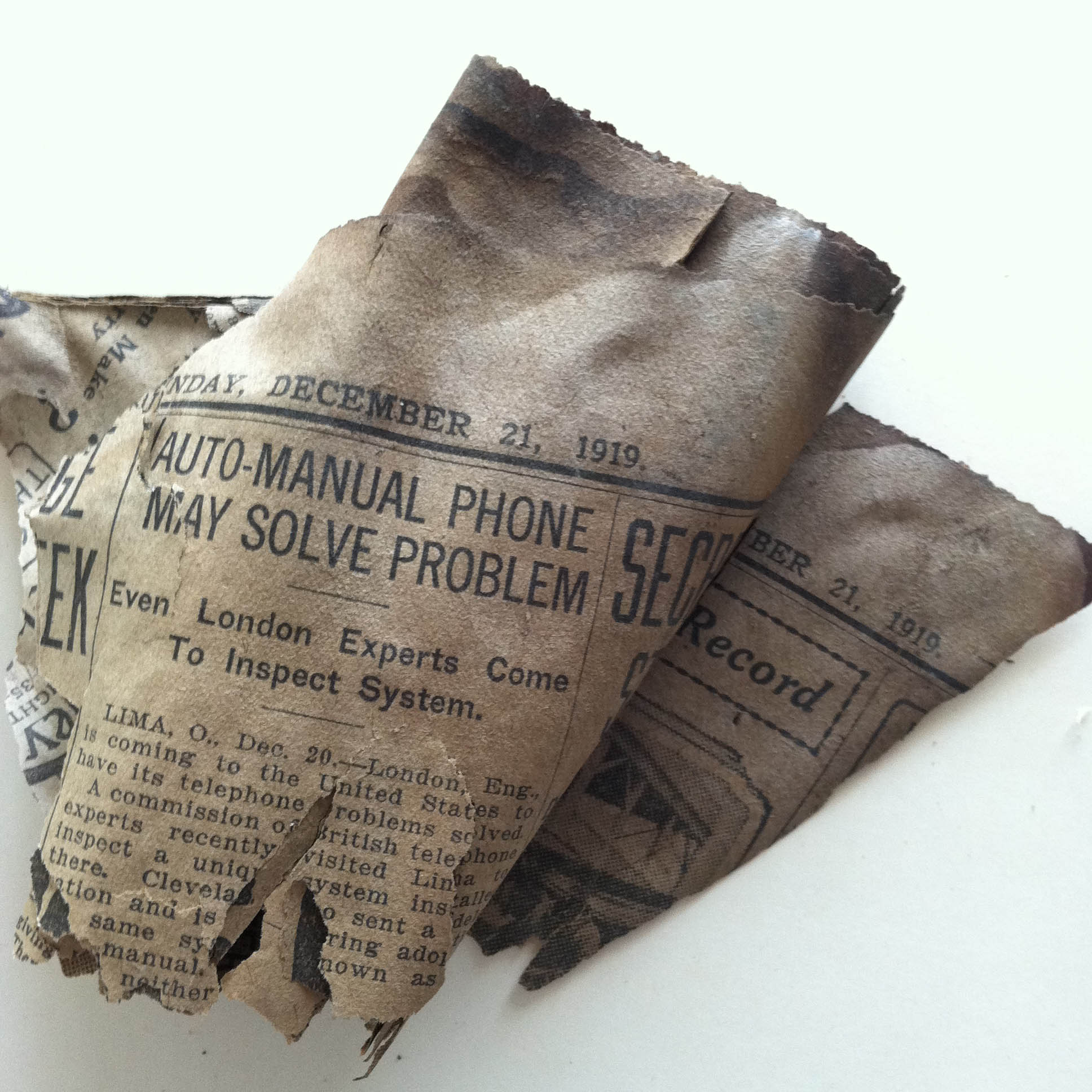
The staff at the Center for Collections and Research work closely with the Capital Projects and Facilities staff on campus restoration and repair projects. The archival staff often provides historical photographs, documentation, and architectural drawings to the project managers. Sometimes the staff makes interesting discoveries during the projects they are working on and share them with us.  The other day Craig Hoernschemeyer (Project Manager for Capital Projects) was in the archives looking for a historic photograph of a dormer window on the east addition (1918-1919) of Cranbrook House.  As luck would have it, he found one.  The following is from Craig:

“Today, when the copper roof was opened up on that dormer – center right in the photo [above]- we found a bunch of newspaper mixed in with the insulation. It was no surprise that it was The Detroit News, but it was dated the first day of winter, December 21, 1919. It was there during the original construction of the wing.”

Detroit News, 1919. Photo Craig Hoernschemeyer.

Detroit News, 21 Dec 1919. Photo Craig Hoernschemeyer.

Leslie S. Edwards, Head Archivist
Create a website or blog at WordPress.com