On the second floor of Cranbrook House is a very lovely painting I’ve appreciated since I started here, but never knew much about.
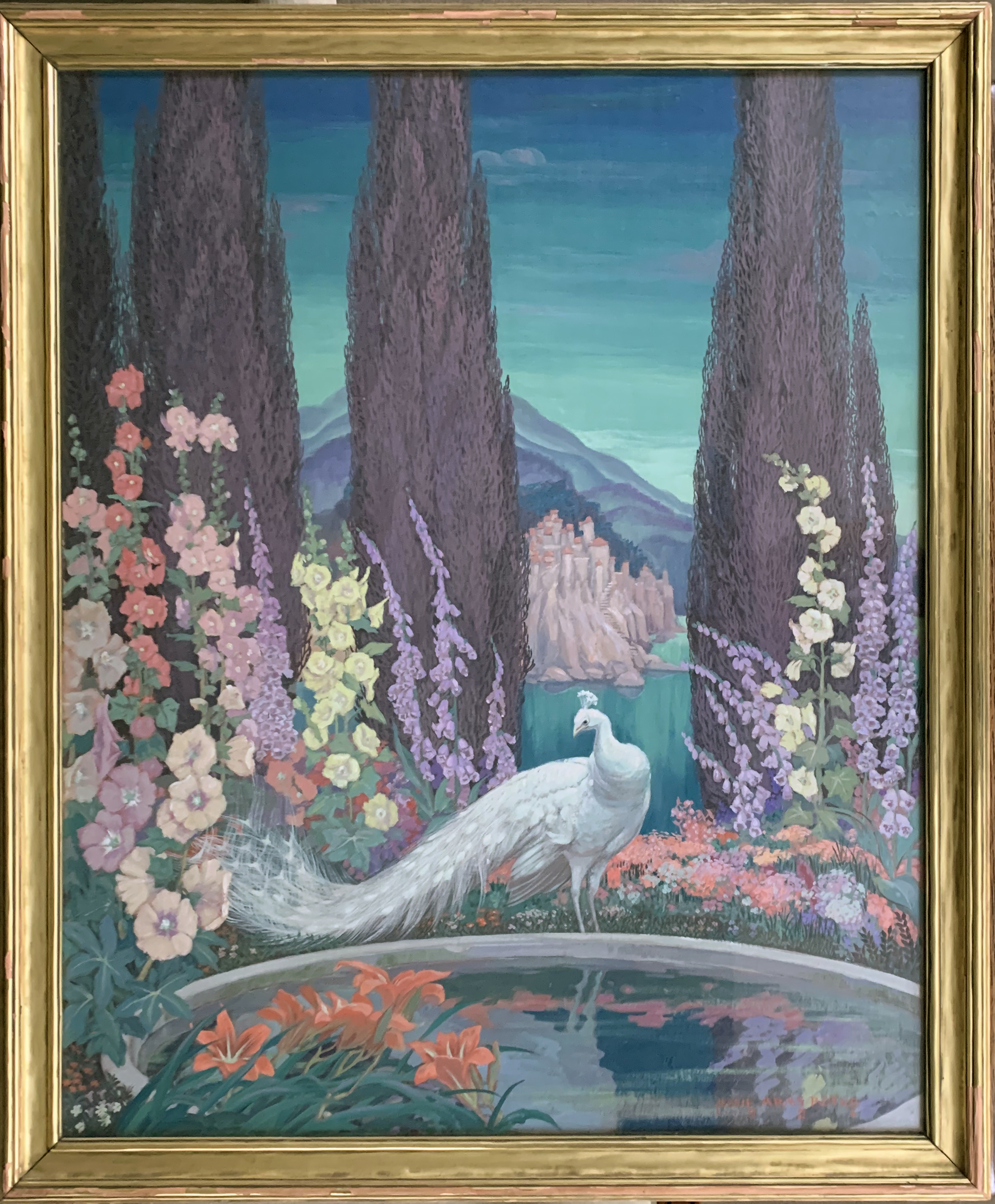
Jessie Arms Botke, The Mirror, 1926. Oil on Canvas. 32×26 in. Bequest of George Gough Booth and Ellen Scripps Booth to The Cranbrook Foundation.
I can confidently say I now know much more about the painting, even if I still know frustratingly little about how it got to be here in the house.
I wasn’t familiar with artist Jessie Arms Botke (1883-1971), even though in her lifetime she was considered the greatest decorative painter in the American West. Botke was prolific, painting six days a week and sketching on Sundays. She had a predilection for white birds (including pelicans, geese, ducks, and cockatoos), and our white peacock is a motif she returned to many times in her career.
Jessie Arms was born in Chicago and studied at the School of the Art Institute of Chicago. Modeled after Paris ateliers, students at the Art Institute were responsible for setting their own goals and objectives and worked among many teachers and classes to develop their individual skills. She noted that the basic curriculum was “practice, practice, practice.” In the summer of 1903, she enrolled in John C. Johansen’s outdoor painting classes in Saugatuck, Michigan.
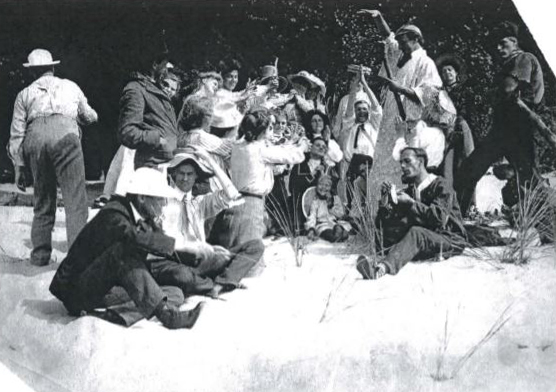
John Johansen’s Summer Art Class at Saugatuck, Michigan, 1903. Courtesy of the Botke Family Archives/William A. Karges Fine Art.
After training in Chicago, she began producing wall decoration and book illustration. Taking a grand tour of Europe in 1909 provided even more artistic influence and inspiration. Following her year aboard, Botke applied to work at the Herter Looms in New York. She applied and was rejected, however, determined to work for the firm, she reapplied directly with Albert Herter. Hired on her second attempt, she produced tapestry cartoons and decorations for the firm. Discussing her experience working for Herter in 1949, Botke reflected:
“Thus began what was a most educational experience. Mr. Herter could have imported trained tapestry cartoonists from Europe, but he wanted to make American tapestry and he filled the studio with young artists just out of school, untainted by stereotyped traditions, with ideals and enthusiasm. We all had to learn the technique of making the tapestry cartoon by doing it. When we were stuck, we were free to go to the Metropolitan and study the tapestries there [and] try to figure out how they did it and apply our conclusions to our modern problems.”
I find this insight into the workshop of Albert Herter fascinating, as Herter Looms would produce its masterpiece, The Great Crusade tapestry, for Cranbrook House Library in 1918 (four years after Botke left).
At Herter Looms, Botke also produced decorative interior schemes and painted panel decorations. A commission for the dining room of actress Billie Burke (famous for her later role as Glinda the Good Witch) led Botke to a lifelong interest in birds. As she recalled, “Mr. Herter came to me with the scheme for the dining room, it was to be in shades of blue and green and he wanted a peacock frieze using the same colors, with white peacocks as notes of accent. I didn’t even know there was such a thing as a white peacock and went up to the Bronx Zoo to find out, and they had one. It was love at first sight and has been ever since.”

Reprint of one of seven paintings by Albert Herter in the Mural Room of the Hotel St. Francis, San Francisco, with border attributed to Jessie Arms Botke. 1912. Courtesy of Tavistock Books.
Botke was also an activist, marching up New York’s Fifth Avenue in 1911 and 1912 in the suffragette parade. She also strongly advocated for the rights and representation of women artists.
In late 1914, Botke left Herter Looms and New York, moving to Chicago to marry Cornelis Botke, a Dutch artist and architectural renderer. They settled first in Chicago and then California, where they moved to the artist community of Carmel in 1919. It was at her Carmel studio where Botke likely painted the peacock now in Cranbrook House, in 1926.
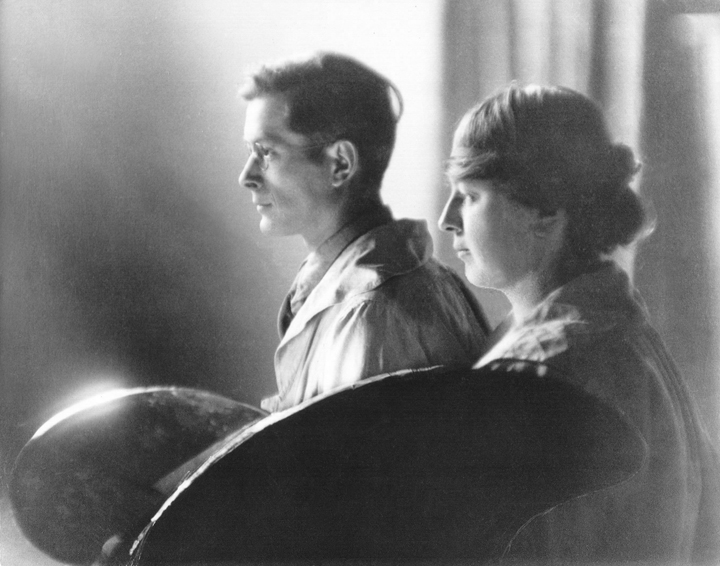
Jessie Arms Botke and Cornelis Botke, n.d. Courtesy of Carmel Art Association.
In 1928, the couple relocated to Los Angeles and then Wheeler Canyon. They continued to paint, with Jessie’s income providing the bulk of the couple’s wealth. In her California home, Botke kept an aviary with peacocks “where I can enjoy and paint peacocks to my heart’s content.” Cornelis died of diabetes in 1954, and Jessie continued to paint until a stroke in 1967. She died in 1971, aged 88, with an enormous body of work and awards to her name.
So how did this Botke peacock come to Cranbrook? After looking in the object records we keep for all of Cranbrook’s art objects, as well as through photo albums, slide albums, record books, and receipt books, I cannot find any records pertaining to when the Botke painting was purchased! On the back of the painting is written the title of the work, the artist, and “Price 750.00.” There is also a stenciled “CF” for Cranbrook Foundation. This might mean the work was purchased by the Foundation for use at Cranbrook, or, more likely, was accessioned by the Foundation directly from Cranbrook House at the time of the George Booth’s death.
Although I’m currently unable to pin down who bought the painting and when, it was probably purchased by George Booth as a decorative piece for the home rather than part of the collection for Cranbrook Art Museum. This would explain why the painting isn’t in the Museum’s records (it is a Cultural Property, not a work in the Art Museum). Botke sold many of her pieces at Gump’s in San Francisco, from which Mr. Booth regularly purchased art, decorative objects, and furniture (and for which we have many receipts, none of which include the peacock).

Detail of The Mirror
In the 1980s, the painting was stored in the Cranbrook House attic. Was it moved there from one of the second-floor bedrooms, which were converted to offices in the 1970s? Sometime later, it was moved to Tower Garage, where the House and Gardens Auxiliary is located. In 2012, it was hung in its current location after the removal of the Cranbrook House vending machine.
I do love that the work features a peacock, as the bird was a favorite motif across Cranbrook and is found all across campus in gates, andirons, tapestries, and inlays. Although Saarinen (frustratingly) never wrote about why he loved the peacock, Jessie Botke did:
“My interest in birds was not sentimental, it was always what sort of pattern they made, and the white peacock was so appealing because it was a simple, but beautiful white form to be silhouetted against dark background, and the texture and pattern of the lacy tail broke the harshness of the white mass without losing the simplicity of the pattern.”
– Kevin Adkisson, 2016-2019 Collections Fellow, Cranbrook Center for Collections and Research
For more information on Jessie Arms Botke, see Patricia Trenton and Deborah Solon, “Birds, Boughs, and Blossoms: Jessie Arms Botke, 1883-1971” (Los Angeles: William A. Karges Fine Art, 1995).





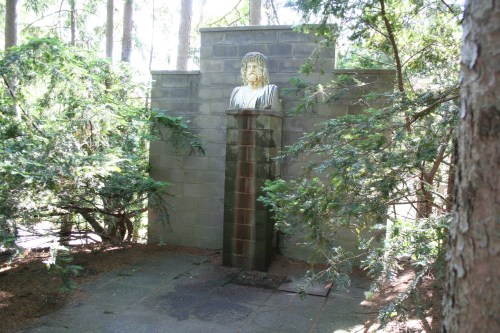 Weeping Zeus (or more formally Zeus of Otricoli [Roman copy of Greek original]) is a marble bust comprised of the shoulders, chest, and head of the Greek god, Zeus. The chest is carved to resemble draped cloth. The curly hair has a wreath in it, and the beard is curly with a full mustache. The bust is set on top of a concrete block column.
 Here at Cranbrook, it would seem the father of the Greek gods finds the peace of this Michigan mountain dull in comparison with the revelries of either Mt. Olympus or his later home in the Scottish Highlands. It is reported tears well up in his eyes and sometimes gush forth. The sculpture became a folly (and why we call him Weeping Zeus) after Henry had holes drilled through the eyes to allow water to flow (squirt, really) out.




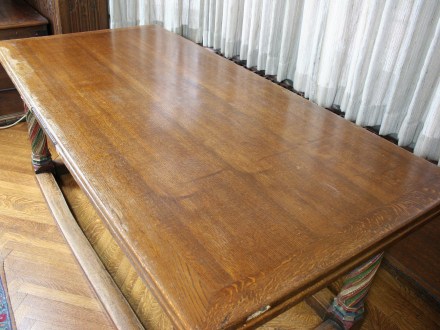 Purchased by George G. Booth, before 1949, for use in Cranbrook House, the Refectory Table (CEC 37) in the Cranbrook House Oak Room has a plain 76 inch by 35-1/2 inch rectangular top, with two extendable tops of 31-1/2 inches each.
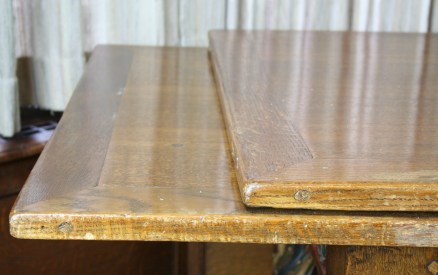 The extension mechanism works by removing the top wood leaf, pulling out each side of tabletop – these are supported by bars under the table top that pull out – removing the center section, then placing the top leaf in the center.
 The frieze runs all around the table and features a grapevine interspersed at regular intervals with Medieval-style figures: mermaids, men, women, and animals.
 The figures carry banners and staffs, are sitting on benches, and, in the case of the mermaid, holding a fish.
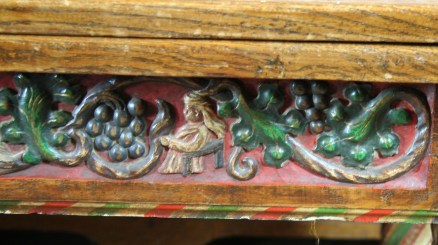 The frieze background is painted red; the grapevine and grapes are brown with black and the leaves are green with gold detailing; the figures and animals are mostly tan with gold and the mermaids are gold as well. The lower edge molding of the frieze is painted with diagonal lines of green, gold, and red.
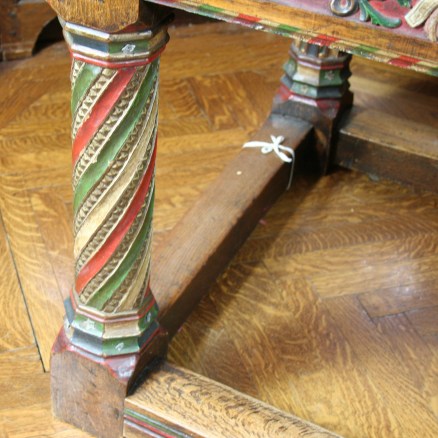 Each of the four carved and painted legs is decorated with a different linear design of stripes, twisted around the trunk, with hexagonal base and top.
 Metal stars are attached to the base and top of each leg. The legs are painted blue, green, red, and tan, all with gold detailing.
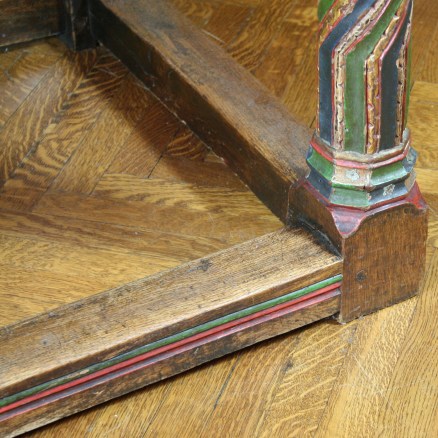 The outer side of each stretcher has carved lines painted red and green.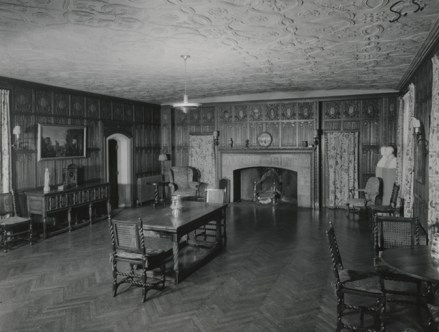
 George G. Booth created the Still Room as a part of his office suites in 1918. It was as a place to take a noonday rest. In old English country houses, the Still Room was a place where medicines were prepared, herbs and flowers were infused in water or oils, and where home-brewed beers and wines were made. As Henry Scripps Booth recalled in another letter, “We started applying the term to the small room at the south end of the wing although Mr. Booth had no intention of making whiskey, beer or wine, but on using it as a quiet place for reading, conversation and taking undisturbed naps.”
 Cranbrook Kitchen Sink