Michigan Modern: The Model T has Left the Building

Sunday marked the last day of the exhibition Michigan Modern: Design That Shaped America at Cranbrook Art Museum.  This means that Monday saw the start of the museum staff’s busiest time—the five weeks in which we take down one exhibition and put up another.  Dismantling Michigan Modern is difficult; we need to say goodbye to objects we love and figure out the difficult process of getting them out the door.  And if there is one object in the entire exhibition that typifies the emotional drama of letting go as well as the physical challenge of moving giant historical artifacts, it is the Model T chassis.

Model T Chassis, The Henry Ford.  On view in Michigan Modern at Cranbrook Art Museum.  September 2013, Shell Hensleigh/Cranbrook Art Museum.

Model T Chassis, The Henry Ford. On view in Michigan Modern at Cranbrook Art Museum. September 2013, Shell Hensleigh/Cranbrook Art Museum.

Continue reading

Dispatch from the Archives: “Gatescapes,” Old and New

On October 5, Cranbrook Archives will be opening its second exhibition in the From the Archives series.  From the Archives: Forging Cranbrook’s Gatescape explores the long-lasting significance of gates to Cranbrook’s campus.  Points of transition and transformation, the gates have also long stood as a public display of Cranbrook’s dedication to art and design.
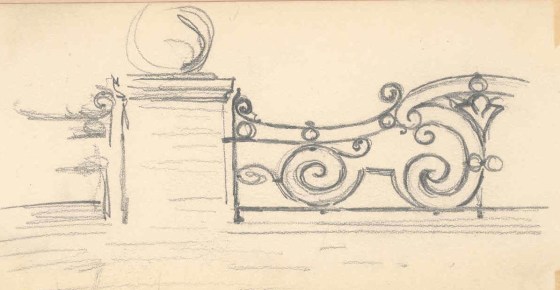
George Gough Booth sketch for a gate.  George Gough Booth Papers, Cranbrook Archives.

George Gough Booth sketch for a gate. George Gough Booth Papers, Cranbrook Archives.

Cranbrook’s love of gates originates with its founding father, George Gough Booth.  Booth, who came from a family of copper and tin metal workers, received early training at the Red Foundry in Ontario, Canada.  This, in part, led to his 1884 purchase of Barnum Wire and Iron Works in Windsor, Ontario with partner Fred Evans.  Booth wrote, “I conceived the idea of creating a new type of industry – selling with my pencil and not so much out of a catalogue – making special designs for fences, signs, bank counter railings…”   One of the earliest gates at Cranbrook designed by George Booth (and fabricated by Detroit Architectural Iron Works in 1916) is the first public gate located at the entrance to the Greek Theatre.
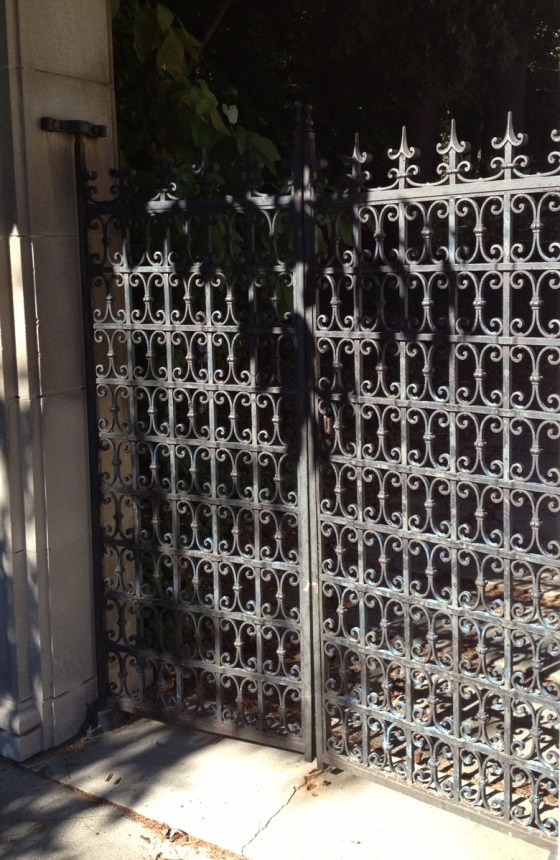
    Greek Theatre gates, designed by George Booth and produced by the Detroit Architectural Iron Works. 1916.

Greek Theatre gates, designed by George Booth and produced by the Detroit Architectural Iron Works. 1916.

Since Booth’s inception of Cranbrook, the community has steadily expanded the campus’ “gatescape.”  The most recent gates installed on campus are the “Valley Way” entrance gates (2012), designed by Architect-in-Residence William Massie.  Located at what was formerly known as the Vaughan Road Entrance, the gates were part of a project which widened the roadway to improve vehicular and pedestrian safety.  Working with Brian Oltrogge, Massie designed an abstraction of geometric triangles, a reference to Eliel Saarinen’s Kingswood gates.   The new gates were fabricated of laser-cut and bent steel.  The hand-bent “infill” was bolted to the steel frame and welded by Jody Cooper, Academy of Art alumni (Architecture Department 2012).

Closeup of Valley Way entrance gates, designed by Cranbrook Academy of Art Architect-in-Residence William Massie. The gates were completed in 2012.

Closeup of Valley Way entrance gates, designed by Cranbrook Academy of Art Architect-in-Residence William Massie. The gates were completed in 2012.

In conjunction with the exhibition opening, I’m going to be leading a walking and bus tour of the gates on Saturday, October 5.  We’ll be exploring all aspects of the gates, from their history in situ to the designers and makers who produced them.  Be sure to sign up here to join us, and get ready to delve deep into Cranbrook’s “gatescape”!

Leslie S. Edwards, Head Archivist

Photo Friday: Cranbrook’s Gatescape

Image

Close-up of the peacock for which Cranbrook School’s Peacock Gates are named. Designed and installed in 1927, restored in 2013. Cranbrook Archives.

Doors, entryways, gates – Cranbrook’s campus was designed with an eye towards points of transition.  Since its foundation 108 years ago, Cranbrook has maintained a long tradition of gate design and fabrication.  This close-up of a stylized peacock comes from Cranbrook School’s famous Peacock Gates; designed by Eliel Saarinen, they were produced by the metalsmith Oscar Bach in 1927.  Recently, a long restoration process culminated with their re-installation on the Cranbrook School campus.   This gate and many others are the subject of the second exhibition in the From the Archives series.  Drawing from the rich collection of the Cranbrook Archives, From the Archives: Forging Cranbrook’s Gatescape explores the history, design, and formation of Cranbrook’s historic and contemporary “gatescape.”

Experiencing the gates from within the walls of the Art Museum is nothing compared to seeing them in person.  With that in mind, Leslie S. Edwards, Head Archivist and exhibition curator, will be leading a walking and bus tour of the gates on Sunday, October 5.   The tour will take participants  to some of Leslie’s favorite gates, from beloved classics to the newest installations on campus.   More information on the exhibition and walking tour is available here.  Be sure to check it out, and get ready to see Cranbrook’s gates in a whole new light!

Happy Birthday, Sol LeWitt!

Sol LeWitt, Wall Drawings 790A and 790B: Irregular Alternating Color Bands (1995), currently on view at the Cranbrook Art Museum.  Photo, P.D. Rearick/Cranbrook Art Museum.

Sol LeWitt, Wall Drawings 790A and 790B: Irregular Alternating Color Bands (1995), currently on view at the Cranbrook Art Museum. Photo, P.D. Rearick/Cranbrook Art Museum.

Solomon “Sol” LeWitt was born in Hartford, Connecticut, on September 9, 1928, making today the 85th anniversary of his birth.   LeWitt died in 2007, but his groundbreaking work continues to be exhibited around the world.  If you’re interested, however, you can catch LeWitt closer to home at Cranbrook.

On exhibition at the Cranbrook Art Museum, LeWitt’s Wall Drawings 790A and 790B: Alternating Color Bands dominate the Hartmann Gallery.  These striking wall paintings are deceptive – though they seem permanent, they exist only for the run of the exhibition.  This short-lived existence reveals LeWitt’s important role in the conceptual art movement, in which the “idea” of the piece holds more significance than the physical manifestation of the concept.  Check out Sol LeWitt: Wall Drawings 790A and 790B: Alternating Color Bands on view at CAM now.

– Shoshana Resnikoff, Collections Fellow

Cranbrook and the Car, Part 3: Suzanne Vanderbilt

If AMC’s long-running television show Mad Men has taught us anything, it is that it is hard being a woman in a man’s world.  And while Peggy Olsen’s struggle to be taken seriously as an advertising professional in the 1960s is fictional, many talented, driven, and creative women found themselves fighting a similar battle in their own professions in the 1960s and 1970s.

Suzanne Vanderbilt was one such woman, and her work as a designer at General Motors is highlighted in A Driving Force: Cranbrook and the Car, now open in the lower galleries of the Cranbrook Art Museum.  A Cranbrook Academy of Art graduate, Vanderbilt was an active member of the “Damsels of Design,” the young women hired by Harley Earl to work on the interiors of vehicles for General Motors in the 1950s and 1960s.

1998-02 Vanderbilt in car, c1950s (2)

Suzanne Vanderbilt in her Corvette, mid 1950s. Suzanne Vanderbilt Papers, Cranbrook Archives.

Though the assembling of these women into a charming and attractive group of “damsels” was a PR ploy, the fact remains that these women designers did real work for GM, re-thinking car interiors at the exact moment that the auto industry began recognizing women as significant consumers of their products.  Women have historically made the majority of household purchasing decisions, and as cars increasingly became associated with domestic American life it became clear that women would have a greater role in buying them.  Recognizing this trend, GM acknowledged that its design, engineering, and marketing of cars would have to shift.  And who better to understand the female consumer than women themselves?

Continue reading

From the Archives: Teaching and Exhibiting Painting at Cranbrook, 1930-1970

Image

From the Archives: Teaching and Exhibiting Painting at Cranbrook, 1930-1970, photograph courtesy of Justine Tobiasz.

With the opening of the summer exhibition season at the Cranbrook Art Museum, the campus is filled with opportunities to learn about art, design, and history.  This also marks the first of a regular series of exhibitions that explore the unplumbed depths of Cranbrook’s archival holdings.  From the Archives: Teaching and Exhibiting Painting at Cranbrook, 1930-1970 highlights the efforts of Cranbrook teachers and curators and explores the work they did promoting painting at Cranbrook at the mid-century mark.  Curated by Head Archivist Leslie S. Edwards, the show uncovers untold accounts about the moments and figures that populate Cranbrook’s storied painting history.   From the Archives: Teaching and Exhibiting Painting at Cranbrook, 1930-1970 will be on view in the Cranbrook Art Museum from June 14 to September 29, 2013, so be sure to check it out!

[Ed. note: if you missed the Archives exhibition in person, don’t worry – it lives forever on the internet! Check out the Archives online exhibition, From the Archives: Teaching and Exhibiting Painting at Cranbrook, 1930-1970.]

From an Intern’s Eyes: Old Drama and Timeless Art

In the second week of May, I began my first day at the Cranbrook Archives for my Senior May Project, a program ran by the Cranbrook Upper School to send anxious fourth quarter seniors off campus for internships and adventures.  And now, after two weeks of dealing with numerous dusty, yellowed papers (and one suspicious wooden box featuring some dead bugs and cobwebs) my initial excitement only grew.

One of my first projects here was to research the tenure of past Academy of Art faculty and staff members between the years of 1932-1976, and to make a comprehensive spreadsheet on the matter. That project led me to read through old faculty files comprised of payroll information (“how did people survive on $200 a month!” I thought to myself), retirement records, old correspondence­—I even came across the first telegram I had ever seen. I wondered, from time to time: “Did the secretary who typed this letter up ever think that a teenaged intern from China would one day behold this work and marvel at its antiquity?”

The first telegram I've ever seen.  1943, Cranbrook Archives.

The first telegram I’ve ever seen. 1943, Cranbrook Art Museum Exhibition Records, Cranbrook Archives.

Continue reading

Cranbrook and the Car, Part 2: The Rocket Arrives

Putting together an automobile exhibition without a car is like making a custard without using eggs: you can use other ingredients as replacements, but you’ll have a hard time achieving that perfectly smooth texture without them.    At the heart of any show about the automobile industry is the car itself.

It was with this thought in mind that I arrived at the Cranbrook Art Museum at 7:45 AM yesterday morning, eagerly awaiting the arrival of a truck that was carrying the eggs for my custard – a 1914 Scripps-Booth Rocket Cyclecar.

The Rocket arrives!  May 9, 2013.

The Rocket arrives! May 9, 2013.

Continue reading

Cranbrook and the Car, Part 1: The Aristocrat of Small Cars

In its 100-year history, Cranbrook has been known for producing artists, designers, scholars, athletes, and leaders.  But cars?  An upcoming exhibition mounted by the Center for Collections and Research (that’s us!) at the Cranbrook Art Museum will explore the relationship between Cranbrook and the automobile industry. Called A Driving Force: Cranbrook and the Car, it will highlight the history of Cranbrook through the lens of the automobile, detailing the ways that members of Cranbrook’s community have innovated and influenced the auto industry for the past 100 years.  You can learn more about the exhibition at Cranbrook Art Museum’s website here.

As we prepare to open A Driving Force: Cranbrook and the Car on June 12, we’ll be writing up occasional posts about the exhibition, highlighting bits and pieces of our research and providing glimpses into the down-and-dirty world of museum exhibiting.   And we’re going to kick it all off with the story of James Scripps Booth and the Scripps-Booth Company.

James Scripps Booth (behind the wheel) with brother Warren Scripps Booth in a Scripps-Booth 4-cylinder Model C at Tower Garage at Cranbrook House. Their father George Gough Booth stands next to the car, partially hidden by the windshield.  Circa 1917, Cranbrook Archives.

James Scripps Booth (behind the wheel) with brother Warren Scripps Booth in a Scripps-Booth 4-cylinder Model C at Tower Garage at Cranbrook House. Their father George Gough Booth stands next to the car, partially hidden by the windshield. Circa 1917, Cranbrook Archives.

Continue reading

Create a website or blog at WordPress.com