Photo Friday: Reporting the News in Style

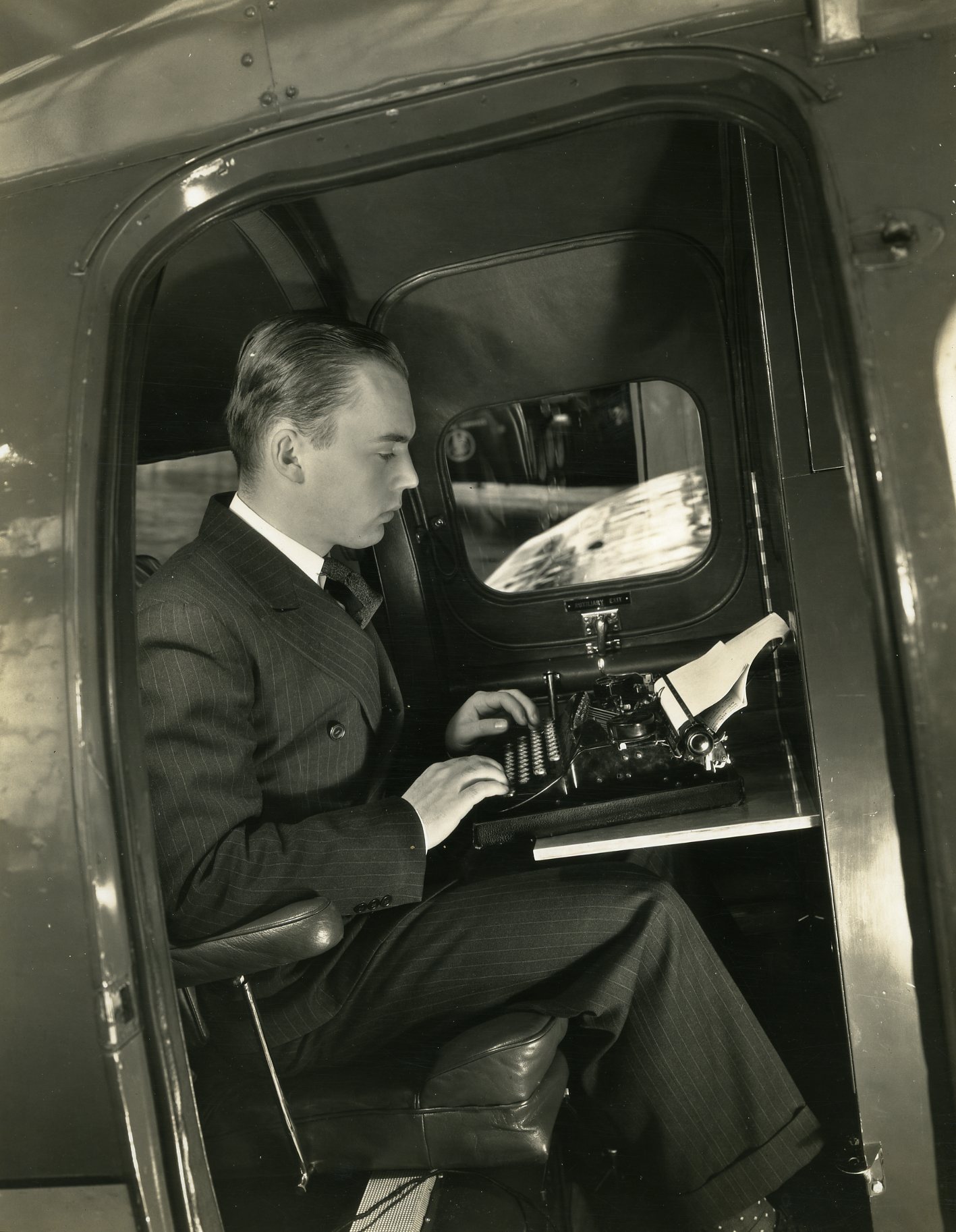
Archivists never know what we might run across during the course of our daily work, which is, of course, part of the allure of the job! Today it was a photo of W Stoddard White (1913-1972) from the Lee A White Papers. (No typo – neither man used a period after his initial!)  Lee White (Stoddard’s father) was a personal friend and confidante of George Booth’s from the Detroit News. White followed Booth to Cranbrook once Cranbrook School was opened and was on the Board of Directors, later becoming head of the public relations department for the community. Clearly Stoddard followed in his father’s footsteps, becoming a news reporter after his graduation from UM in 1935. (Interestingly, while at UM, he was in Sigma Chi along with Edgar Guest Jr.)

Stoddard White, Detroit News Employee, Oct 1935. Courtesy Cranbrook Archives, Lee A White Papers.

Stoddard White, Detroit News Employee, Oct 1935. Courtesy Cranbrook Archives, Lee A White Papers.

This photo caught my attention because of the content – what a great image of young Stoddard, as a Detroit News reporter, seated at his typewriter in what was likely the Detroit News Lockheed Vega airplane. Just one more reason I love my job!

Leslie S. Edwards, Head Archivist

Historical Menus Reveal Cultural Past

The Henry Scripps Booth Collection of Menus is a fascinating glimpse into another era and the travel exploits of the leisure class. The Cranbrook Archives has digitized a portion of the collection, mainly menu covers, that can be viewed in our digital database. Menus are wonderful cultural documents that reveal economic, dietary, artistic, sometimes geographic and even literary information about an era.

Many of the menu covers have artistic renderings, some of them signed. The 1952 menu for the farewell dinner on the Queen Elizabeth has a reproduction of a painting of the ship, with the name “C.F. Hopkinson” visible in the lower right corner.

Farewell Dinner Menu for R.M.S. Queen Elizabeth Courtesy Cranbrook Archives

Farewell Dinner Menu for R.M.S. Queen Elizabeth.
Courtesy Henry Scripps Booth Menu Collection, Cranbrook Archives

Doing a Google search, I found Hopkinson’s name in a blog post, written by the archivist in charge of the Cunard Archives (imagine what a fascinating archive that must be) in the Special Collections & Archives at the University of Liverpool Library. The blog cited C.F. Hopkinson in a discussion about land-based Cunard employees who served during World War I. The Cunard Line Staff Magazine was the source for this information, and the blog emphasized the importance of staff magazines in an archival collection, as company records rarely contain information about individual employees. The little information they presented on C.F. Hopkinson confirmed that he was an artist, even though employed as an accountant by Cunard. Moreover, the blog post elicited a response and additional information from C.F. Hopkinson’s daughter.

Charles Francis Hopkinson completeing bust of Samuel Cunard Courtesy Cunard Archiv, Special Collections and Archives at the University of Liverpool

Charles Francis Hopkinson working on bust of Samuel Cunard.
Courtesy Cunard Archive, Special Collections and Archives at the University of Liverpool

While there’s nothing earthshaking about the tidbit of information I found, it’s always fun to have a bit of serendipity in one’s work and to be reminded of what a small world we live in–and of the power of blogs!

– Cheri Y. Gay, Archvist

Logical Design: Using Primary Sources

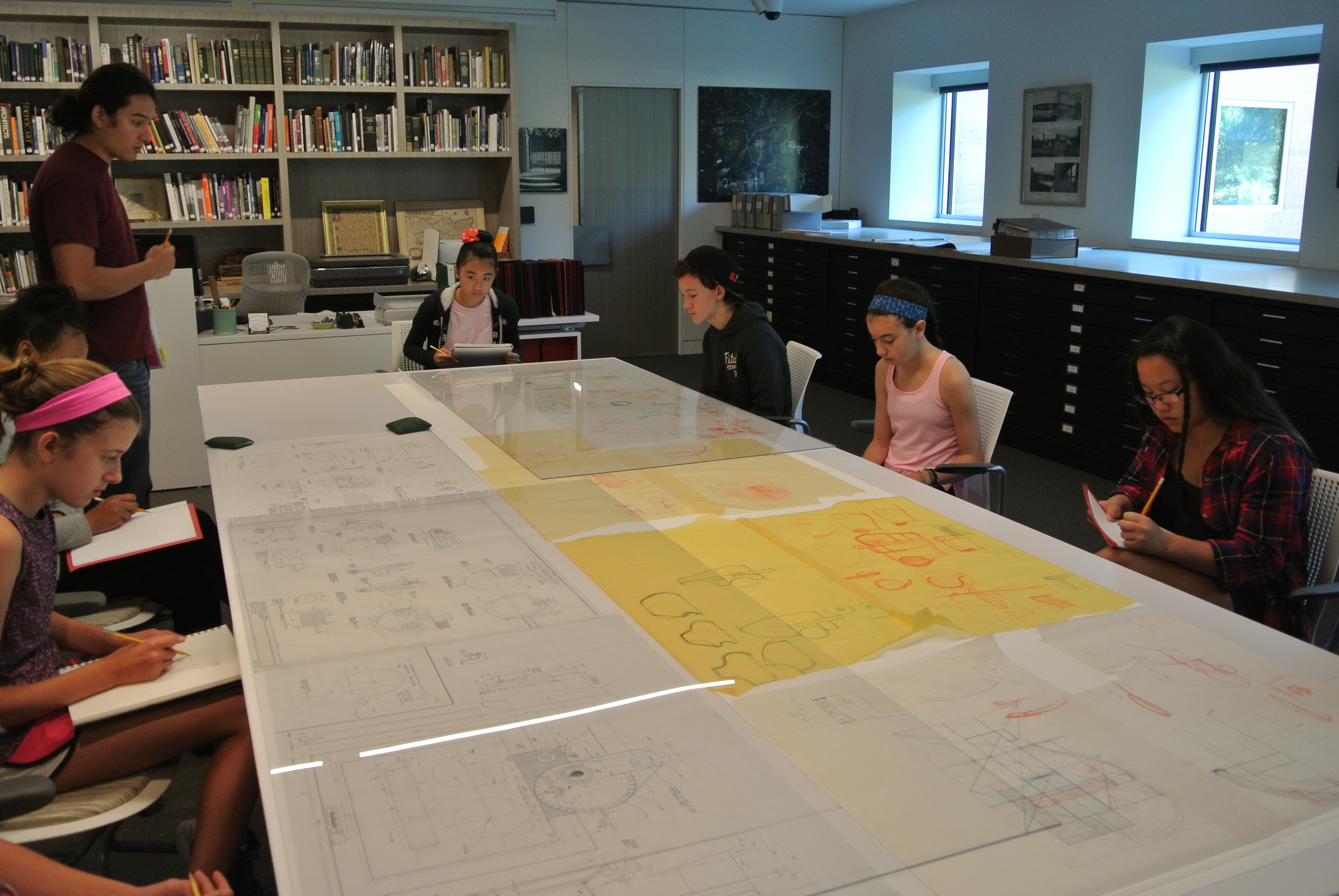
As summer camps are winding down, we wanted to share how campers used the collections in the Archives this week. Earlier in the week, my daughter, who is attending Cranbrook Art Museum’s camp session “Problem Solving by Design,” told me of the industrial design concepts they were learning. I immediately thought of the collection of Design Logic, Inc. Records that we have in the Archives, which contain beautiful color transparencies of 3D projects designed in the 1980s by David Gresham and Martin Thayer. (See Cheri Gay’s post.)

Studying the design drawings for the View Master and the Projector, Aug 2015.

Studying the design drawings for the View Master and the Projector, Aug 2015.

The next morning, I spoke with Kanoa, the camp instructor and a 2015 grad of the Academy of Art, and he agreed the photos would be great to show the kids. We coupled them with a copy of the exhibition catalog Cranbrook Design: The New Discourse, which featured several prototypes by Design Logic, as well as by other designers, many of whom studied under Kathy and Michael McCoy here at Cranbrook in the 1980s. The following day, I took the kids to the Art Museum vault to actually look at some of the objects. Kanoa had them do several sketches from different angles, all the while talking about various design concepts. Then the following day of course I had to show them some of Gresham and Thayer’s own design drawings which are also a part of the collection in the Archives. The kids were able to view conceptual sketches through finished drawings that were then sent to the manufacturer.

Sketching objects in the Cranbrook Art Museum vault, Aug 2015.

Sketching objects in the Cranbrook Art Museum vault, Aug 2015.

All in all, I hope it was a great experience for the kids. It certainly was fun for me to be able to enrich their camp experience with primary source materials from Cranbrook Archives.

Leslie S. Edwards, Head Archivist

Swimming Was a Privilege: The By-Gone Days of Lake Jonah

Mention Lake Jonah to anyone who has been around Cranbrook since 1999, and the response will be immediate – bittersweet. Fond memories mixed with sadness that it is not used as a swimming hole any longer. Originally referred to as the “Milles Fountain Lake,” the man-made lake is also known as Jonah Lake or Jonah Pool. Funded by George Booth as a place for community members to swim during the summer months, Lake Jonah, built in 1933, became a gathering place – for Trustees and Directors and their families, Academy of Art students and faculty, Summer Theatre and Summer Institute campers, Horizons-Upward Bound students, and hundreds of Cranbrook-Kingswood day and boarding school students, who all loved to hang out in the natural setting.

George Booth originally intended for the lake to be a water feature at the end of Academy Way, but quickly realized that people would swim in it anyway, so he turned it into a swimming pool. When the water was first turned on, a large amount of seepage was discovered so waterproofing of the pool bottom began in July 1934.

Lining the bottom of Lake Jonah

Lining the bottom of Lake Jonah, Sep 1934. Richard G. Askew, photographer.

The cost of construction was just over $34,000. This included the liner, the drain, paving, and landscaping around the pool, designed by Detroit landscape architect, Edward Eichstaedt. The pools covered 54,375 square feet (or 1.248 acres) and held 3,082,830 gallons of water.

Swimming lessons Summer Institute

Swimming lessons, Summer Institute, Jul 1946. Harvey Croze, photographer.

Initially overseen by the Cranbrook Central Committee (a department of the Cranbrook Foundation), Lake Jonah gradually became too expensive and too risky for Cranbrook Educational Community to maintain. Swimmers snuck onto campus at all hours and swam in the pools without lifeguard supervision. After the summer of 1999, the decision was made to close Lake Jonah for swimming and thus ended decades of summer memories.

Leslie S. Edwards, Head Archivist

Photo Friday: Academy of Art Graduation Day

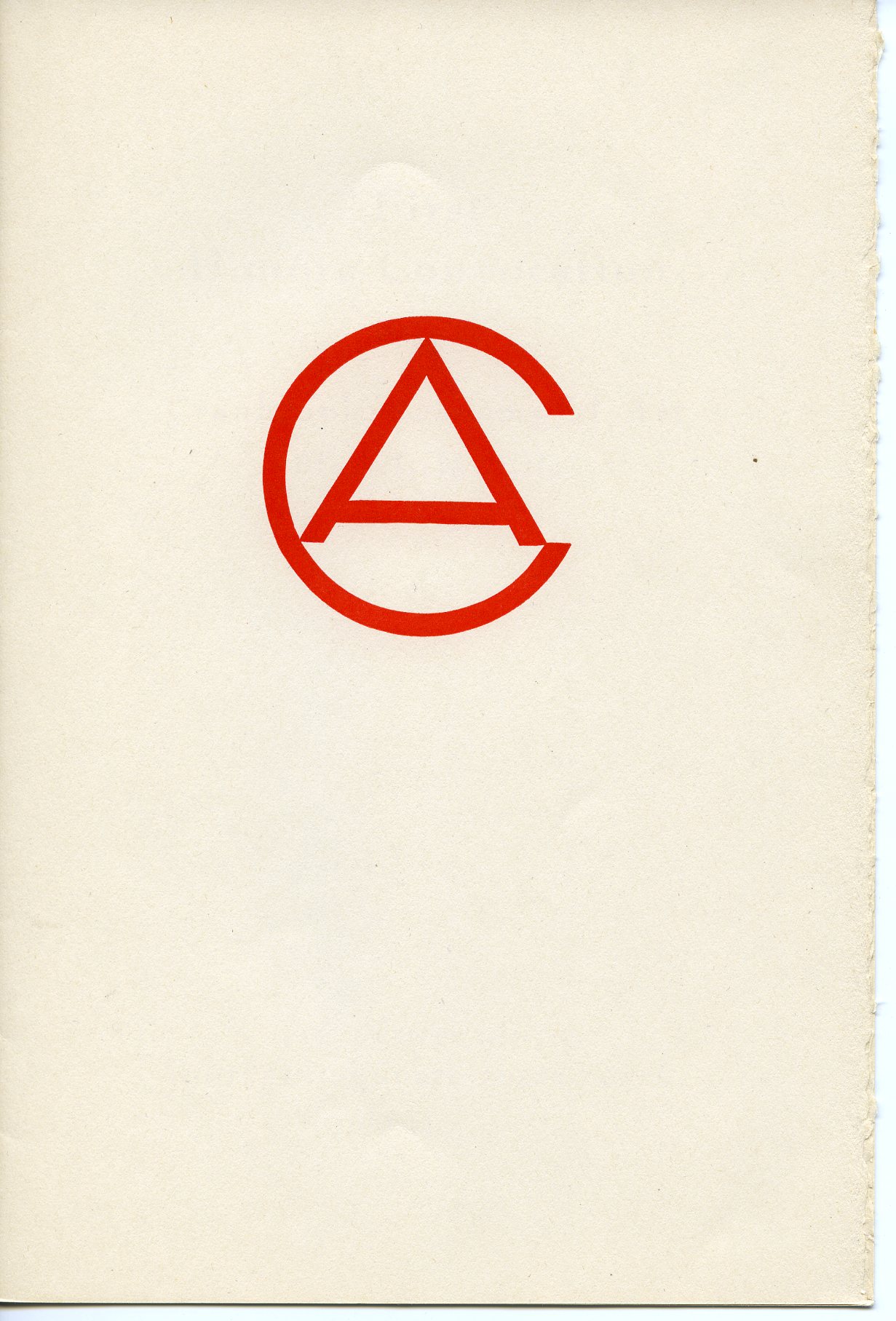
Congratulations to the Cranbrook Academy of Art (CAA) students who graduate today! In honor of today’s festivities we are posting a photo of the cover of the program for the first Honors Convocation (29 May 1943). Although the Academy had been educating students for ten years, it was not until 1942 that it became independent and chartered by the State of Michigan as an institution of higher learning with power to grant degrees. The class of ’43 was the first class to receive an accredited degree. Henry Scripps Booth presented the candidates and degrees were conferred by Eliel Saarinen.

CAA Honors Convocation, 1943

Cranbrook Academy of Art Honors Convocation, 29 May 1943. Courtesy Cranbrook Archives.

Gina Tecos, Archivist

Photo Friday: Viva Mexico!

With Cinco de Mayo quickly approaching, we are thinking about Mexico. George and Ellen Booth visited Mexico for two months in 1939. The image below was taken by their travel companion, Nellie Beveridge. The Booths traveled by rail and visited Chichen-Itza,Vera Cruz, Merida, and the ruins of Uxmal.

Temple of Quetzalcoatl

Temple of Quetzalcoatl, 1939. George Gough Booth Papers, Cranbrook Archives.

The Golden Anniversary of Horizons-Upward Bound at Cranbrook

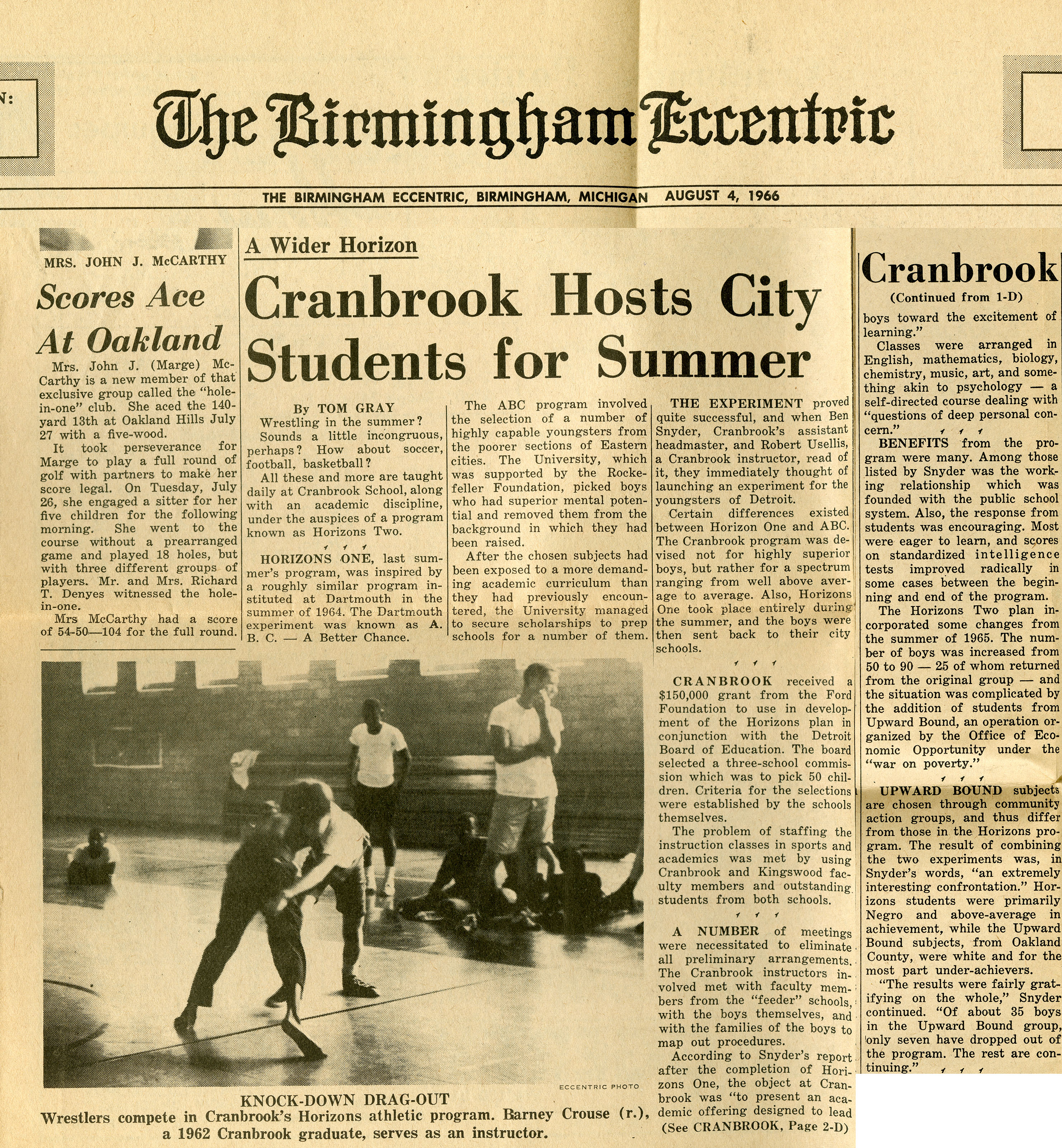
The Archives new exhibition, “50 Years Strong: The Evolution of HUB at Cranbrook,” opens this Saturday, April 25th, in the lower level of Cranbrook Art Museum. Horizons-Upward Bound, known as HUB, has its roots in a partnership with Cranbrook Schools that began in 1965. Over the past fifty years, HUB has evolved into a year-round program which prepares both boys and girls with limited financial opportunities to enter and succeed in post-secondary education.

HUB Theme Day, 1971

Horizons-Upward Bound Theme Day, 1971. Photographer, Jack Kausch. Cranbrook Archives.

The exhibition sheds light on the history of the program and its continued affiliation with Cranbrook Schools and highlights key individuals and events that have helped make it the successful legacy it is today. Through news clippings, program invitations, brochures and newsletters, student publications, and historic photographs, the exhibition presents a chronological history of the multi-faceted academic enrichment program known as HUB.

News Clipping, 1966.

News clipping, The Birmingham Eccentric, 1966. Cranbrook Archives.

Ways of the Designer: Betty Odle and the Wayanas

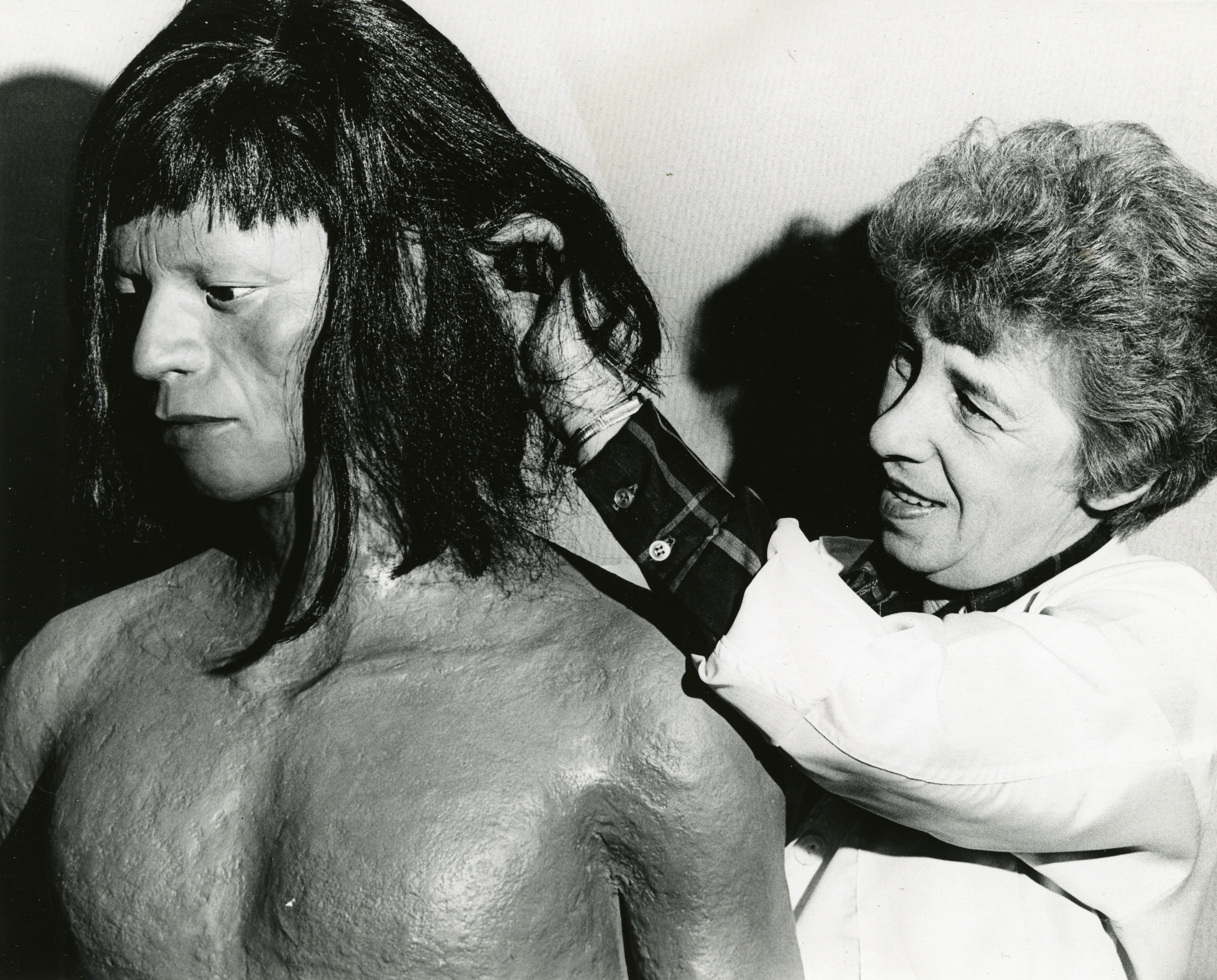
Early in 1969 then Cranbrook Institute of Science Director Warren Wittry gave exhibits designer, Betty Odle, an assignment to “design and build an exhibit on the Wayana Indian tribe of French Guiana and Suriname of northeast South America.” Odle and assistant Stella Toland worked over seven months to transform Caucasian store mannequins into the native Wayana people. Odle created the facial features, coloring, and anatomy from studies of photographs taken by explorer Art Erickson who lived with the Wayanas during his expedition to French Guiana.

Betty Odle adjusts a wig on a Wayana figure, Aug 1969. Cranbrook Archives.

Betty Odle adjusts a wig on a Wayana figure, 12 Aug 1969. Cranbrook Archives.

Creative modifications were necessary to create an accurate depiction of the Wayanas. Odle and Toland spent hours applying paper mache and plasticine to the bodies of the mannequins. Modeling clay was used to shape the faces before oil paint was applied to complete the finest details. The exhibit, “Ways of the Wayana,” opened in October 1969 and included a recreation of the “Wasp Mat Ceremony” with Odle’s life-size figures.

Betty Odle sits with the Wayanas she created, Sep 1969. Cranbrook Archives.

Betty Odle sits with the Wayanas she created, 10 Sep 1969. Cranbrook Archives.

Odle received high praise for the accuracy in her work by Erickson. Her work as the exhibits designer at the Institute spanned from 1959-1985. In 1984 she received Cranbrook’s Founder’s Medal for her many contributions to Cranbrook Educational Community.

Gina Tecos, Archivist

Anne Morrow Lindbergh: The Cranbrook Connection

The Archives has in its collection photographs of a sculpture modeled by Anne Morrow Lindbergh. How did Lindbergh come to study at Cranbrook? In April 1942, Charles Lindbergh, at the invitation of Henry Ford, came to metro-Detroit as a technical consultant to assist with retrofitting the Willow Run plant from auto manufacturing to bomber production. In July, the Lindberghs moved to Bloomfield Hills and signed a one-year lease for a furnished home then owned by Kathleen Belknap. Originally known as “Stonelea,” the home, designed by Albert Kahn in 1923, is located at the corner of Cranbrook Road and Woodward Avenue and is now known as Lyon House. The Lindberghs were quickly welcomed to the neighborhood by Carolyn Farr Booth (wife of Henry Scripps Booth). During the summer of 1943, Anne enrolled at the Cranbrook Academy of Art where she studied modeling and sculpture with sculptor Janet DeCoux, and art history with Ernst Scheyer. Since Charles was away much of the time, Anne asked Janet and her partner, Eliza Miller, to move in with her to help raise her four children. Thus began a friendship among the three women that lasted until the end of Mrs. Lindbergh’s life. (Approximately fifty letters, 1944-1952, from Anne Morrow Lindbergh to DeCoux can be found in the Janet De Coux Papers at the Smithsonian’s Archives of American Art.)
Anne Morrow Lindbergh

Anne Morrow Lindbergh, 1943. Cranbrook Archives.

At the Academy, Anne was treated not as the wife of a celebrity or even as a grieving mother, but as any other student. In her diaries (published in “War Within and Without”) Anne wrote of the freedom she experienced at Cranbrook “where people take me on faith.” Work in the studio, exhibitions at the Art Museum, and parties with music and conversation about art, books, and writing allowed Anne the freedom to “give my true self as I have never done in a group of people before.” She developed social courage and friendships with Janet and Eliza, Carl and Olga Milles, Ernst Scheyer, and neighbors like Kate Thompson Bromley. Her work as a sculptor taught her to see the world through a different lens – she learned how to sketch the human figure and transpose her ideas into her sculpture and it both surprised and excited her that she could actually see beauty in a sculpture, especially one made of her own hands. She was inspired by the natural beauty of Cranbrook, cross-country skiing on the grounds, and writing in her brown trailer in the woods. (Anne wrote her novella “The Steep Ascent” while at Cranbrook.) She relished the time with her children, and often walked them down the hill to Brookside School. Dinners with the Saarinens were exhilarating where they talked of “cities of the future.”

AnneLindbergh021

Anne Morrow Lindbergh picnicking at the Greek Theatre at Cranbrook, Jun 1944. Copyright The Detroit News.

In August 1943, Kathleen Belknap decided to sell the home, then known as Belwood, and the Lindberghs moved into a home at 411 Goodhue Road, behind Christ Church Cranbrook, for the next year. The two years spent at Cranbrook forever changed Anne spiritually. She discovered self-confidence, and that people liked her for who she was. After the Lindberghs returned to the east coast in 1944, Anne missed her Cranbrook friends and the life she had discovered here and wrote that she felt “only half alive since I left Cranbrook.” The Lindbergh family continued to return to the Detroit area to visit Charles’ mother Evangeline at her Grosse Pointe residence until she passed away in 1954. In January 1974, at the request of the Class of 1974, Kingswood School headmaster Wilfred Hemmer invited Anne to be the school’s forty-fourth commencement speaker.

Leslie S. Edwards, Head Archivist

Discoveries Around Campus

The dormers at Cranbrook House. Cranbrook Archives.

The dormers at Cranbrook House. Cranbrook Archives.

The staff at the Center for Collections and Research work closely with the Capital Projects and Facilities staff on campus restoration and repair projects. The archival staff often provides historical photographs, documentation, and architectural drawings to the project managers. Sometimes the staff makes interesting discoveries during the projects they are working on and share them with us.  The other day Craig Hoernschemeyer (Project Manager for Capital Projects) was in the archives looking for a historic photograph of a dormer window on the east addition (1918-1919) of Cranbrook House.  As luck would have it, he found one.  The following is from Craig:

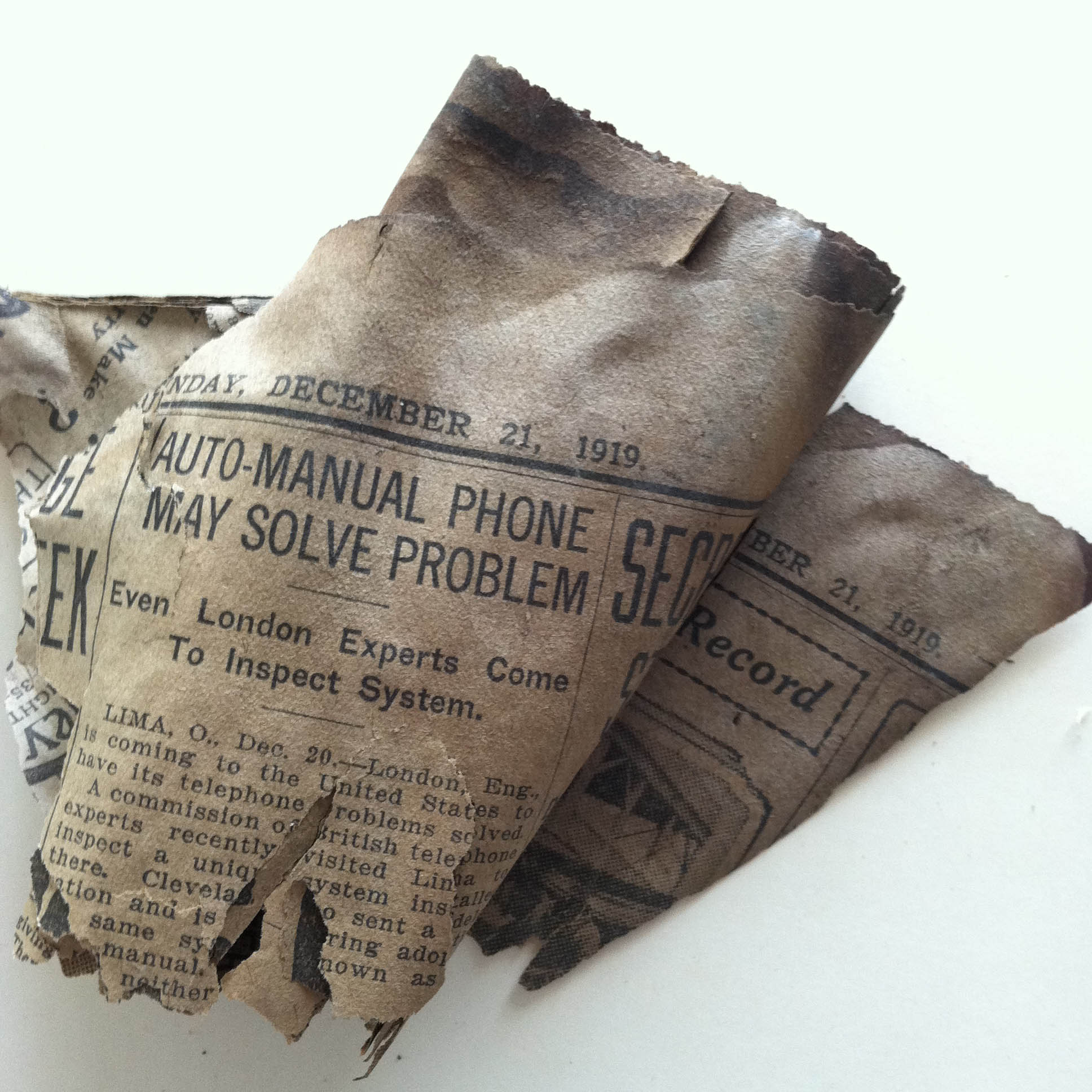
“Today, when the copper roof was opened up on that dormer – center right in the photo [above]- we found a bunch of newspaper mixed in with the insulation. It was no surprise that it was The Detroit News, but it was dated the first day of winter, December 21, 1919. It was there during the original construction of the wing.”

Detroit News, 1919. Photo Craig Hoernschemeyer.

Detroit News, 21 Dec 1919. Photo Craig Hoernschemeyer.

Leslie S. Edwards, Head Archivist

Create a website or blog at WordPress.com