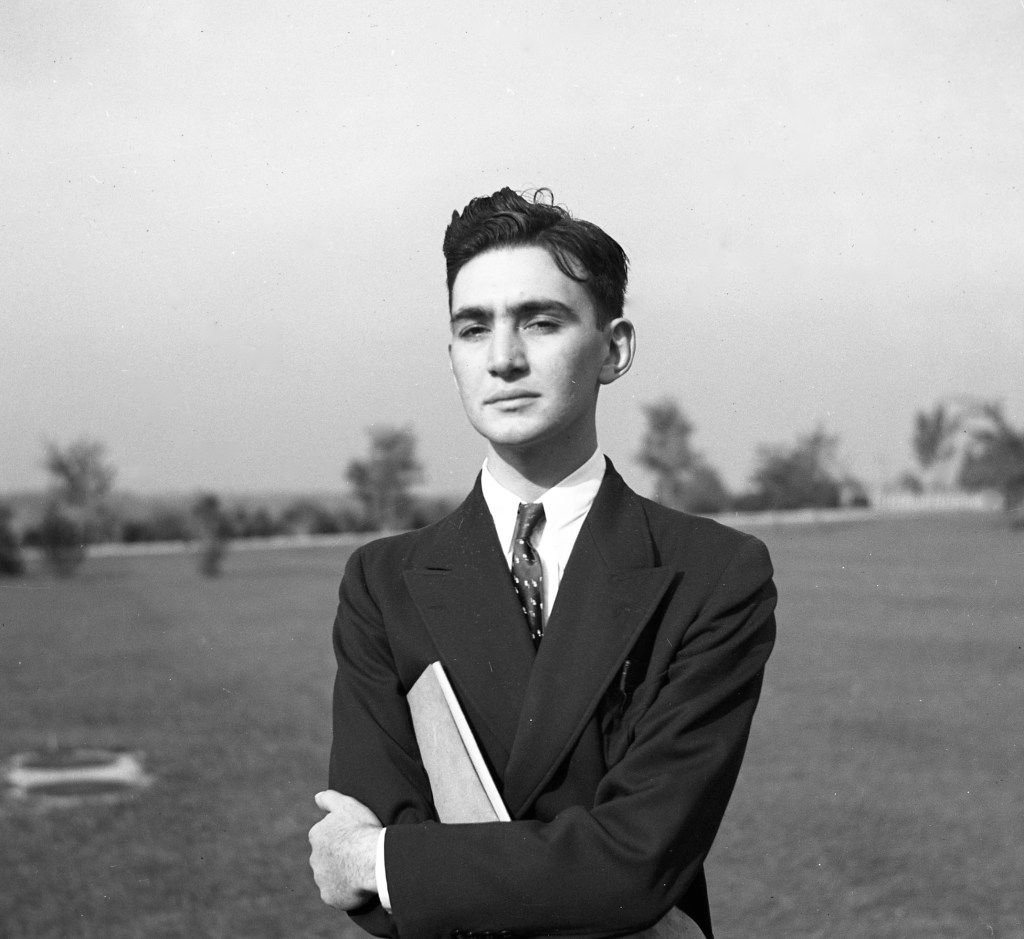
Happy Birthday Milles!

Any chance you have a trip planned to Europe this summer? If so, your itinerary really must include Stockholm. Not only is it a beautiful city—one of my favorites—but it also was home to one of Cranbrook’s most celebrated artists, Carl Milles. Long before he took up residence at Cranbrook, the Swedish sculptor started to plan and build his home and studio, Millesgården. Built high on a cliff overlooking Stockholm’s harbor, Millesgården now is a magical museum and sculpture park and the site of this year’s summer-long birthday party, The Sculptor Carl Milles at 150. Yes, if Carl Milles had lived to be the world’s oldest man, he would have turned 150 this Monday, June 23.


Carl Milles working in his Cranbrook Academy of Art studio, circa 1950. Margueritte Kimball, photographer. Courtesy of Cranbrook Archives.

While anyone taking the time to read this blog no doubt has an image in mind of one of Milles’s works at Cranbrook (there are no fewer than 45 outdoors on our campus and another 52 in the Art Museum or other buildings), my guess is that the story of the twenty years he spent working in America are a little foggy (unless, of course, you attended our 2021 virtual fundraiser, A Global House Party at Cranbrook and Millesgården, and watched the film, Carl Milles: Beauty in Bronze, we produced for the occasion). As a refresher course, or even a primer, I thought I would take you on a journey, one that starts in America and ends, twenty-two years later, back in Sweden (and Italy, as the case may be).

Milles arrived in the United States for the first time in October 1929. With the stated purpose of attending the opening of his second group exhibition in New York City, he took advantage of the trip to sell work to collectors, negotiate a commission in Chicago for his Diana Fountain, present the concept for the monumental doors he would create for the Pennsylvania State Capitol, and meet with Tage Palm, the President of the Chicago-based Swedish Arts and Crafts Company who would become his business manager. Most important for this next chapter of his career, he also traveled by train to Michigan where he met with George Booth who asked him to teach at the art school he was building north of Detroit, Cranbrook Academy of Art.

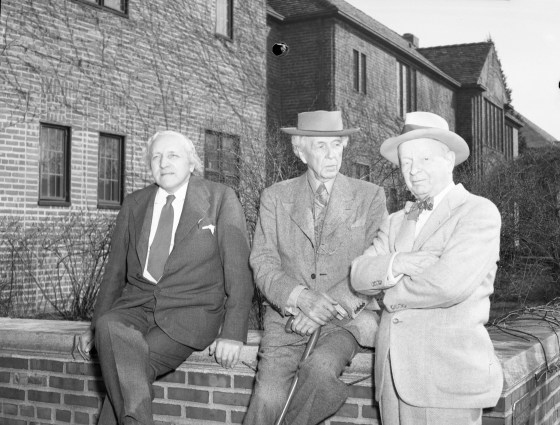
Carl Milles, Frank Lloyd Wright, and Eliel Saarinen (l to r) outside Saarinen House, March 1945. Harvey Croze, photographer. Courtesy of Cranbrook Archives.

George Booth and his wife Ellen Scripps Booth, as most Cranbrook Kitchen Sink blog readers know, were wealthy newspaper publishers and philanthropists. Although their flagship paper, the Detroit News, was based in Detroit, their home was in the countryside of Bloomfield Hills. By the late 1920s, they had begun to work with the Finnish architect Eliel Saarinen to transform their private estate into an educational community that eventually included an Episcopal church, boys and girls schools, an art academy and museum, and an institute of science (and, even later, a center for collections and research). Although the archival record is a little murky, Saarinen and Milles were at least acquaintances long before the sculptor met with his future patron at Cranbrook.

As Milles contemplated moving to Cranbrook to direct the Academy’s Sculpture Department, there was one small problem: he had no desire to teach. Two years and many conversations later, Booth and Milles came to an agreement: the sculptor would not need to “teach” but simply “mentor” students in his studio. (Not a bad deal!)

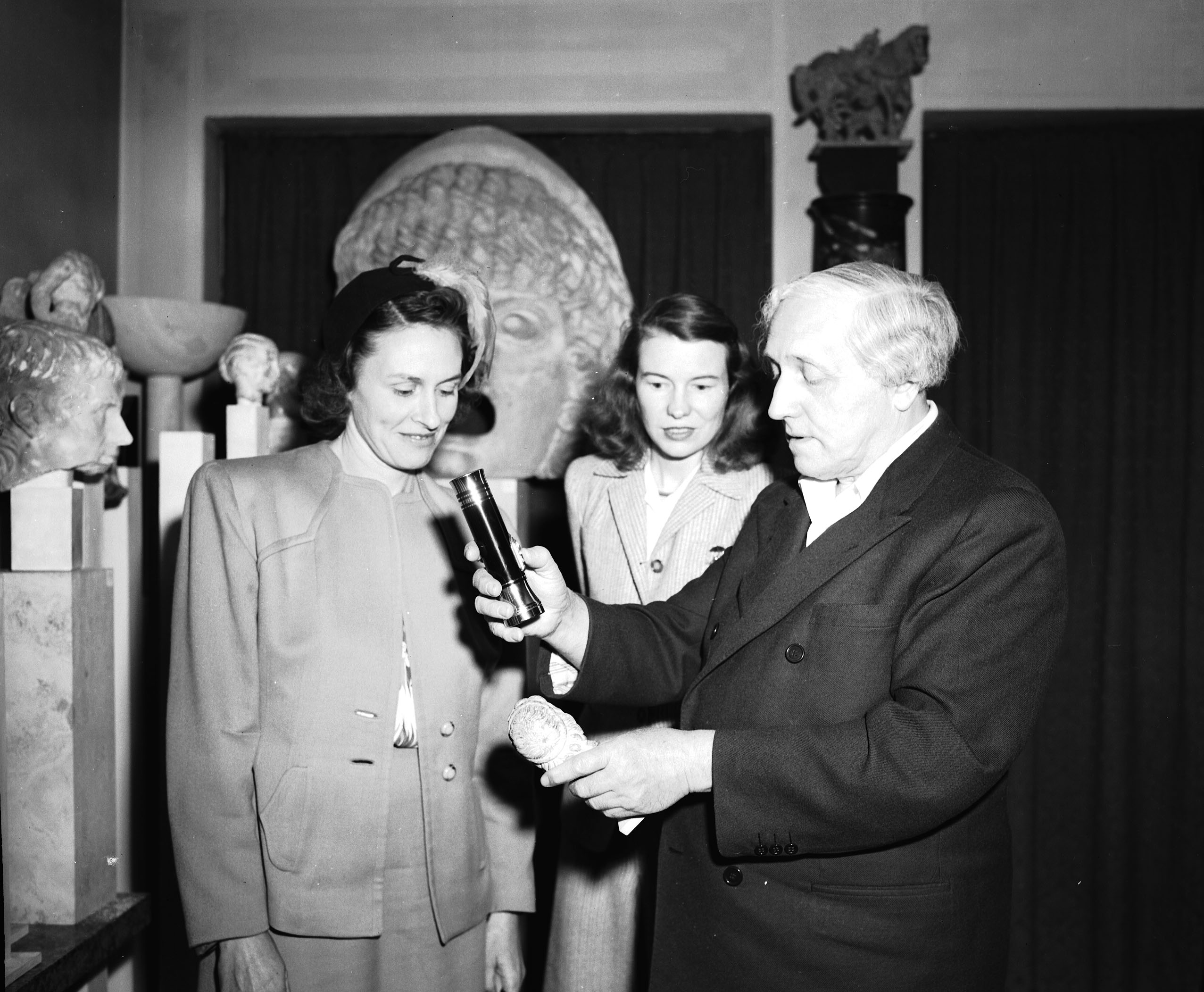
Carl Milles discusses details of a sculpture during an open house, 10 May 1947. Courtesy of Cranbrook Archives.

In January 1931, Carl and his wife Olga Milles arrived at Cranbrook where they lived for the next twenty years. Their home, where they displayed Milles’s collection of ancient sculpture, was designed by Saarinen, as were his three studios—including the grand thirty-foot-tall studio Milles used for his largest commissions such as the Orpheus Fountain for the National Concert Hall in Stockholm.

Carl Milles in his studio at Cranbrook Academy of Art, sculpting the figure of Orpheus for the Orpheus Fountain, 1934. Richard G. Askew, photographer. Courtesy of Cranbrook Archives.

But Milles was not satisfied. He wanted to be surrounded by his sculpture just as he was at Millesgården. The four works Booth had acquired—including the only work Milles made at Cranbrook for Cranbrook, the playful Jonah Fountain—were not enough. In 1934, in the middle of the Great Depression, Booth agreed to pay Milles a princely sum—$120,000 and change—for sixty-three of his sculptures. This purchase not only included most of the works that had been part of a traveling exhibition that opened in St. Louis in 1931, but also casts of the eight figures from the Orpheus Fountain and his monumental Europa and the Bull from the fountain in Halmstad.

Milles’s Triton Pools, looking north towards Europa and the Bull, and beyond that, the future site of Cranbrook Art Museum, circa 1934. Richard G. Askew, photographer. Courtesy of Cranbrook Archives.

The decision, one that would come to define Cranbrook’s campus, was supported by Milles’s fellow Scandinavian and friend Eliel Saarinen, who Booth had named the President of Cranbrook Academy of Art in 1932. Indeed, there was a feeling of mutual respect between the architect and the sculptor, with Saarinen realizing that Milles’s work would enhance the buildings and Milles realizing that Saarinen’s architecture provided the perfect context.

Continue reading

Did Leonard Bernstein Write “West Side Story” at Cranbrook?

With Maestro now streaming on Netflix—and nominated for four Golden Globe Awards—it’s high time I set the record straight about the Cranbrook House Steinway Grand and its most famous pianist, Leonard Bernstein. It is a legendary story, told and retold for decades, that places Bernstein composing none other than his most famous work, West Side Story, here, at Cranbrook.

It is a story, however, that is hard to unravel fact from fiction. So, like all Center historians and archivists, I started by doing some digging in Cranbrook Archives. This is the story I uncovered.

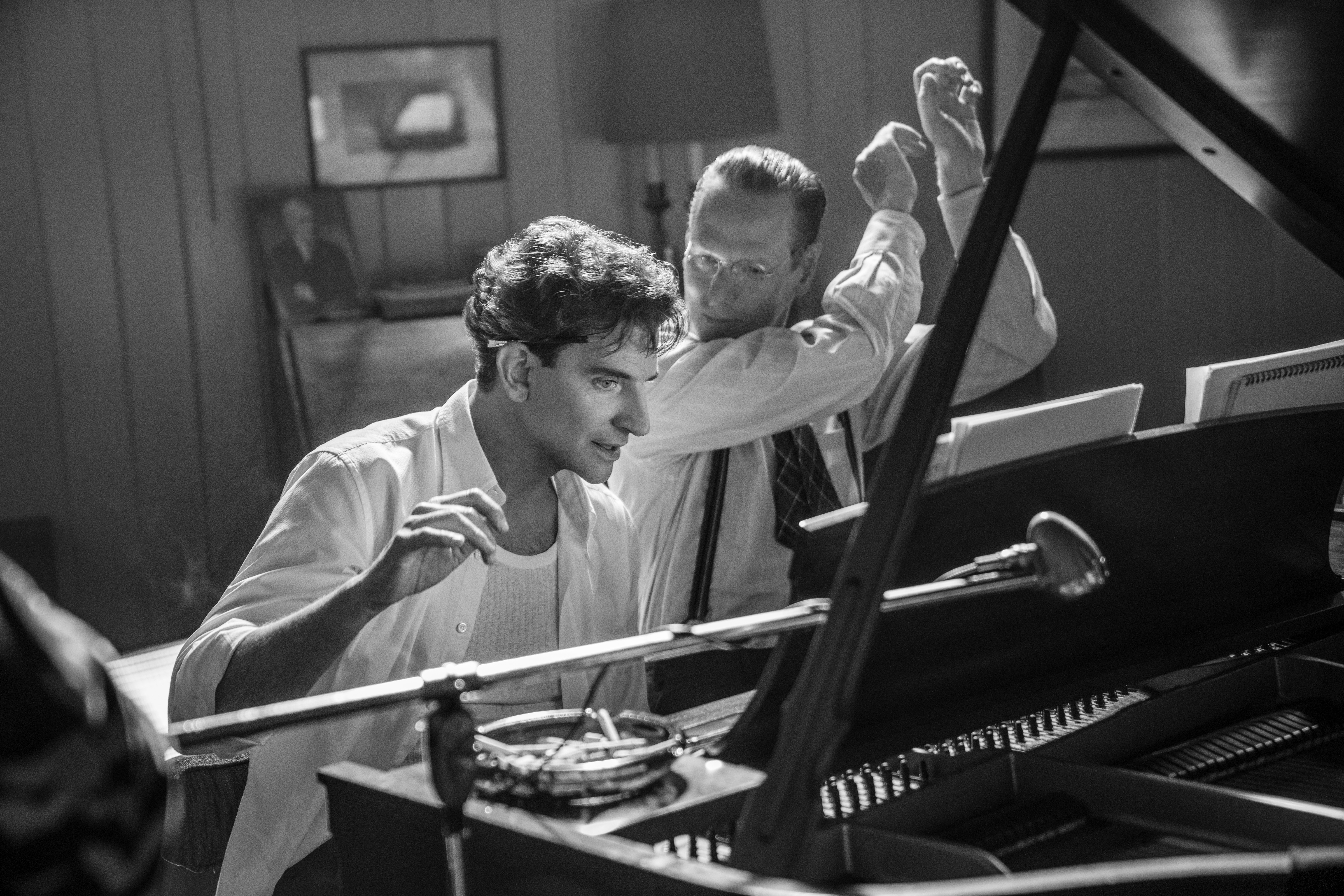
Bradley Cooper as Leonard Bernstein, and Brian Klugman as Aaron Copland in Maestro. Courtesy of Netflix © 2023.

First, the Piano

Cranbrook has several Steinway grand pianos, including two of the grandest: a Model D concert grand in Page Hall on the original School for Boys campus, and a second Model D in the Cranbrook House Library. The Cranbrook House concert grand piano was manufactured by Steinway & Sons of New York City and completed a little more than eighty-five years ago on December 18, 1929. It was purchased by Grinnell Brothers of Detroit in January 1930 and, later that year, sold to the Colony Town Club, a women’s club located on East Jefferson Avenue in Detroit.

Cranbrook House library facing south. Steinway & Sons Model D Concert Grand piano sits below the “Story of Ceres” tapestry, March 1957. Photographer Harvey Croze. Courtesy of Cranbrook Archives.

Enter, George Booth

The black concert grand piano was to have a short life at the Colony Town Club. Within a few years, its members sold it back to Grinnell Brothers where, in February 1935, it was purchased by George Booth. I remain intrigued by the fact that Booth purchased a “pre-owned” piano. While America was in the throes of the Great Depression, I think it was more than a simple cost-saving measure; it was a decision warranted by the piano’s intended use.

The piano did not begin its life at Cranbrook in the Booths’ Library, the center of their social life after it was completed in 1919. Rather, Booth first placed the piano in the main hall of the Cranbrook Pavilion on Lone Pine Road. Known today as St. Dunstan’s Playhouse, in 1935 the recently renovated pavilion was being used as an exhibition gallery and event space for the Academy of Art and its nascent Art Museum. The piano was played at exhibition openings and for preludes before lectures, including at least one by Frank Lloyd Wright. Although St. Dunstan’s Guild began using the pavilion in 1937 for rehearsals and storage, Cranbrook Academy of Art continued to hold exhibitions there until 1942, when the new Eliel Saarinen-designed museum opened.

Cranbrook Pavilion staged for an Academy of Art formal party, January 16, 1936. In the center is what would become known as the Cranbrook House Steinway concert grand piano; in the background is the Cranbrook Map Tapestry, designed by Eliel Saarinen and woven by Studio Loja Saarinen in 1935. Courtesy of Cranbrook Archives.

Sometime between 1942 and the summer of 1946, when the pavilion was cleared out and rented by the Cranbrook Foundation to St. Dunstan’s Guild, George Booth moved the Steinway down the road to Christ Church Cranbrook “to protect the instrument from damage by dampness or other causes and to give it the benefit of expert use.” It was also during this period, in March 1944, that George and Ellen Booth formally deeded to the Cranbrook Foundation the Homestead Property, which encompassed not only Cranbrook House but also the forty acres adjacent to the house, including the Cranbrook Pavilion and its Steinway.

Enter, Leonard Bernstein

Continue reading

Mail Matters: Another Michigan Mural

On the eve of World War II, while Americans continued to suffer from the economic fallout of the Great Depression, the United States Treasury Department’s “Section of Fine Arts” commissioned Zoltan Sepeshy, the Head of the Painting Department at Cranbrook Academy of Art, to paint a mural for a new post office in downtown Caro. At the same time, one of his star students, David Fredenthal, was commissioned to paint a mural for the new post office in Lincoln Park. (Having trouble placing Caro, if not also Lincoln Park, on a map of Michigan? For your first geography lesson, place your right hand, palm side up, next to you. Caro is located in the middle of your thumb, while Lincoln Park is closer to your wrist.)

Separate and distinct from the more extensive and influential WPA or Works Progress Administration’s “Federal Arts Project,” which essentially was a work-relief program for artists, the purpose of the Treasury Department’s “Section” program, as it came to be known, was “to secure for the Government the best art which this country is capable of producing, with merit as the only test.” Sepeshy and Fredenthal, with their recently minted Cranbrook credentials, fit the bill. Fredenthal even had some mural experience, having recently painted an octopus mural for the Academy’s now infamous Crandemonium Ball in 1936.

Octopus mural by David Fredenthal for Crandemonium Ball, March 1936. Cranbrook Archives.

Meanwhile, Jimmy Southers, Lincoln Park’s postal superintendent, was more than a little perplexed and worried about the mural David Fredenthal was to paint for his post office. The week of September 25, 1939, Southers received a letter from Washington notifying him that Fredenthal, who the government described as a “sensational young artist” from Cranbrook Academy of Art, had been named to paint the mural—a fresco no less. Southers, who more than likely had not paid a visit to the seven-year-old Academy in Bloomfield Hills, not only had no idea what a fresco painting was but was intimidated by the government’s suggestion that he was to confer with the artist about the subject matter. His big idea? He thought a mural showing all of Lincoln Park’s postal superintendents (no doubt with him in a position of prominence) would do just fine.

Fortunately for Southers, geography intervened. Pulling out his own map of Michigan, Sepeshy did some calculations (which I just repeated using Google Maps). Realizing that Caro was some seventy-two miles from his studio in Bloomfield Hills while Lincoln Park was just twenty-six, the Hungarian painter decided to pull rank. He had the commissions switched and assigned the Caro project to his student while he decided to paint the mural in Lincoln Park, a few miles south of Dearborn.

Continue reading

Welcome Deborah Rice, New Head Archivist!

I am quite thrilled to announce that we have an outstanding new Head Archivist (and future Kitchen Sink blogger), Deborah Rice. Let me take this opportunity to introduce her to the readers of the Kitchen Sink Blog.

Deborah has over seventeen years of experience as a professional archivist. For the past fifteen years, she has been working in Detroit at Wayne State University with the Walter P. Reuther Library, Archives of Labor and Urban Affairs.  At Wayne she not only served as a Collection Archivist, Technical Services Archivist, and Audiovisual Archivist, but also the Interim Assistant Director—all of which are invaluable experience for her work here at Cranbrook. Prior to her work at Wayne, she was the Archivist for the Detroit Institute of Arts Research Library & Archives.

Deborah holds a BA in Art History from the University of Michigan and an MLIS degree (Master of Library and Information Services) and Archives Administration Certificate from Wayne State University. Equally important is what you will find to be her warm and engaging personality, and her sincere desire to engage audiences and help us make Cranbrook Archives a welcoming environment for our on-campus visitors and a digitally accessible resource for an even broader public worldwide.

In her first weeks here, Deborah has been off to a running start learning about Cranbrook history, getting a lay of the land and our extensive archival holdings, meeting with a potential donor in Lansing, and helping Cranbrook staff and our many outside researchers in our endless stream of research requests.

While there will be many opportunities to meet Deborah later this fall, her first official public event will be the Center’s gala fundraiser on Saturday, September 21: “A House Party at Cranbrook: History in the Making.”  The event, which focuses this year on the nearly 80-year journey of Cranbrook Archives, will include tours of three campus locations that have been, are, and hopefully will be important to the Archives future.  These include the current Reading Room where Deborah will be sharing with you some of the Archives’ hidden treasures.

We are grateful that Deborah made the decision to take the same journey that our founders made in 1904, traveling up Woodward Avenue from Detroit to Bloomfield Hills.  You can look forward to new blog posts from her very soon!

Greg Wittkopp, Director, Cranbrook Center for Collections and Research

Green Book, Don Shirley, and Henry Booth: Because There’s Always a Cranbrook Connection

It was the morning after New Year’s Day. No sooner had I reached my office and turned on my computer than I saw that I had just missed a call from long-time Cranbrook friend and Kingswood graduate, Jeanne Graham. Always eager to speak with Jeanne, I immediately returned her call. Jeanne, who had not even taken time to leave me a message, already was in the processing of dialing the Center’s archivists. She had a question and was eager for an answer.

Like Jeanne, one of the movies that I saw over the holidays (one of the best, I might add) was Green Book. Masterly cast with Mahershala Ali as the legendary African-American classical and jazz pianist Don Shirley and Viggo Mortensen as the Italian-American bouncer-cum-driver and bodyguard “Tony Lip” Vallelonga, the film tells the story of a road trip (a concert tour) through the Jim Crow South of the early 1960s and the unlikely friendship that develops along the way. While I was watching the movie, Cranbrook was the furthest thing from mind; while Jeanne was watching the movie, she could not get Cranbrook out of her mind. “Was it my imagination or did I attend a concert by Don Shirley in Kingswood Auditorium while I was a student at Cranbrook in the 1950s?” Jeanne asked.

Admittedly stumped, I did what any good director would do—I consulted my knowledgeable staff. Within minutes, tantalizing facts were speeding their way to me from Associate Archivist Laura MacNewman: articles in the Clarion and the Crane, Kingswood’s and Cranbrook’s student newspapers; a concert announcement in the Birmingham Eccentric; links to nineteen Kingswood negatives; and references to thirteen letters sent between Shirley and his agents and Henry Scripps Booth, the youngest son of Cranbrook’s founders. Finally, Laura calmly announced that she had found black and white photographs of Shirley swimming and riding a bike at Henry’s and his wife Carolyn’s home near Cranbrook, Thornlea. I, meanwhile, yelled out in excitement!

Who knew? Well actually, there are a few people that did know. Before I could even begin to sift through the materials in Cranbrook Archives, I received a call from Carolyn Scripps, Henry and Carolyn Booth’s granddaughter. Carolyn also had seen Green Book and wanted to make sure that I knew about the story of her progressive grandfather and Shirley.

Scene One. Shirley did, in fact, perform in Kingswood Auditorium on Wednesday, March 2, 1955 (and yes, it was while Jeanne Graham was a student). Shirley, who was twenty-seven years old at the time, was accompanied by bassist Richard Davis. They performed nine songs that evening, many of which the two musicians recorded on Shirley’s 1955 album Tonal Expressions, including one of my favorites, “No Two People Have Ever Been So in Love.” What does a rendition by Shirley of a popular song like “No Two People” sound like? In the words of Henry Booth: “While the concert was labeled ‘Jazz,’ the music was a subtle rendering of the contemporary, having a classical quality which should appeal to the devotees of classical music—that is if they will condescend to listen.” Five days after this classically inspired, popular jazz concert, Henry wrote his first letter to Shirley (at least the first one that survives in Cranbrook Archives). With regards from his wife Carolyn and their daughter Melinda (Carolyn Scripps’s aunt), Henry invited the pianist to consider a second performance at Cranbrook sponsored by the nascent Cranbrook Music Guild.

The Clarion, March 11, 1955. Collection of Cranbrook Archives.

Scene Two. While it took numerous letters from Henry to both Shirley and his agent—and some convincing of the Music Guild members who Henry described to Shirley as not very “’Jazz’ minded”—the pianist and bassist returned to Cranbrook in December. Thanks to clippings from the Birmingham Eccentric and the Crane, we know the concert took place on Saturday, December 3, 1955, and, like the first concert, it took place at Kingswood. And thanks to a page in the Thornlea Guest Book, now in the collection of Jeffrey Booth (Henry and Carolyn’s grandson), we also know that Henry and Carolyn hosted an Afterglow for the musicians that evening in their home on Cranbrook Road.
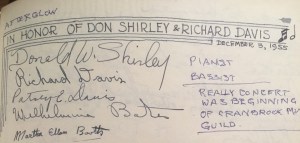
Thornlea Guest Book, Detail of Guest List for December 3, 1955. Collection of Jeffrey Booth.

Scene Three. Henry Booth was a documentarian. Included in the Henry Scripps Booth and Carolyn Farr Booth Papers, which are preserved—and accessible—in the Cranbrook Archives, are a series of photo albums that chronicle and illustrate Henry’s and Carolyn’s lives. The 1956 album includes seven black and white photographs of Shirley. While they were processed in July, another entry in the Thornlea Guest Book more precisely places both Shirley and Richard Davis at Cranbrook on June 20, 1956. Three of the photographs were taken by Henry at a night club, presumably Baker’s Keyboard Lounge in Detroit where the Don Shirley Duo performed no less than twelve times that June. One shows Shirley on stage, while the other two show Carolyn and Melinda Booth in the audience, including a photograph of Carolyn and Shirley sitting together at a table. The other four show Shirley relaxing at Thornlea—sitting in a wicker chair, swimming in the pool, riding a bike in the courtyard, and posing with the Booth’s youngest child, Melinda’s sister Martha (Carolyn Scripps’s mother). Henry, ever the Cranbrook publicist, dutifully followed up the visit by sending to Shirley “a selection of Cranbrook catalogs and booklets.”

Scene Four. There is where it gets interesting. While Green Book has Shirley and Tony Vallelonga departing from Shirley’s Carnegie Hall apartment and beginning their 1962 concert tour with a stop in Pittsburgh before immediately heading south, the actual route also brought them to Detroit. During the road trip, Vallelonga wrote letters to his wife Dolores. In an excerpt from one of the letters, published on Cinemabuzz.com, Vallelonga wrote:

Dr. Shirley decided to stop off in Detroit for a day to visit some people he knows, you remember I told you he knows people wherever he goes and he knows all big people (millionaires). We went over some guy’s house, I’m sorry I meant a mansion, it was really a castle. His name was Henry Booth, he lives in a place called Mich Hills, it’s like Riverdale Yonkers, but the place makes Riverdale look like the Bowery. Dolores, I never saw such beautiful and fabulous homes in all my life.

I’m guessing this visit to “Mich Hills” took place in April 1962. In a letter dated April 25, Henry wrote to Shirley, referencing a visit that took place “a week or so ago.” Eager for another concert at Cranbrook, Henry proposes that the Music Guild bring the Don Shirley Trio to Cranbrook that summer for a week of concerts in the Greek Theatre. But he also references “Carol’s original idea” (Henry referred to Carolyn as Carol): she wanted Shirley to be their guest at Thornlea on August 11, which would have been Henry’s sixty-fifth birthday. In his letter Henry was emphatic: “This is a definite date — put it down please!” In the only letter in the Archives from Shirley to Booth, Shirley references their telephone conversation and offers a very business-like reply to the concert requests: “Although our usual contract fee for an evening concert by the Trio is $2500.00, we would be delighted, for various reasons, to play at Cranbrook during the evening of 12 August 1962 for a special all-inclusive fee of $1250.00.” Alas, even the comprehensive records of Cranbrook Archives contain no evidence that the summer concerts or birthday party guest appearance transpired.

Letter from Don Shirley to Henry Booth, Summer 1962. Collection of Cranbrook Archives, Henry Scripps Booth and Carolyn Farr Booth Papers (Box 40: Folder 9).

Final Scene. In April 1986, as Henry Booth approached his eighty-ninth birthday (he would live to be ninety), Henry reached out to Shirley one more time. Reminiscing about the first concerts in Kingswood Auditorium, one of which Jeanne Graham attended, Henry wrote hopefully about one more concert:

I hope a concert by you can be arranged for next fall or winter, although a summer concert in Cranbrook’s Greek Theatre would be a fine location except for having a good, well-tuned piano at your disposal rather than rain or a shower! Will you put me in touch with your agent? Please do! Meanwhile a big hug for Don Shirley.

The trail in the Archives ends with Shirley sending Henry a flyer of his upcoming concert in Carnegie Hall (where Shirley still lived in an apartment). At the very bottom the pianist simply drew an arrow pointing to the contact for his agent noting, “It’s all here.”

It is, indeed, all preserved here in the Cranbrook Archives. Because there will always be a Cranbrook connection that needs to be researched and a Cranbrook story that needs to be shared.

Gregory WittkoppDirector
Cranbrook Center for Collections and Research


Create a website or blog at WordPress.com