A Donkey for Christmas: Brighty Comes to Cranbrook

George G. Booth’s “Old Country Office” at Cranbrook House. Photograph by Kevin Adkisson.

Every year at Christmas, the Center for Collections and Research decorates George Booth’s office in Cranbrook House with a special display. This year, our Christmas display is all about Brighty of the Grand Canyon, a movie produced by Stephen Booth, a grandson of Cranbrook’s cofounders. Brighty was a real donkey who inspired first a children’s novel, then a feature film.

In the late 1800s, there were hundreds of half-wild donkeys in the Grand Canyon, brought there by prospectors and then lost or abandoned. Brighty was one of them. 

Photograph by Kevin Adkisson.

Brighty lived in the Grand Canyon from 1892 to 1922. In the winter, he roamed the warm depths of the canyon. A sociable animal, he liked the company of prospectors, hunters, and hikers, but if anyone loaded a heavy pack on his back he would soon make his escape. Every summer, he returned to the North Rim to stay with the McKee family who rented cabins to tourists. He would carry water, give children rides, and visit each cabin in turn for attention and treats—his favorite food was flapjacks and honey.

In 1953, the author Marguerite Henry learned about Brighty, and immediately decided to base her next novel on him. In search of more stories about the adventurous donkey, she travelled to the Grand Canyon herself, where she interviewed locals who had known him, hiked in the canyon, and even sampled the creek water and tasted the plants that Brighty would have eaten! She adopted her own donkey, Jiggs, to learn from him how the real Brighty might have behaved. In Brighty of the Grand Canyon, a free-spirited donkey helps solve a murder mystery and protects his human friends from a dangerous bandit.
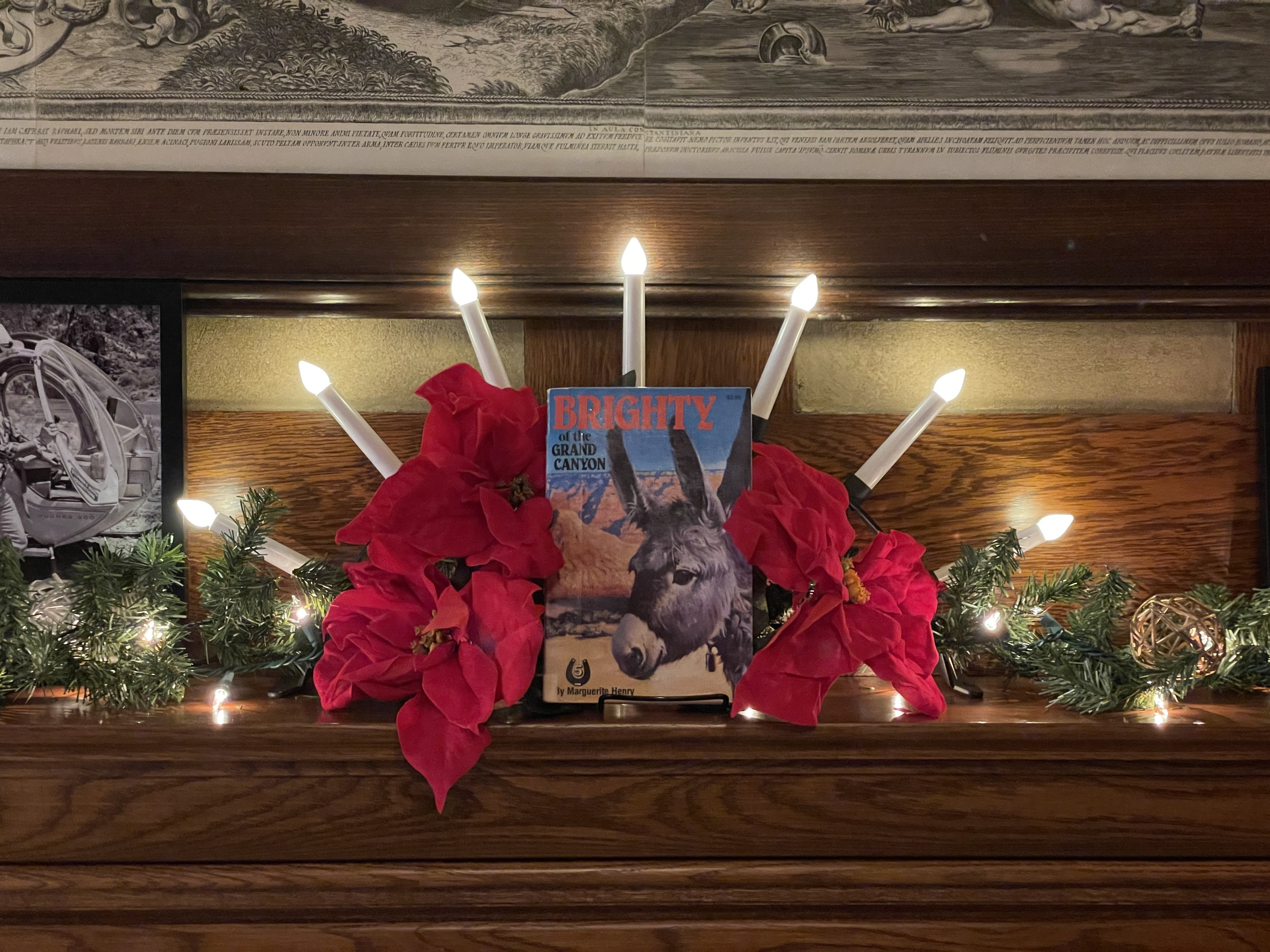
This is the 1963 edition of the novel, the same year that the Booths bought a copy to read on their family road trip. Photograph by Kevin Adkisson.

Stephen Booth and his wife Betty bought a copy of the book to read to their children, Douglas, Charles, and George. They all loved the story, especially Stephen, who had his own film production company, and decided to make a movie about Brighty. 

Filming began in 1965, with Marguerite Henry’s own pet donkey, Jiggs, starring as Brighty. Filmed on location at the Grand Canyon and in the Dixie National Forest in Utah, the actors and crew spent weeks living in the canyon. A tiny helicopter and an airplane with a camera mounted on the front were used for aerial shots, and for flying special visitors, like Stephen’s parents, Henry and Carolyn Booth, down into the canyon. 

Norman Foster, the film’s director, reviews the script with Jiggs the Donkey. Stephen Farr Booth Papers, Cranbrook Archives

The movie premiered on November 22, 1966, just down the road in Birmingham, doubling as a fundraiser for Kingswood School for Girls. As the star of the movie, Jiggs himself came along to the premiere. Afterward, he participated in the Festival of Gifts at Christ Church Cranbrook, an annual Christmas tradition that began in 1928 and continues today. 

From left to right: Betty Booth, Stephen Booth, Marguerite Henry, and Jiggs greet children at the film’s premiere. Stephen Farr Booth Papers, Cranbrook Archives.

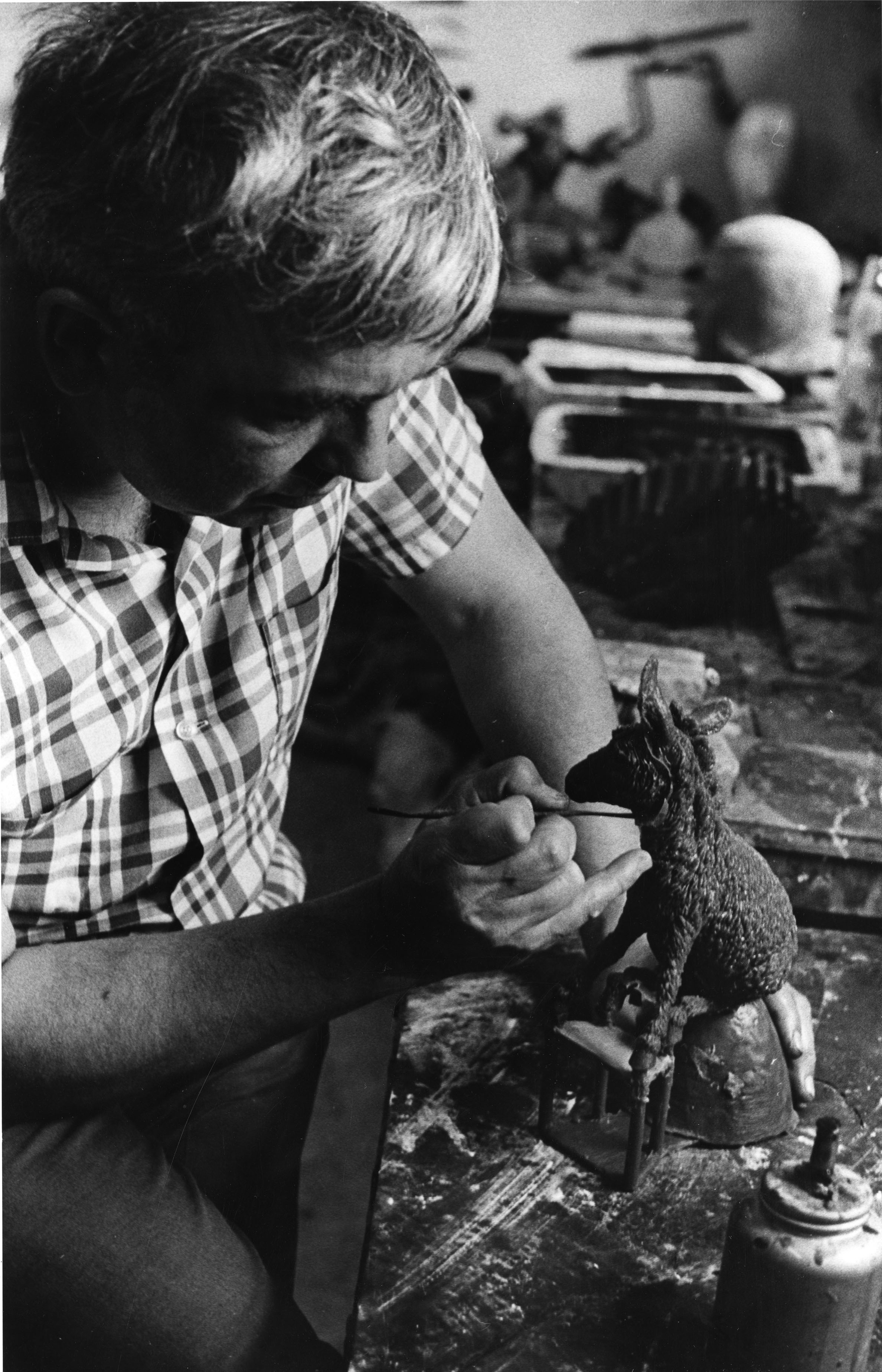
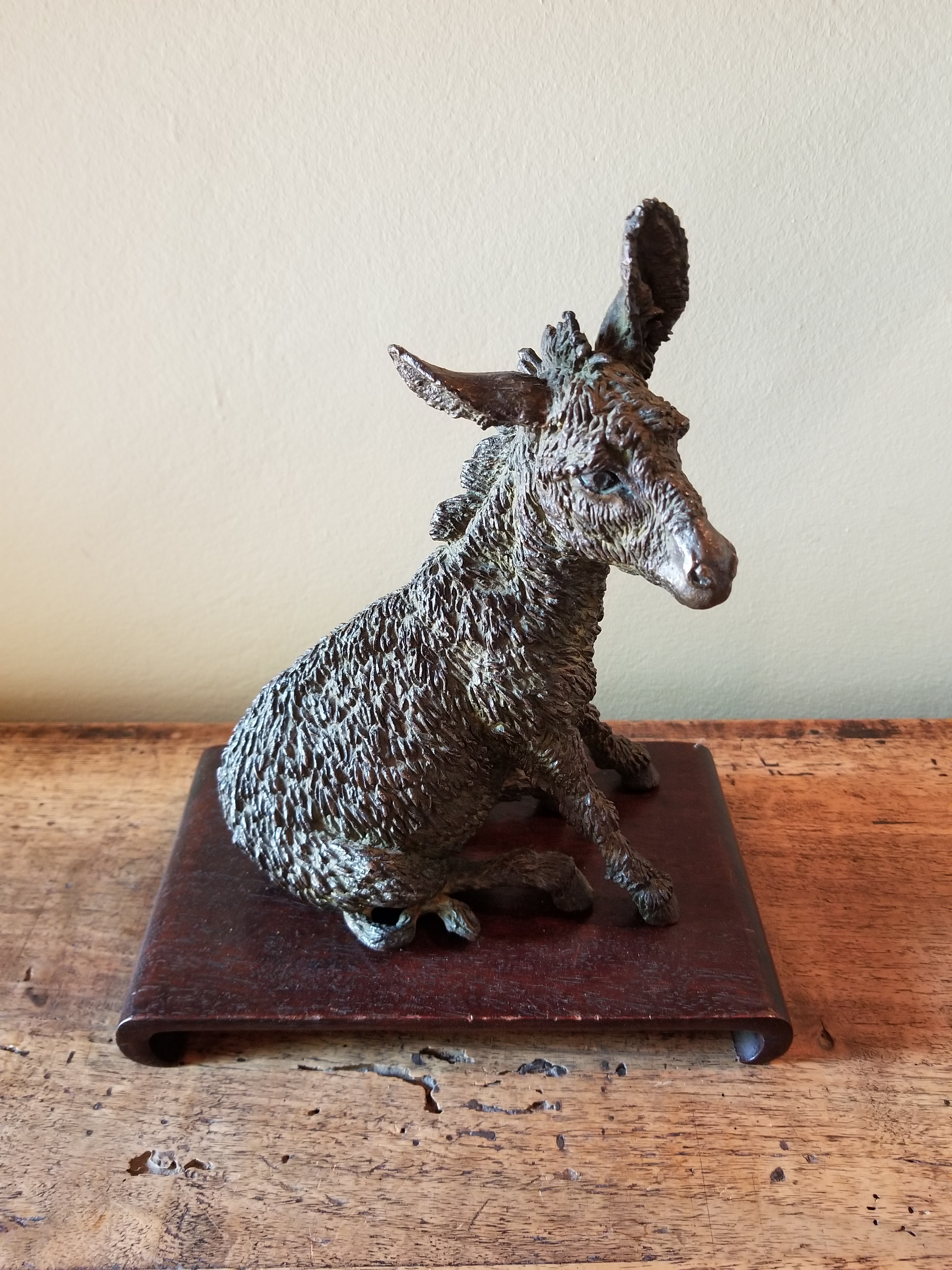
While Brighty was visiting Bloomfield Hills, he also posed for a series of sculptures by Peter Jepsen. They were modelled here at Cranbrook, on the second floor of Thornlea Studio. We still have one of the sixty Brighty figurines that Stephen Booth had made to give as presents to people who had helped in the making of the movie. Our Brighty was given to Stephen’s parents, Henry and Carolyn, to thank them for their support.

Photograph by Kevin Adkisson.
Peter Jepsen at work on Brighty in Thornlea Studio. Stephen Farr Booth Papers, Cranbrook Archives.

Stephen also commissioned Jepsen to make a life-size sculpture of Brighty. In 1968, Stephen gave that version to the Park Rangers at the Grand Canyon as a Christmas present. You can still see Jepsen’s Brighty at the visitor’s lodge on the North Rim of the Canyon, close to where the real Brighty spent his summers, more than a hundred years ago.

Peter Jepsen poses with his sculpture at the lodge on the North Rim of the Grand Canyon. Stephen Farr Booth Papers, Cranbrook Archives.

Mariam Hale, Collections Fellow, Cranbrook Center for Collections and Research

Ed. Note (July 17, 2025): It appears the Dragon Bravo wildfire has severly damaged the original Brighty statue at the the lodge on the North Rim of the Grand Canyon. https://www.facebook.com/share/p/1CDkSfoutX/

Please know that the Cranbrook Center for Collections and Research will do everything it can to support efforts to restore or replace Brighty,
Brighty of Thornlea House

20180822_125558

Peter Jepsen, Brighty, cast bronze. 1966. Collection of Thornlea House, Cranbrook. Courtesy of Cranbrook Center for Collections and Research.

In the foyer of Thornlea, the home of Henry Scripps and Carolyn Farr Booth, sits this statue of a burro, Brighty, by Peter Jepsen. He was a gift from their son, Stephen, commemorating a movie project he spearheaded.
BrightyOfTheGrandCanyon

Dust jacket of Brighty of the Grand Canyon. 1953 (first edition). Courtesy of Michigan eLibrary (MelCat).

In 1953, Newbery Award winner Marguerite Henry (1902-1999) published the novel Brighty of the Grand Canyon. It tells the story of a real burro named Brighty who lived in the Grand Canyon from 1890-1922. Brighty spent summers carrying water up the canyon to the North Rim. He was rewarded for his work with pancakes. Brighty became popular with visitors, and is said to have accompanied Teddy Roosevelt on one of his three visits to the Grand Canyon. In 1963, Betty Booth bought a copy of Brighty of the Grand Canyon for her three boys, Douglas, Charlie, and Woody, to read on vacation. Betty was the wife of Stephen Farr Booth, who was a television producer at the time. Stephen read the book and loved it so much he decided to make it into a movie of the same name. The movie premiered in Detroit in 1967.
Brighty-poster

Movie poster for Brighty of the Grand Canyon. 1967. Courtesy WikiCommons.

To promote the movie, Stephen had commercial artist Peter L. Jepsen (1921-1994) create a life-sized, 600-pound statue of Brighty to be placed in the Grand Canyon’s South Rim’s Visitor Center (it was later moved to the North Rim’s Grand Canyon Lodge, where it resides today and where visitors rub his nose for good luck). Stephen also had 100 small-scale versions of the sculpture made and distributed to various people who worked on the movie. Stephen also gave one to his parents, who placed Brighty right inside the door of their home Thornlea. We don’t encourage visitors to rub Brighty’s nose for good luck, but he is a fun and memorable addition to welcome guests to Thornlea. – Leslie S. Mio, Associate Registrar Note: The book, movie, and statue have kept the legend of Brighty alive. Brighty even has his own Facebook page. Ed. Note (July 17, 2025): It appears the Dragon Bravo wildfire has severly damaged the original Brighty statue at the the lodge on the North Rim of the Grand Canyon. https://www.facebook.com/share/p/1CDkSfoutX/ Please know that the Cranbrook Center for Collections and Research will do everything it can to support efforts to restore or replace Brighty,

Enduring Traditions: The Festival of Gifts

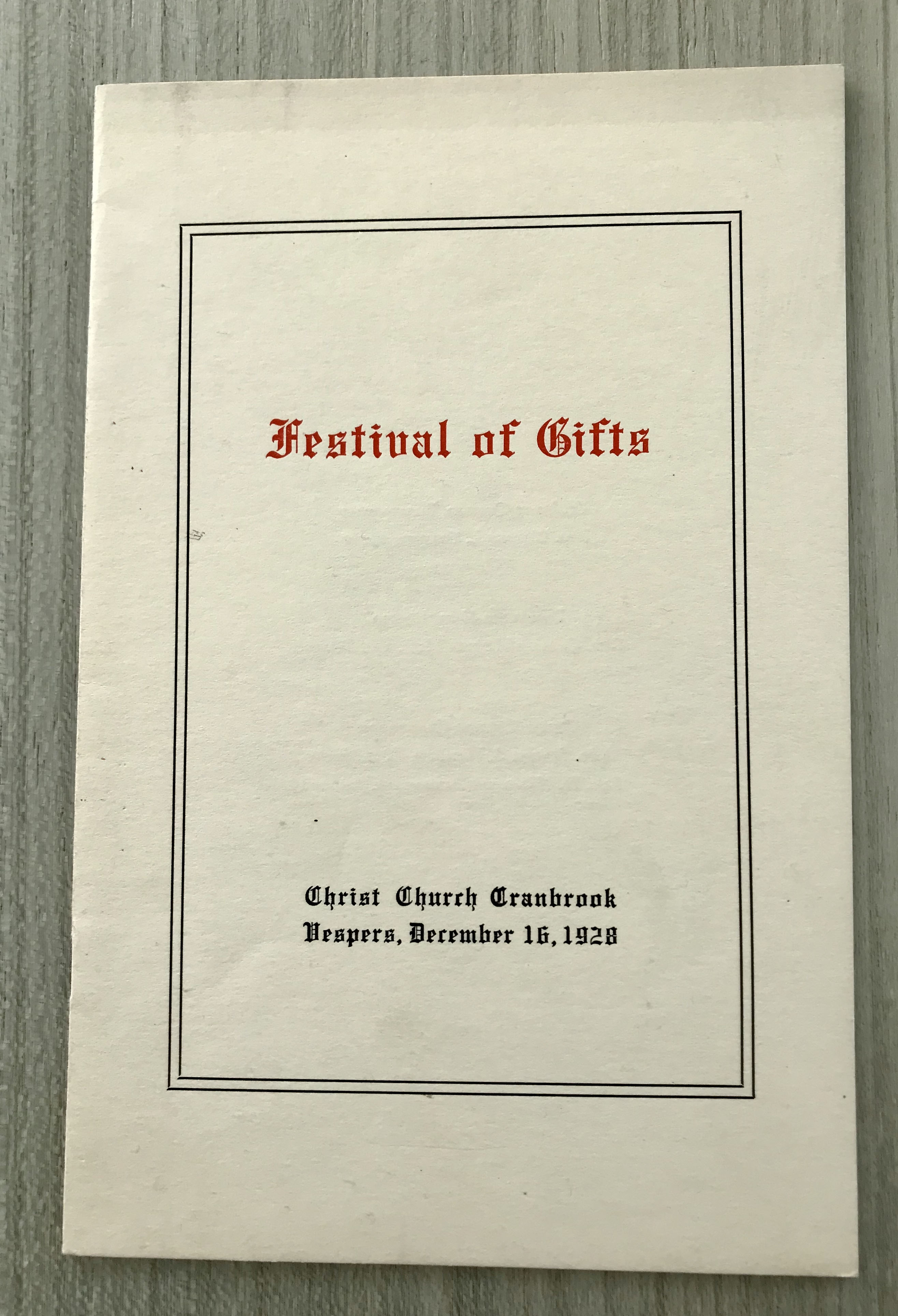
Next year will mark the 90th celebration of the Festival of Gifts at Christ Church Cranbrook – as the church also celebrates its 90th anniversary in 2018. Henry Scripps Booth wrote, produced, and participated in a nativity play at St. James Church in Birmingham prior to the building of Christ Church. With the establishment of the new parish, Booth suggested that the two combine efforts in a special Christmas program. According to documentation in the Henry Scripps and Carolyn Farr Booth papers, “the cooperation turned out to be in name only.”

Festival of Gifts order of procession and liturgy, 1928. Courtesy Cranbrook Archives.

The Festival of Gifts is an adaptation of the St. James play, with a procession of the entire congregation to the nativity tableau followed by the entrance of the Holy Family, shepherds, and wise men as the story of the birth of Christ is read. As the congregation proceeds to the altar they lay gifts at the manger, which are then distributed to local families in need.

Some of the original festival costumes were re-purposed from the 1916 Cranbrook Masque and others were purchased by Henry Scripps Booth in Tunisia in 1922. Originally a doll was laid in the manger, but at some point, the decision was made to cast an infant from the parish. Animals have also been a part of the event, however, according to Henry Scripps Booth, “Brighty” (star of Stephen Booth’s movie Brighty of the Grand Canyon) made the greatest impression!

Gina Tecos, Archivist

Create a website or blog at WordPress.com