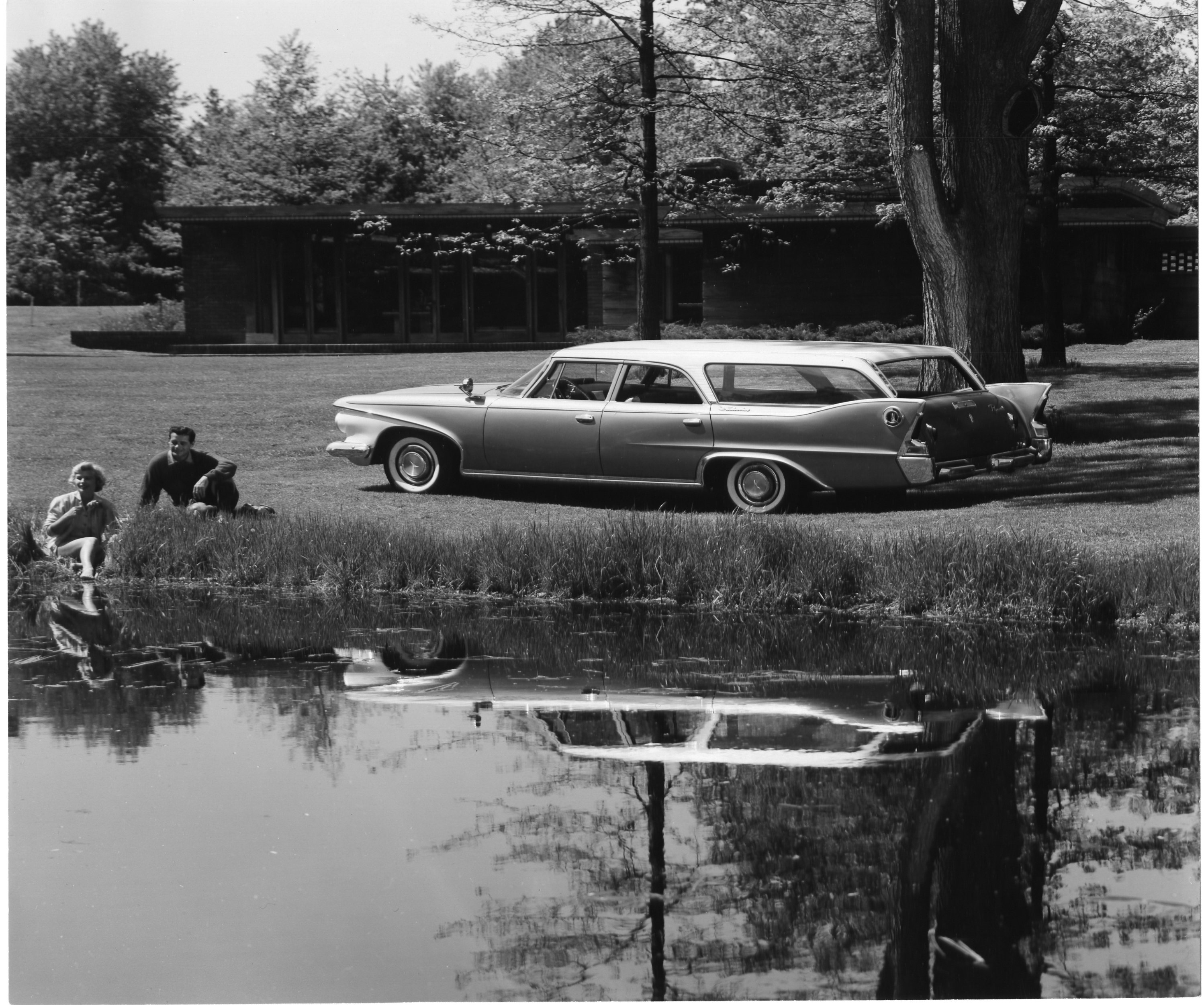
Oakland County is decked out in checkered flags this Friday for the annual Woodward Dream Cruise. As the crowds gather in their folding chairs and thousands of classic cars roar past my windows, I’m reminded of a much more serene image from automotive history: the 1960 Plymouth Suburban stretched out on the manicured lawn of the Frank Lloyd Wright Smith House.
1960 Plymouth Suburban, on location at the Frank Lloyd Wright Smith House. Smith Papers, Cranbrook Archives.
In 1959, Chrysler was developing promotional materials for the 1960 Plymouth. Seeking a sleek, modern backdrop for the long lines of the Suburban station wagon, Chrysler’s Public Relations Department contacted Melvyn and Sara Smith about staging a photoshoot at their Frank Lloyd Wright-designed home in Bloomfield Hills. The resulting photographs show the 18-ft long Suburban, not parked in the pea-gravel driveway or the distinctive cantilevered carport, but pulled to the back of the house where it could be reflected in the natural setting of the Smith’s newly expanded pond.
1960 Plymouth Suburban, on location at the Frank Lloyd Wright Smith House. Smith Papers, Cranbrook Archives.
The long, low horizon line of Frank Lloyd Wright’s Usonian architecture, with its stacking roof planes, seems a great fit for the station wagon’s extended style lines and characteristic fins. In a second image, two casually-dressed models (check out those long socks and walking shorts!) lounge in rattan Tropi-Cal armchairs on the living room patio. Designed by Danny Ho Fong, the Tropi-Cal armchairs were recently identified through the diligent research of the Center’s Summer intern Clare Catallo.
As Michigan emerges from our lockdown and we slowly begin driving to more places and contemplating summer road trips, I thought we’d look back to a time before asphalt, air conditioning, and safety features.
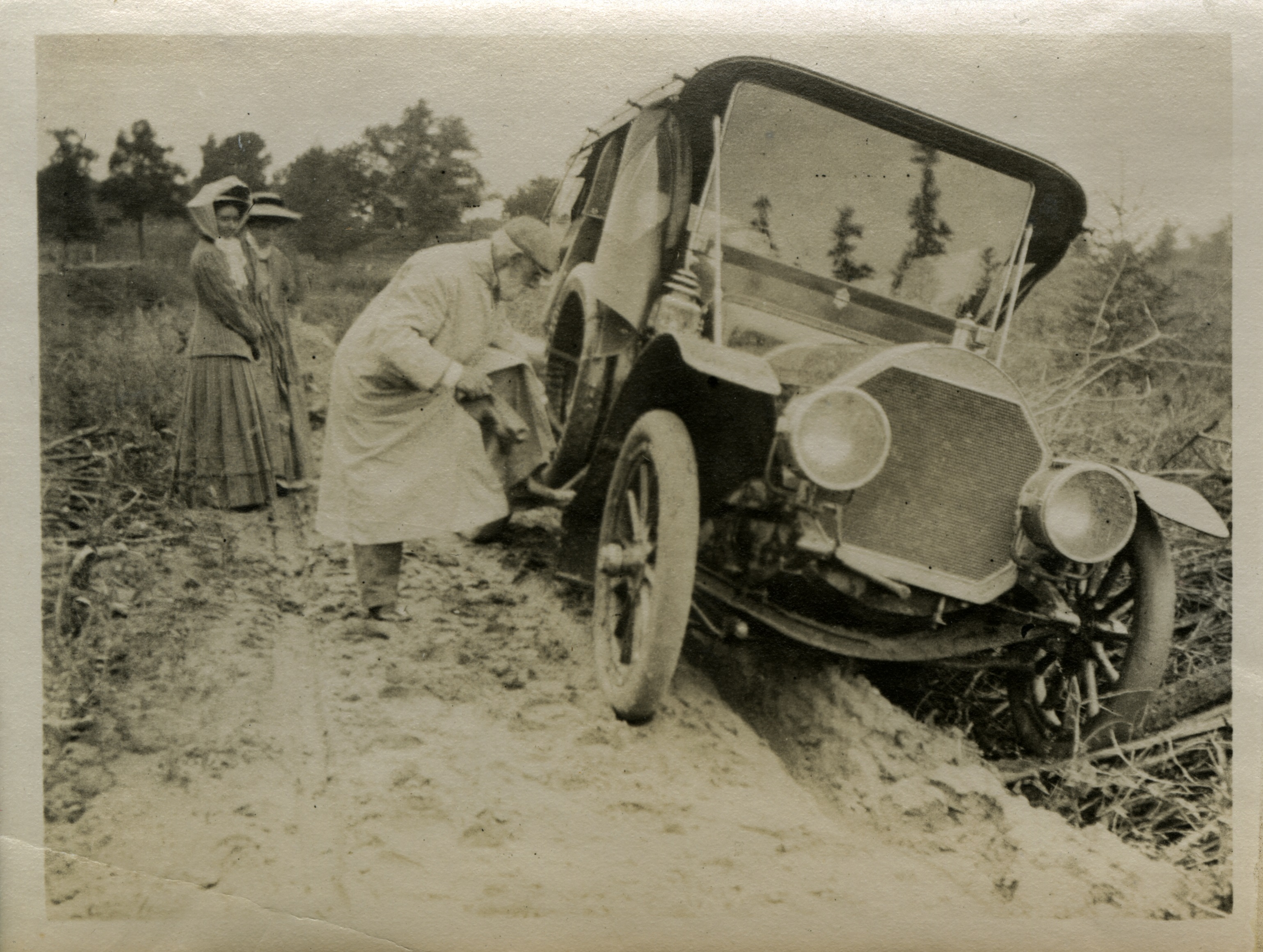
Ellen Scripps Booth, Jean McLaughlin Booth and Henry Scripps Booth on Lahser Road with the 1908 Pierce-Arrow in the ditch, 1911. Courtesy Cranbrook Archives.
Here, we see Ellen Scripps Booth, daughter-in-law Jean McLaughlin Booth, and young Henry stranded somewhere along Lahser Road. I love the ladies’ wide hats and wraps, intended to keep their hair in and dust out. Henry looks particularly pleased with the situation (sort of like me when my own mom got a speeding ticket—she didn’t appreciate my backseat smirking, either).
Instead of AAA, the family turned to their own skills. Here’s Henry Wood Booth, Ellen’s father-in-law, addressing the situation:
Henry Wood Booth works on the Pierce-Arrow on Lahser Road, 1911. Courtesy Cranbrook Archives.
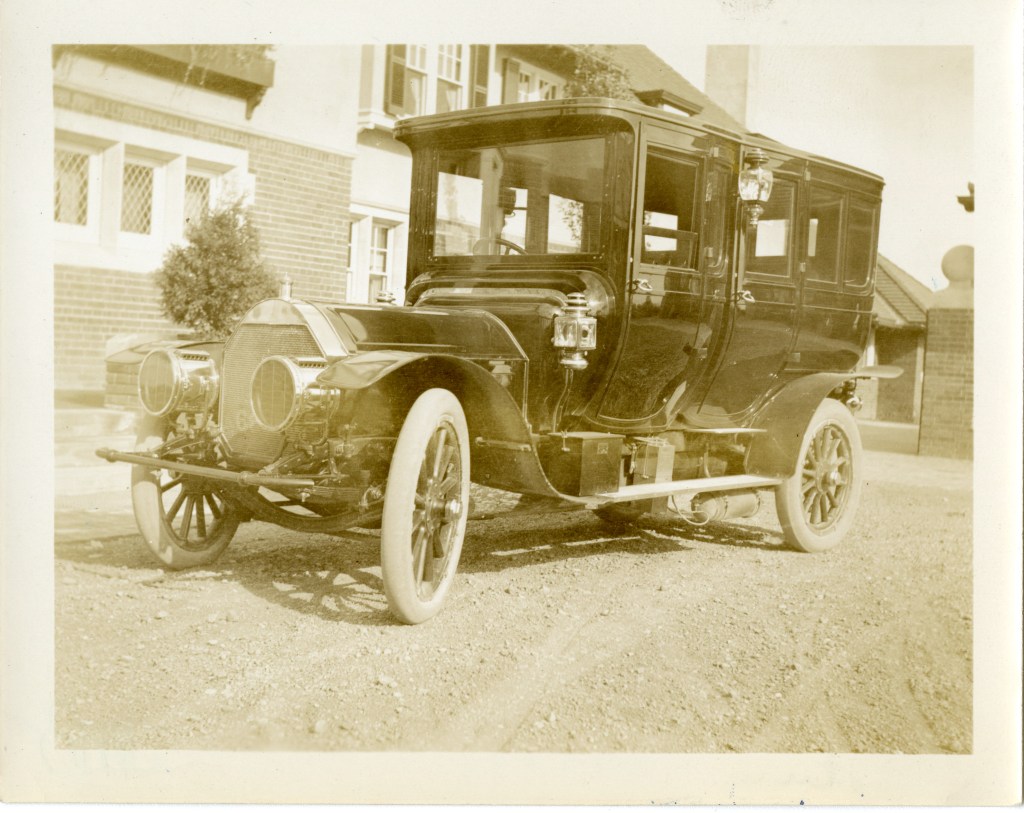
The Booth family’s Pierce-Arrow Limousine was one of several cars they used to move about here in Michigan and in Europe (where they traveled with the Pierce-Arrow and chauffeur). Purchased for $7,750 in July 1908 ($215,984.08 in 2020), the seven-seater, 6-cylinder touring car came with two bodies: a closed limousine body for winter use and a sports-touring body for summer. As Henry Scripps Booth later wrote:
The original garage at Cranbrook House had a traveling crane in it so the Pierce-Arrow’s winter and summer bodies could be conveniently changed with the seasons. The crane spanned the depth of the garage, having an iron track bolted to the east and west walls on which the crane with a hand operated hoist could be pulled to the spot where the two respective bodies could be removed or hoisted into place.
The Pierce-Arrow with its winter body in front of Cranbrook House, 1908. James Scripps Booth photographer, Copyright Cranbrook Archives.
The Pierce-Arrow with its summer body in front of Cranbrook House, 1908. James Scripps Booth photographer, Copyright Cranbrook Archives.
The accident on Lahser Road wasn’t the first time Ellen had been betrayed by poor road conditions. In 1908, she wrote in her diary of a similar event that took place as the family traveled from Grand Rapids to Lake Michigan:
“Wed. Aug. 12. We decided to take the auto as far as Holland on the way to Ottawa Beach but I wish we hadn’t for it took us five hours to go the 25 miles—We got off the road and one place slid into a ditch. It took an hour & a half to get a team to pull us out. We later frightened a horse and it ran down this deep ditch and horse, top-buggy and all just lay right down flat. The old couple in it were not hurt at all.”
If you want to learn more about the history and social impact of cars, register for our free virtual Bauder Lecturethis Sunday, June 28, 2020, at 3:00pm EST. Brendan Cormier, Senior Design Curator at the Victoria and Albert Museum in London, will be speaking about his recent exhibition and publication, Cars: Accelerating the Modern World. Center for Collections and Research Director Greg Wittkopp will deliver an introduction about Cranbrook and cars, featuring more treasures from Cranbrook Archives relating to our place in automobile history.
—Kevin Adkisson, Associate Curator, Cranbrook Center for Collections and Research



 Cranbrook Kitchen Sink