Classical music, wandering musicians, ballet, cabaret, white paper lanterns, illuminated boats on the lake, Hawaiian torches, Italian tree lights, champagne, dinner, and dancing on a night with a fair-sized moon—these were some of the possibilities that Henry Scripps Booth recorded in December 1964 notes for a music gala called Night of Delight, a fundraiser for the Cranbrook Music Guild of which he was a founding member.
Patrons in line to attend Cranbrook Music Guild concert and ballet performance, July 10, 1960. Harvey Croze, photographer. Courtesy of Cranbrook Archives.
The Guild is one of the most eminent accomplishments in Cranbrook’s legacy of music and it endures to this day (the Archives holds records for the organization through 2007). Born of the inspiration of Christ Church Cranbrook Music Director, Maurice Garabrandt, and Betty (Mrs. Benjamin) Brewster, the Guild was established in 1951 to utilize Cranbrook’s setting as a wonderful place to appreciate music.
During the first decade alone, the Guild sponsored performances by distinguished artists, including violinists Zino Francescatti and Mischa Mischakoff, pianists such as Mischa Kottler, Phillipe Entremont, Jean Casadesus, and Leon Fleischer, cellist George Miquelle, the Severo ballet, jazz musicians such as Dave Brubeck and Don Shirley, classical guitarist Richard Dyer-Bennet, and soprano Eileen Farrell.
Program for Jean Casadesus performance, November 16, 1960. Courtesy of Cranbrook Archives.
The objectives of the Guild were not only to provide high quality programming, support the creation of new music, and the development of high caliber performers, but also to share knowledge about the appreciation of music through lectures, demonstrations, recitals, and exhibitions. The programs for the concerts thus shared brief contextual comments on the history of the piece and the composer.
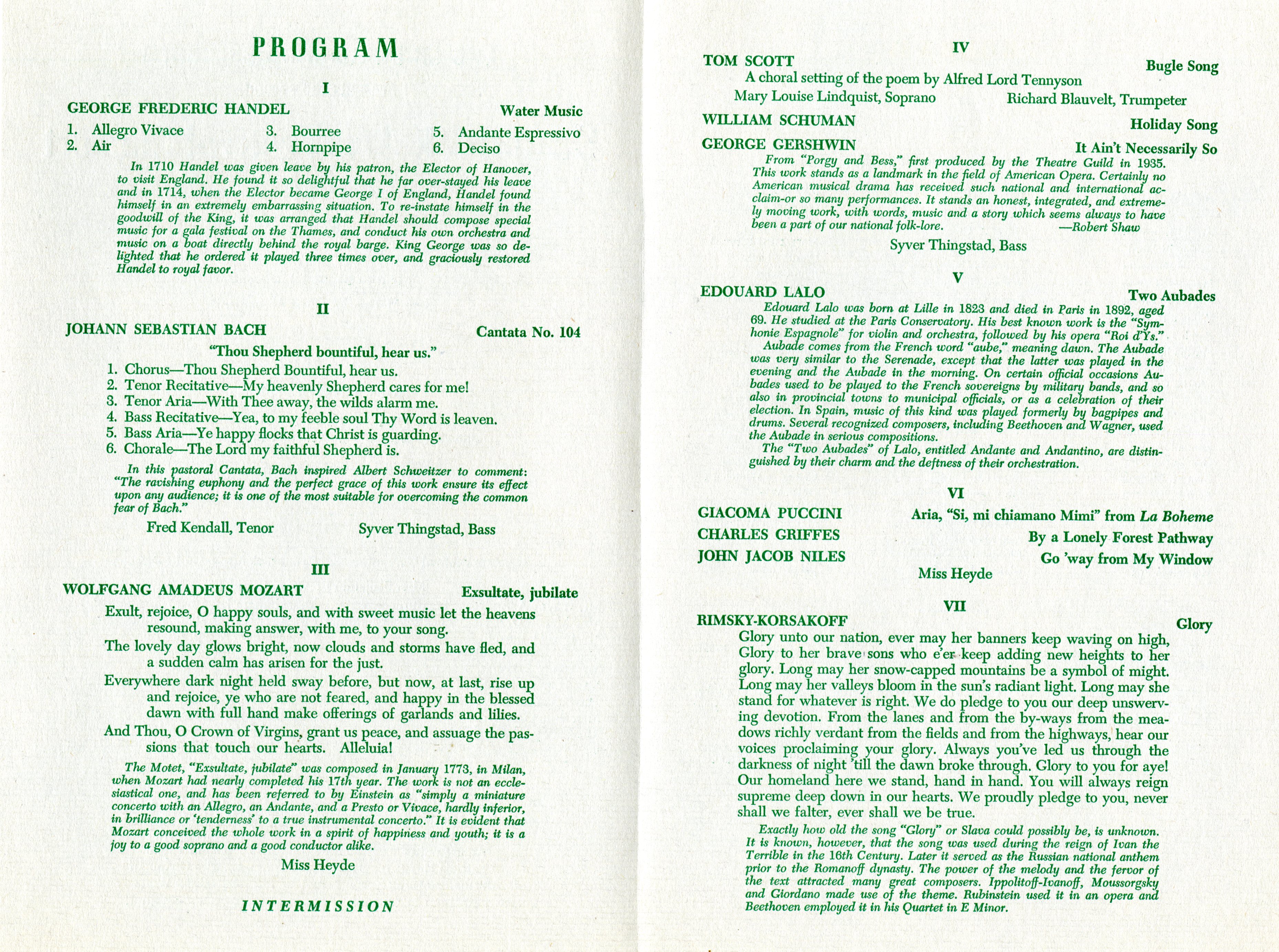
In the program for the Second Cranbrook Arts Festival Concert, which was performed at the Greek Theatre on June 1, 1952, I noticed a comment that is playfully instructive but also particularly salient to later developments in the Guild programming. The second concert program included Johann Sebastian Bach’s Cantata 104, “Thou Bountiful Shepherd, Hear Us,” and it was noted that it had inspired Albert Schweitzer to comment:
“The ravishing euphony and the perfect grace of this work ensure its effect upon any audience; it is one of the most suitable for overcoming the common fear of Bach.”
Program for Second Cranbrook Arts Festival Concert, June 1, 1952. Courtesy of Cranbrook Archives.
The Cantata must have worked its magic, because in 1966, the idea of a Bach at Cranbrook festival was introduced. It would be a satellite festival chaired by James L. Schneider and hosted by Christ Church Cranbrook with the aim to perform Bach’s music as he intended—with a small chorus and orchestra in a church setting. At a special meeting on February 23, 1966, the Cranbrook Music Guild agreed to sponsor the Bach at Cranbrook festival.
At a regular meeting a few days later, Henry expressed concern regarding the conflict of dates. The Bach festival was set for May 14 and his Night of Delight was being planned for the 21st. The Board responded that it was impossible to sponsor two big events that would appeal to same group of people, and that there was no choice but to sponsor the Bach festival, to which they had already committed, and postpone the gala to another year.
Program cover from the first Bach at Cranbrook festival, May 14, 1966. Courtesy of Cranbrook Archives.
Thus, the first Bach at Cranbrook festival took place on May 14, 1966 at Christ Church with 25 members of the Detroit Symphony Orchestra and the 40-voice Kenneth Jewell Chorale. It was a stellar success with an audience of over 1,200 people. The following year, the festival grew into a two-day, three-day concert event. After being renamed the Cranbrook Festival with a broader scope of classical and baroque composers, the festival was dissolved in 1979.
A scene from the Bach at Cranbrook festival, May 14, 1966. Harvey Croze, photographer. Courtesy of Cranbrook Archives.
The gala, Night of Delight, would never take place beyond Henry’s musings. For those with a romantic imagination, his words invite one to feel the warm summer evening, the fragrance of fresh flowers, strains of music across the courtyard filled with joyful chatter, elegance, and conviviality beneath the light of the moon. If your senses require something more tangible, fear not, for the Center for Collections and Research is celebrating the legacy of music at Cranbrook at our House Party on May 18th. Join us for live music, dinner, dancing, paper lanterns, and even a fair-sized moon! It will truly be a Night of Delight!
What you might think at first look is simply a bell tower at Christ Church Cranbrook is actually much, much more. The tower holds a carillon, a musical instrument consisting of cast bronze bells in fixed suspension, tuned in half steps (chromatic order). It is played from a clavier (keyboard) containing wooden leavers and pedals wired to clappers.
South view of Christ Church Cranbrook, 1932. Photo by Max Habrecht. Courtesy of Cranbrook Archives, Cranbrook Center for Collections and Research.
The Christ Church Cranbrook carillon is known as the “Booth-Wallace Carillon” as the instrument was a gift to the church from Grace Booth Wallace, her husband Harold Lindsey Wallace, and their five children, Elizabeth, Ellen, Richard, Shirley, and Catherine. It originally consisted of forty-six bells made by the Taylor Bell Foundry in Loughborough, England.
The largest bell (bourdon) is 6,700 pounds, five-feet eight-inches in diameter, and rings a low B-flat. The carillon was later expanded in 1978 with smaller treble bells to its current total of fifty bells, or four complete octaves. The carillon is in concert pitch, meaning it sounds the notes implied by the keyboard arrangement. To play the large instrument, the clavier is struck with fists and feet. The carillon requires physical exertion as the clappers can weigh several hundred pounds–however, the instrument is balanced for ease of use.
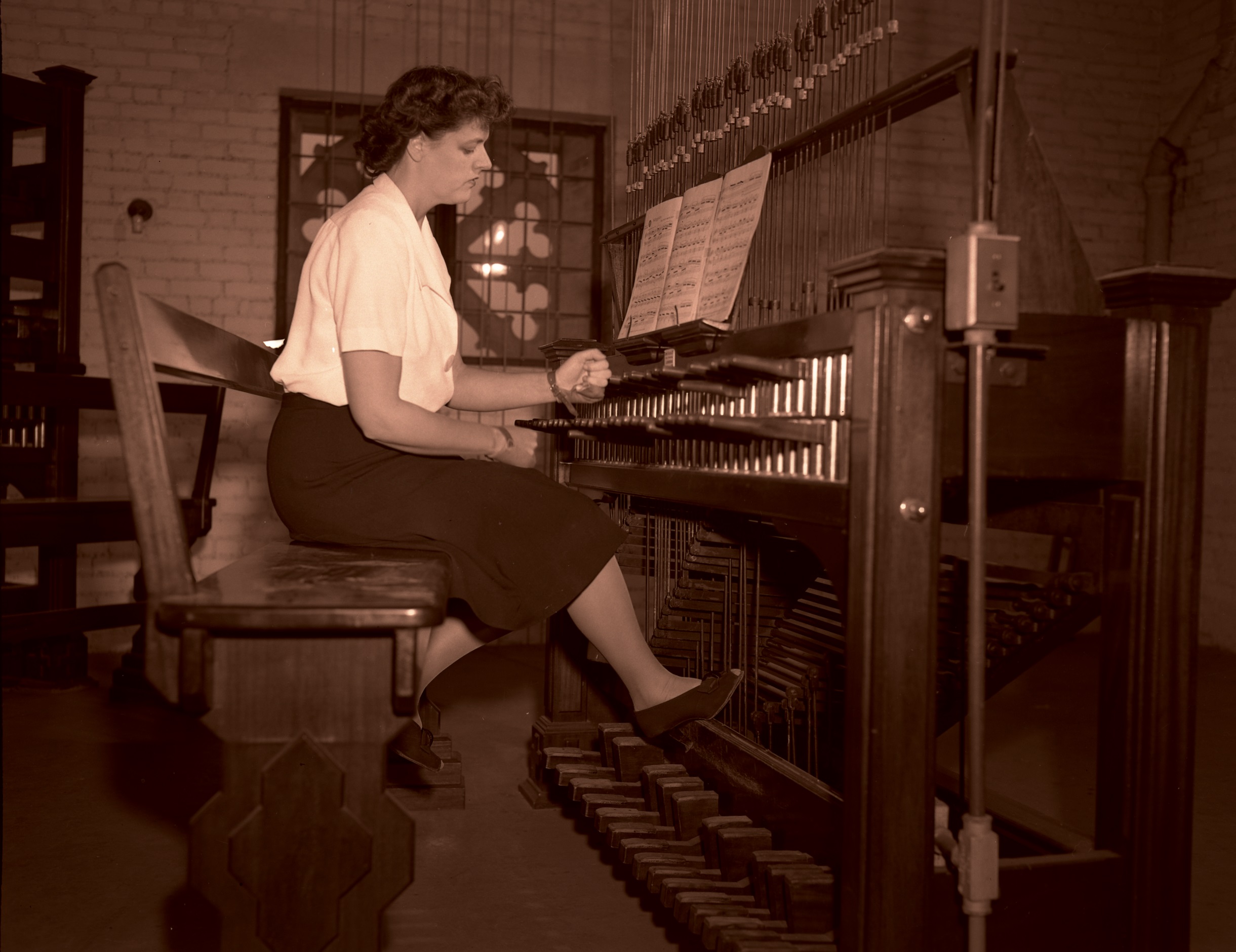
Nellie Beveridge at the clavier of the Booth-Wallace Carillon in May 1946. Note the use of her fists to play the instrument. Beveridge also served as nurse and companion to George and Ellen Booth. Courtesy of Cranbrook Archives, Cranbrook Center for Collections and Research.
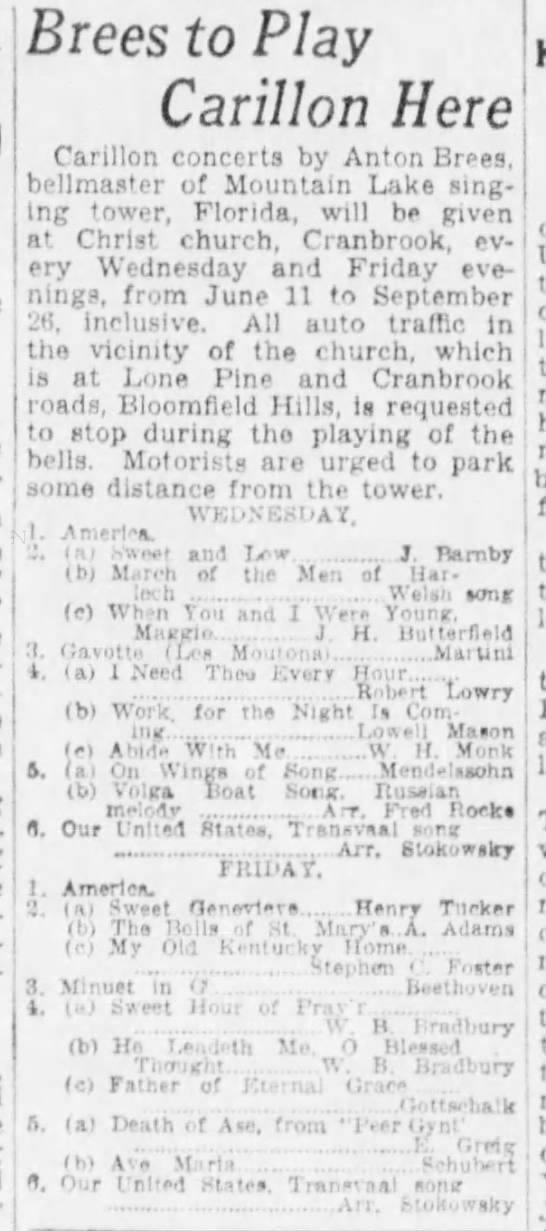
The Booth-Wallace Carillon was dedicated on Sunday, September 30, 1928. The first carillonneur to play the instrument was Anton Brees, at the time one of the world’s leading carillonneurs and famously the carillonneur of the Singing Tower at Bok Tower Gardens in Lake Wales, Florida. He would return to Christ Church for several summers to play, beginning what is now called the Summer Carillon Series.
Article from the June 8, 1930 the Detroit Free Press regarding Brees and the Christ Church Summer Carillon Series.
The 2020 Summer Carillon Series at Christ Church Cranbrook has already begun. You can listen to the July 5th concert below and go to the church’s Facebook page to learn more about future concerts.
Christ Church Cranbrook has had a number of carillonneurs or carillonists throughout its history.
Carillonist Beverly Buchanan preparing the instrument to play, February 1970. Courtesy of Cranbrook Archives, Cranbrook Center for Collections and Research.
Beverley B. Buchanan played the carillon at Christ Church from 1964-1988. Beverly was a graduate of the University of Michigan, School of Music where she majored in organ and carillon. She was a long time member of the American Guild of Organists and the Guild of Carillonneurs in North America. She concertized on the carillon throughout North America, Europe, and Australia.
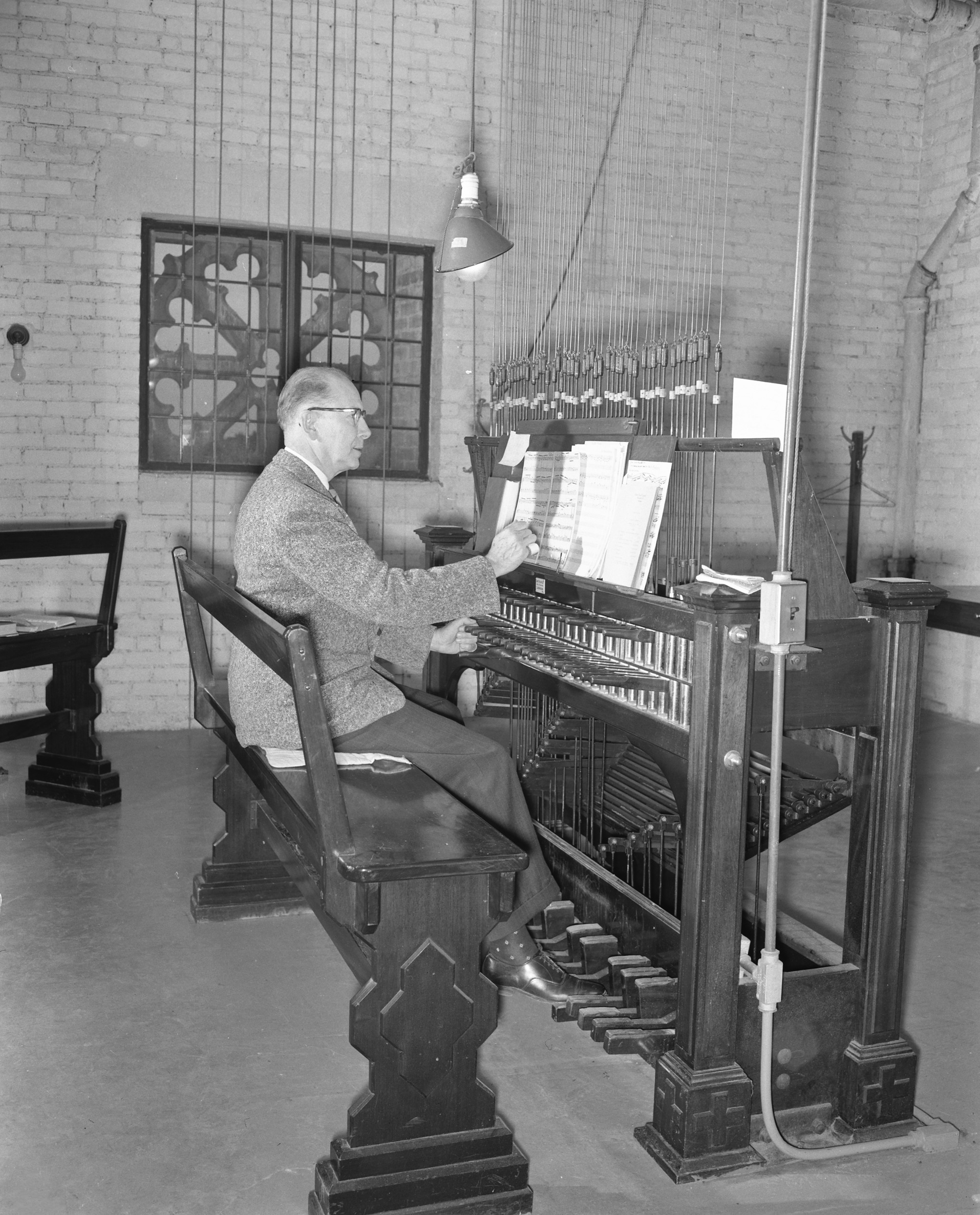
Dr. Maurice Garabrant playing the carillon, September 1956. Courtesy of Cranbrook Archives, Cranbrook Center for Collections and Research.
Other carillonneurs of Christ Church include Dr. Maurice Garabrant (1949-1959), Dr. Don Cook (1988-1991), and Dr. Phillip Burgess (1991-mid 1990s). The current carillonist at Christ Church is Jenny L. King, who has been at Christ Church since the mid-1990s..
We hope that you will be able to enjoy more of the Christ Church Cranbrook Booth-Wallace Carillon this summer, whether in person or online. I think sitting on the wide lawn in front of the church enjoying a concert sounds like the perfect socially distant activity! For the complete program for the Summer Carillon Series, click here.
– Leslie S. Mio, Associate Registrar, Cranbrook Center for Collections and Research





 Cranbrook Kitchen Sink