Night of Delight

Classical music, wandering musicians, ballet, cabaret, white paper lanterns, illuminated boats on the lake, Hawaiian torches, Italian tree lights, champagne, dinner, and dancing on a night with a fair-sized moon—these were some of the possibilities that Henry Scripps Booth recorded in December 1964 notes for a music gala called Night of Delight, a fundraiser for the Cranbrook Music Guild of which he was a founding member.

Patrons in line to attend Cranbrook Music Guild concert and ballet performance, July 10, 1960. Harvey Croze, photographer. Courtesy of Cranbrook Archives.

The Guild is one of the most eminent accomplishments in Cranbrook’s legacy of music and it endures to this day (the Archives holds records for the organization through 2007). Born of the inspiration of Christ Church Cranbrook Music Director, Maurice Garabrandt, and Betty (Mrs. Benjamin) Brewster, the Guild was established in 1951 to utilize Cranbrook’s setting as a wonderful place to appreciate music.

During the first decade alone, the Guild sponsored performances by distinguished artists, including violinists Zino Francescatti and Mischa Mischakoff, pianists such as Mischa Kottler, Phillipe Entremont, Jean Casadesus, and Leon Fleischer, cellist George Miquelle, the Severo ballet, jazz musicians such as Dave Brubeck and Don Shirley, classical guitarist Richard Dyer-Bennet, and soprano Eileen Farrell.

Program for Jean Casadesus performance, November 16, 1960. Courtesy of Cranbrook Archives.

The objectives of the Guild were not only to provide high quality programming, support the creation of new music, and the development of high caliber performers, but also to share knowledge about the appreciation of music through lectures, demonstrations, recitals, and exhibitions. The programs for the concerts thus shared brief contextual comments on the history of the piece and the composer.

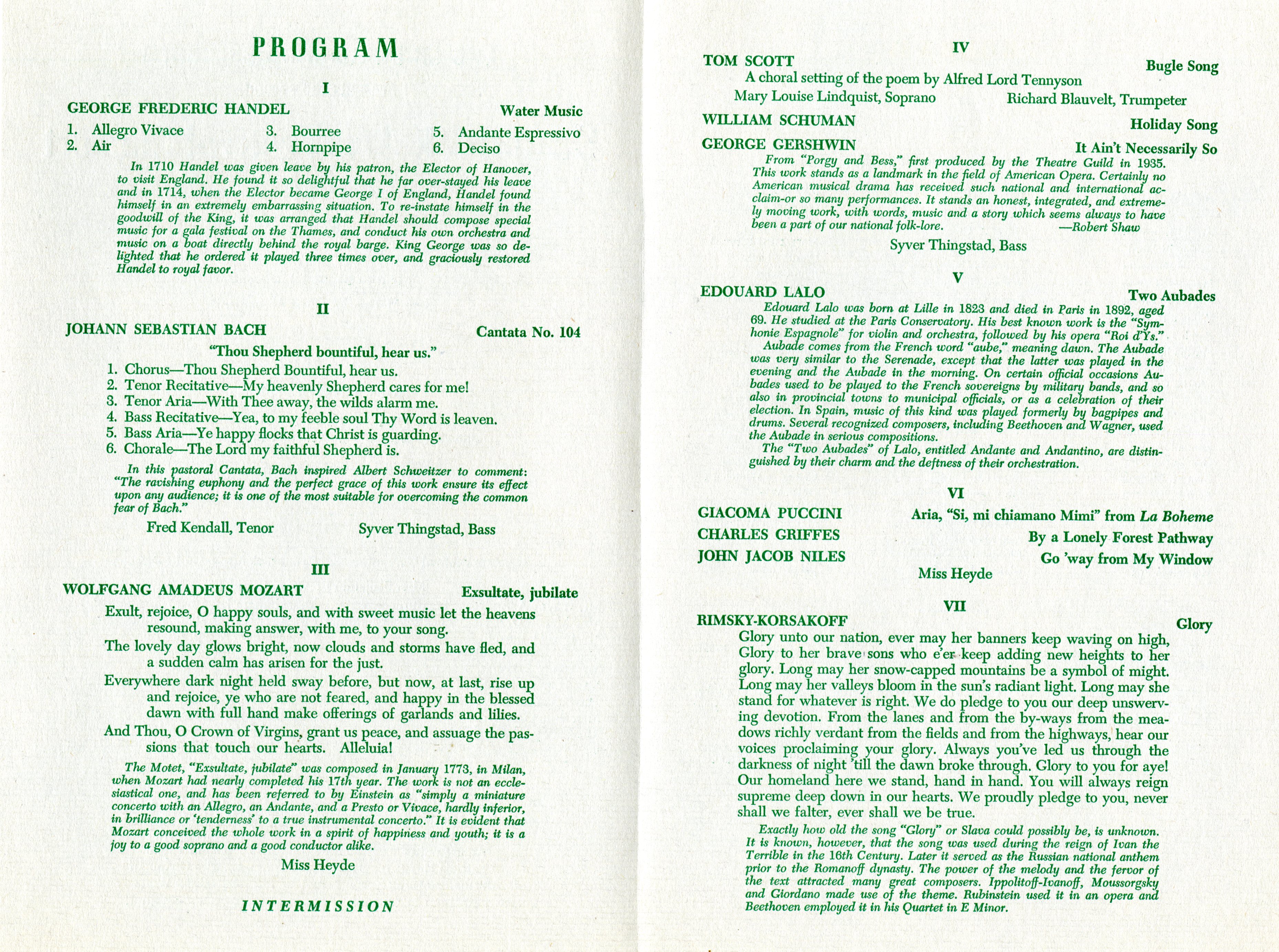
In the program for the Second Cranbrook Arts Festival Concert, which was performed at the Greek Theatre on June 1, 1952, I noticed a comment that is playfully instructive but also particularly salient to later developments in the Guild programming. The second concert program included Johann Sebastian Bach’s Cantata 104, “Thou Bountiful Shepherd, Hear Us,” and it was noted that it had inspired Albert Schweitzer to comment:

“The ravishing euphony and the perfect grace of this work ensure its effect upon any audience; it is one of the most suitable for overcoming the common fear of Bach.”

Program for Second Cranbrook Arts Festival Concert, June 1, 1952. Courtesy of Cranbrook Archives.

The Cantata must have worked its magic, because in 1966, the idea of a Bach at Cranbrook festival was introduced. It would be a satellite festival chaired by James L. Schneider and hosted by Christ Church Cranbrook with the aim to perform Bach’s music as he intended—with a small chorus and orchestra in a church setting. At a special meeting on February 23, 1966, the Cranbrook Music Guild agreed to sponsor the Bach at Cranbrook festival.

At a regular meeting a few days later, Henry expressed concern regarding the conflict of dates. The Bach festival was set for May 14 and his Night of Delight was being planned for the 21st. The Board responded that it was impossible to sponsor two big events that would appeal to same group of people, and that there was no choice but to sponsor the Bach festival, to which they had already committed, and postpone the gala to another year.

Program cover from the first Bach at Cranbrook festival, May 14, 1966. Courtesy of Cranbrook Archives.

Thus, the first Bach at Cranbrook festival took place on May 14, 1966 at Christ Church with 25 members of the Detroit Symphony Orchestra and the 40-voice Kenneth Jewell Chorale. It was a stellar success with an audience of over 1,200 people. The following year, the festival grew into a two-day, three-day concert event. After being renamed the Cranbrook Festival with a broader scope of classical and baroque composers, the festival was dissolved in 1979.

A scene from the Bach at Cranbrook festival, May 14, 1966. Harvey Croze, photographer. Courtesy of Cranbrook Archives.

The gala, Night of Delight, would never take place beyond Henry’s musings. For those with a romantic imagination, his words invite one to feel the warm summer evening, the fragrance of fresh flowers, strains of music across the courtyard filled with joyful chatter, elegance, and conviviality beneath the light of the moon. If your senses require something more tangible, fear not, for the Center for Collections and Research is celebrating the legacy of music at Cranbrook at our House Party on May 18th. Join us for live music, dinner, dancing, paper lanterns, and even a fair-sized moon! It will truly be a Night of Delight!

Visit our website to learn more about A House Party at Cranbrook: Celebrating the legacy of music at Cranbrook! Last Call–Ticket sales end on Monday!

Laura MacNewman, Associate Archivist, Cranbrook Center for Collections and Research

Harry Belafonte Visits Cranbrook

Following on the heels of Leonard Bernstein, Don Shirley, and Dave Brubeck, yet another famous musician came to Cranbrook: Harry Belafonte. While his trip to campus, unfortunately, did not involve a performance, it is well-recorded in the Archives: in news items, photographs, and a Society page headline in the Wednesday, November 23, 1960, Birmingham Eccentric.

Being a relatively new recording star on the RCA record label, the 1960 visit included Belafonte’s third Detroit performance. After his debut in 1956 in a show called “Sing, Man, Sing!” Belefonte played the newly converted live venue, the Grand Riviera Theater the following year in support of his record album, “An Evening With Belafonte.”

Portrait of Harry Belafonte, singer and actor. Courtesy of E. Azalia Hackley Collection, Detroit Public Library.

At this point, the actor and singer was pretty much a household name, having starred in the 1954 film Carmen Jones, and riding the wave of his 1956 breakthrough hit album, Calypso, the first million-selling LP by a single artist. Who doesn’t know the song “Day-O (The Banana Boat Song)?”

When Belafonte returned to the Riviera in 1960, his show was again billed as “An Evening With Belafonte” but now featuring an opening performance by South African singer Miriam Makeba, sponsored by the Junior Women’s Association for the Detroit Symphony Orchestra. And this time, in the audience were Henry Scripps Booth (son of Cranbrook founders George and Ellen Booth), his wife Carolyn, and their son Stephen with his wife Betty.

It’s not surprising that Henry (known to family and friends as Harry) was in attendance. An avid music aficionado, he was a charter member of the Cranbrook Music Guild, founded in 1951, and had been floating the idea of a creative music center on Cranbrook campus for at least that long. In fact, earlier in 1960, he had even proposed in a letter to Eero Saarinen the building of a music shell on the west lawn of Cranbrook House. Alas, the music center (and Saarinen music shell) never came to be.

In any case, Henry must have been visibly enjoying Belafonte’s concert. According to another Eccentric columnist, “Cheers went up at Harry Booth’s impromptu performance. Mr. Belafonte took his mike down to Mr. Booth’s ringside seat and induced him to give forth on a chorus of ‘Matilda‘ (it was all unrehearsed – we checked).”

A few days later, Belafonte made the trip from Detroit, at Henry’s invitation, to dine at the Booth’s home, Thornlea, with the family. Afterwards, he was given a brief tour of Cranbrook where he stopped at the Academy of Art to meet students and view work in their studios.

Join the Center on May 18 to help us celebrate the legacy of music at Cranbrook—dine at Thornlea and enjoy musical stylings from the era of Harry Belafonte’s visit. Head to our website to learn more and purchase your tickets to A House Party at Cranbrook!

Deborah Rice, Head Archivist, Cranbrook Center for Collections and Research

Green Book, Don Shirley, and Henry Booth: Because There’s Always a Cranbrook Connection

It was the morning after New Year’s Day. No sooner had I reached my office and turned on my computer than I saw that I had just missed a call from long-time Cranbrook friend and Kingswood graduate, Jeanne Graham. Always eager to speak with Jeanne, I immediately returned her call. Jeanne, who had not even taken time to leave me a message, already was in the processing of dialing the Center’s archivists. She had a question and was eager for an answer.

Like Jeanne, one of the movies that I saw over the holidays (one of the best, I might add) was Green Book. Masterly cast with Mahershala Ali as the legendary African-American classical and jazz pianist Don Shirley and Viggo Mortensen as the Italian-American bouncer-cum-driver and bodyguard “Tony Lip” Vallelonga, the film tells the story of a road trip (a concert tour) through the Jim Crow South of the early 1960s and the unlikely friendship that develops along the way. While I was watching the movie, Cranbrook was the furthest thing from mind; while Jeanne was watching the movie, she could not get Cranbrook out of her mind. “Was it my imagination or did I attend a concert by Don Shirley in Kingswood Auditorium while I was a student at Cranbrook in the 1950s?” Jeanne asked.

Admittedly stumped, I did what any good director would do—I consulted my knowledgeable staff. Within minutes, tantalizing facts were speeding their way to me from Associate Archivist Laura MacNewman: articles in the Clarion and the Crane, Kingswood’s and Cranbrook’s student newspapers; a concert announcement in the Birmingham Eccentric; links to nineteen Kingswood negatives; and references to thirteen letters sent between Shirley and his agents and Henry Scripps Booth, the youngest son of Cranbrook’s founders. Finally, Laura calmly announced that she had found black and white photographs of Shirley swimming and riding a bike at Henry’s and his wife Carolyn’s home near Cranbrook, Thornlea. I, meanwhile, yelled out in excitement!

Who knew? Well actually, there are a few people that did know. Before I could even begin to sift through the materials in Cranbrook Archives, I received a call from Carolyn Scripps, Henry and Carolyn Booth’s granddaughter. Carolyn also had seen Green Book and wanted to make sure that I knew about the story of her progressive grandfather and Shirley.

Scene One. Shirley did, in fact, perform in Kingswood Auditorium on Wednesday, March 2, 1955 (and yes, it was while Jeanne Graham was a student). Shirley, who was twenty-seven years old at the time, was accompanied by bassist Richard Davis. They performed nine songs that evening, many of which the two musicians recorded on Shirley’s 1955 album Tonal Expressions, including one of my favorites, “No Two People Have Ever Been So in Love.” What does a rendition by Shirley of a popular song like “No Two People” sound like? In the words of Henry Booth: “While the concert was labeled ‘Jazz,’ the music was a subtle rendering of the contemporary, having a classical quality which should appeal to the devotees of classical music—that is if they will condescend to listen.” Five days after this classically inspired, popular jazz concert, Henry wrote his first letter to Shirley (at least the first one that survives in Cranbrook Archives). With regards from his wife Carolyn and their daughter Melinda (Carolyn Scripps’s aunt), Henry invited the pianist to consider a second performance at Cranbrook sponsored by the nascent Cranbrook Music Guild.

The Clarion, March 11, 1955. Collection of Cranbrook Archives.

Scene Two. While it took numerous letters from Henry to both Shirley and his agent—and some convincing of the Music Guild members who Henry described to Shirley as not very “’Jazz’ minded”—the pianist and bassist returned to Cranbrook in December. Thanks to clippings from the Birmingham Eccentric and the Crane, we know the concert took place on Saturday, December 3, 1955, and, like the first concert, it took place at Kingswood. And thanks to a page in the Thornlea Guest Book, now in the collection of Jeffrey Booth (Henry and Carolyn’s grandson), we also know that Henry and Carolyn hosted an Afterglow for the musicians that evening in their home on Cranbrook Road.
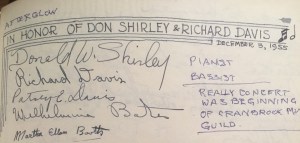
Thornlea Guest Book, Detail of Guest List for December 3, 1955. Collection of Jeffrey Booth.

Scene Three. Henry Booth was a documentarian. Included in the Henry Scripps Booth and Carolyn Farr Booth Papers, which are preserved—and accessible—in the Cranbrook Archives, are a series of photo albums that chronicle and illustrate Henry’s and Carolyn’s lives. The 1956 album includes seven black and white photographs of Shirley. While they were processed in July, another entry in the Thornlea Guest Book more precisely places both Shirley and Richard Davis at Cranbrook on June 20, 1956. Three of the photographs were taken by Henry at a night club, presumably Baker’s Keyboard Lounge in Detroit where the Don Shirley Duo performed no less than twelve times that June. One shows Shirley on stage, while the other two show Carolyn and Melinda Booth in the audience, including a photograph of Carolyn and Shirley sitting together at a table. The other four show Shirley relaxing at Thornlea—sitting in a wicker chair, swimming in the pool, riding a bike in the courtyard, and posing with the Booth’s youngest child, Melinda’s sister Martha (Carolyn Scripps’s mother). Henry, ever the Cranbrook publicist, dutifully followed up the visit by sending to Shirley “a selection of Cranbrook catalogs and booklets.”

Scene Four. There is where it gets interesting. While Green Book has Shirley and Tony Vallelonga departing from Shirley’s Carnegie Hall apartment and beginning their 1962 concert tour with a stop in Pittsburgh before immediately heading south, the actual route also brought them to Detroit. During the road trip, Vallelonga wrote letters to his wife Dolores. In an excerpt from one of the letters, published on Cinemabuzz.com, Vallelonga wrote:

Dr. Shirley decided to stop off in Detroit for a day to visit some people he knows, you remember I told you he knows people wherever he goes and he knows all big people (millionaires). We went over some guy’s house, I’m sorry I meant a mansion, it was really a castle. His name was Henry Booth, he lives in a place called Mich Hills, it’s like Riverdale Yonkers, but the place makes Riverdale look like the Bowery. Dolores, I never saw such beautiful and fabulous homes in all my life.

I’m guessing this visit to “Mich Hills” took place in April 1962. In a letter dated April 25, Henry wrote to Shirley, referencing a visit that took place “a week or so ago.” Eager for another concert at Cranbrook, Henry proposes that the Music Guild bring the Don Shirley Trio to Cranbrook that summer for a week of concerts in the Greek Theatre. But he also references “Carol’s original idea” (Henry referred to Carolyn as Carol): she wanted Shirley to be their guest at Thornlea on August 11, which would have been Henry’s sixty-fifth birthday. In his letter Henry was emphatic: “This is a definite date — put it down please!” In the only letter in the Archives from Shirley to Booth, Shirley references their telephone conversation and offers a very business-like reply to the concert requests: “Although our usual contract fee for an evening concert by the Trio is $2500.00, we would be delighted, for various reasons, to play at Cranbrook during the evening of 12 August 1962 for a special all-inclusive fee of $1250.00.” Alas, even the comprehensive records of Cranbrook Archives contain no evidence that the summer concerts or birthday party guest appearance transpired.

Letter from Don Shirley to Henry Booth, Summer 1962. Collection of Cranbrook Archives, Henry Scripps Booth and Carolyn Farr Booth Papers (Box 40: Folder 9).

Final Scene. In April 1986, as Henry Booth approached his eighty-ninth birthday (he would live to be ninety), Henry reached out to Shirley one more time. Reminiscing about the first concerts in Kingswood Auditorium, one of which Jeanne Graham attended, Henry wrote hopefully about one more concert:

I hope a concert by you can be arranged for next fall or winter, although a summer concert in Cranbrook’s Greek Theatre would be a fine location except for having a good, well-tuned piano at your disposal rather than rain or a shower! Will you put me in touch with your agent? Please do! Meanwhile a big hug for Don Shirley.

The trail in the Archives ends with Shirley sending Henry a flyer of his upcoming concert in Carnegie Hall (where Shirley still lived in an apartment). At the very bottom the pianist simply drew an arrow pointing to the contact for his agent noting, “It’s all here.”

It is, indeed, all preserved here in the Cranbrook Archives. Because there will always be a Cranbrook connection that needs to be researched and a Cranbrook story that needs to be shared.

Gregory WittkoppDirector
Cranbrook Center for Collections and Research


Contemporary Jazz Finds Its Way to Cranbrook

For more than 60 years, the Cranbrook Music Guild has been providing chamber music to Oakland County residents. The Guild, started by a group of music lovers in 1951, wanted to promote and provide chamber music on the beautiful grounds of Cranbrook. Consequently, the first Cranbrook Festival was held during the summer that year. While the early years focused on presenting classical music, including performances by the Julliard String Quartet and the Detroit Symphony Wind Quartet, by 1959 the Guild members were looking to expand the roster and even included ballet in the summer program.

img_5384

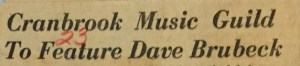
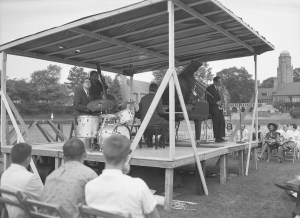
Encouraged by the response during the 1959 season, the summer of 1960 featured the Michigan Chorale (a 100-mixed voice ensemble), the Severo Ballet accompanied by the DSO, and even a jazz concert in order to “present the best in all fields of art.” The first two performances were, as usual, held at the Greek Theatre. The third of the season was the Dave Brubeck Quartet. One Rochester [Michigan] News reporter called it “the Guild’s boldest experiment” to date. In anticipation of a capacity crowd, the performance was held at the football stadium at Cranbrook School instead of the Greek Theatre, which is a smaller venue.

Dave Brubeck Quartet, Cranbrook School, July 14, 1960. Harvey Croze, photographer. Copyright Cranbrook Archives.

Dave Brubeck Quartet, Cranbrook School, July 14, 1960. Harvey Croze, photographer. Copyright Cranbrook Archives.

In 1960, the members of The Dave Brubeck Quartet were Dave Brubeck (piano), Paul Desmond (alto saxophone), Joe Morello (drums), and Eugene Wright (double bass). The concert at Cranbrook was held on Sunday afternoon, July 14th at 4:30 pm. While the Guild was hopeful for a full house of 2,000, more than 1,100 people actually attended, still beating the Guild’s previous attendance record of 775.

Cranbrook Music Guild Records. Courtesy Cranbrook Archives.

Cranbrook Music Guild Records. Courtesy Cranbrook Archives.

While I was not able to find any notes or articles about what the Quartet played at Cranbrook, it is highly likely that they played at least a few songs from their album, “Time Out,” which was recorded in 1959. Most of you will recognize the song “Take Five” from the album, which became one of their most popular. It is fun to imagine sitting outside at the stadium (now known as Thompson Oval) listening to this “new jazz.”

Leslie S. Edwards, Head Archivist

Editor’s Note: Thanks to Chris Morton for bringing this event to our attention!


“The Last Minstrel” at Cranbrook

Richard Dyer-Bennet poster

Troubadour, poet, and composer Richard Dyer-Bennet (1913–1991) was among the best known and most respected folk singers in America during the 1940s and 1950s. He became the first solo folk musician to appear in Carnegie Hall and on December 7, 1941, NBC radio broadcast Richard Dyer-Bennet singing “The Ploughboy” when the broadcast was interrupted with the announcement of the attack on Pearl Harbor.

Richard Dyer-Bennet performs at Cranbrook, Feb 1954. Harvey Croze, photographer.

Richard Dyer-Bennet performs at Cranbrook, Feb 1954. Harvey Croze, photographer.

Brought to Cranbrook by the Cranbrook Music Guild in February 1954, Dyer-Bennet presented “The Voice of Minstrelsy,” a program of traditional folk songs which spanned six centuries and included old-world European songs as well as American folk ballads.  A year later, Dyer-Bennet founded his own record label in order to maintain artistic control over the sound quality, repertory, and style of his performances.

To see the poster featured in this blog, as well as numerous others from our collection, visit the Archives’ exhibition Designs of the Times: 100 Years of Posters at Cranbrook.

Leslie S. Edwards, Head Archivist

Create a website or blog at WordPress.com