Fashioning Architecture

In 1931, attendees at the Beaux-Arts Ball in New York came dressed to impress. An annual party thrown by the Society of Beaux-Arts Architects, the ball featured a different theme each year. 1931’s theme of “Fete Moderne — a Fantasie [sic] in Flame and Silver” was inspired by the New York skyline and the iconic skyscrapers that had recently come to define it. Fully committing to the theme, many guests came dressed as famous New York buildings. In this photo William Van Alen holds center court as the Chrysler Building (of which he was the architect) while other personified buildings crowd around him.

William Van Alen as the Chrysler Building, with other masquerading architects around him. On the far right is Joseph Freelander as the Museum of the City of New York.  Source: NY Times/untappedcities.com.

William Van Alen as the Chrysler Building, with other masquerading architects around him. On the far right is Joseph Freelander as the Museum of the City of New York. Source: NY Times/untappedcities.com.


Continue reading

Illuminating Lives: Documenting Women in the Cranbrook Archives

In the publication Perspectives on Women’s Archives, recently released by The Society of American Archivists , editors Tanya Zanish-Belcher and Anke Voss begin their introduction with the following : “the history of women’s archives and the collecting of women’s records reflect the larger cultural and societal developments occurring in American history over the past few centuries.” This poses the question—how do we at Cranbrook document the lives of the women who worked and studied here? What can we do to actively collect the papers and records that will illuminate the lives of these women? How have their experiences contributed to our community and to the world at large?

Currently, the Cranbrook Archives has a small percentage of collections donated by women or their families that speak to these issues, including the collections of Cranbrook artists and the papers of former CEC president Lillian Bauder. However, the bulk of women’s history can be found in our institutional records. I would like to spotlight three unsung women in this blog: Helen McIlroy, Pearl Peterson, and Marjorie Bingham.

Helen McIlroy at her desk at Cranbrook House, 1950. Cranbrook Archives.

Helen McIlroy at her desk at Cranbrook House, 1950. Cranbrook Archives.

Continue reading

Touchdown in Bloomfield Hills: The Detroit Lions Come to Cranbrook

As Superbowl season engulfs America and the Detroit Lions’ seemingly endless search for a new head coach comes to a close, we at Cranbrook look fondly back at the days when the Lions were a seasonal presence here on campus.  You might be forgiven for not immediately associating a 100+ year-old arts and education campus with pro football, but get ready to be schooled: the Lions used Cranbrook’s bucolic campus as their training ground for a number of years.

Detroit Lions players and coaching staff arrive at Cranbrook School for training camp. Pontiac Press, date unknown.

Detroit Lions players and coaching staff arrive at Cranbrook School for training camp. Pontiac Press, date unknown.

Continue reading

West to East: Cranbrook School Chairs Return

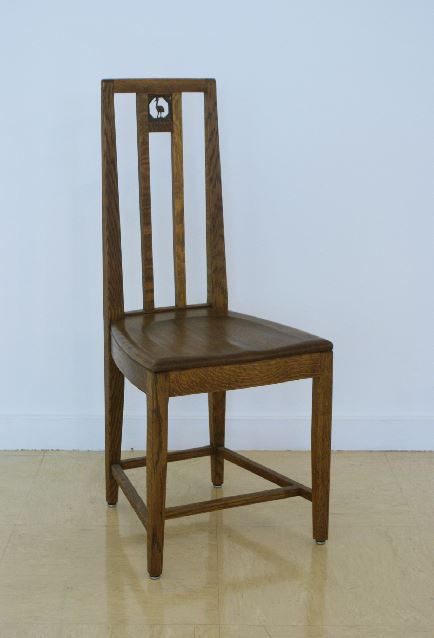
The scene feels like the opening shot in a movie: a man browses a flea market, aimlessly brushing his hands over knickknacks while he waits for something to catch his attention. A pair of chairs  jump out at him, their warm brown wood and right angles crying out for his attention.  He investigates them, noting their early 20th century construction and the curious metal design inset at the crest of the chairs.  They look familiar, he thinks, and the camera zooms out as he purchases them and takes them home.

Cranbrook School Dining Hall side chair, designed by Eliel Saarinen in 1928.

Cranbrook School Dining Hall side chair, designed by Eliel Saarinen in 1928. The chairs discovered in California are identical.

Continue reading

Cranbrook and the Car: A Different Look

Currently on display, the exhibition A Driving Force: Cranbrook and the Car thoughtfully illustrates two key ways in which Cranbrook has been affiliated with the automotive industry throughout its history.  James Scripps Booth was an avid artist and inventor, even taking apart, rebuilding and designing cars in the garage of Cranbrook House from an early age.  Later on, the Academy of Art encouraged students to enter competitions which included designs for Packard Motor Car hood ornaments (1934) and exterior design, hood ornaments and trunk lid medallions (1950).  Graduates were employed by the Big Three automakers in a variety of ways—working in the design studios building models for new cars, as part of Harley Earl’s “Damsels in Design,” and as textile designers for automotive interiors.

But Cranbrook’s relationship with the car goes beyond the realm of design.  The Booth family’s list of cars includes a Winton (1904), a Christie (1904), a Cartercar (1907), two Pierce Arrows (one was a limousine), a Brush Runabout (1910), a Chalmers 40 (1910), a Lozier “Briarcliff” (1911) and a Detroit Electric (1921) which was driven by Henry Wood Booth at the age of 88.

Warren and Grace Booth with chauffeur in the Chalmers 40 in front of Cranbrook House. Circa 1910, Cranbrook Archives.

Warren and Grace Booth with chauffeur in the Chalmers 40 in front of Cranbrook House. Circa 1910, Cranbrook Archives.

Continue reading

Photo Friday: Cranbrook’s Gatescape

Image

Close-up of the peacock for which Cranbrook School’s Peacock Gates are named. Designed and installed in 1927, restored in 2013. Cranbrook Archives.

Doors, entryways, gates – Cranbrook’s campus was designed with an eye towards points of transition.  Since its foundation 108 years ago, Cranbrook has maintained a long tradition of gate design and fabrication.  This close-up of a stylized peacock comes from Cranbrook School’s famous Peacock Gates; designed by Eliel Saarinen, they were produced by the metalsmith Oscar Bach in 1927.  Recently, a long restoration process culminated with their re-installation on the Cranbrook School campus.   This gate and many others are the subject of the second exhibition in the From the Archives series.  Drawing from the rich collection of the Cranbrook Archives, From the Archives: Forging Cranbrook’s Gatescape explores the history, design, and formation of Cranbrook’s historic and contemporary “gatescape.”

Experiencing the gates from within the walls of the Art Museum is nothing compared to seeing them in person.  With that in mind, Leslie S. Edwards, Head Archivist and exhibition curator, will be leading a walking and bus tour of the gates on Sunday, October 5.   The tour will take participants  to some of Leslie’s favorite gates, from beloved classics to the newest installations on campus.   More information on the exhibition and walking tour is available here.  Be sure to check it out, and get ready to see Cranbrook’s gates in a whole new light!

Photo Friday: Cranbrook Soda Fountain

Students at the Cranbrook School Soda Fountain, May 1955.

Students at the Cranbrook School Soda Fountain, May 1955.  Historic Photograph Collection, Cranbrook Archives.

We were all set to write something pithy and charming about boarding school life and 1950s Cranbrook, but let’s be serious: it’s Friday, and we all wish there was still a soda fountain on campus.  Who wants to build one?

P.S. stop by the Cranbrook Archives reading room sometime if you want to see one of those original Cranbrook School pennants still in action!

Photo Friday: Cranbrook Hockey, Football-style

Image

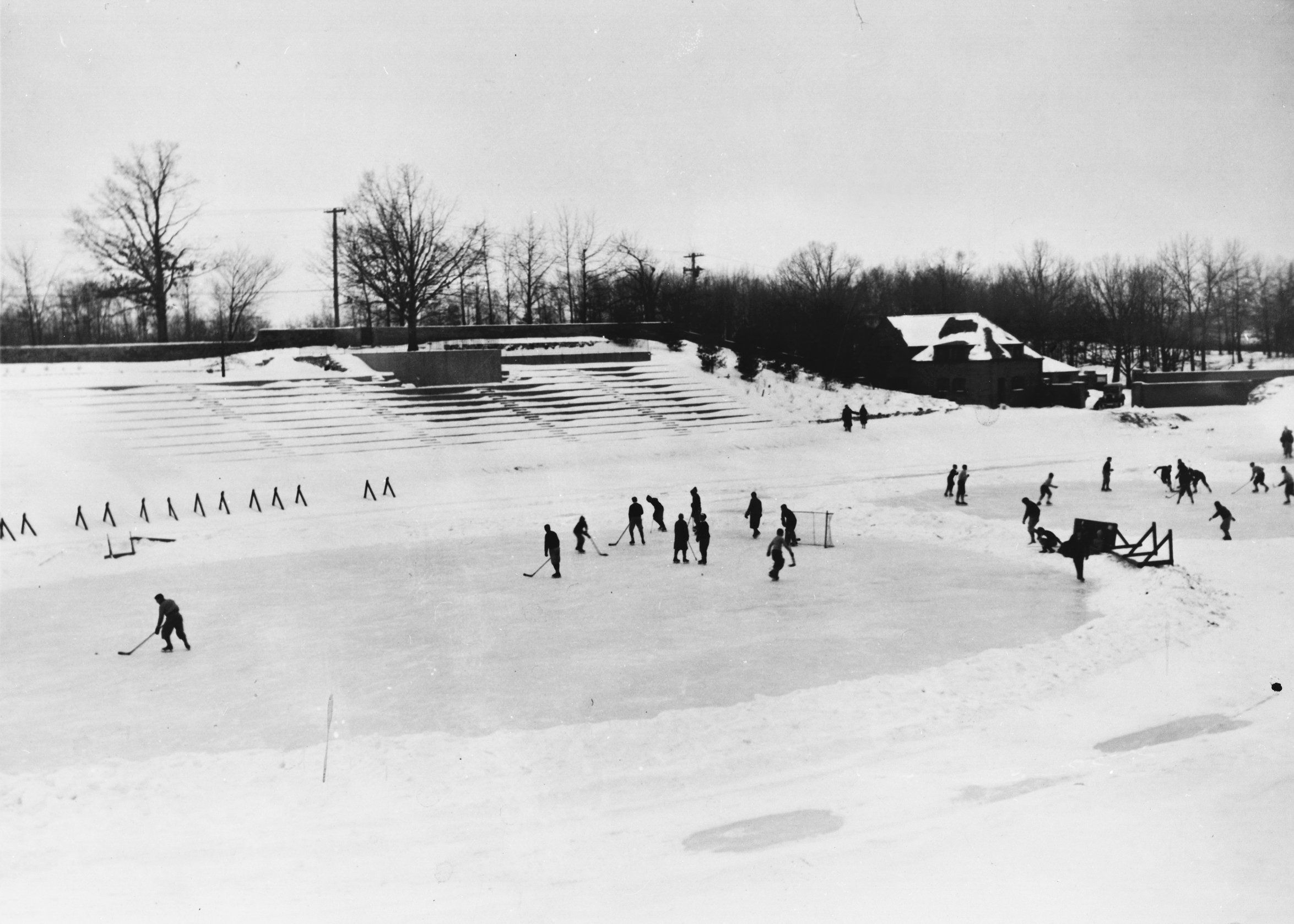
Cranbrook School hockey practice on the football oval, 1928. Cranbrook Archives.

Hockey at Cranbrook has a long tradition, but it didn’t always have a home.  In 1928, the Cranbrook School hockey team found itself with two out of the three elements necessary for a successful game.  Eager players, check.  Required equipment, check (minus helmets, apparently).  Ice rink?  Not so much.  Always resourceful, however, the team made do, holding practices on the iced-over Cranbrook football field.  Things have changed since then; now the team plays at Wallace Arena, and they tend to wear helmets as well.

Create a website or blog at WordPress.com