“Grace, Elegance, and Pizazz” – Fifties Fashion in a Nutshell

For this May’s upcoming A House Party at Cranbrook: Celebrating the Legacy of Music, we are celebrating the music and spirit of the 1950s. Naturally, that means digging into our closets for our best mid-century modern outfits, and more importantly, our dancing shoes. Seventy-five years ago, guests invited to a Cranbrook party could head down to Hudson’s department store on Woodward Avenue for a full evening’s attire. That is, unless they, like Loja Saarinen, preferred to design and sew their own clothes! This year, we may be deprived of Hudson’s and its record-breaking 705 changing rooms, but we do not lack sources of inspiration for a fifties night at Cranbrook.

Cranbrook Academy of Art: Packard Motor Competition, 1950. Cranbrook Archives, Cranbrook Center for Collections and Research.
Eliel and Loja Saarinen at the front entrance of Saarinen House, Cranbrook Academy of Art, circa 1950. Cranbrook Archives, Cranbrook Center for Collections and Research.

The 1950s was an exciting time for snappy dressers, even those not as artistically gifted as Loja Saarinen. While Cranbrook-trained designers like Ruth Adler Schnee and Florence Knoll were transforming the look of the modern American interior, American clothing was undergoing a revolution of its own. The 1950s can be seen as the dawn of the modern fashion era, defined by an extraordinarily diverse range of stylish modes of dress, and a new emphasis on comfort and adaptability. The introduction of novel synthetic fabrics like orlon and spandex, and a new prominence for sports and lounge wear anticipated the rise of current athleisure apparel. The cocktail dress reached its zenith in this decade, as did the requisite accessories: shoes, handbag, and a trunkful of costume jewelry.

Many designers, including Christian Dior himself, continued to embrace the sloping shoulders and hourglass shapes of the “New Look,” inaugurated in the late forties. However, no single silhouette dominated the womenswear scene. Waistlines and hemlines rose and fell according to the whims of individual designers, dresses and coats billowed outward or narrowed to follow the line of the body, and the range of possibilities for fashionable dressers expanded rapidly in all directions.

The one common and consistent demand for women’s clothing then was elegance; truly casual clothing was not yet a part of the upper or middle-class woman’s wardrobe. Whether in a cocktail dress, playsuit, full-skirted evening gown, or daring slacks, women were still expected to present a polished exterior. Menswear, on the other hand, trended towards greater informality and comfort across the decade.

Attendees at a Cranbrook Academy of Art weavers’ party, 1959. Cranbrook Archives, Cranbrook Center for Collections and Research.

The structure of the modern suit gradually loosened, while ties, worn short and wide at the start of the decade, narrowed and lengthened, and soft knit ties became an accepted part of a business wardrobe. Boxy, straight cut and swing jackets, for men and women alike, allowed for complete freedom of movement, and leant a jaunty sway to an outfit’s profile. A new pop of color enlivened men’s suits, in the form of a bright shirt, tie, belt, or a contrasting waistcoat. For the more daring, a colorful velvet smoking jacket might be just the thing for an evening party.

Youth culture drove much of the sartorial transformation, particularly in casual dress; Elvis Presley, Marlon Brando, and James Dean modelled the classic white t-shirt and jeans for the first time on the big screen in this decade, and James Dean’s short career in Hollywood left a lasting fashion legacy in the form of his distinctive red nylon golf jacket, in Rebel Without a Cause.

Theatrical poster for Rebel Without a Cause, 1955. Warner Brothers Pictures Distributing Corporation. Image via Wikimedia Commons.

In fact, it would be hard to find better – or more entertaining – fashion inspiration than in the films of the 1950s. Throughout the decade, star actresses like Audrey Hepburn, Grace Kelly, and Dorothy Dandridge modelled iconic looks, both onscreen and off.

Dorothy Dandridge photographed for LIFE Magazine in 1955. Image via Harper’s Bazaar.

Eight-time Oscar-winning costume designer Edith Head (the inspiration for superhero costumier Edna “E” Mode in The Incredibles (2004)), created some of the 1950’s most iconic looks, for men and women alike. Her designs reflect the breadth of possibilities for glamorous women’s dress in the period, from Grace Kelly’s full tulle skirts, inspired by ballet tutus, to Kim Novak’s sleekly severe suits in Vertigo (1958). True couture also made appearances on screen, as Hepburn was dressed by M. Hubert de Givenchy himself for Sabrina (1954) and Funny Face (1957), the latter a cinematic send-up of the fashion industry itself.

Menswear in these classic films receives less attention on Pinterest boards today, but it too evinced a witty, modern spirit and a widening range of options. There’s a new, comfort driven sensibility behind Gregory Peck’s lightweight, loosely-cut suits in Roman Holiday, joy and humor in Fred Astaire’s dance number in Funny Face, in which his white duster coat’s scarlet lining transforms it into a matador’s cape, and there is nothing uptight or understated about Cary Grant’s polka-dotted scarf and striped sweater in To Catch a Thief.

The glamorous costumes of the big screen set a high bar for fifties fashion, but even Audrey Hepburn had a more ordinary go-to look: the capris, sweater, and ballet flats ensemble that she was photographed in time and time again.  The ease with which the stars of the fifties wore their exquisite clothes reminds us, in our own era, not to take our own wardrobe too seriously. Not even for A House Party at Cranbrook!

Join the Center in your 1950s-inspired finery on May 18 to help us celebrate the legacy of music at Cranbrook with a garden gala at Thornlea House and enjoy musical stylings from the era. Head to our website to learn more and purchase your tickets to A House Party at Cranbrook: Celebrating the Legacy of Music!

Mariam Hale, 2023-2025 Collections Fellow, Cranbrook Center for Collections and Research

Let’s Beguine Again: A Syllabus for Music and Dance

This year the Center is celebrating the life and work of Loja Saarinen for our House Party fundraiser. Lynette Mayman’s post on 1930s fashion offered an excellent guide to dressing à la mode for this historically themed evening event, while highlighting Loja’s freedom and creativity in celebrating her own authentic style. Being curious about the events to which such attire might be worn, I looked to the Kingswood School records to explore its history of music and dance events during that era.

Kingswood School Annual Dance Book, 1932. Courtesy of Cranbrook Archives.

From the abundance of programs and ephemera, it was clear that music and dance were a valued part of the curriculum and school life, and its purpose was elucidated by the educational philosophy in the school catalogs for the 1930s:

“Music and Dance, two of the greatest social forces, and most closely related in essential nature, are organized in the curriculum under the direction of one department for concurrent purposes… The program of work is such as to encourage the fullest and freest development of individual personality which is the basis for true dramatic and musical expression.”

Kingswood School Catalogs, Kingswood School Records (1980-01)

Formal classes in music theory and social dancing (taught in physical education classes under the direction of Luella Hauser) were augmented by extracurricular activities. These included the Glee Club and various kinds of themed and annual dances, which offered students a variety of ways in which they could learn through participation, as well as recitals by visiting performers, which offered learning through observation and listening.

Program for the Mothers’ Day Tea, May 1937. Courtesy of Cranbrook Archives.

The Glee Club for girls was formed in 1932 for those interested in singing. They performed one concert per year, the first being held on March 11, 1932. The Club would also perform at other events throughout the year, such as the Mothers’ Day Tea and the ‘Carnival,’ which was an informal jamboree of themed gaiety and fun. The first Carnival, on December 10, 1932, was described as one of “grand vaudeville,” including a fashion show that embraced lovely old fashions and lively modern ones.

The 1937 Carnival was a Masque that traced the development of dance from the fourteenth century to the present time, including the Carole, Pavane, Sarabande, Minuet, Gavotte, Waltz, Schottische, Tango, and Fox Trot. The Glee Club sang songs typical of each period, while three jolly spirits, Dance, Play, and Song, presented the dancers.

Invitation to the Ypsilanti Madrigal Club performance, December 1931. Courtesy of Cranbrook Archives.

The first visiting performance was held on December 11, 1931, when the Madrigal Club, a choir of men and women from State Normal College, Ypsilanti, under the direction of Mr. Frederic Alexander, performed as a Christmas gift from Mr. Alexander to Mr. George Booth. The concert of unaccompanied songs and compositions on harpsichord was described as “unusual in character and delightful in content,” and became an annual event at the school.

Other annual visitors included Mildred Dilling, the internationally known harpist, and Cameron McLean, the Canadian baritone who was accompanied by various local pianists, including Detroiter Gizi Szanto. There were also one-time visits by performers such as pianists Stanley Fletcher and Samuel Sorin, singer Marion Anderson, baritone Earle Spicer, and opera singer Alexander Kipnis.

Program of Music printed by Cranbrook Press, April 1932.

Kingswood School Records. Courtesy of Cranbrook Archives.

Celebrated teachers of modern dance were invited to give dance recitals including Ted Shawn, Ronny Johansson, and Martha Graham. Visiting in March 1936, Graham gave a comprehensive recital of her work, leaving us with an autographed program—an archival treasure!

Program for Dance Recital autographed by Martha Graham, March 1936. Courtesy of Cranbrook Archives.

While Graham’s dance was reported in the Kingswood Newssheet as casting aside, “all old standards of beauty and grace,” through her use of angles and quick movements rather than the legato rhythm of conventional dancing, her philosophy of the dancer speaks poetically to the purpose of the 1930s Kingswood curriculum for music and dance—drawing out the essence of the individual through social artforms:

“You traverse, you come to the light, you work, you make it right… you embody within yourself as much curiosity, use that curiosity and avidity for life … and the body becomes a sacred garment – it’s your first and your last garment, and as such it should be treated with honor, and with joy, and with fear too, but always with blessing.”

Martha Graham, Martha Graham on Technique

As we celebrate the life and work of Loja Saarinen this year, we celebrate her as immigrant, entrepreneur, designer, and fashionista. Please join us for the Virtual Film Premiere as we support and acknowledge the work of the Center at our House Party, May 21, 2022.

Laura MacNewman, Associate Archivist, Center for Collections and Research

Beginning the Beguine

Before everybody buys, borrows, or burrows in a closet for something to wear for Cranbrook Center’s annual House Party, let us consider the fashions of the times. We’re going back to the 1930s, to celebrate the heyday of Loja Saarinen, doyenne of the Cranbrook art scene as designer of interiors, weaver, fashionista, textile designer, businesswoman, landscaper, and modelmaker. Between husband Eliel, daughter Pipsan, and son Eero, the Saarinen family had inventiveness, imagination, skill, and audacity all sewn up. With the Saarinens’ extensive network of friends, colleagues, and students, the atmosphere at the Art Academy must have been rarified indeed.

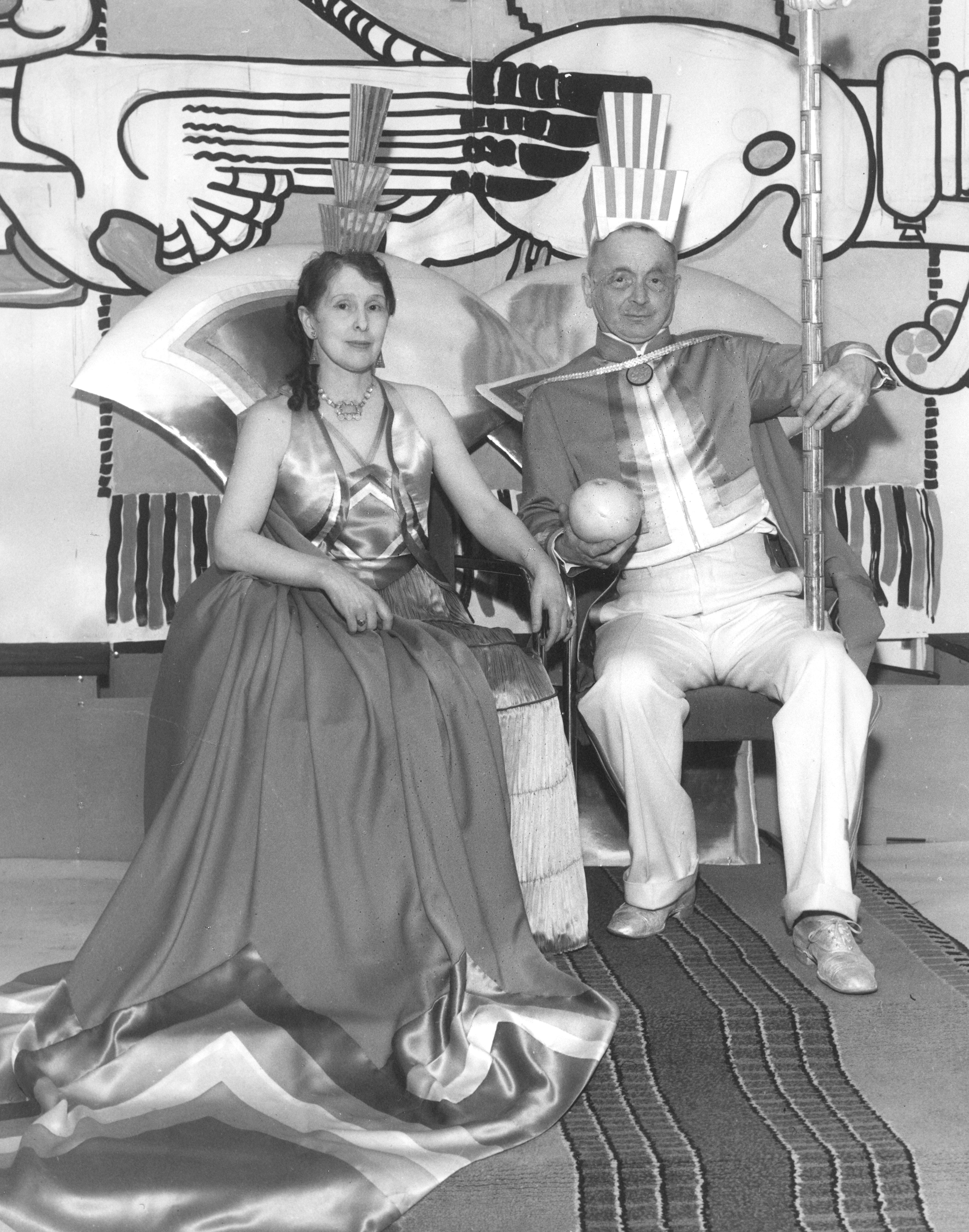
Small wonder, then, that when it came time for parties, Loja Saarinen could craft her own iconic evening attire for the Art Academy’s Crandemonium Ball of February 1934, including that of her consort, as you can find in the photograph on the flyer for the event of May 21, 2022.

Eliel and Loja Saarinen at the Cranbrook Academy of Art “Crandemonium Ball,” February 1934. Photography by Richard G. Askew, Copyright Cranbrook Archives.

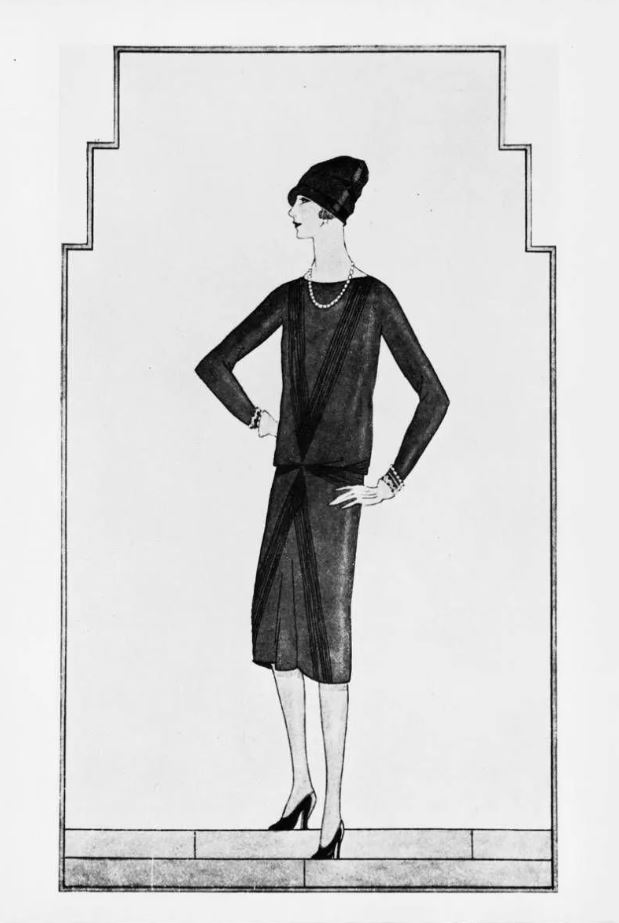
Four our House Party, if you were thinking of the little black dress, Coco Chanel brought this simple concept to the public eye in 1926, with Vogue Magazine proclaiming it “Chanel’s Ford” in homage to the Model T which famously came in any color you wanted as long as it was black. Do note the chevrons (just visible in the Chanel dress) on the Saarinen dress also.

Coco Chanel–the Little Black Dress, as illustrated in American Vogue, October 1926. Source: Vogue.

Post WWI 1920s design was the big break away from the 19th century drapery which required all kinds of padding and corsetry. Chanel prided herself on getting women out of corsets, and they never went back into them. The fashions were shapeless, short, and sack-like at their extreme, with lots of embellishment for evening dresses to make up for their lack of pizazz. Think Fitzgerald and Gatsby.

At this time too, the tuxedo or dinner jacket was becoming acceptable for ordinary men who were not English royalty or American billionaires.

Continue reading

The Fashions of Ruth Adler Schnee

Sometimes it seems there are infinite possible discoveries within a single archives collection. Such is the case with the Edward and Ruth Adler Schnee Papers. Just over a year ago I wrote about the Schnees’ long-running Detroit retail business, Adler/Schnee, but I knew then that story was only the tip of the iceberg.  

And so I was happy to find myself returning recently to one of my favorite collections in the Archives. Replacing materials that had been on loan to the Cranbrook Art Museum for their exhibit, Ruth Adler Schnee: Modern Designs for Living, I was once again struck by her achievements as a high school student at Cass Technical High School in Detroit from 1940-1942. In particular, her skill at fashion design. Maybe it was the months of hearing about sweatpants and Zoom shirts, but it was so refreshing to spend a few moments remembering what real fashion means. 

Ruth Adler Schnee illustration, circa 1941. Courtesy of Cranbrook Archives.

Before Ruth Adler Schnee made a name for herself in interior design, including her iconic textile designs, she was interested in becoming a fashion designer. Attending Cass Tech afforded Ruth the opportunity to nurture her natural artistic talents, which are clearly evident in drawings from her primary school days. And, she had already shown an affinity for fashion design—out of necessity, Ruth had already been designing her own clothes since she was a 13-year-old Jewish girl in Nazi Germany (her family emigrated in 1939).

Amongst other documents in her collection, the story of Ruth’s high school years and her passion for fashion are perhaps best captured in three notebooks. One of my favorite boxes in the collection holds nothing but pages from a notebook entitled Dress Design VI. Labeled “hours 1-4″ it is clearly a class project, and one for which Ruth received high marks. Divided into four parts (Machine Attachments, Illustrative Material, Drafting Problems, and Analysis of Dresses), the book includes drawings, pattern pieces (not to scale), paper mockups of mainly women’s sportswear designs, samples of sewing technique (actual fabric pinned to the page), textile identification pages (with real fabric samples), and an essay on silk. 

Sleeve Form page, in “Notes on the Draping of Garments,” Ruth Adler Schnee, circa 1942. Courtesy of Cranbrook Archives.
Continue reading

Loja Saarinen: Lady of Fashion

If this were an article for Harper’s Bazaar it would be an imagined interview between a reporter and Loja Saarinen, but since my status is beneath lowly, I won’t presume. Loja Saarinen is a fascinating person in many respects: she was professionally a sculptor, photographer, textile designer, maker of architectural models, landscape designer, teacher, weaver, entrepreneur, designer in general, without mentioning the unquantifiable but no less important aspects of her life. Married to architect Eliel Saarinen and mother of two extraordinarily gifted children, she must have been party to some incredible family discussions on style, architecture, design of practically everything, including fashion.

Daughter Pipsan Saarinen Swanson briefly led a fashion course at Cranbrook Academy Art, and she and her mother made many of their own clothes.  Even though the ready-made clothing industry was growing, women in the 1930s and beyond who had sewing skills but not necessarily the money for special garments would make their own. Commercial patterns abounded: Vogue, Butterick, Simplicity, McCall, among others not all of which survive today.

Here is a Vogue pattern from the times:

Vogue Dress for Lynettes blog

Courtesy of Etsy.com

Remember this look.

Considering Loja Saarinen’s formal training in sculpture in Paris and her own textile designs, not to mention her model-building skills and creativity, one must assume she was ideally set up for making her own special clothes. They would be unique. What could be better?  And then there was the wonder of downtown Detroit’s J. L. Hudson’s vast floor of fabrics.

Hudsons detroit fabric shop

Fabric Department at J. L. Hudson Company Department Store, 1920s. H.W. Brooks, Commercial Photographer. Courtesy of the Detroit Historical Society.

Of course, the essence of fashion is being appropriately dressed. Working from the informal to the more formal attire, one may examine a few photographs of Loja Saarinen as samples of her impeccable taste and ingenuity.

Here is Loja on a relaxed afternoon standing with husband Eliel Saarinen in the 1930s:

Eliel and Loja Saarinen at Cranbrook copy neg CEC493 copyright Cranbrook Archives

Eliel and Loja Saarinen. Copyright Cranbrook Archives.

This looks like a take on a peasant dress with its loose sleeves and wide flat fell seams and flared, lightly gathered skirt. What says hand-made to me is the embroidered belt.  While it is possible Loja bought the dress and altered it to fit sleeve length and hem, I think this would have been easy enough to whip up. It is casual, comfortable and different enough to mark her as a person with an eye for good design who is not going to be dressed like anyone else.

Here is a dress in tasteful black which looks a lot like the above Vogue pattern:

Loja Saarinen in Saarinen House Dining Room c 1940 copy neg CEC490 Courtesy Cranbrook Archives

Loja Saarinen in her dining room, c. 1940. Courtesy Cranbrook Archives.

The sleeves are a bit longer. Note the Chemex coffeemaker as accessory.

Next is a design so Loja-esque, given the proliferation of triangles all over the campus in every medium you can think of, including in her own contributions, this fabric and the garment have to be Loja Saarinen designs.

I am not sure what the pale fabric is, obviously soft and drapey, but the design could be embroidered or appliqued ribbon. (Family boost: she’s sitting in one of the Eero-designed auditorium chairs.)

Loja Saarinen c 1934 Copyright Cranbrook Archives

Loja Saarinen, c. 1934. Courtesy Cranbrook Archives.

This is one of the best examples of Loja’s sense of style, though probably not her own work. She is warm, stylish and utterly without fuss. Attention PETA, this is before the days of reasonable-looking faux fur. The coat is a thick wool with light-colored top-stitching down the sleeves and front bodice panels.

Eliel and Loja Saarinen at the rear of Saarinen House copy neg CEC491 Copyright Cranbrook Archives

Eliel and Loja Saarinen. Copyright Cranbrook Archives.

Dress-up clothes, we have them: a lovely photograph of a younger L. S. Swirls of fabric and triangle earrings.

Portrait of Loja Saarinen by Max Habrecht 1932 copyright Cranbrook Archives

Portrait of Loja Saarinen, 1932. Max Habrecht, photographer. Copyright Cranbrook Archives.

This looks like a dress with swaths of color in the bodice such as you might see in her rug design. This could be silk satin, or what was called “art silk.” It looks bias-cut, which would make for a good fit, but which is unforgiving for the seamstress. You can’t see her hair very well, but it appears fashionably cropped.

In the following Crandemonium photograph Loja’s attire looks like a variation on a theme.  I suspect this is a top she made for the occasion, worn over a separate skirt.  Eliel Saarinen’s jacket has matching color stripes. The Saarinen column hats make the outfit for both party-goers. Loja’s dress has a train as befits the queen of Crandemonium. The orb of office for King Eliel is a grapefruit.

Loja and Eliel Saarinen at Crandemonium Ball Feb 1934 Copyright Cranbrook Archives

Loja and Eliel Saarinen at the Crandemonium Ball, Feb. 1934. Richard G. Askew, photographer. Copyright Cranbrook Archives.

At last a color photograph. This may be the same top with a matching skirt, and quite a few years later, but now we see the Saarinen choice of color (Family boost: another Eero chair.)

Loja Saarinen in Vaughn Road home c 1962 Courtesy Cranbrook Archives

Loja Saarinen in her Vaughn Road home, c. 1962. Courtesy Cranbrook Archives.

Loja Saarinen was not a self-promoter. Her work speaks for itself. Her hand is in so many aspects of design all over the Cranbrook campus. This is just a glimpse at a few (fashion) design choices Mrs. Saarinen made about herself. She told Virginia Christ-Janer in a 1964 interview, “With our family [art is] a disease.” More than that, the Saarinens were all so capable, why would they not keep designing? Just like Karl Lagerfeld, to design is to breathe.

For a last word on anything to do with fashion, from all-time humorist Mark Twain: “Clothes make the man. Naked people have little or no influence on society.”

–Lynette Mayman, Collections Interpreter

Create a website or blog at WordPress.com