Did you know that Horizons-Upward Bound (HUB) had its own flag and that it was created by a HUB student? Continuing with the HUB Records digitization project, I came across evidence of this unique item and an interesting story behind it.
Feature on the front page of The Hub, a newsletter published by students in the Summer Program Publications Class, July 26, 1974. Courtesy of Cranbrook Archives.
In 1974, Gregory Loving, HUB student and a senior from Cass Technical High School (17 years old), won a flag design contest for Cranbrook School’s event, Soulfest II. Building on the tradition of institutional flags at Cranbrook begun by Henry Scripps Booth, Gregory’s design incorporated three wide vertical stripes. The center stripe displayed multiple hands of varying skin tones holding an upward-pointing arrow, a motif that would repeat often in HUB graphics and is likely based on Cranbrook School’s logo.
Detroit News clipping featuring Gregory Loving with Henry S. Booth, and Nancy Corkery, May 1974. Courtesy of Cranbrook Archives.
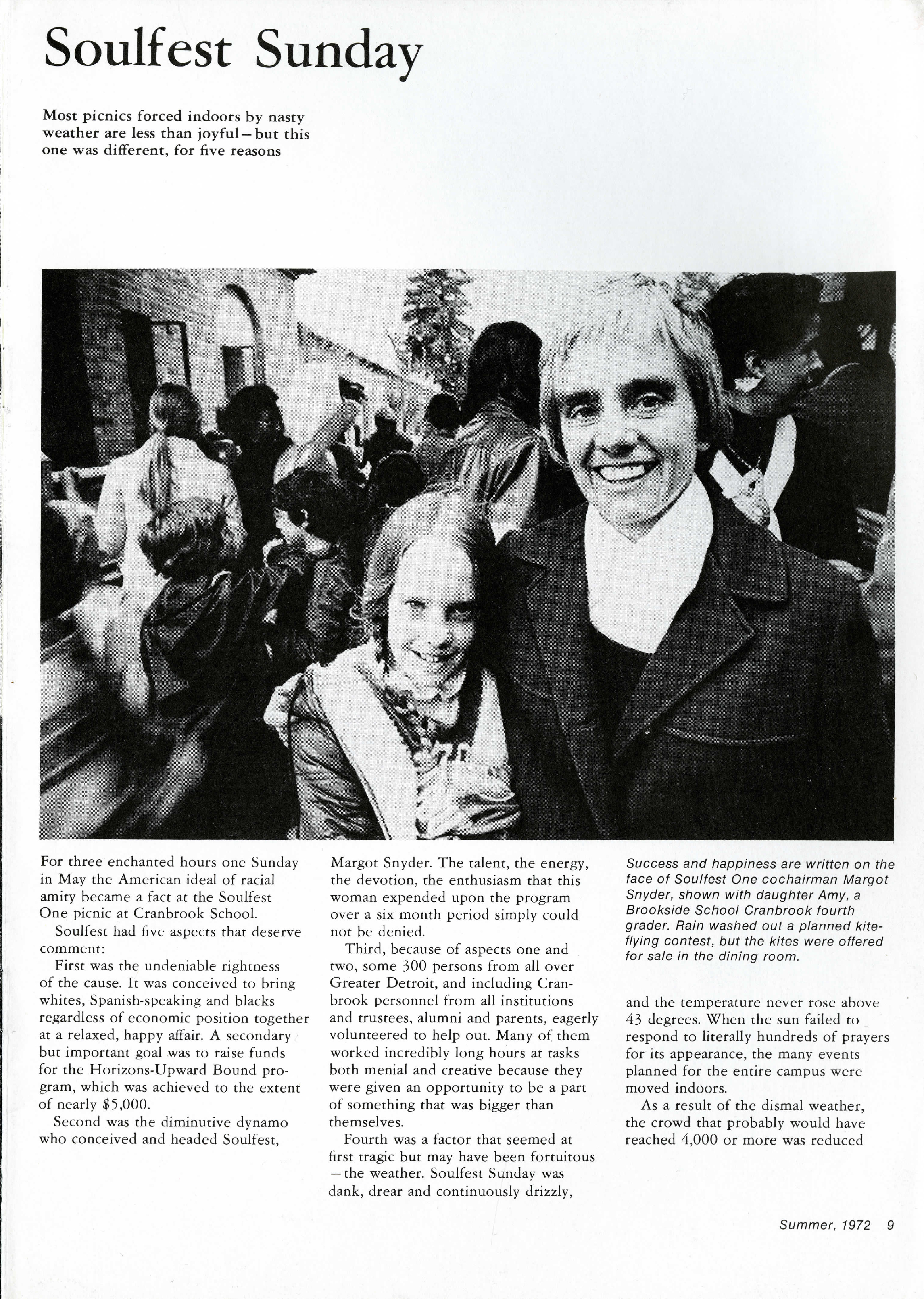
Soulfest was an biannual and major community fundraising event for the HUB program in the 1970s. It was inspired by HUB parent, Lula Barnes, who also provided the recipes, and created and organized by Margot Snyder. Margot, “whose sustaining and nurturing hands…helped shape Horizons-Upward Bound since its beginnings, ” was an integral and beloved member of the Cranbrook Schools and HUB community and wife of HUB founder Ben M. Snyder (HUB class brochure, 1994).
Cranbrook Magazine, Vol. 3, No. 4, Summer 1972, featuring Soulfest’s inaugural event with Margot Snyder and daughter, Amy. Courtesy of Cranbrook Archives.
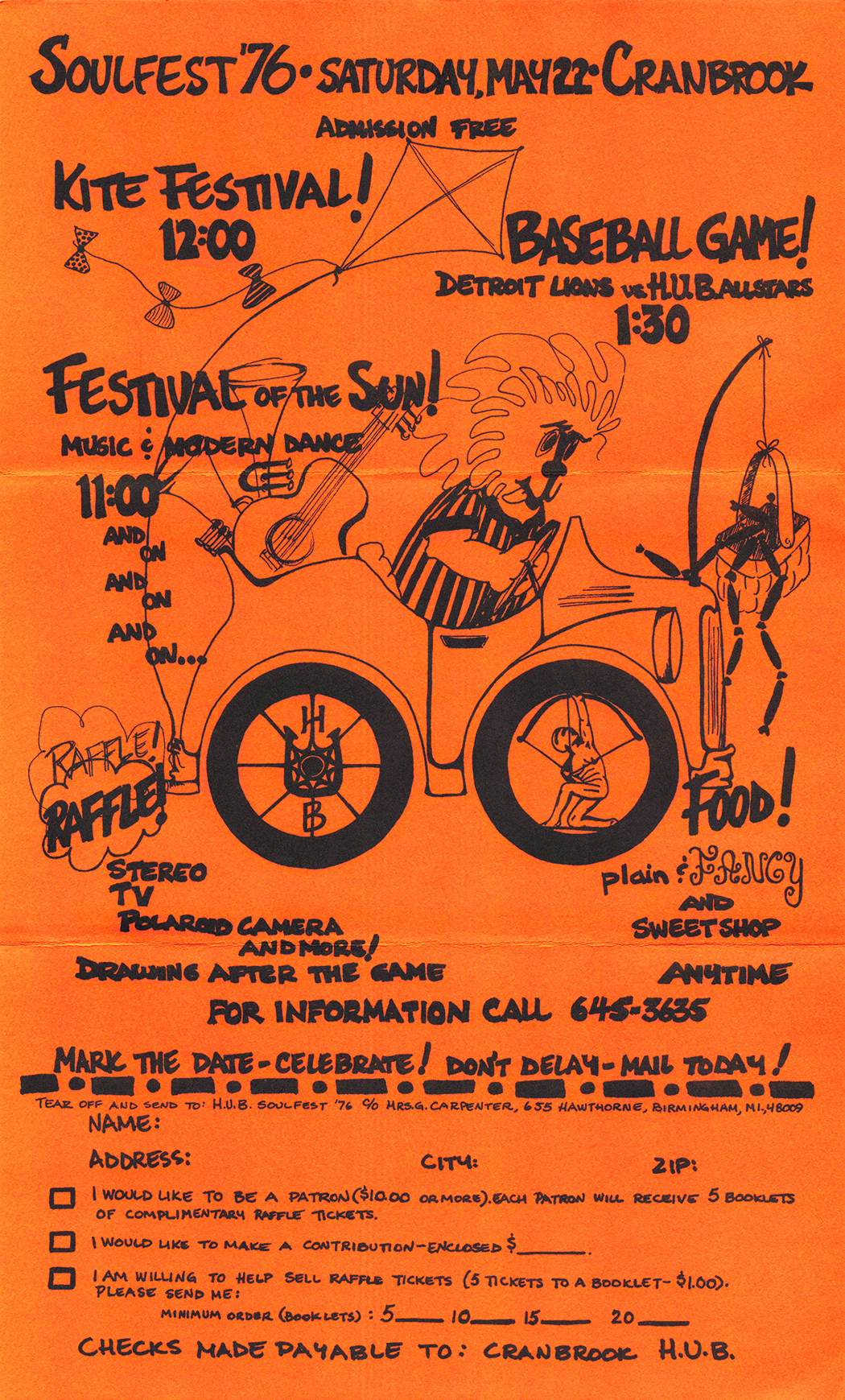
1976 flyer featuring repeats of popular features of the 1974 event, including participation of the Detroit Lions! Courtesy of Cranbrook Archives.
In a memo to Cranbrook School and HUB faculty in March 1974, Margot writes, ” We look upon this as a project stressing Cranbrook’s involvement with the community at large…we hope to raise some much need funds for HUB, we are trying to beat the high cost of living and labor.” Gregory’s winning flag design can be viewed as a visual interpretation of Margot and the Soulfest committee’s goal of increased community involvement. Both the event and flag embody collectivity and upward mobility through the work of multiple hands from varying backgrounds.
—Courtney Richardson, Project Archivist, Cranbrook Center for Collections and Research
HUB digitization is funded by a NHPRC Archival Projects Grant for projects that ensure online public discovery and use of historical records collections. The NHPRC was established by Congress in 1934 as a statutory body affiliated with the National Archives and Records Administration and chaired by the Archivist of the United States.
Classical music, wandering musicians, ballet, cabaret, white paper lanterns, illuminated boats on the lake, Hawaiian torches, Italian tree lights, champagne, dinner, and dancing on a night with a fair-sized moon—these were some of the possibilities that Henry Scripps Booth recorded in December 1964 notes for a music gala called Night of Delight, a fundraiser for the Cranbrook Music Guild of which he was a founding member.
Patrons in line to attend Cranbrook Music Guild concert and ballet performance, July 10, 1960. Harvey Croze, photographer. Courtesy of Cranbrook Archives.
The Guild is one of the most eminent accomplishments in Cranbrook’s legacy of music and it endures to this day (the Archives holds records for the organization through 2007). Born of the inspiration of Christ Church Cranbrook Music Director, Maurice Garabrandt, and Betty (Mrs. Benjamin) Brewster, the Guild was established in 1951 to utilize Cranbrook’s setting as a wonderful place to appreciate music.
During the first decade alone, the Guild sponsored performances by distinguished artists, including violinists Zino Francescatti and Mischa Mischakoff, pianists such as Mischa Kottler, Phillipe Entremont, Jean Casadesus, and Leon Fleischer, cellist George Miquelle, the Severo ballet, jazz musicians such as Dave Brubeck and Don Shirley, classical guitarist Richard Dyer-Bennet, and soprano Eileen Farrell.
Program for Jean Casadesus performance, November 16, 1960. Courtesy of Cranbrook Archives.
The objectives of the Guild were not only to provide high quality programming, support the creation of new music, and the development of high caliber performers, but also to share knowledge about the appreciation of music through lectures, demonstrations, recitals, and exhibitions. The programs for the concerts thus shared brief contextual comments on the history of the piece and the composer.
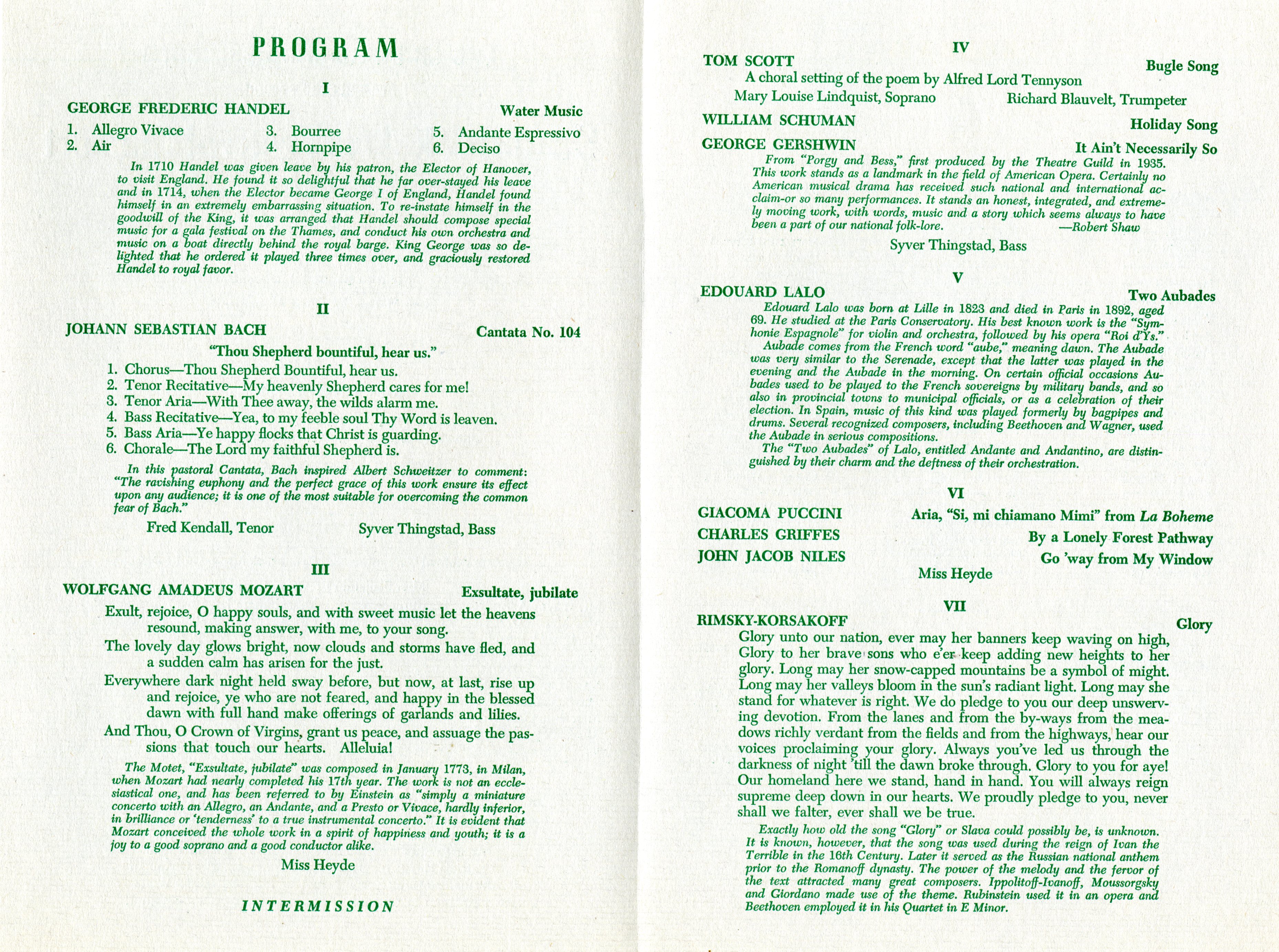
In the program for the Second Cranbrook Arts Festival Concert, which was performed at the Greek Theatre on June 1, 1952, I noticed a comment that is playfully instructive but also particularly salient to later developments in the Guild programming. The second concert program included Johann Sebastian Bach’s Cantata 104, “Thou Bountiful Shepherd, Hear Us,” and it was noted that it had inspired Albert Schweitzer to comment:
“The ravishing euphony and the perfect grace of this work ensure its effect upon any audience; it is one of the most suitable for overcoming the common fear of Bach.”
Program for Second Cranbrook Arts Festival Concert, June 1, 1952. Courtesy of Cranbrook Archives.
The Cantata must have worked its magic, because in 1966, the idea of a Bach at Cranbrook festival was introduced. It would be a satellite festival chaired by James L. Schneider and hosted by Christ Church Cranbrook with the aim to perform Bach’s music as he intended—with a small chorus and orchestra in a church setting. At a special meeting on February 23, 1966, the Cranbrook Music Guild agreed to sponsor the Bach at Cranbrook festival.
At a regular meeting a few days later, Henry expressed concern regarding the conflict of dates. The Bach festival was set for May 14 and his Night of Delight was being planned for the 21st. The Board responded that it was impossible to sponsor two big events that would appeal to same group of people, and that there was no choice but to sponsor the Bach festival, to which they had already committed, and postpone the gala to another year.
Program cover from the first Bach at Cranbrook festival, May 14, 1966. Courtesy of Cranbrook Archives.
Thus, the first Bach at Cranbrook festival took place on May 14, 1966 at Christ Church with 25 members of the Detroit Symphony Orchestra and the 40-voice Kenneth Jewell Chorale. It was a stellar success with an audience of over 1,200 people. The following year, the festival grew into a two-day, three-day concert event. After being renamed the Cranbrook Festival with a broader scope of classical and baroque composers, the festival was dissolved in 1979.
A scene from the Bach at Cranbrook festival, May 14, 1966. Harvey Croze, photographer. Courtesy of Cranbrook Archives.
The gala, Night of Delight, would never take place beyond Henry’s musings. For those with a romantic imagination, his words invite one to feel the warm summer evening, the fragrance of fresh flowers, strains of music across the courtyard filled with joyful chatter, elegance, and conviviality beneath the light of the moon. If your senses require something more tangible, fear not, for the Center for Collections and Research is celebrating the legacy of music at Cranbrook at our House Party on May 18th. Join us for live music, dinner, dancing, paper lanterns, and even a fair-sized moon! It will truly be a Night of Delight!
My three weeks at the Center for Collections and Research have been an exhaustive tour of all the activities and responsibilities of maintaining Cranbrook’s history. From getting ready for the annual House Party, scanning historical documents, and cleaning the Smith House in preparation for summer, being a member of this community requires one to wear many hats to preserve its history.
Scrubbing the Frank Lloyd Wright Smith House in Bloomfield Township. Photo by Leslie Mio.
During my first week with the Center, I entered into the great anticipation of the annual House Party fundraiser. With this year’s theme involving Cranbrook’s influences from England, many of my projects involved making Cranbrook House a better fit for this theme. As favors for the guests, I assembled nearly 300 pastry boxes to fill with scones and other iconic English treats like tea and marmalade.
My collection of pastry boxes from my week at Cranbrook House. Photo by Grace Quinn.
Following the party, I helped scan many folders of documents from the Archives on George G. Booth and his involvement with the Detroit Arts and Crafts Society and with renowned architect Albert Kahn. Although I knew very little about the Arts and Crafts movements, I came to a much stronger understanding of how the Booths focused much of their wealth and influence on buying and displaying handcrafted goods.
These were not just shows of wealth but were a way of honoring the artisans who built this campus and saying, without words, that a quality place like this will withstand much more than inhuman, mass-produced art and furniture. Even though this notion is not new, rising technological advances seem to only make cheapness and speed priorities in design, rather than beauty or emotional value. The art of patience and supporting artists is a refreshing notion compared to the on-demand nature of online shopping and rampant consumerism.
While scanning documents from the George G. Booth Papers was my main Archives project, I also got to work with architectural drawings of Glen Paulsen from the 1950s. Photo by Deborah Rice.
When reflecting on what I had learned during this internship, I realized that before this I had never given much thought to how this campus came to fruition. I knew that some famous architects built it, but as I scanned archival documents and helped maintain Cranbrook’s houses, I can now fully realize the cultural influence Cranbrook has had in Detroit’s history.
Cranbrook’s inspiration stretches across borders and countries; it has a prominent space in contemporary architecture and in the earlier Arts and Crafts Movement. Cranbrook’s exercises in art and design are on display to inspire others to emphasize detail, quality, and creative talent in designing schools and creating diverse communities.
—Grace Quinn, Cranbrook Kingswood Upper School 2023
Editor’s Note: The Senior May Project is a school-sponsored activity that encourages Cranbrook Kingswood Upper School seniors to acquire work experience in a field they are considering as a college major, a potential profession, and/or as a personal interest.
Grace’s efforts in making A House Party at Two Cranbrooks a success, her can-do attitude, and her flexibility in tackling projects large and small were much appreciated by the Center staff. We wish her luck as she heads to the Rochester Institute of Technology’s College of Art and Design in the fall!







 Cranbrook Kitchen Sink