Weeping Zeus

A folly, in landscaping terms, is a ornamental building or tower with no practical purpose built in a large garden or park. Around 1961, Mr. and Mrs. Henry S. Booth placed a small folly on the grounds of Cranbrook. However, for anyone wanting to play a joke on a friend, this folly has a very practical purpose.
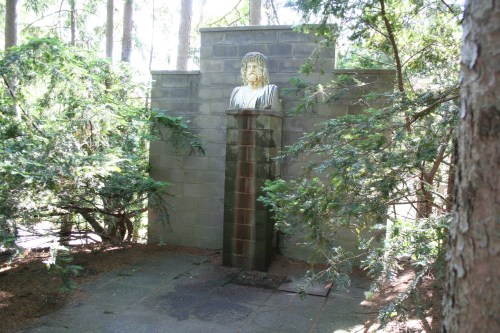
IMG_2531.JPGWeeping Zeus (or more formally Zeus of Otricoli [Roman copy of Greek original]) is a marble bust comprised of the shoulders, chest, and head of the Greek god, Zeus. The chest is carved to resemble draped cloth. The curly hair has a wreath in it, and the beard is curly with a full mustache. The bust is set on top of a concrete block column.

This sculpture has an interesting and complex history. It was carved of Carrara marble in Italy in the early 19th Century and soon afterward became a decorative feature of the manor house of Abercairny, Crieff, Perthshire, Scottland. It remained there for well over 100 years until it sold at auction. Henry Scripps Booth purchased the bust in 1961 from Michael Brett of Broadway, England. Brett had purchased it from the Abercairny the year before. The manor house, once visited by Queen Victoria, was demolished in 1960, hence the sale of sculptures from the estate.

IMG_2535.JPGHere at Cranbrook, it would seem the father of the Greek gods finds the peace of this Michigan mountain dull in comparison with the revelries of either Mt. Olympus or his later home in the Scottish Highlands. It is reported tears well up in his eyes and sometimes gush forth. The sculpture became a folly (and why we call him Weeping Zeus) after Henry had holes drilled through the eyes to allow water to flow (squirt, really) out.

In reality, he’s not crying on his own. Have your guest stand in front of Zeus while you, as their friend, stand on the special stone that activates water to splash the guest from Zeus’s eyes.

As Summer comes to a close, invite that one friend who always pulls tricks on you for a beautiful walk through Cranbrook House Gardens and introduce them to Zeus.

Leslie S. Mio, Associate Registrar

Note: Weeping Zeus is located on the Mountain in the Cranbrook House Gardens, up the stairs directly opposite the House’s front door. Cranbrook Gardens is open daily from 9:00 am to 5:00 pm, May 1 through October 31. Admission to Cranbrook Gardens is FREE for the 2018 tour season, courtesy of presenting sponsor, PNC Bank, and sponsors, All Seasons Independent Livingfleurdetroit, and Roberts Restaurant Group

A Face Above Beauty

Sometimes we walk past something 100 times and see it but never really “notice” it. For me, it is the masque of “Art”  (left) in the Cranbrook School Quadrangle, near the dining hall. It is a woman’s face beautifully created by sculptress Elizabeth Palmer Bradfield, but, as always, there is more to the story.CR1588-2

Elizabeth Virginia (Palmer) Bradfield (1875-1954) was born in Port Huron and grew up in Pontiac. Her grandfather was Charles Henry Palmer (railroad and mining developer who established the Pewabic mine in the Upper Peninsula). The Palmer family was well known in Pontiac and their house still exists on Huron Street. In the months before her wedding, Elizabeth traveled to Paris with her parents, where she studied sculpture at the Académie Julian in Paris. In 1896, she married Thomas P. Bradfield.

63541262_133164903264

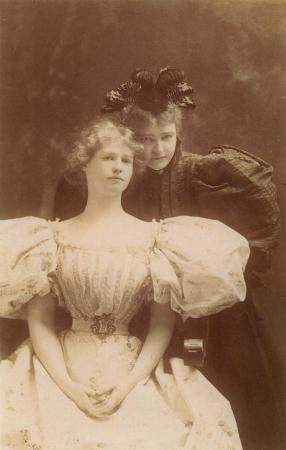
Elizabeth Palmer Bradfield with her mother, Mrs. Charles H. Palmer, Jr. Source

Thomas and Elizabeth Bradfield lived in Grand Rapids, Michigan, until 1904. The Bradfields and their two children (Virginia Palmer Bradfield Ward and Thomas Palmer Bradfield) later settled in Pontiac, Michigan, where Bradfield lived until her death in 1954.

In 1914, Bradfield began exhibiting her work — first paintings, then sculpture — in the Scarab Club’s Annual Exhibition at the Detroit Museum of Arts, alongside such artists as Myron Barlow, Katherine McEwen, and James Scripps Booth. The Scarab Club honored her sculpture “Myra” with their first presentation of the annual Scarab-Hopkin Prize for Sculpture. She exhibited again in 1915, 1916, 1917, and 1921. In 1921, she won “Honorable Mention” for her bronze sculpture “Baby’s Head.”

It is likely George Gough Booth met Bradfield at one of these exhibitions; correspondence between them began in 1926 when Booth purchased a small bronze of a dog from her.

Dog CEC 188

Dog, 1912, by Elizabeth Palmer Bradfield (CEC 188).

Booth then commissioned her to model “two large groups of Great Danes ready for plaster cast” to be displayed at Cranbrook School. These sculptures were to be approximately 6 feet high, by 2 feet wide, by 3 feet tall, but subject to Eliel Saarinen’s approval. Bradfield used the studio and architectural office, without expense to her. It is not known if Bradfield ever completed these large dogs, or if Saarinen negated the idea, but the sculptures were never realized in full scale. Milles’ “Running Dogs” probably replaced them on the Cranbrook Campus.

The masque of “Art” was purchased by Booth in October 1927. It was exhibited in two shows. One was in March 1929 – the annual exhibition of the Detroit Society of Women Painters. It was written up in the Detroit News, which said, “The masque has the imponderable quality we find in things of lasting beauty.”

It was then in the first Cranbrook Art Museum for several years before being installed over the “Beauty Arch” in Cranbrook School’s Quadrangle.

CR1588-2.jpg

The “Art” Masque, that “lasting beauty,” hangs over George Booth’s famous quote, “A life without beauty is only half lived” on the so-called “Beauty Arch” in Cranbrook School’s Quadrangle

Leslie S. Mio, Associate Registrar

Related links:

Clothing worn by Elizabeth Virginia (Palmer) Bradfield

Biographical information

Three Women and a Conservator

One of the interesting components of our jobs as collections managers, registrars, and archivists is that we get to interact and learn from conservators in our fields. On Friday, three of us went down to Detroit and met with Giogio Ginkas of Venus Bronze Works. A non-descript warehouse building sported a gray metal door which led us into the lobby gallery where Giorgio has displayed art from his personal collection of metro-Detroit artists, including Cranbrook’s Gary Griffin. Then we walked into the “shop” where his tools and equipment are interspersed with numerous sculptures (primarily metal) in various stages of repair, restoration, and conservation.

Giorgio Ginkas explaining the conservation process for the Wishing Well. Courtesy Cranbrook Archives.

Giorgio Ginkas explaining the conservation process for the Wishing Well. Courtesy Cranbrook Archives.

Currently, Venus Bronze Works has three of Cranbrook’s works in his shop – two are awaiting reinstallation on the grounds, while the metal “arch” from the Wishing Well at Cranbrook House is just undergoing restoration.

Parts of the Wishing Well “arch” removed for restoration. One element was missing so a replacement piece had to be fabricated. Courtesy Cranbrook Archives.

Parts of the Wishing Well “arch” removed for restoration. One element was missing so a replacement piece had to be fabricated. Courtesy Cranbrook Archives.

Orpheus figure, restored and waiting to be reinstalled at Cranbrook Academy of Art (CAM 1931.9). Courtesy Cranbrook Archives.

Orpheus figure, restored and waiting to be reinstalled at Cranbrook Academy of Art (CAM 1931.9). Courtesy Cranbrook Archives.

For more on Venus Bronze Works, including Detroit’s own RoboCop statue, see: http://www.dailydetroit.com/2015/08/24/remember-robo-cop-statue/

Leslie S. Edwards, Head Archivist

Create a website or blog at WordPress.com