When you take the time to look, the windows of Cranbrook House are surprisingly varied. Some are leaded casement windows straight out of an Elizabethan manor house, others are modern sash windows, fitted with plate glass. A few rooms in the house enjoy a special distinction – their windows are fitted with inset panels of stained glass.
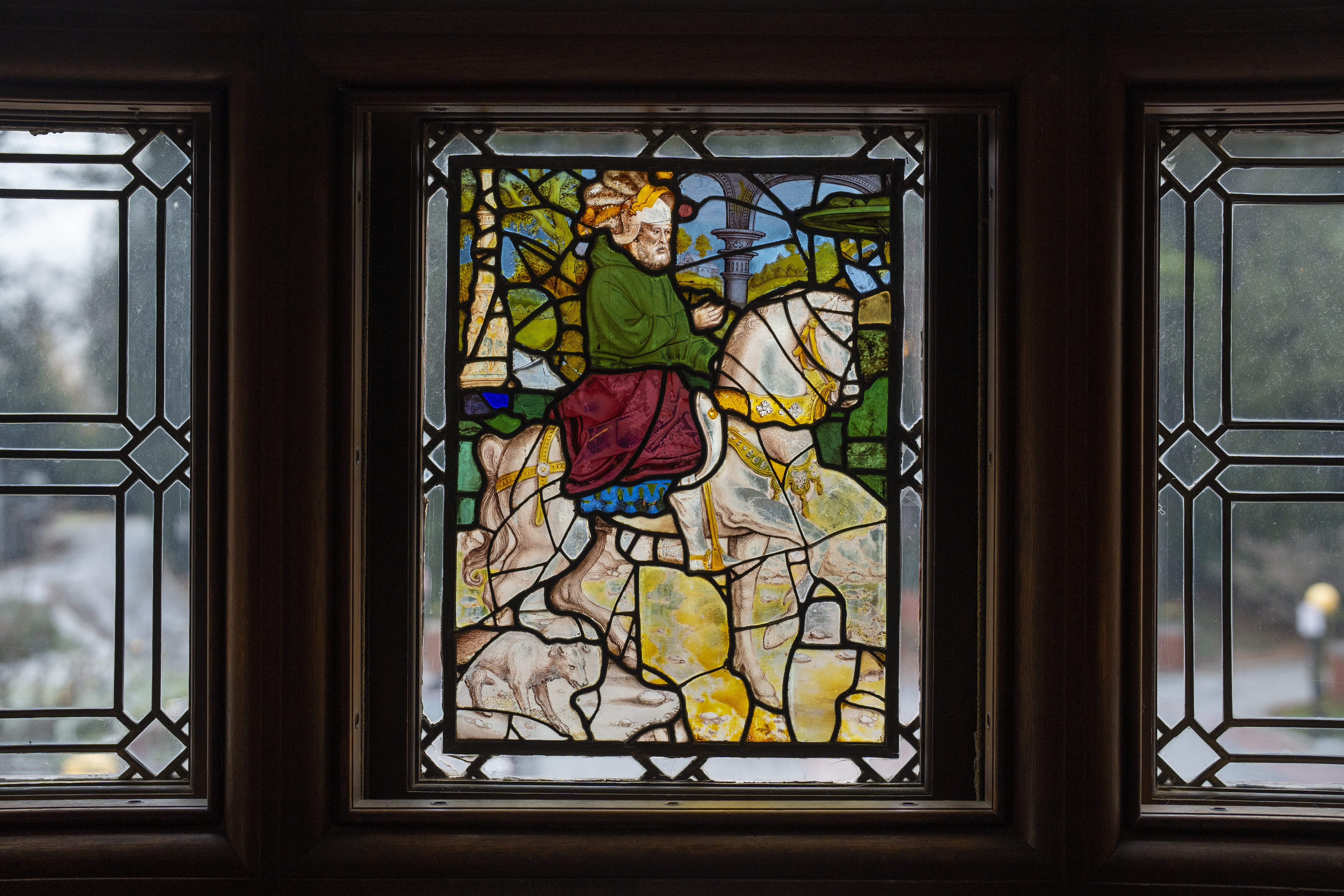
These stained-glass panels were a later addition to Cranbrook House. When first completed in 1908, the windows were all clear glass. It was only while pondering extending the house, in the latter half of the 1910s, that George Booth began purchasing stained-glass panels for his home. The most prominent stained-glass work in Cranbrook House is the 16th-century Flemish panel, depicting a man on horseback, placed in the main window over the staircase in the Reception Hall.
It was not part of the original design for the window, but added in 1922. That panel, and several others scattered throughout the house, were purchased from Thomas & Drake, an English firm specializing in historic glass.
Others, like the heraldic roundel in the library’s east window, were purchased by the Booths in Lucerne, Switzerland. There was some debate as to their final destination. George Booth wrote, in a letter to his son Henry, in March 1922:
They do not make an imposing collection but I think they are good and that everyone will like them – I did think I would let the [Detroit] museum [of Art] buy them at cost if they wished to begin to accumulate some historical glass, but your mother and Florence say no – they are to be put into the windows at Cranbrook but we will see.
(George Gough Booth to Henry Scripps Booth, 26 March 1922. Cranbrook Archives, George Gough Booth Papers.)
In the event, Ellen and Florence won out, and at least a few of the Swiss purchases made their way into the windows of Cranbrook House.
I have mentioned in the blog before that I am working with Center Director Gregory Wittkopp and Center Curator Kevin Adkisson on reviewing all fourteen of our cultural properties collections (over 9,000 objects), reviewing the data already on file and adding as much additional information about each object as we can.
The most recent collection I have been working on is Cranbrook Kingswood Upper School – Cranbrook Campus (f.k.a. Cranbrook School for Boys). The current campus buildings, classrooms, and staff offices, all had the potential to contain cultural properties (historic objects). And many that we visited did!
When I researched the Cranbrook Kingswood Upper School – Kingswood Campus (f.k.a. Kingswood School for Girls), I was fortunate to have the “Kingswood School Cranbrook Inventory of Equipment and Supplies.” It recorded the purchases and payments made from 1930-1938 for the outfitting of the school. It proved invaluable in locating quantities and makers of objects.
There had to be an equivalent for Cranbrook Campus?! Unfortunately, not that I had yet seen.
I only had a 1952 Inventory which listed fixed items, like light fixtures; and “movable” furniture and fixtures, like chairs, tables, desks, artwork. This was a great resource, but it did not always give me the makers or artists. Undeterred, I started searching in Cranbrook Archives, the “little gem” at Cranbrook, to borrow a phrase from Frank Lloyd Wright.
In Box 43, Folder 11 of the Cranbrook Foundation Office Records were the “Building Costs for Cranbrook School from 1926-1946.” And then, I saw it. A small black book labeled “Cranbrook School Book.” Could it be what I was looking for?
“Cranbrook School Book.” Cranbrook Foundation Office Records, 1981-05. Cranbrook Archives, Cranbrook Center for Collections and Research.
Inside were listed payments made to the builder Wermuth & Son and to the W. J. Sloane Company for furniture. It listed the artists who painted, carved, and outfitted the school, as well as contractors who installed various materials in the buildings.
Pages 20 and 21 “Cranbrook School Book” lists payments to Parducci Studio, J.L. Hudson’s, W.J. Sloane, as well as Pipsan Saarinen Swanson..
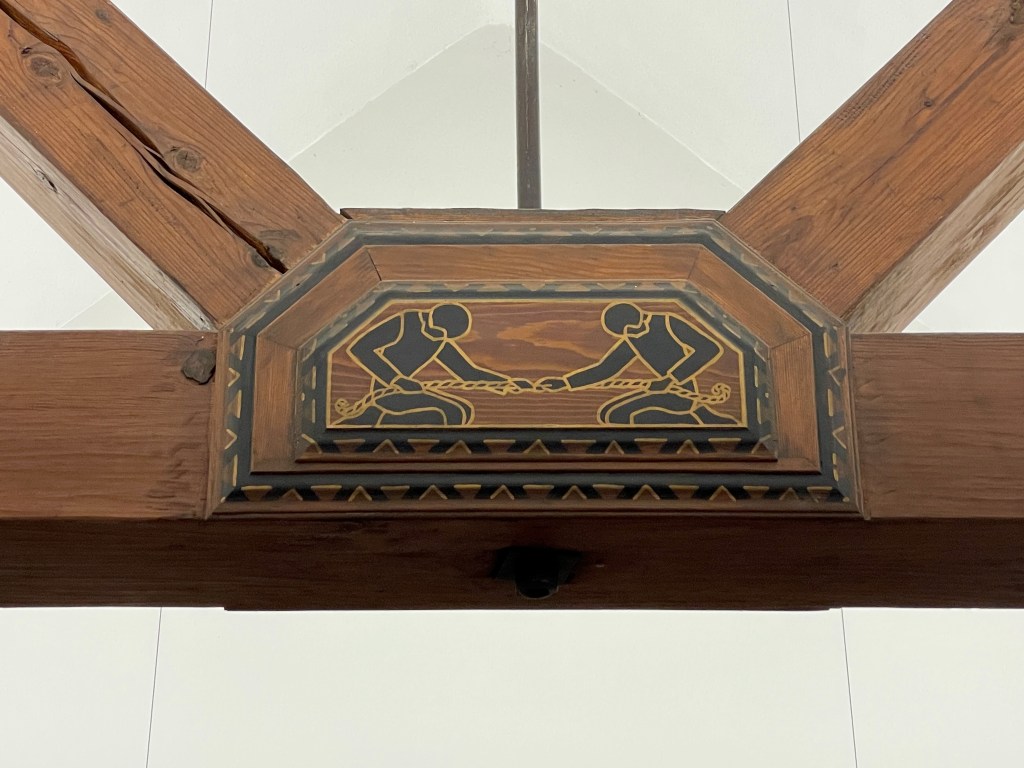
Detail of page 20 of “Cranbrook School Book.” On March 2, 1928, Pipsan was paid for “Decorating truss plaques for Study Hall.”
One of Pipsan’s ten truss plaques in the Cranbrook Campus Library Study Hall, 2022.
These entries were great, but what else would it lead to? The answer: the “Cranbrook Schools” series in the Cranbrook Architectural Office Records.
Many of the folders were labeled “Cranbrook School correspondence, Wermuth & Son” with dates. The “Cranbrook School Book” had given me an idea of what to look for. Who Wermuth and the Cranbrook Architectural office (and sometimes George G. Booth himself) were corresponding with was the key. Inside were letters from vendors of tiles, furniture, stained glass, stonework, mirrors, mattresses, windows, everything needed to build a well-appointed school.
Here are just a few examples:
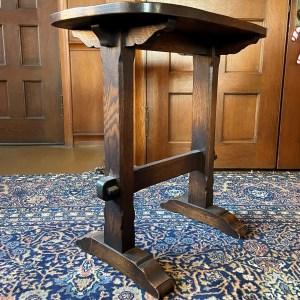
Copies of blueprints for furniture made by W. J. Sloane Company’s “Company of Master Craftsmen,” many of which were selected for Cranbrook.
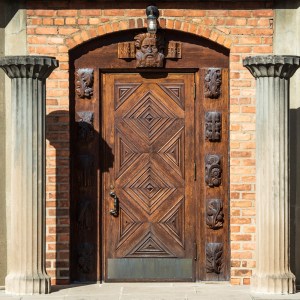
A letter from L.A. Sielaff & Co. indicating it was contracted to carve the wood ornaments on the Geza Maroti-designed doorcases outside the Library
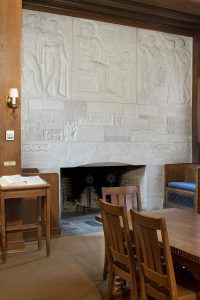
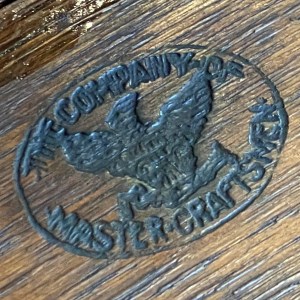
Letter from L. A. Sielaff & Co., dated August 3, 1928.Cranbrook School Study Hall Door, also called the “Door of Knowledge.” Photographer James Haefner.Letter from Cranbrook Architectural Office, dated August 8, 1928.Cranbrook School Library Reading Room “Gift of Knowledge” Overmantel. Photographer P.D. Rearick.Letter from George G. Booth to Swedish Arts & Crafts Company, dated June 4, 1928. Booth’s sketch is at right.Cranbrook School Dining Hall hanging fixtures.Blueprint for table #41919 by W. J. Sloane Company’s “Company of Master Craftsmen.”Table #41919 in use in a Cranbrook Campus office.Maker’s mark for “Company of Master Craftsmen” on the underside of many pieces of furniture on the campus.
Next up, Cranbrook Campus’ custom light fixtures! I can already hear Kevin’s words in my head . . .
. . . Cranbrook light fixtures are all around campus. There are multiple types of the light fixtures. These were designed by architect and former Head of the Architecture Department Dan Hoffman. He was the architect-in-residence who probably did more to revive the tradition at Cranbrook that was so such a passion project of George Booth and Eliel Saarinen . . .
– Leslie S. Mio, Associate Registrar, Cranbrook Center for Collections and Research
p.s. For more on Cranbrook Campus, check out these videos by Center Curator Kevin Adkisson:





 Cranbrook Kitchen Sink