Gravity, Dignity, and Softness: The Voice of the Pipe Organ

In addition to working as an Associate Archivist at Cranbrook, I am also a fledgling volunteer docent at Christ Church Cranbrook. Recently, I gave a tour of the Chancel to test my skills with my teachers. As I prepared, I found there was very little written about the history of the pipe organ at the church. So, where to turn for more information? Cranbrook Archives, of course.

In August of 1925, George Booth and Oscar Murray (of Bertram G. Goodhue Associates, the church architect), started in earnest to finalize their thoughts and feelings about the choice of organ for the church. While the organ itself was installed in January 1928, plans for its ducts and conduits had to be decided early, before the concrete floors were poured.
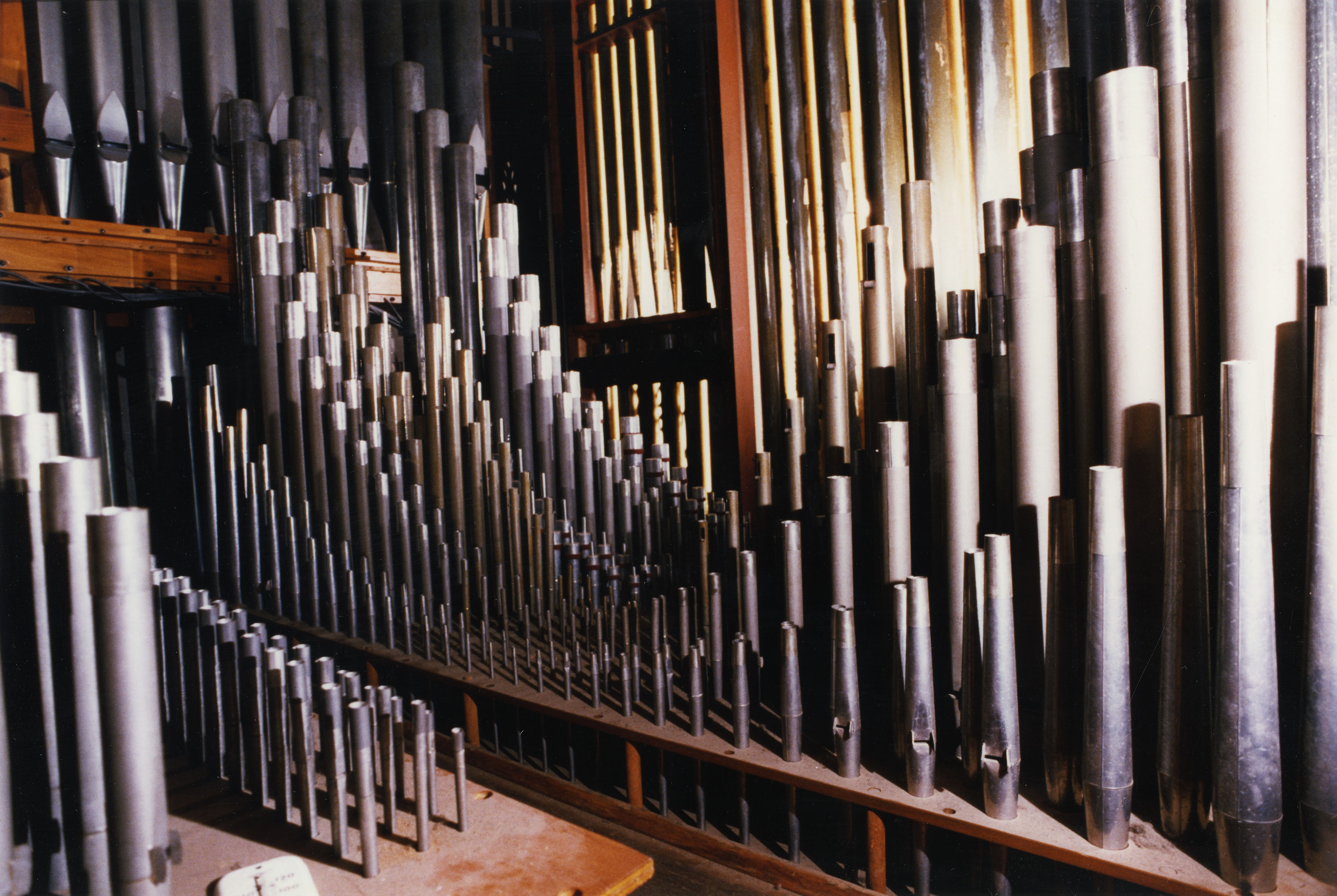
Christ Church Cranbrook organ pipes prior to the 1997 restoration. Jack Kausch, photographer. Courtesy of Cranbrook Archives.

The correspondence suggests that the E.M. Skinner Organ Company was the only company considered. The Boston-based firm was considered America’s finest and most technologically advanced organ builder. Skinner’s specifications for the organ, console, and bench were submitted in October 1925.

George Booth inquired of his colleague Cyril Player to provide comments on the specifications, and Player begins his commentary saying,

“I think I would emphasize gently to them that you want gravity, dignity and softness—the three prime essentials of any church organ, large or small… [gravity] is secured by an adequate and properly-balanced pedal department; dignity by volume of foundation tone in the basic divisions of the instrument; and softness and refinement by skillful voicing with a copious wind stream at a moderate pressure.”

Cyril Player to George G. Booth, November 1925

In passing along the comments to Murray, Booth remarks that, “the desired qualities, viz; gravity, dignity and softness; seems to me peculiarly to express my own feelings and desire.”
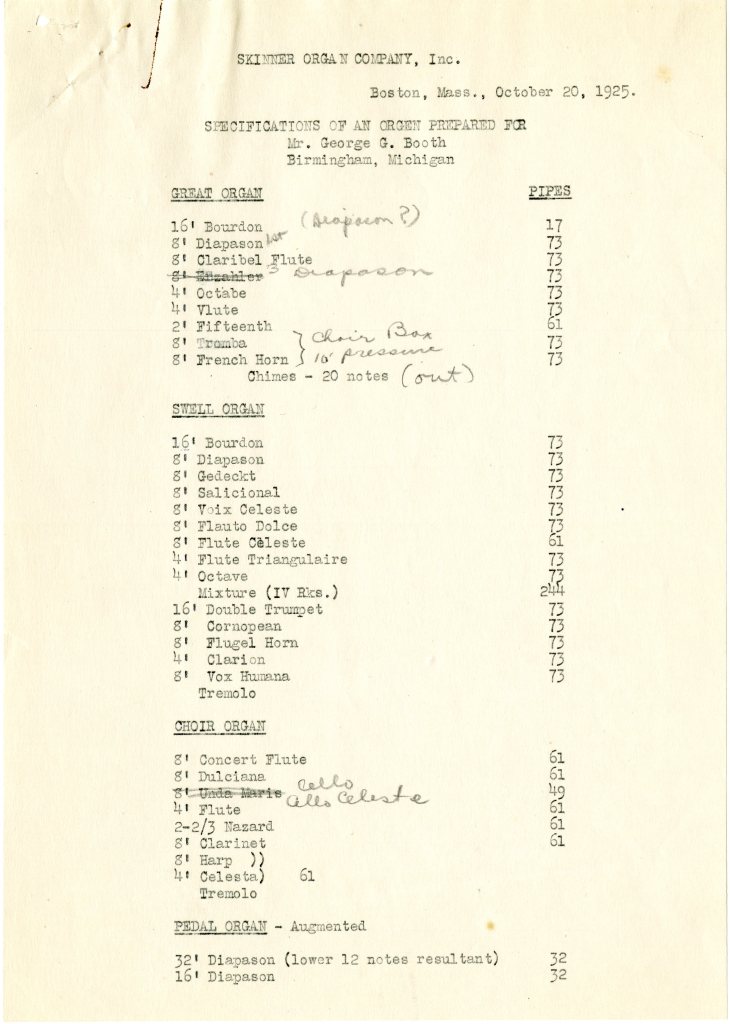
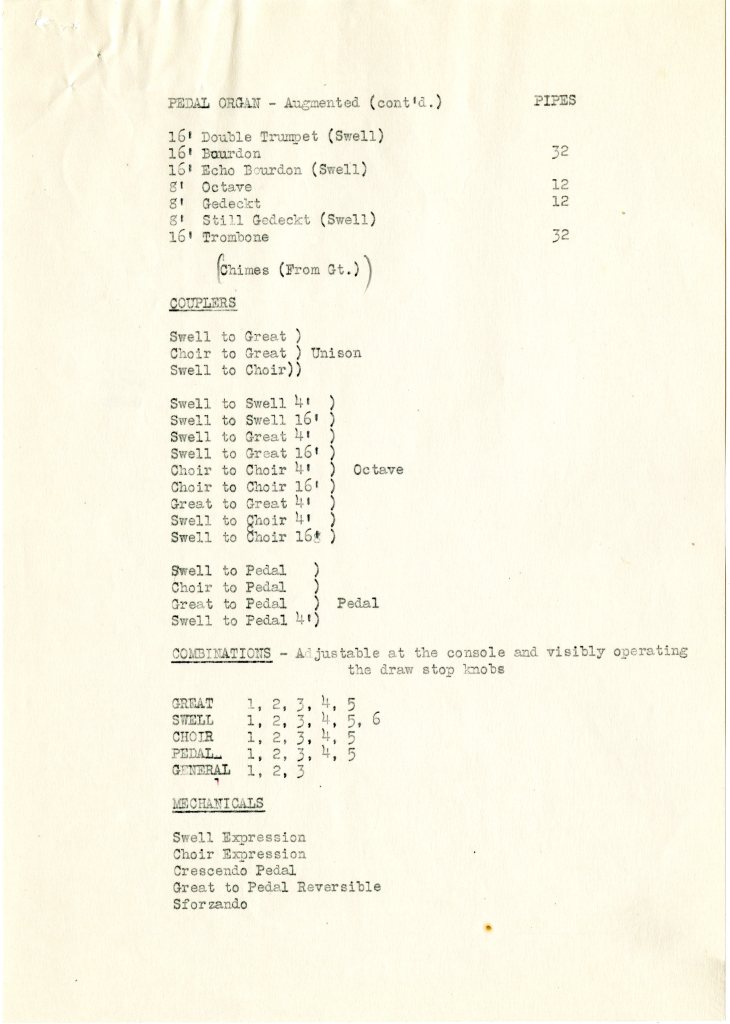
William Zeuch of Skinner Organ Company revised the specifications following some of Player’s suggestions, while some revisions were the suggestion of Henry Willis, the great English organ builder who was a consultant to the firm. The contract for the organ (including the Great, Swell, Choir, and Pedal pipe divisions) was duly signed in December 1925 and work proceeded.

At the same time, a separate contract was made with Alfred Floegel to decorate the organ case doors. Booth wished to confine the oak finish to the exterior of the doors while having the rest richly decorated with color. Booth imagined the opening of the organ doors to represent the opening of the mind. He also envisioned the organ case to read as a triptych (a picture or altarpiece on three hinged panels) when open.  
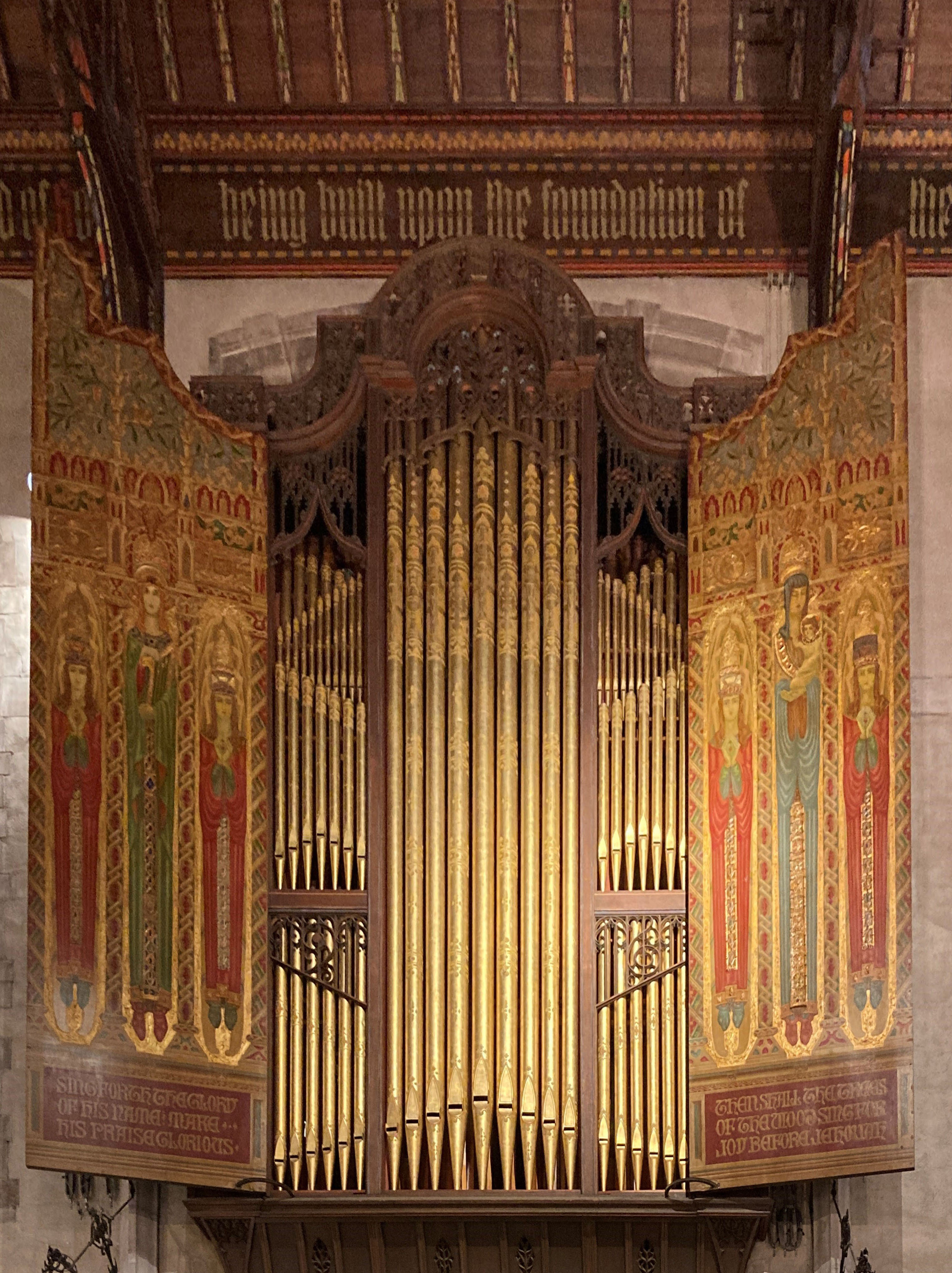
Organ case doors, woodwork by Irving and Casson, decoration by Alfred Floegel. Gift of James Scripps Booth. Laura MacNewman, photographer.

In July 1927, work on the organ console began. The console is where the organist sits to play the instrument, distinguished by its multiple hand keyboards (called manuals), pedalboard, and other controls. Rev. Dr. Marquis requested a change from a 3-manual (Great, Swell, and Choir pipe divisions) to a 4-manual, by adding the Solo division. Zeuch responded positively as it was not too late to build a 4-manual console; however, having already instructed the architect to reduce the dimensions of the organ chamber, which had been too large and would have interfered with the proper effect of the sound in the church, the architect would now need to find space for the Solo division. Room was found above the Sacristy.

Continue reading
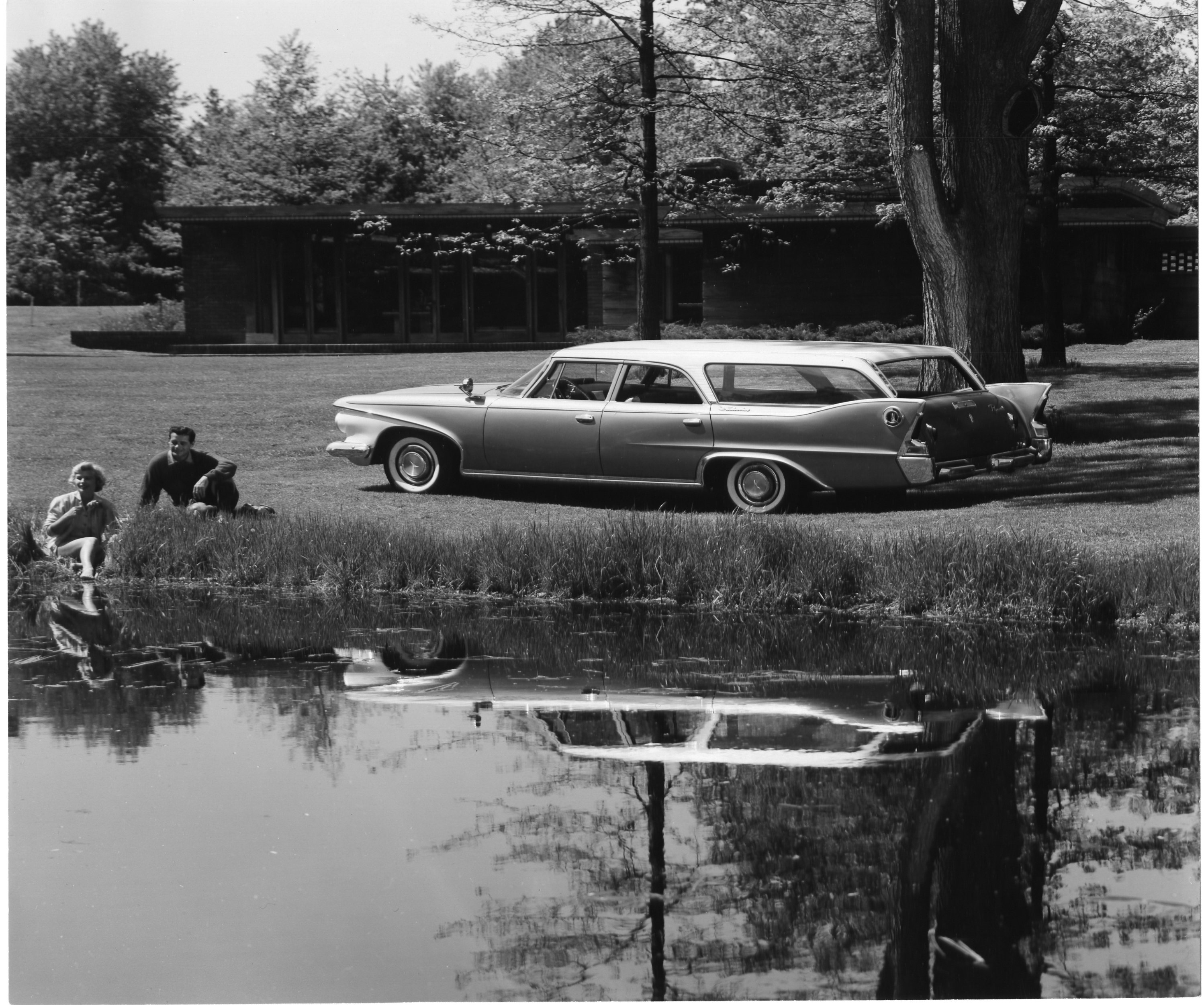
Photo Friday: Smith House and the 1960 Plymouth Suburban

Oakland County is decked out in checkered flags this Friday for the annual Woodward Dream Cruise. As the crowds gather in their folding chairs and thousands of classic cars roar past my windows, I’m reminded of a much more serene image from automotive history: the 1960 Plymouth Suburban stretched out on the manicured lawn of the Frank Lloyd Wright Smith House.

1960 Plymouth Suburban, on location at the Frank Lloyd Wright Smith House. Smith Papers, Cranbrook Archives.

In 1959, Chrysler was developing promotional materials for the 1960 Plymouth. Seeking a sleek, modern backdrop for the long lines of the Suburban station wagon, Chrysler’s Public Relations Department contacted Melvyn and Sara Smith about staging a photoshoot at their Frank Lloyd Wright-designed home in Bloomfield Hills. The resulting photographs show the 18-ft long Suburban, not parked in the pea-gravel driveway or the distinctive cantilevered carport, but pulled to the back of the house where it could be reflected in the natural setting of the Smith’s newly expanded pond.

1960 Plymouth Suburban, on location at the Frank Lloyd Wright Smith House. Smith Papers, Cranbrook Archives.

The long, low horizon line of Frank Lloyd Wright’s Usonian architecture, with its stacking roof planes, seems a great fit for the station wagon’s extended style lines and characteristic fins. In a second image, two casually-dressed models (check out those long socks and walking shorts!) lounge in rattan Tropi-Cal armchairs on the living room patio. Designed by Danny Ho Fong, the Tropi-Cal armchairs were recently identified through the diligent research of the Center’s Summer intern Clare Catallo.

Continue reading

Photo Friday: Rosa Parks at HUB

Last weekend, Cranbrook’s Horizons-Upward Bound program celebrated the completion of its fifty-eighth annual six-week summer residency program. Students and their families spent Theme Day on campus learning about the academic and artistic successes of the summer (including a display organized by the Center about our Architecture Elective, and a performance in the Greek Theatre by students and the Autophysiopsychic Millennium collective).

Rosa Parks addresses Cranbrook’s Horizons-Upward Bound graduation, held at Cleveland Middle School, July 11, 1989. Cranbrook Archives.

But did you know that in 1989, HUB celebrated the end of the summer with a special graduation address by legendary activist Rosa Parks? The “mother of the freedom movement,” Parks spoke to Cranbrook’s HUB students in a ceremony held at Cleveland Middle School in Detroit on July 11, 1989.

A speaker at the HUB graduation stands beneath a banner welcoming Rosa Parks, July 11, 1989. Cranbrook Archives.

While we couldn’t find the subject matter of Park’s HUB address or too many details of the special occasion, I am confident we will learn more about this moment in HUB history (and so many others) as Cranbrook Archives embarks on an exciting, multi-year digitization effort of the Horizons-Upward Bound Records made possible by a grant from the National Archives and Records Administration, through the National Publications and Records Commission’s Access Program.

In fact, the work has already begun! During the summer months, two current HUB students worked in the archives, digitizing more amazing materials like these images of Rosa Parks! Look for more Cranbrook Kitchen Sink posts drawn from the HUB collection in the future!

Kevin Adkisson, Curator, Cranbrook Center for Collections and Research

Create a website or blog at WordPress.com