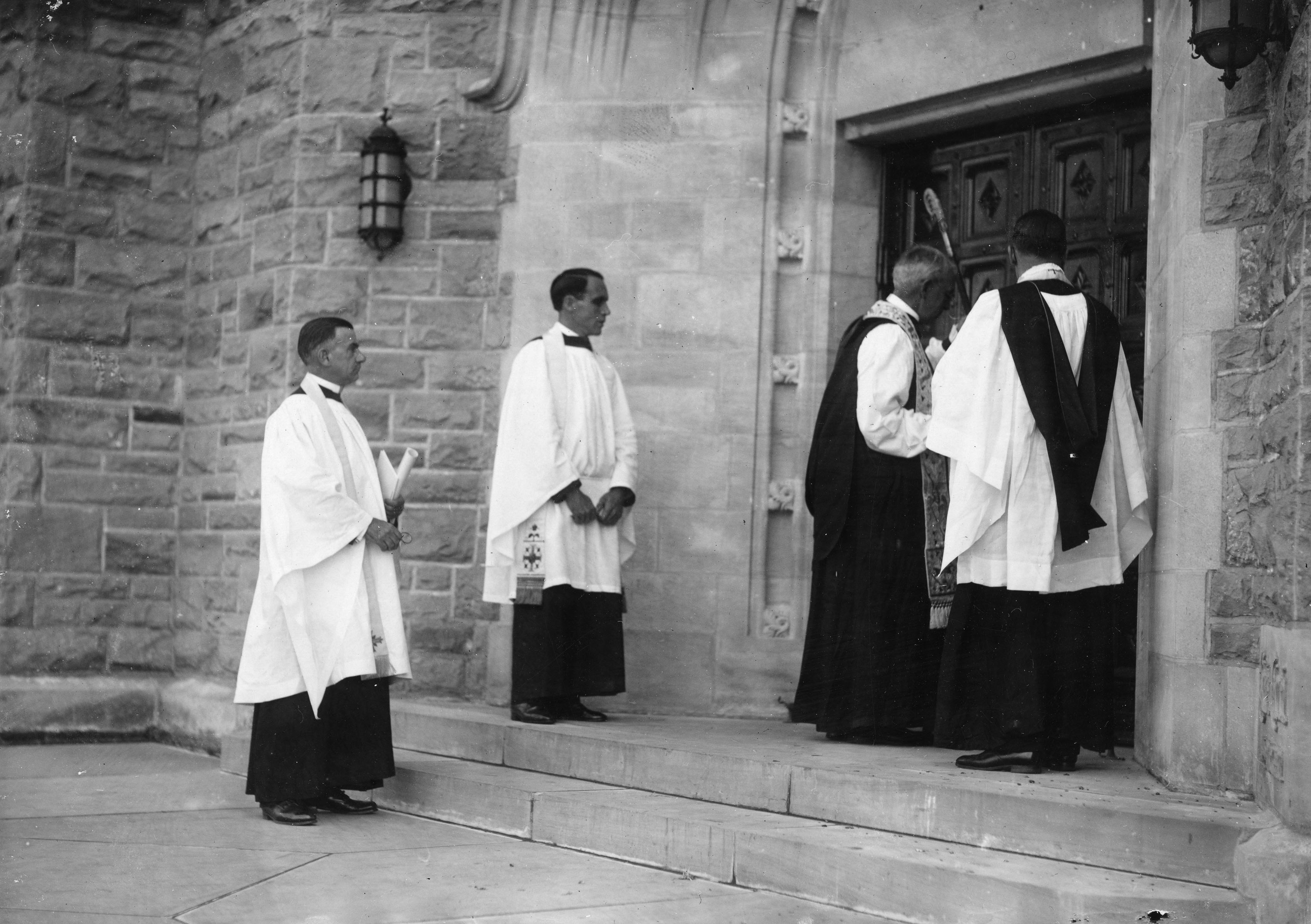
Consecration of Christ Church Cranbrook, September 29, 1928. Archdeacon Ramsey knocks on the door of the church, accompanied by Mr. Kinder, Bishop Page, Mr. Forsyth.
Today marks ninety-five years since the consecration of Christ Church Cranbrook!
Consecration Service Program for Consecration of Christ Church Cranbrook, September 29, 1928.
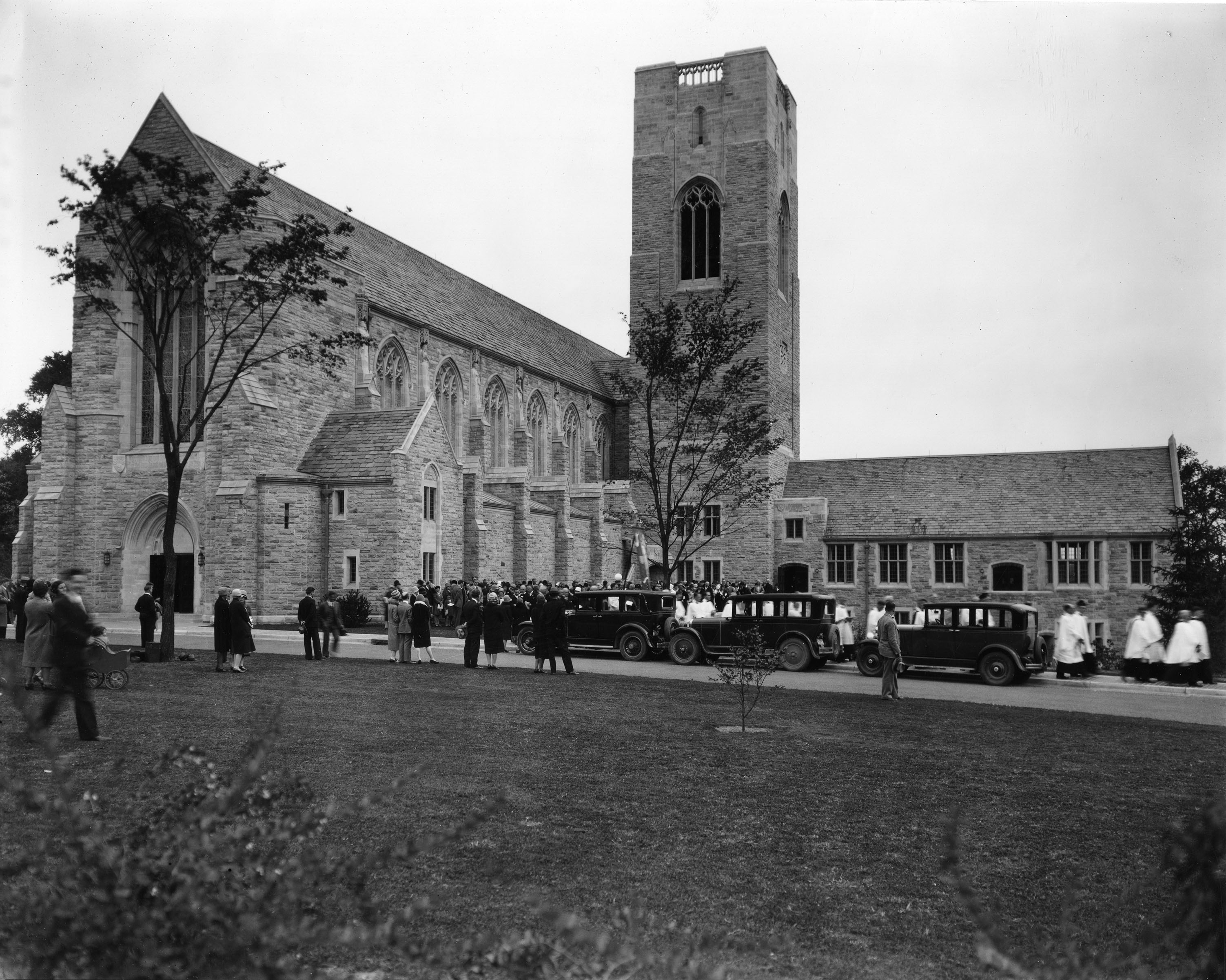
Planning for the church began in earnest in 1923, with the cornerstone being laid in 1925. After three years of construction, and countless hours of labor from masons, artisans, and clergy, the church was ready to be consecrated.
Christ Church Cranbrook Consecration–Parish House Recessional, September 29, 1928.
The consecration was led by Charles L. Ramsay, Archdeacon of the Episcopal Diocese of Michigan, declared the church sacred and ready for services. While the architecture was complete in 1928, it would be several more years before the last pieces of art were installed.
Consecration of Christ Church Cranbrook Recessional, September 29, 1928.
—Kevin Adkisson, Curator, and Laura MacNewman, Associate Archivist, Cranbrook Center for Collections and Research
On this, the last day of summer, I thought we’d look back at the Center’s second-annual Architecture Elective for the Horizons-Upward Bound Summer Component. It was a real highlight of my summer!
A grant from the Society for Architecture Historians enabled Nina Blomfield, the Center’s Collection Fellow, and me to co-teach the six-week elective. Each Monday and Wednesday morning from June 28 to August 2, we met in Gordon Hall of Science at Cranbrook with fifteen enthusiastic HUB students, grades 9 through 12. While we started most mornings in the classroom with our textbook or a slideshow of images, the real excitement came on class trips.
I mean, what better way to learn about excellent architecture than to study the buildings of Cranbrook?
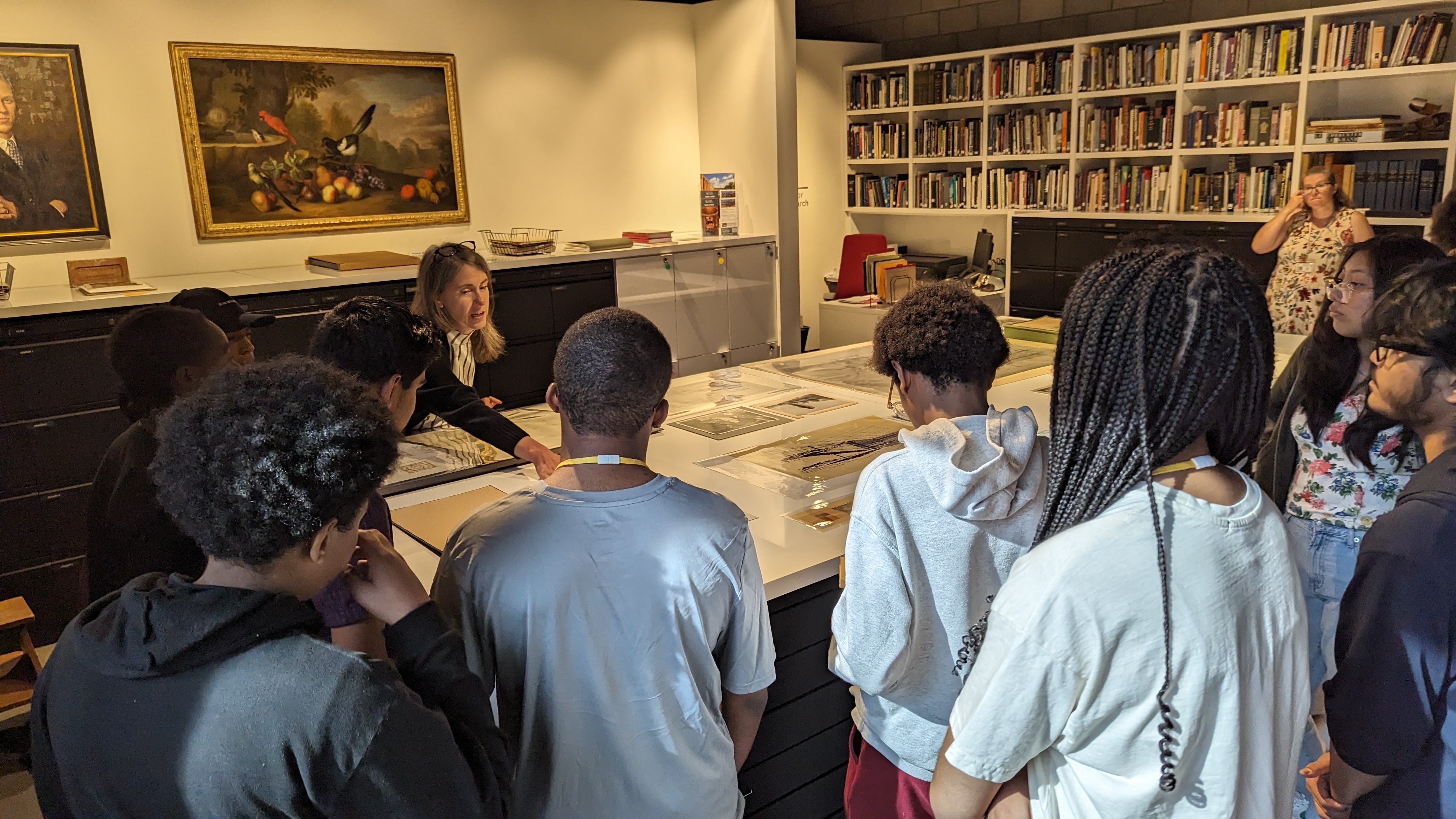
Head Archivist Deborah Rice showing our HUB students architectural treasures from Cranbrook Archives. Nina Blomfield, photographer.
To orient ourselves, we started with a morning spent in Cranbrook Archives, studying original sketches, renderings, blueprints, photographs, and even fundraising literature about Cranbrook’s many architectural treasures. We saw the great diversity of how our buildings were imagined, represented, and constructed, and how an architect moves from a loose, gestural sketch to formal construction documents that communicate complex structural systems.
Then, we spent a class period each at Cranbrook House, Saarinen House, and the Frank Lloyd Wright-designed Smith House. In each location, students carried their sketchbooks and made notes and drawings about the architecture. I was especially impressed at the students’ analytical skills. In fact, while I usually love talking about the nitty-gritty specifics of Saarinen House, I found myself sitting much more quietly, asking students questions about what they noticed, liked, or disliked in each room. Listening to their observations and conversation helped me see each space anew.
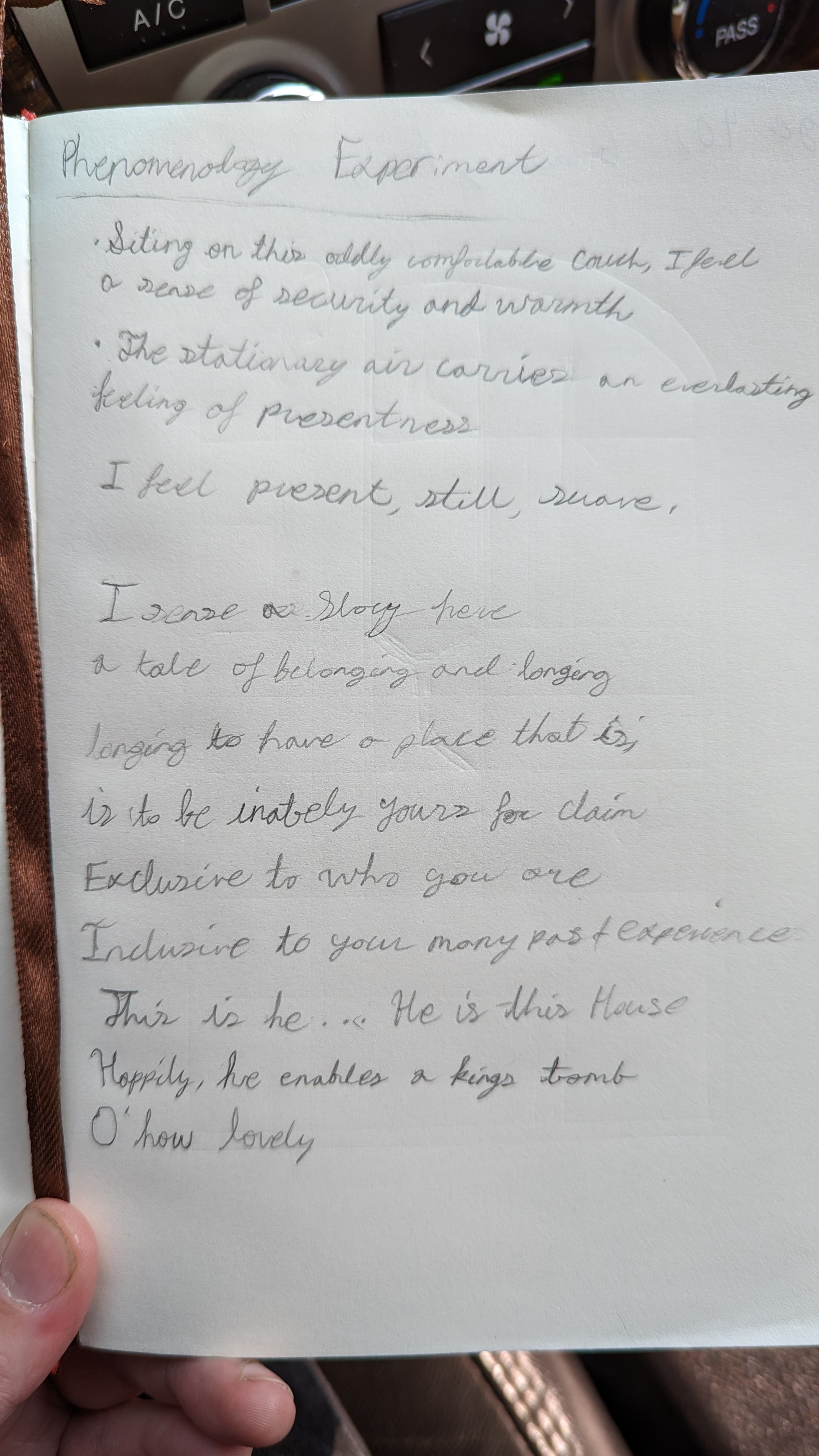
At Smith House, Nina led a phenomenology exercise, where, instead of telling the students the story of Frank Lloyd Wright and the Smiths, she simply asked each student to find a spot in the house to sit in quietly. Then, they wrote or sketched what they observed and sensed. Having such a tactile experience with the architecture and nature proved to be more memorable than a conventional tour.
Have you ever wondered what it would be like to cook in a kitchen designed by Frank Lloyd Wright? As the summer intern for the Center, I got a taste of the experience.
Clare in the Smith House workspace, August 2023. Photograph by Nina Blomfield.
My name is Clare Catallo and I am a 2020 graduate of Cranbrook Schools and a rising senior at Kalamazoo College. I am a history major and I am hoping to have a career in museum curation. As a Schools student, I had the opportunity to tour Cranbrook House, Saarinen House, and Smith House and learn about the designers and art movements that are intertwined with the legacy of the campus. It sparked my interest in design history and material culture, and I am very grateful to have spent the past two summers interning with the Center.
Studio glass by Sally Kovach (Cranbrook Academy of Art, Sculpture, 1975) comes alive in front of Clare’s camera. Photograph by Nina Blomfield.
Last year, I helped clean the exterior of the Frank Lloyd Wright-designed Smith House, inventory the books in Melvyn and Sara Smith’s collection, and do genealogical research. This summer, I have been researching the histories of household objects and conducting object photography at Smith House, as well as assisting with the Cranbrook Horizons-Upward Bound Architecture elective course. In August, I assisted the Center team with preparations for “At Home with the Smiths,” an immersive evening program held at the Frank Lloyd Wright-designed Smith House. Preparing for this event has brought my two summers here together as we work to emulate Melvyn and Sara Smith’s 1970s house parties.
Cookbooks from Melvyn and Sara Smith’s collection. Photograph by Nina Blomfield.
The cookbooks found at Smith House provide a glimpse into the family’s lifestyle and the home cooking trends of the 1960s and 1970s. Many of the Smiths’ cookbooks present an image of a modern, working woman who has more to do with her time than spend hours in the kitchen. World War II had made families rearrange their menus and ideas about food, due to rationing and shortages which continued even through to the postwar years. Menus became less formal, and fewer families had maids to cook for them.
These national trends align with Frank Lloyd Wright’s kitchen design, meant to function as a utilitarian, servantless workspace. Combined with the growing numbers of women in the workplace in the 1960s and 1970s, the demand for quick and easy recipes rose. This trend is reflected in the Smiths’ cookbooks like the excellently-titled Dinner Against the Clock (Quick, Sumptuous Meals With the Look and Taste of Infinite Leisure), and The Keep it Short and Simple Cookbook, the latter of which is dedicated to “every homemaker,” whether “housewife, career girl, or bachelor”. These recipes use few ingredients, many of which are ready-made, require a small number of utensils, and demand little time.






 Cranbrook Kitchen Sink