Time to Study! (History, that is)

As college students across the country buckle down to study for final exams and finish writing end-of-semester papers, there will be one school where that’s not happening: Cranbrook Academy of Art. Instead, our Academy students are busy making in their studios, and frantically producing work for their semi-regular critiques with Artists-in-Residence. This follows the model set up here by founding president Eliel Saarinen, who famously rejected what he called the “non-creative-school-book-learned-art-teacher” in favor of a method he called “self-education under good leadership.”

While the Academy’s extremely self-directed, studio-based education is proudly traced back to our founding, Cranbrook did, in fact, once offer formal courses in the history of art. These quarterly courses—taught by museum curators, visiting professors, and artists—utilized both slide shows and actual paintings.

Museum Director Albert Christ-Janer teaching his “Survey of the Arts” history class for Cranbrook Academy of Art students, 1945. Christ-Janer arrived at Cranbrook in June of 1945 and left for the University of Chicago in September 1947. Harvey Croze, photographer. Courtesy Cranbrook Archives.

Here, we see Museum Director Albert Christ-Janer lecturing in the then-new Cranbrook Academy of Art Museum and Library. The classroom is simple, just folding chairs and an illuminated blackboard set up in the lower-level galleries. In front of the students hangs Doris Lee’s Fisherman’s Wife. I admire Christ-Janers books, and imagine it would’ve been very exciting to attend one of his lectures.

Christ-Janer discussing Fisherman’s Wife by Doris Lee (CAM 1945.27). Lee painted the scene of Key West, Florida while she was a visiting artist at Michigan State in 1945. It was purchased by the Cranbrook Foundation that same year. Harvey Croze, photographer. Courtesy Cranbrook Archives.

In the Academy’s 1945 Course Catalog, Christ-Janer is listed as “Instructor in the Survey of the Arts.” By the 1970s, then President Wallace Mitchell stopped offering anything like a history of art course at the Academy in favor of a history/theory seminar called the Humanities Forum. This evolved into the Critical Studies program today—the only required lecture/seminar for Academy students, but which is, as always, ungraded.

I’d note that Christ-Janer is teaching in a full suit and tie—a sight rarer at the Academy today than a history of art course!

Even though the Academy no longer offers a History of Art course in its curriculum, I like to think that the Center’s History of American Architecture lecture series continues the tradition of art history at Cranbrook. For the past six years, I’ve taught architecture history to interested Academy and Cranbrook Schools students, and open to members of the public.
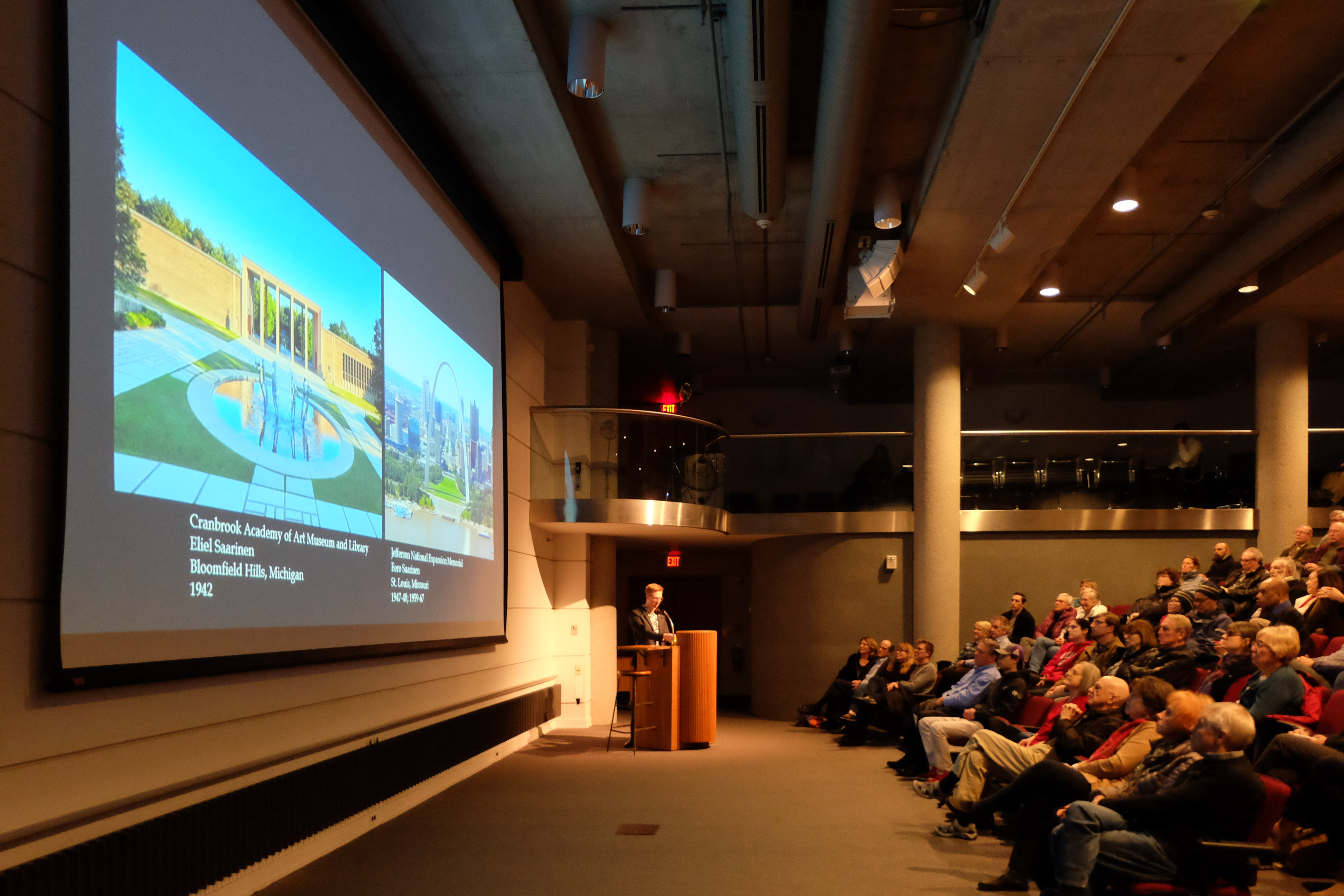
Kevin Adkisson teaching History of American Architecture: Cranbrook in Context, March 3, 2020. Photography by Daniel Smith, CAA 2021, Courtesy Cranbrook Center for Collections and Research.

Starting on February 6, 2024, the History of American Architecture lecture series returns. This year’s subject is “Detroit and the World,” and we are offering two ways to attend the lecture: virtually, at noon or 6:30pm EST, or in person at Cranbrook Art Museum’s de Salle Auditorium at 6:30pm. We launched the website and ticket sales on Wednesday, and I encourage you to read more about each week’s topic and consider signing up over on our website. There’s so much great Detroit architecture, and I am excited to share it with you in lectures this winter!

In his unpublished 1950 manuscript, The Story of Cranbrook, Eliel Saarinen wrote of Cranbrook students as “the pupil is like an empty sack to be filled during the school year.” I hope you’ll join me in February as we fill ourselves up with knowledge!

Kevin Adkisson, Curator, Cranbrook Center for Collections and Research

Image: The Greater Penobscot Building by Wirt Rowland of Smith, Hinchman & Grylls, Detroit, Michigan, 1928;  Photography by James Haefner, Courtesy James Haefner.    

HISTORY OF AMERICAN ARCHITECTURE

DETROIT AND THE WORLD

This installment will focus on the architecture of Detroit, studying the buildings, designers, and policymakers that shaped the city’s dramatic transformations from the late nineteenth century to today, and how Detroiters have influenced the course of architecture around the globe. 

A Donkey for Christmas: Brighty Comes to Cranbrook

George G. Booth’s “Old Country Office” at Cranbrook House. Photograph by Kevin Adkisson.

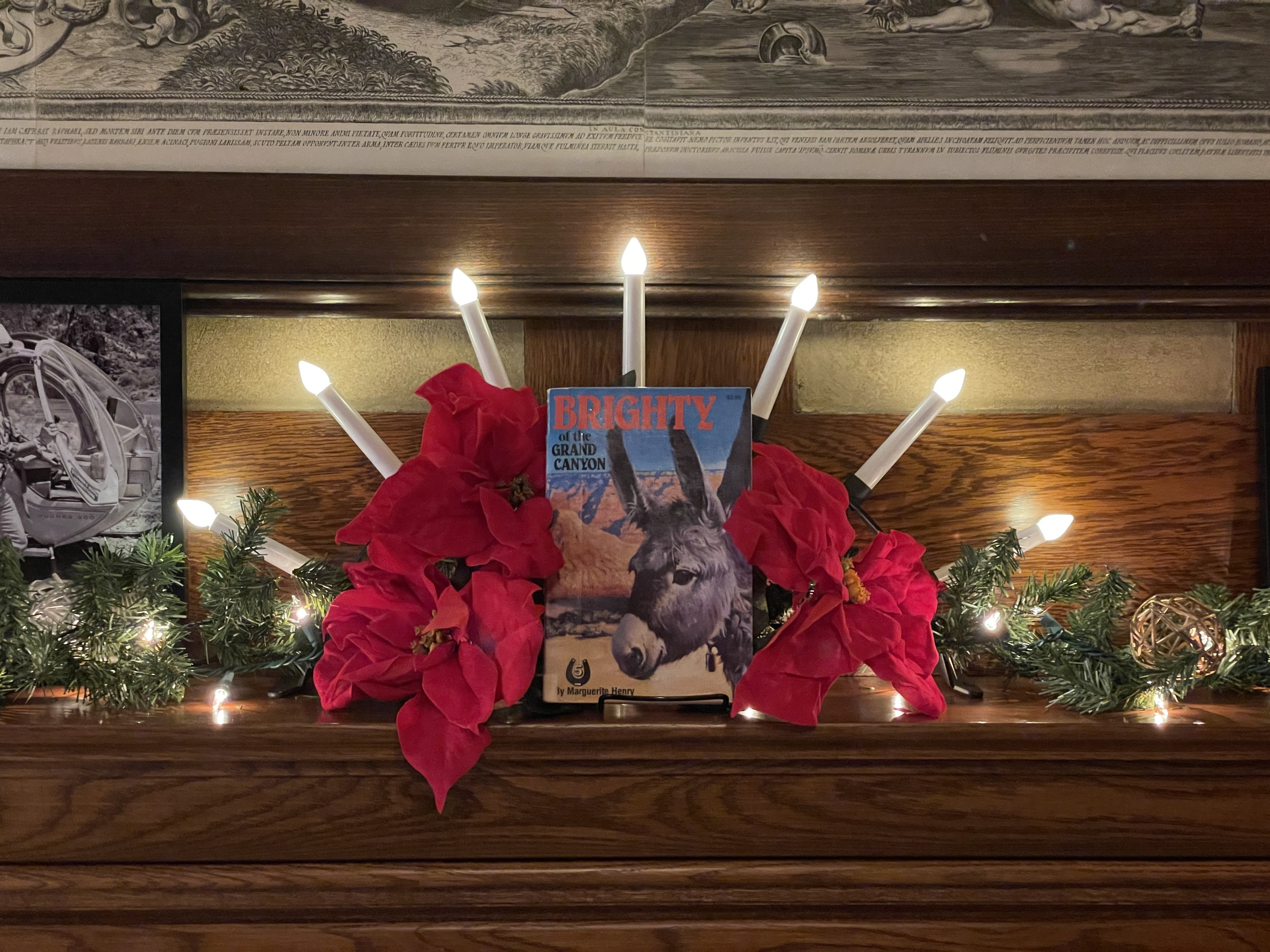
Every year at Christmas, the Center for Collections and Research decorates George Booth’s office in Cranbrook House with a special display. This year, our Christmas display is all about Brighty of the Grand Canyon, a movie produced by Stephen Booth, a grandson of Cranbrook’s cofounders. Brighty was a real donkey who inspired first a children’s novel, then a feature film.

In the late 1800s, there were hundreds of half-wild donkeys in the Grand Canyon, brought there by prospectors and then lost or abandoned. Brighty was one of them. 

Photograph by Kevin Adkisson.

Brighty lived in the Grand Canyon from 1892 to 1922. In the winter, he roamed the warm depths of the canyon. A sociable animal, he liked the company of prospectors, hunters, and hikers, but if anyone loaded a heavy pack on his back he would soon make his escape. Every summer, he returned to the North Rim to stay with the McKee family who rented cabins to tourists. He would carry water, give children rides, and visit each cabin in turn for attention and treats—his favorite food was flapjacks and honey.

In 1953, the author Marguerite Henry learned about Brighty, and immediately decided to base her next novel on him. In search of more stories about the adventurous donkey, she travelled to the Grand Canyon herself, where she interviewed locals who had known him, hiked in the canyon, and even sampled the creek water and tasted the plants that Brighty would have eaten! She adopted her own donkey, Jiggs, to learn from him how the real Brighty might have behaved. In Brighty of the Grand Canyon, a free-spirited donkey helps solve a murder mystery and protects his human friends from a dangerous bandit.

This is the 1963 edition of the novel, the same year that the Booths bought a copy to read on their family road trip. Photograph by Kevin Adkisson.

Stephen Booth and his wife Betty bought a copy of the book to read to their children, Douglas, Charles, and George. They all loved the story, especially Stephen, who had his own film production company, and decided to make a movie about Brighty. 

Filming began in 1965, with Marguerite Henry’s own pet donkey, Jiggs, starring as Brighty. Filmed on location at the Grand Canyon and in the Dixie National Forest in Utah, the actors and crew spent weeks living in the canyon. A tiny helicopter and an airplane with a camera mounted on the front were used for aerial shots, and for flying special visitors, like Stephen’s parents, Henry and Carolyn Booth, down into the canyon. 

Norman Foster, the film’s director, reviews the script with Jiggs the Donkey. Stephen Farr Booth Papers, Cranbrook Archives

The movie premiered on November 22, 1966, just down the road in Birmingham, doubling as a fundraiser for Kingswood School for Girls. As the star of the movie, Jiggs himself came along to the premiere. Afterward, he participated in the Festival of Gifts at Christ Church Cranbrook, an annual Christmas tradition that began in 1928 and continues today. 

From left to right: Betty Booth, Stephen Booth, Marguerite Henry, and Jiggs greet children at the film’s premiere. Stephen Farr Booth Papers, Cranbrook Archives.

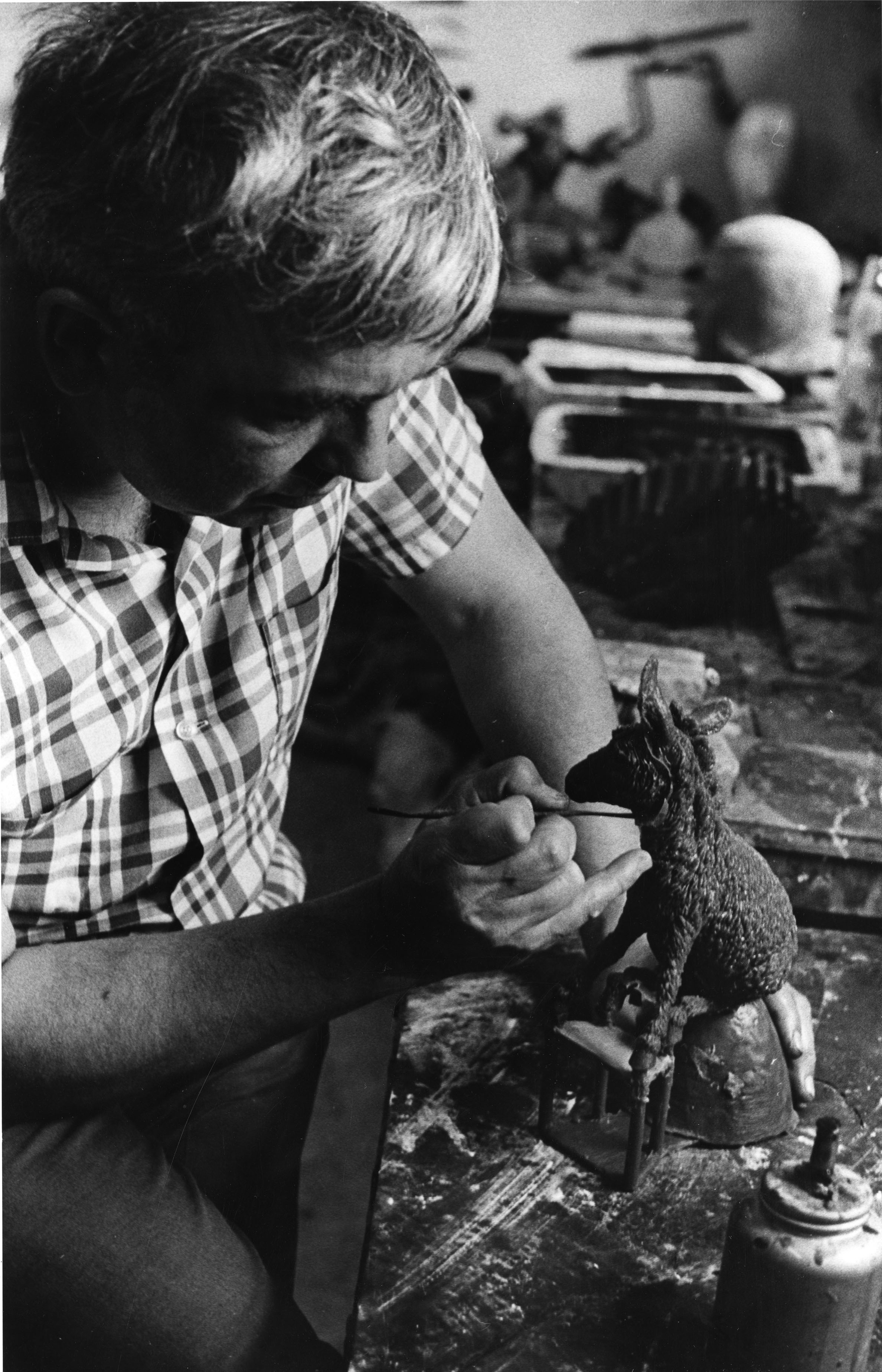
While Brighty was visiting Bloomfield Hills, he also posed for a series of sculptures by Peter Jepsen. They were modelled here at Cranbrook, on the second floor of Thornlea Studio. We still have one of the sixty Brighty figurines that Stephen Booth had made to give as presents to people who had helped in the making of the movie. Our Brighty was given to Stephen’s parents, Henry and Carolyn, to thank them for their support.

Photograph by Kevin Adkisson.
Peter Jepsen at work on Brighty in Thornlea Studio. Stephen Farr Booth Papers, Cranbrook Archives.

Stephen also commissioned Jepsen to make a life-size sculpture of Brighty. In 1968, Stephen gave that version to the Park Rangers at the Grand Canyon as a Christmas present. You can still see Jepsen’s Brighty at the visitor’s lodge on the North Rim of the Canyon, close to where the real Brighty spent his summers, more than a hundred years ago.

Peter Jepsen poses with his sculpture at the lodge on the North Rim of the Grand Canyon. Stephen Farr Booth Papers, Cranbrook Archives.

Mariam Hale, Collections Fellow, Cranbrook Center for Collections and Research

Ed. Note (July 17, 2025): It appears the Dragon Bravo wildfire has severly damaged the original Brighty statue at the the lodge on the North Rim of the Grand Canyon. https://www.facebook.com/share/p/1CDkSfoutX/

Please know that the Cranbrook Center for Collections and Research will do everything it can to support efforts to restore or replace Brighty,

Create a website or blog at WordPress.com