Photo Friday: A Labor of Love

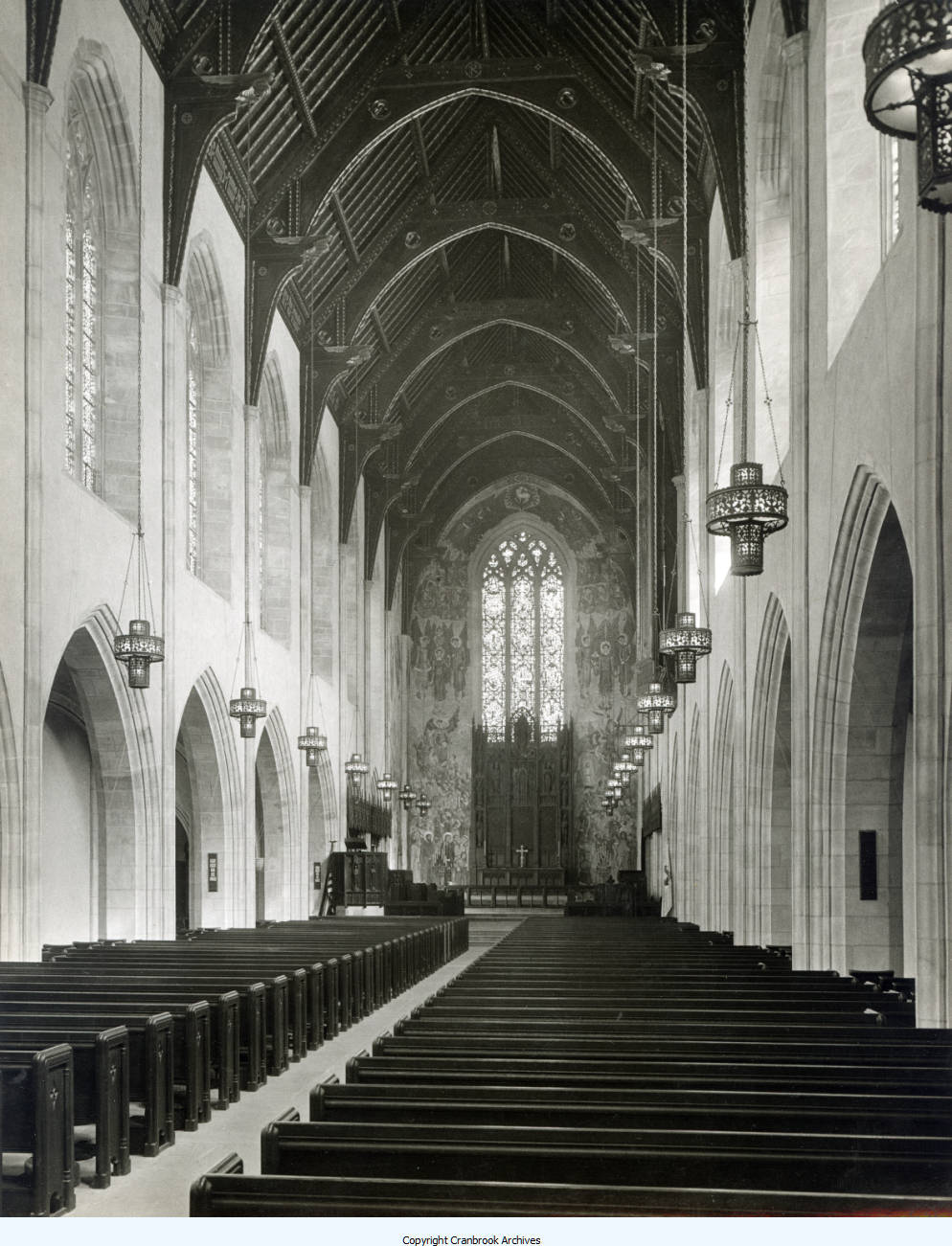
Christ Church Cranbrook Interior. Cranbrook Historic Photograph Collection, Cranbrook Archives.
CCCnave

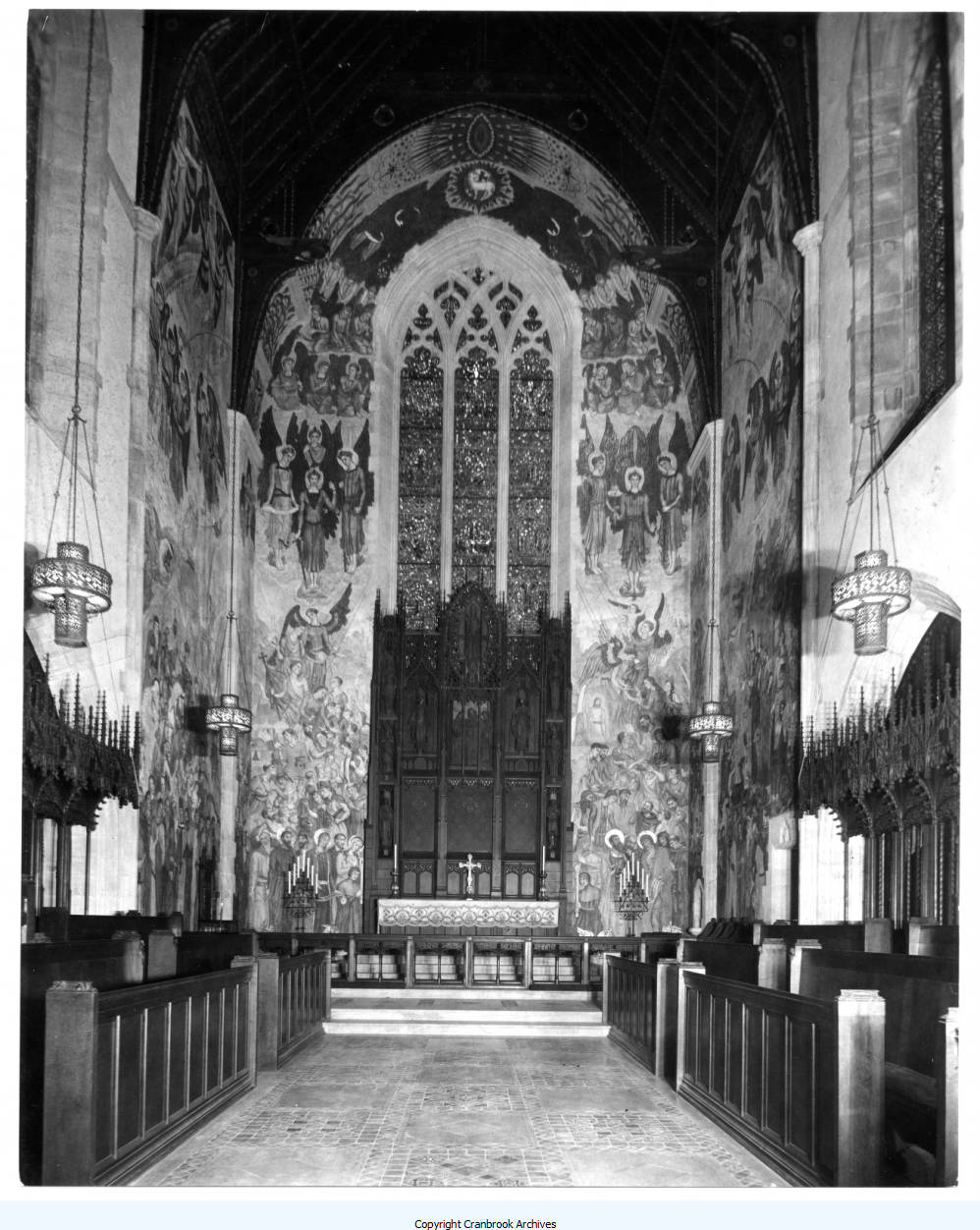
Christ Church Cranbrook Nave. Cranbrook Historic Photograph Collection, Cranbrook Archives.

After a visit to Christ Church Cranbrook earlier this week, I knew it needed to be highlighted as today’s Photo Friday! George G. Booth conceived Christ Church to be the moral center of the new community which he was building at Cranbrook. The photos show a great overview of the expansiveness of the church and shed some light on the magnitude of the work involved in its design. Each of these elements adds to the overwhelming detail of George Booth’s vision and the care in the design of Christ Church Cranbrook.

The church is Booth’s testament to the Arts and Crafts movement. He carefully acquired and commissioned each work of art to add to the overall wonderment of the church and to pay tribute to those who have devoted their lives toward artistic and altruistic pursuits.  The works of art range from the sterling altar plate to stained glass windows, altar frontals, tilework, woodcarvings, paintings, sculptures, and metalwork, most from noted Arts and Crafts men and women.

These photographs, taken five years after the 1928 dedication of Christ Church Cranbrook show the interior of the church sanctuary and a detail view of the nave of the church. The large fresco flanking the high altar was designed and executed by Katherine McEwen, an old friend of Booth’s, and one of the founding members of the Detroit Society of Arts and Crafts.  From the work of Katherine McEwen to Oscar Bach, Samuel Yellin, and Hildreth Meire, to name a few, Christ Church Cranbrook is an architectural gem which should be experienced in person!

Stefanie Dlugosz, Center for Collections and Research, Collections Fellow


Surely Shirley: an Early Knoll Textile

Architect Ralph Rapson may be a household word, especially among aficionados of mid-century modern architecture.  But few likely know of the creative talents of his first wife, Shirley Fletcher.  Just out of high school in 1941, Shirley enrolled in the Intermediate School at Cranbrook Academy of Art.  Like many other students of the day, she spent time in various departments, but found her niche in the weaving department under Marianne Strengell.  While here, she developed a series of block-printed textile designs.  Though she did not continue past her first year (she left to marry Ralph!), Shirley continued to design textiles after she left Cranbrook.

In 1944, Hans Knoll and Ralph Rapson (who was designing furniture at the time for Knoll) discussed the formation of a textile division within Knoll.  Their idea was to introduce contemporary textiles that would complement the modern furniture being produced by the company.  The following year, Rapson brought  Shirley’s designs to the attention of Hans Knoll and her textile “Isles” became one of the earliest printed fabrics at Knoll.  Marianne Strengell may also have contributed to Knoll’s decision to feature “Isles” which was published as part of an assemblage of Academy of Art student “textile studies” in the July 1945 issue of Arts and Architecture.

IMG_1571

“Isles” by Shirley Fletcher Rapson in Arts and Architecture, July 1945.

In October, Hans Knoll wrote Rapson that even though they were “very anxious to do something with Shirley’s fabrics,” due to the shortage of materials during the war, they had to wait until adequate supplies of cloth could be acquired.  The pattern was slightly altered (notice the solid in-fill blocks) when Florence Schust Knoll used “Isles” for drapery in the Rockefeller family offices at Rockefeller Center in 1946.

"Furniture by H.G. Knoll & Associates," Arts & Architecture, September 1947, p. 24. Cranbrook Academy of Art Library.

“Furniture by H.G. Knoll & Associates,” Arts & Architecture, September 1947, p. 24. Cranbrook Academy of Art Library.

The Knoll Textile Division debuted in February 1947 in a new Knoll showroom in New York.  Shirley Rapson textiles were part of the collection (a slightly different version of “Isles” was offered in four different color ways), along with designs by Cranbrook’s Marianne Strengell and Antoinette “Toni” Webster Prestini.

Image

Shirley Rapson’s”Isles” at the Rockefeller Center family office building, 1946.

Leslie S. Edwards, Head Archivist

California to Cranbrook: What I Did on My Summer Vacation

Everyone who has endured a Michigan winter agrees that a Michigan summer is the universe’s way of making it up to you.  Having completed my first winter at Cranbrook, then, it seems a shame that I missed the glory of summer in the Mitten State.   I was called back to my home state of California to celebrate my mother’s birthday (a milestone year that she wouldn’t appreciate having publicized on the internet) and to enjoy a few solid weeks of family reunions, state-wide road trips, and delicious, delicious tacos.  I traded the sun and heat of Southeastern Michigan for the fog and chill of Northern California, but at the end of the day I still managed to find a little bit of Cranbrook in California. Continue reading

Create a website or blog at WordPress.com