Balthazar Korab and his Island of Serenity

A great portion of the time I’ve spent as an archivist at Cranbrook has focused on our photo collections. It would be impossible for me to choose a favorite photo, but I definitely find that one photographer in particular always comes to mind when I get a photo request or when I conjure up an image of campus.

Born in Budapest, Hungary, architect and photographer Balthazar Korab (1926-2013) documented life and work here at Cranbrook for several decades. His iconic images continue to be some of our most requested.

Korab at work at Eero Saarinen and Associates, 1957. Courtesy Cranbrook Archives.

Korab at work at Eero Saarinen and Associates, 1957. Courtesy Cranbrook Archives.

Korab studied architecture at the Polytechnicum Jozsef Nador in Budapest until he felt the necessity to escape his country’s communist regime in 1949. He opted for France, where he continued his education at the École des Beaux Arts in Paris, and received his degree in architecture there in 1954. During this time, Korab worked throughout Europe as a journeyman with notable architects, including Le Corbusier.

In 1955 he came to the United States and was hired by Eero Saarinen to work at Eero Saarinen and Associates (ESA). While Korab was worked there, he saw how Saarinen built models of his designs. Korab volunteered to use his knowledge of photography to develop techniques for dramatic photos of the models. This took him off the drawing board and he soon began to get assignments from other architects. What followed was an illustrious career photographing the works of many of the most significant architects world-wide, including: Ludwig Mies van der Rohe, Gunner Birkerts, Minoru Yamasaki, Frank Lloyd Wright, and many others.

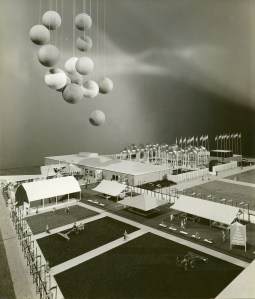
Yamasaki's model of the U.S. Pavilion at the World Agricultural Fair, India. Photograph by Balthazar Korab, ca 1959.

Yamasaki’s model of the U.S. Pavilion at the World Agricultural Fair, India. Photograph by Balthazar Korab, ca 1959.

Korab was introduced to Cranbrook during his time at ESA. In an interview for the Observer and Eccentric in June 1995, he said: “Arriving from a war-torn Europe, I soon was involved with Eero Saarinen’s GM Tech Center, a marvel of the dynamic, brash, wining face of America. It left me in awe and admiration. But my love went for the other Saarinen marvel, a then-middle-aged beauty, Cranbrook. It became a place of refuge and comfort, a source of nutrients for my severed roots to take hold in this strange soil. Its radiant aura was my inspiration.”

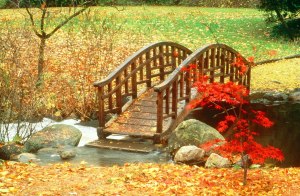
Oriental Garden bridge, Fall 1980. Copyright Balthazar Korab/Cranbrook Archives.

“Oriental Garden” bridge, Fall 1980. Copyright Balthazar Korab/Cranbrook Archives.

In the early 1980’s Korab was hired as one of several contract photographers here at Cranbrook. Over the next three decades, his images provided breath-taking panoramas, as well as minute details of the grounds, art, and architecture of this campus. The beauty of his work cannot be over-stated.

– Gina Tecos, Archivist

Editor’s Note: In an July 1998 article in ambassador magazine, Korab referred to Cranbrook Educational Community as his “island of serenity.”

Photo Friday: Back to School

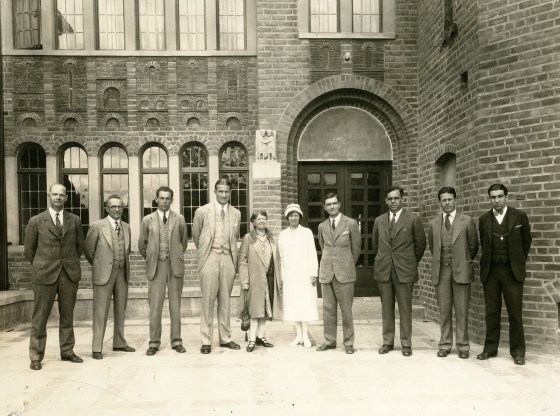
From left to right: Charles Keppel (Chemistry), John M. Harlow (French), George T. Mickelson (English), Herbert Snyder, Elizabeth Bemis (Dietician), Estelle Adams, (Nurse), William O. Stevens, Unidentified, C. Warren Moore (Arts & Crafts), Howard Yule (Latin)

Cranbrook School faculty and staff in front of the Cranbrook School Main academic building (now known as Hoey Hall), ca 1928. From left to right: Charles Keppel (Chemistry), John M. Harlow (French), George T. Nickerson (English), Herbert Snyder, Elizabeth Bemis (Dietician), Estelle Adams, (Nurse), William O. Stevens (Headmaster), Unidentified, C. Warren Moore (Arts & Crafts), and Howard Yule (Latin)


Summer Break in the Archives

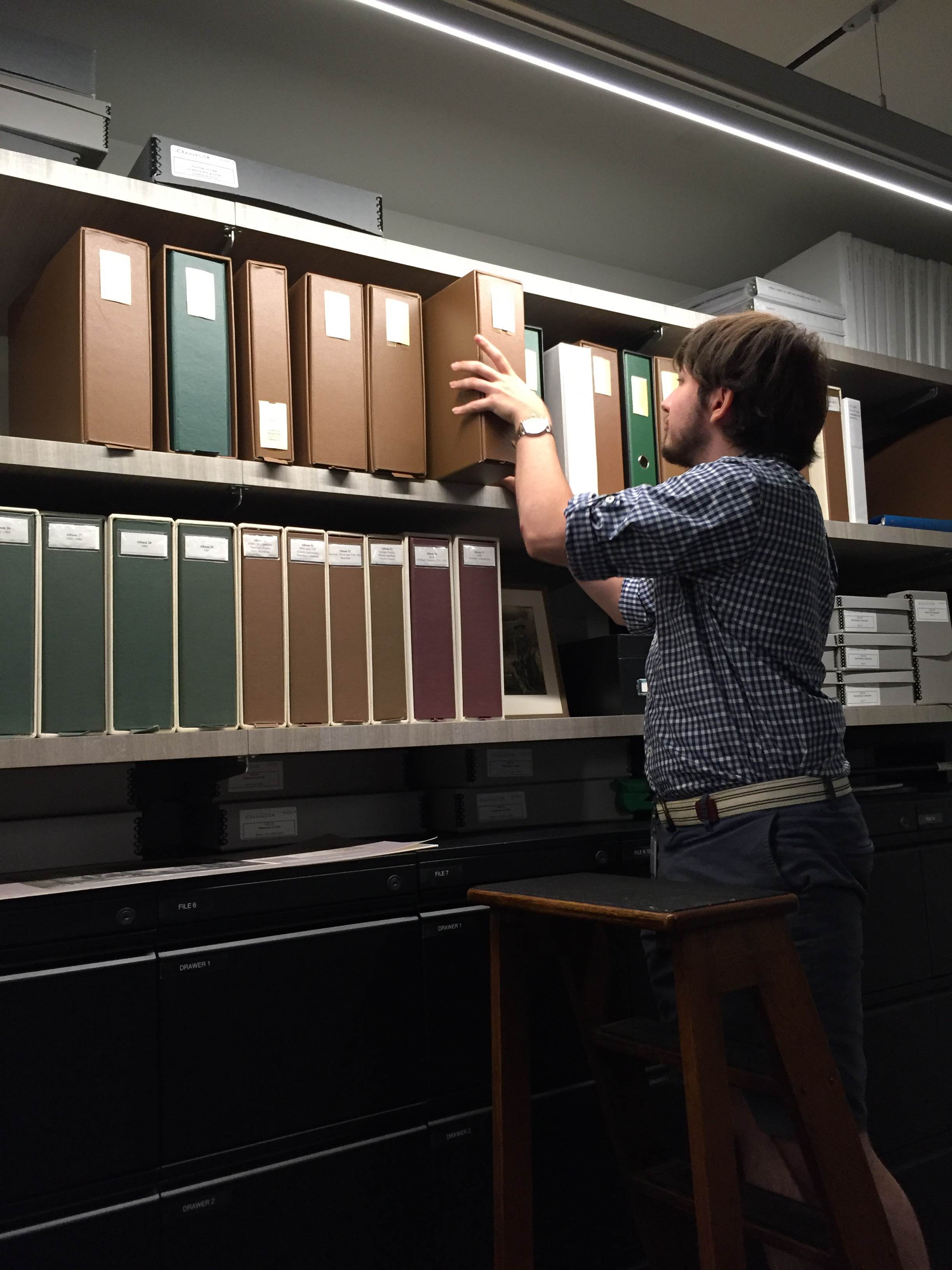
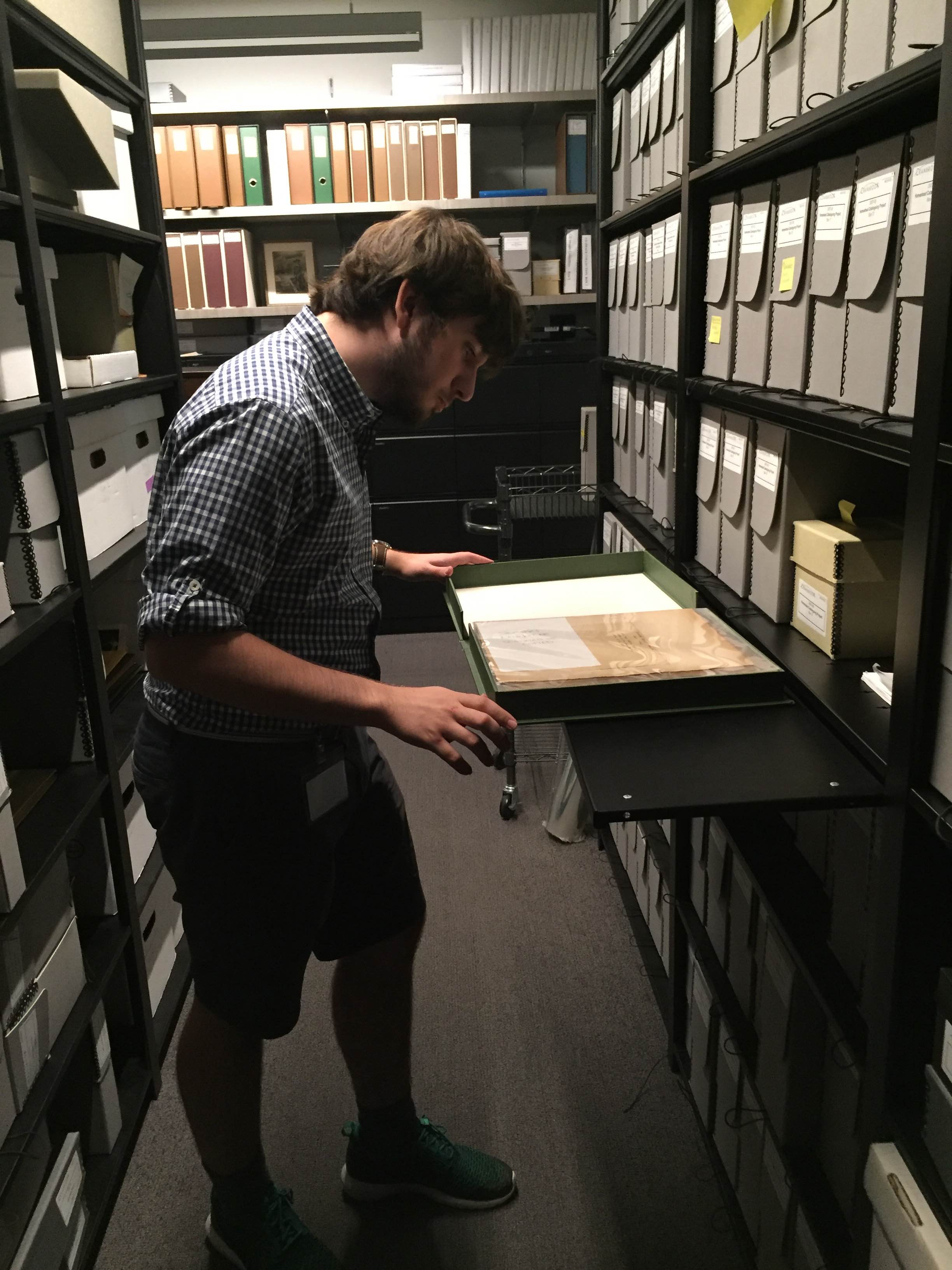
Giuliano working with the slide collections.

Giuliano working with the slide collections.

Reviewing primary source material in the Archives.


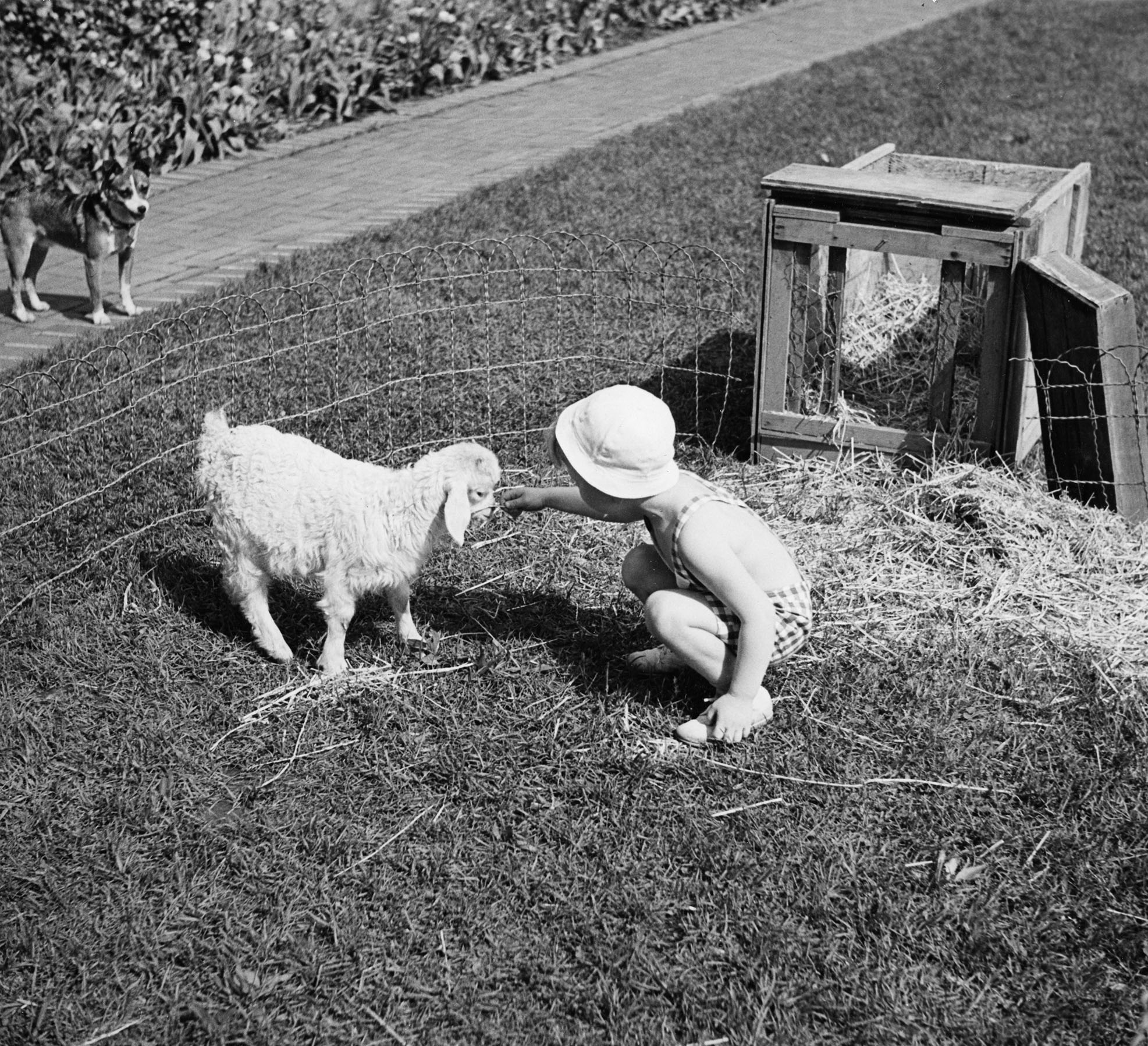
Volunteering in the Archives was a great experience! As a Cranbrook grad, it was really interesting seeing how things used to be at my old school. It was especially fun seeing photos from familiar events like the fifth grade December Program, taken decades before my own class’ production. There were also of course some less familiar things, like pictures of Brookside students at the Art with goats. Personally I think Cranbrook should consider bringing that back, but maybe that’s just because I’m a fan of goats. That was one of several things I enjoyed seeing, as were photos of Amelia Earhart and even… my dad’s yearbook! All in all, it made for a great three weeks. My thanks to all the great people I worked with!

Brookside School pet show, 1936.

Brookside School pet show, 1936.

– Giuliano Stefanutti, CKU ’15

Editor’s Note: We are very grateful for the work Giuliano completed when he was here. He processed slide collections, sorted historic photographs, and inventoried a large audio-visual collection. We wish him well as he heads back to college!


Paris Calls: Cranbrook and Marcel Duchamp

Occasionally we post blogs that we hope will illustrate and educate about the work that we do here, both as archivists and registrars. One of my greatest pleasures is answering interesting research queries, so I thought I would share one from today.

I received a phone call from Paul B. Franklin, an independent art historian and one of the world’s experts on Marcel Duchamp. Born in Detroit, he received his doctorate from Harvard where his dissertation was on Duchamp. He now lives in Paris, where he edits the journal “Étant donné Marcel Duchamp.”

Exhibition card, 1959

Exhibition Announcement Card, 1959. Courtesy Cranbrook Archives.

Today, Paul was seeking clarification about the exhibition “Art and the Found Object” (which was held here at Cranbrook in April 1959 in what was then known as the Galleries of Cranbrook Academy of Art) for his catalogue essay in conjunction with the upcoming exhibition “”Marcel Duchamp: Porte-bouteilles” to be held in Paris in the fall.

News clipping, Detroit News, 9 Apr 1959. Courtesy Cranbrook Archives.

News clipping, Detroit News, 9 Apr 1959. Courtesy Cranbrook Archives.

In an email exchange with Paul, he told me the Paris exhibition “is centered on the version of “Bottle Rack” that Duchamp exhibited in “Art and the Found Object” and which Robert Rauschenberg purchased for a mere three dollars.” (Rauschenberg’s work “Odalisque/Odalisk” was also in the exhibition.) “Duchamp signed his readymade for Rauschenberg in March 1960, and Rauschenberg retained possession of it his entire life.”

What a great story! And the fact that we had materials in the collections of Cranbrook Archives to add to the story is even better. Thanks, Paul, for allowing me to share this story with our readers.

– Leslie S. Edwards, Head Archivist

A New Identity

In May 1930, the Cranbrook Foundation voted to appoint a board to oversee the development of the Cranbrook Institute of Science (CIS) and to design a building for the Institute’s programs. Initially, CIS was a department within the Foundation, but by Dec 1931, George Gough Booth concluded that it had proven itself such an important unit in the Cranbrook educational group, that it should no longer be an activity of the Foundation. It became a separately organized trust which held title to the land and buildings and operated its programs independently.

In Dec 1935, then-CIS Director, Robert T. Hatt, wrote to well-known painter and illustrator, Rockwell Kent. Hatt had been drawn to a volume of Kent’s bookplates that he had in his collection, and asked him if he would create a new seal for the Institute. By Feb 1936 Kent submitted his final design to Hatt, stating, “it is entirely unlike both what you originally suggested and the sketch that I submitted.”

Rockwell Kent's final design for the CIS emblem, 1936.

Rockwell Kent’s final design for the CIS emblem, 1936.

In the CIS sixth annual report, Hatt described the new seal: “the triangle is the basic geometrical figure. The two figures looking respectively upwards at the stars and downwards at the earth represent the field of Science as both extensive and intensive.”

Rockwell Kent created bookplates for the Rochester (NY) Public Library, Joseph Kennedy, the Library of Congress, and many others. Kent was also a prolific illustrator. His work includes well-known editions of Moby Dick, Candide, Leaves of Grass, the Canterbury Tales, and Beowulf (among others). In addition to Kent’s enduring design legacy at CIS, his gift of archaeological relics from Greenland in 1937 was the first material from that area to be accessioned into the Institute’s collection.

– Gina Tecos, Archivist


Photo Friday: Keeping Cool

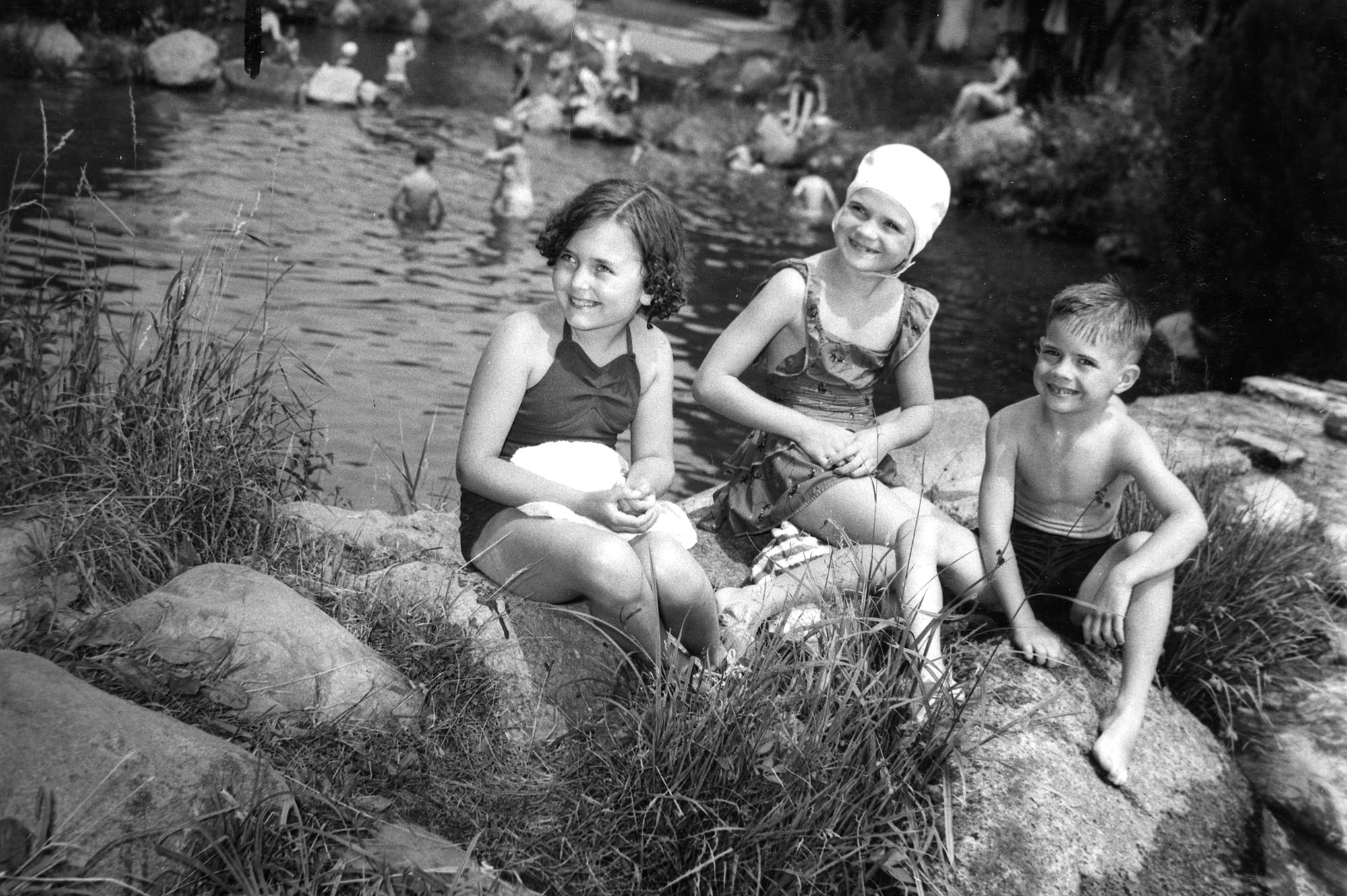
The temps have been high this July! We hope you are keeping cool. The smiling faces in today’s Photo Friday are from the 1953 session of the Kingswood-Cranbrook Summer Day Camp. The program was a precursor to the summer camps offered today on the Brookside, Kingswood, and Cranbrook school campuses.

The first summer “camp” at Cranbrook was a war-inspired program for girls ages 14 and older– the Summer Institute of Kingswood-Cranbrook School. The curriculum provided courses that were helpful to the war effort. The Summer Institute of Kingswood-Cranbrook School continued through 1944 when it evolved into the Kingswood Summer Day Camp. In 1947, Cranbrook initiated the Cranbrook Summer Institute, offering “programs and recreation for the entire family.” Summer Institute provided courses in weaving, ceramics, lapidary techniques, music, theatre — and of course, the opportunity to cool off in Lake Jonah!

Children sitting on the rocks at Lake Jonah/Jonah Pools. Harvey Croze, photographer, Jul 1953.

Children sitting on the rocks at Lake Jonah. Harvey Croze, photographer, Jul 1953.

– Gina Tecos, Archivist

Out From the Shadows #2: Colonel Edwin S. George

Many years ago, when I worked at the Oakland County Pioneer and Historical Society, I came across a man named Edwin S. George in reference to his home, “Cedarholm,” which he built in 1923 in Bloomfield Hills, and is now a part of Kirk in the Hills Presbyterian Church.

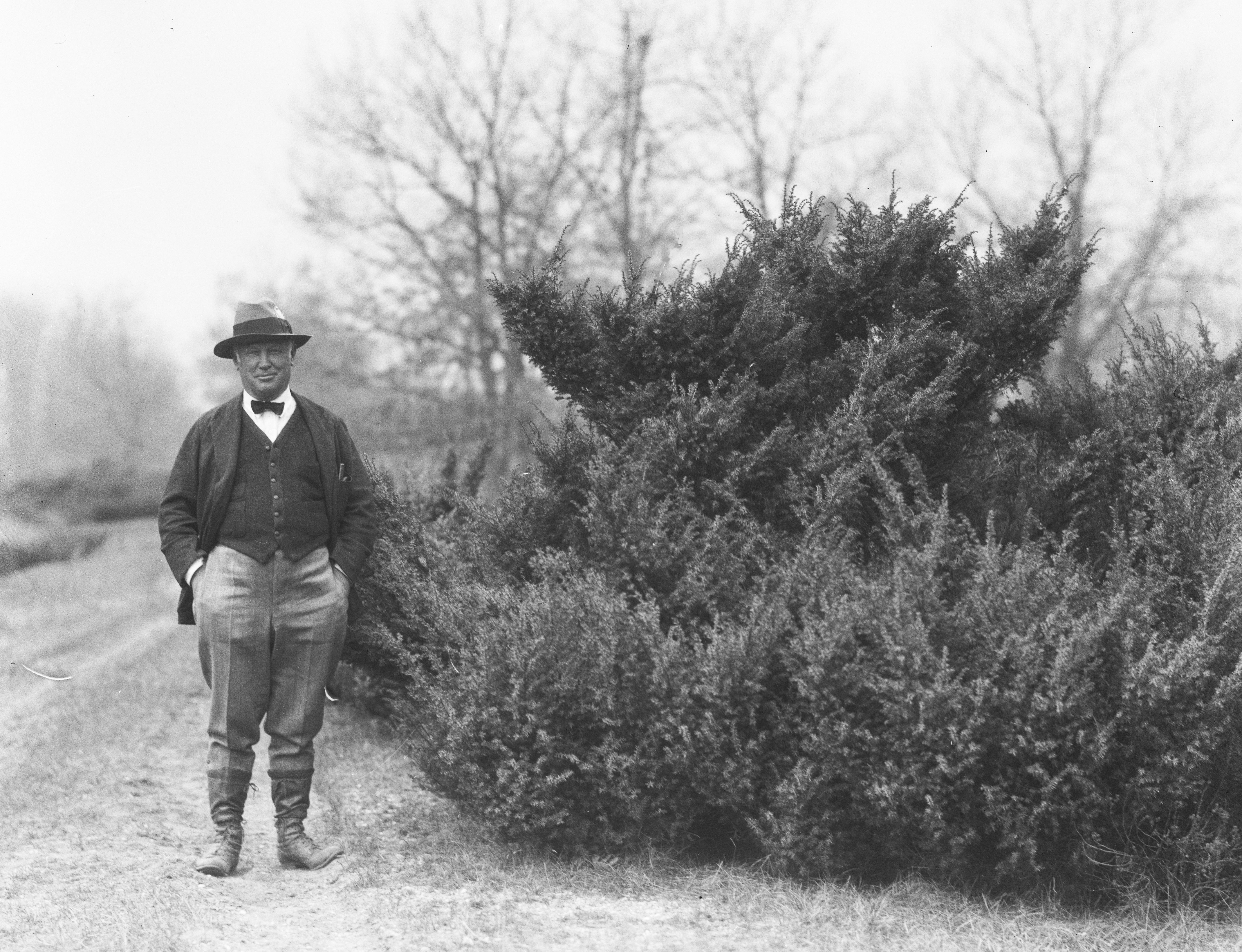
What many people do not realize is the colonel’s long-standing connection to Cranbrook. Recently, while searching for photographs for a researcher, I stumbled upon the negative of a stocky, kind-looking man standing by a grove of trees. Fortunately, early Cranbrook photographers kept great records and I was able to look up the subject on the index of negatives in the archives, and it is indeed a photo of Colonel George.

Colonel Edwin S. George, Apr 1930. W. Bryant Tyrell, photographer.

Colonel Edwin S. George, Apr 1930. W. Bryant Tyrell, photographer.

Much can be read about the Colonel’s acumen as an influential Detroit businessman and philanthropist, and there is no doubt that he and George Booth knew one another in Detroit. However, once they both moved to Bloomfield Hills, the relationship grew. The colonel organized the Bloomfield Hills Country Club of which Booth was a founding member, and both men were members of the Bloomfield Open Hunt Club. In 1912, Colonel George became one of the stockholders in the Bloomfield Hills Seminary (the pre-cursor to Brookside School) established by George Booth, and in 1926, the two men worked together to bring a post-office to the then Village of Bloomfield Hills.

Cranbrook School students with Colonel George (seated), The Edwin George Reserve, Sep 1930. W. Bryant Tyrell, photographer.

Cranbrook School students with Colonel George (seated), The Edwin George Reserve, Sep 1930. W. Bryant Tyrell, photographer.

But certainly the most important contribution Colonel George made to Cranbrook was through the Institute of Science. In 1930, the colonel became a member of the Institute’s first Board of Trustees, a position he held until just before his death in 1950. That same year, he donated 1,250 acres of land near Pinckney, Michigan to the University of Michigan to be used not as a public park, but as an educational resource for University of Michigan students, scout troops, and Cranbrook School students. Known as “The Edwin George Reserve,” it featured hiking trails, streams and a small lake, stables, outbuildings, a gate lodge, and even an airstrip. Colonel George also stocked the reserve with wildlife including deer brought from Michigan’s Upper Peninsula and antelope from Alberta, Canada. The colonel wanted the boys to have “an appreciation of the truer values of life as expressed by the truth in Nature,” and provided a place for them to do so.

So, while we have no direct proof that Booth and the colonel discussed the virtues of nature as education, it sure seems to me that they had a lot more in common than we previously thought!

– Leslie S. Edwards, Head Archivist

Nunsense

Over the past few years, I have listened to researchers in the Archives and visitors to the museum describe works of art as divine or heavenly, but I don’t remember those words used to describe the artist. Until now. Did you know that during the 1950s-1960s there were several artists who studied at the Academy of Art who were also members of a divine order? Admittedly, I have not had much interaction with nuns in my lifetime, but I have a keen fascination (cue: “The hills are alive with the sound of music..”).

Sister Mary James Ann Walsh, BVM (Order of the Blessed Virgin Mary) was one of several nuns to study at the Academy where she received her MFA in painting in 1955. In 1953, Sister Mary was the First Prize Winner of the 9th Annual Iowa Water Color Show for her piece, “Ecce Homo.” That painting is now part of the Sioux City Art Center’s permanent collection. In addition to her Cranbrook degree, Sister Mary studied at the State University of Iowa and the University of Colorado. In 1959 she became head of the Clark College department of Art in Dubuque, Iowa.

Sisters at work in the metal shop, 1954. Courtesy Cranbrook Archives.

Sisters at work in the metal shop, 1954. Courtesy Cranbrook Archives.

The photo above shows Sister Mary Grace Esther Mehren, BVM, and Sister Mary Barbara Cerny at work in the metal shop in 1954. We are still looking for information about Sister Mary Barbara, but according to the Chicago Tribune (15 Jun 1958), Sister Mary Grace Esther was appointed to oversee construction of an eleven-story Scholasticate on the campus of Mundelein College. The building houses lecture halls, classrooms, a dining hall, and a chapel.

Another CAA alum (Metalsmithing ’49), Sister Helene O’Connor, O.P. (Dominican Order of Preachers), founded Studio Angelico in 1935, at Siena Heights University in Adrian, Michigan. Studio Angelico, the art department at Siena Heights, was named for the 15th century Dominican painter, Fra Angelico. Sister Helene chaired the art department, taught classes, and directed community workshops. An accomplished sculptor, ceramicist, weaver, and muralist – her work has been exhibited at the Portland Museum of Art, the Detroit Institute of Arts and the Metropolitan Museum of Art.

Sister Marie Gertrude's, "Mother Hen," Bay City Times, 27 Sep 1964.

Sister Marie Gertrude’s, “Mother Hen,” Bay City Times, 27 Sep 1964.

Also of the Dominican order, Sister Marie Gertrude Lohman, O.P., received her MFA in Sculpture from the Academy in 1966. Several of Sister Marie Gertrude’s sculptures display in Illinois, including a statue of St. Catherine of Siena at the Queen of Heaven Cemetery in Chicago and a statue of St. Albert the Great in the student courtyard at St. Rose Priory. Sister Marie Gertrude studied in Schifanoia, Italy, and her work has been exhibited in Chicago and Dubuque. In 1964, her work, “Mother Hen,” was displayed at the Studio 23 space at the Arts Center in Bay City, MI.

This research has only deepened my fascination of the divine sisterhood. I wonder what drew the sisters to Cranbrook? There were several other nun-students at CAA – I look forward to learning more about their contributions to Cranbrook and the art world.

– Gina Tecos, Archivist
Photo Friday: Coming to Light

The Institute of Science photograph collection (1929-1995) is a treasure trove of fascinating images, taken by various Institute of Science staff during the course of their field research. Many of them document places that have become popular northern Michigan summer vacation destinations.

Thunder Bay Island Lighthouse, Jul 1929. W. Bryant Tyrrell, photographer. Courtesy Cranbrook Archives.

Thunder Bay Island Lighthouse, Jul 1929. W. Bryant Tyrrell, photographer. Courtesy Cranbrook Archives.

This photo was taken by naturalist W. Bryant Tyrrell who was employed by the Cranbrook Foundation in 1929 as the director of the first natural history museum, then housed in what is now known as the Academy of Art Administration building. Tyrrell worked with Brookside School students, taking them on nature walks around campus and teaching them how to build bird houses. He also taught general nature study to Cranbrook School students. Tyrrell’s field work, primarily in Michigan, led to the formation of several Institute of Science collections from which he was able to prepare exhibitions.

The W. Bryant Tyrrell Photograph Collection can be found at the Washington D.C. Community Archives. For a history of the Thunder Bay Lighthouse, see: http://www.terrypepper.com/lights/huron/thunder/

– Leslie S. Edwards, Head Archivist

Out From the Shadows #1: Myrtle Hall

While most everyone equates the names Saarinen, Knoll, and Eames with Cranbrook, there are hundreds, if not thousands, of people who have contributed to the community whose stories have never been told. We archivists thought it would be interesting to tell some of their stories here.

The first is Myrtle Hall. She was not an alumna, faculty, or staff at any of the Cranbrook institutions, however, she did work at the Academy of Art as a model for drawing and painting students in the late 1930s and early 1940s. Not much is known about the models – there are no employee files for them, and their names are not listed in reports or meeting minutes. Fortunately however, I did uncover evidence that a line-item, established in the budget for the Academy of Art’s 1934-1935 academic year, specifically provided funding for the life models for the drawing and painting classes (taught by Wally Mitchell.) Models worked twenty-one hours per week.

Painting and drawing class, summer 1940.

Painting and drawing class, summer 1940.

By her own admission, Myrtle was the “first black model at Cranbrook” and for that matter, the first black model in the Detroit area including at the Meinzinger School of Art. In addition to modeling, Myrtle was also an artist herself and a member of Detroit’s Pen and Palette Club, which was formed in 1925 by the Detroit Urban League to help young artists exhibit their works. In 1935, Myrtle received an award for one of her paintings at the club’s Ninth Annual Exhibition. She also studied for a time at the Society of Arts and Crafts, exhibited at the Detroit Artists Market, and was one of the founding members of the Extended Arts Gallery (1958). During the 1940s, Myrtle abandoned painting and became an accomplished ceramicist. She had her own pottery studio (which she designed herself) on Erskine Street in Detroit. The studio was filled with antiques, paintings and sculpture by Michigan artists, as well as her own ceramics and of course her kiln and glazes. In a 1963 interview, she stated “I can’t stand things that are useless” and her oven-to-table casseroles, salad bowls, drinking mugs, and lamp bases reflected just that.

Myrtle Hall, Detroit Free Press, Mar 1994.

Myrtle Hall, Detroit Free Press, Mar 1994.

A 1994 article in the Detroit Free Press also tells the story of Myrtle Hall as a quiet but effective activist. She stood up for civil rights when she saw injustice, and was instrumental in affecting a change in Meinzinger Art School’s discrimination of African American students after World War II. Myrtle Hall is quoted as saying “I didn’t just model, I noticed things.”

– Leslie S. Edwards, Head Archivist

Editor’s Note: We do not have any biographical information on Myrtle, but if you know anything about her, please let us know!

Create a website or blog at WordPress.com