Recently, after years of research and investigation, the carpeting in the Cranbrook House Library was restored to its original appearance.
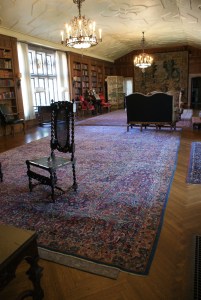
The previous rugs were donated to Cranbrook House in the 1990s but were not historically accurate.
By studying images of the Library in Cranbrook Archives, we could determine that in George and Ellen Booth’s lifetimes there was a large, solid carpet on the floor, not the oriental rugs seen in recent years.
A review of the Cranbrook House 1921, 1933, 1937, and 1949 inventories (itemized lists of the house’s contents for insurance purposes), as well receipts and historic images, revealed the style and color of the rug: Axminster mottled brown or taupe. This may sound boring, but monochromatic rugs were chosen by the Booths to draw visitors attention up to the furnishings, books, elaborate carvings, and tapestries in the Library.
Axminster was both a brand name and specific type of carpet. Axminster is cut pile carpet (a style of carpet where the woven loops are cut leaving straight tufts of carpet). It derives its name from the small town in England where the process of weaving its distinctive style was created. Looking for a modern, cost-effective equivalent, made in the same fashion as the original Axminster, led us to Bloomsburg Carpet Industries, Inc. They have woven wool broadloom Aximinster and Wilton carpets in Bloomsburg, Pennsylvania using traditional methods since 1976. With the help of interior designer (and Cranbrook Academy of Art Board of Governor) Lynda Charfoos, we were able to select a color that both closely matched the description “‘mottled’ brown or taupe” and also looked great with the tones and colors of the Library.
On April 30, we cleared the Library so that on May 1, the rugs could be installed by Carpet Design Group, LLC.
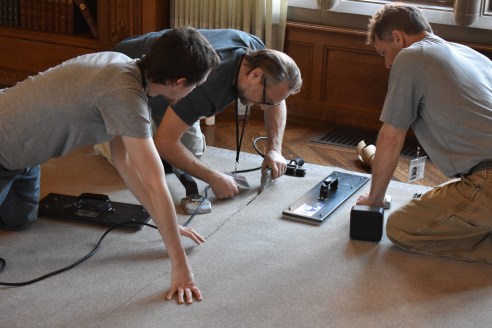
Workmen from Carpet Design Group fusing together the four sections of the carpet.
The Library was reinstalled the next day with a new floor plan based on careful examination of historic photographs and itemized lists of what sat where. Watch the slideshow to compare historic images to the reinstalled room:


We feel guests and staff alike will enjoy this return of the original look to the Library. It will allow the carvings to pop, the colors in the tapestries to appear stronger, and make for a more historically accurate room. Continuing to keep the Booth house looking its best is all part of helping to tell the Cranbrook story to guests from the neighborhood and around the world.

Photograph by Jim Haefner. Courtesy of Jim Haefner and Cranbrook Center for Collections and Research.
The Center would like to thank the following, without whom this project would not have been possible: Cranbrook Educational Community, Cranbrook House and Gardens Auxiliary, Lynda Charfoos, Bloomberg Carpet, Carpet Design Group, and Chet’s Cleaning Service. Special thanks also to Jim Haefner for photographing the Library.
Come see the new look of the Cranbrook House Library this summer on a Cranbrook House and Gardens Auxiliary house tour.
– Leslie Mio, Associate Registrar
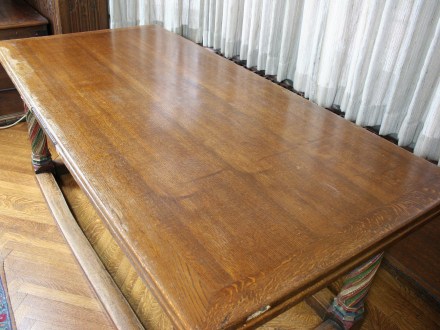 Purchased by George G. Booth, before 1949, for use in Cranbrook House, the Refectory Table (CEC 37) in the Cranbrook House Oak Room has a plain 76 inch by 35-1/2 inch rectangular top, with two extendable tops of 31-1/2 inches each.
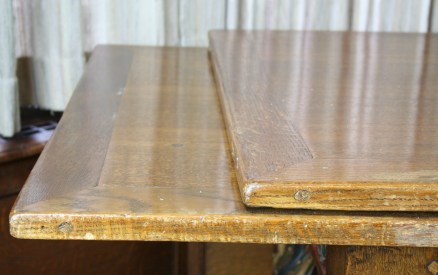 The extension mechanism works by removing the top wood leaf, pulling out each side of tabletop – these are supported by bars under the table top that pull out – removing the center section, then placing the top leaf in the center.
 The frieze runs all around the table and features a grapevine interspersed at regular intervals with Medieval-style figures: mermaids, men, women, and animals.
 The figures carry banners and staffs, are sitting on benches, and, in the case of the mermaid, holding a fish.
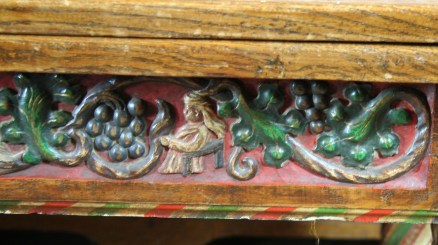 The frieze background is painted red; the grapevine and grapes are brown with black and the leaves are green with gold detailing; the figures and animals are mostly tan with gold and the mermaids are gold as well. The lower edge molding of the frieze is painted with diagonal lines of green, gold, and red.
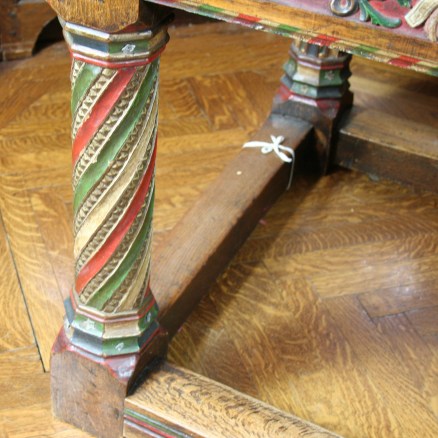 Each of the four carved and painted legs is decorated with a different linear design of stripes, twisted around the trunk, with hexagonal base and top.
 Metal stars are attached to the base and top of each leg. The legs are painted blue, green, red, and tan, all with gold detailing.
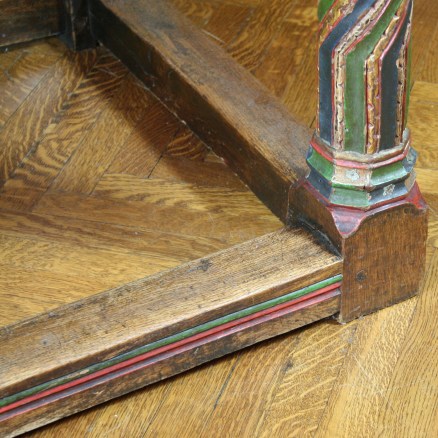 The outer side of each stretcher has carved lines painted red and green.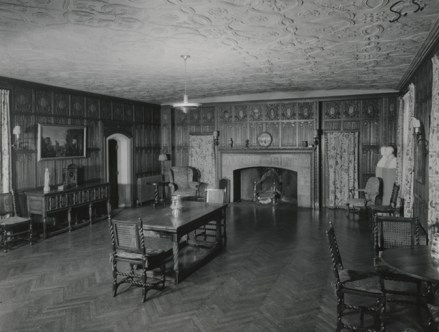

 George G. Booth created the Still Room as a part of his office suites in 1918. It was as a place to take a noonday rest. In old English country houses, the Still Room was a place where medicines were prepared, herbs and flowers were infused in water or oils, and where home-brewed beers and wines were made. As Henry Scripps Booth recalled in another letter, “We started applying the term to the small room at the south end of the wing although Mr. Booth had no intention of making whiskey, beer or wine, but on using it as a quiet place for reading, conversation and taking undisturbed naps.”








 Cranbrook Kitchen Sink