Photo Friday: Learning by Living and Observing

BS1930s001

Brookside School, ca 1928. The photograph was taken by Arnold Studio, a local Birmingham studio who took most of the early photographs of Brookside School. Cranbrook Archives.

In the 1930s, Brookside School children spent part of their time applying what they learned in the classroom to conditions from real life. Here, children were learning by “living and observing” the daily routines at a pretend store. The “Greenfield Sausage” package on the front of the table was from Hammond Standish & Company meat packing business of Detroit. The company was founded by George H. Hammond, who built Detroit’s first skyscraper—the “Hammond Building.” Hammond also patented the first refrigerated boxcar, and by the mid-1880s, Hammond Standish & Company was using 800 refrigerated boxcars to deliver meat to the Atlantic seaboard each week.

Gina Tecos, Archivist

Photo Friday: Poly Mer and the Emulsions

Doug "Do" Huston (MFA Printmaking, 1975) holds his Poodle Bass guitar, while Chuck Baughman (MFA Printmaking, 1975) is armed with a saxaphone. Lorraine Wild (BFA Design 1975) wears the blue dress. Image courtesy of Steve Milanowski.

Doug “Dog” Huston (MFA Printmaking, 1975) holds his Poodle Bass guitar, while Chuck Baughman (MFA Printmaking, 1975) is armed with a saxephone. Lorraine Wild (BFA Design 1975) wears the blue dress. Image courtesy of Steve Milanowski.

Spring has finally arrived, and with it comes the urge to stay outdoors, enjoy the great weather, and maybe even celebrate with a little music! In 1974, CAA students Doug Huston and Chuck Baughman (both MFA Printmaking, 1975) joined up with Lorraine Wild (BFA Design, 1975) and others to form the band Poly Mer and the Emulsions. As you enjoy our newfound sun (and revel in a landscape finally free of snow), take a moment to consider what sort of sounds might come from a poodle bass guitar, featured here in the arms of the appropriately nicknamed “Dog” Huston.

Photo Friday: The Rocket Takes Off (and Says Goodbye)

James Scripps Booth showing off the JB Rocket prototype in Indianapolis, the conclusion of a test-drive from Detroit to Indiana, 1913. Cranbrook Archives.

James Scripps Booth showing off the JB Rocket prototype in Marion, Indiana, at the conclusion of a test-drive from Detroit to Indiana, 1913. Cranbrook Archives.

Today’s Photo Friday comes courtesy of A Driving Force: Cranbrook and the Car. The exhibition, organized by the Cranbrook Center for Collections and Research and hosted at Cranbrook Art Museum, features objects, renderings, and historic photographs that connect the Cranbrook community with Detroit’s long and venerable history of car production. And of course we also brought in actual 1914 car, because how could we not? Anyone who reads this blog regularly already knows quite a bit about the exhibition, so we won’t go on. If you haven’t had a chance to see the show, though, be sure to stop by Cranbrook Art Museum on Saturday or Sunday before the whole thing comes down once and for all!

Shoshana Resnikoff, Collections Fellows

Photo Friday: Cage at Cranbrook

Limited edition postcard featuring CAA student Jim Poole wearing a Cage Bag as a mask on Cranbrook's campus, 1974. Courtesy Stephen Milanowski.

Limited edition postcard featuring CAA student Jim Poole wearing a Cage Bag as a mask on Cranbrook’s campus, 1974. Courtesy Stephen Milanowski.

In 1974, artist-composer John Cage traveled to Cranbrook for the opening of the museum exhibition Music-Mushrooms-Manuscripts. His visit prompted an incredible spate of creative production among CAA students, including this postcard. Part of a limited edition set created as part of Cage’s visit, the card features CAA student Jim Poole wearing a “Cage Bag” as a mask. The Cage bags (paper bags featuring silk-screened images of John Cage’s face) were made to be used in a performance of Cage’s compositions held on campus.

If this all seems confusing, don’t worry – you can get some clarity on this amazing, confusing, and exciting time period by visiting Cranbrook Art Museum on Sunday, March 23. Shelley Selim, the 2013-2015 Jeanne and Ralph Graham Fellow, will be lecturing on John Cage’s visit to Cranbrook as well as discussing Mushroom Book and Sounds of Venice, two Cage works currently on display in the Cranbrook Art Museum exhibition My Brain Is in My Inkstand: Drawing as Thinking and Process. The lecture starts at 4 pm, and immediately following will be a performance of Sounds of Venice by Detroit musician and composer Joel Peterson (check out his amazing gallery/restaurant/performance space Trinosophes, across from Eastern Market). For more information, check out Cranbrook Art Museum’s website. You can also read more about the Cage visit in Shelley’s amazing blog entry, hosted hereon our sister blog Cranbrook Sightings. And if you haven’t yet seen My Brain Is in My Inkstand, be sure to catch it soon–the exhibition closes on March 30!

Dear Diary: Women in Their Own Words

“When women tell their life stories in their own words, a distinct enthusiasm, engagement and affirmation emerges . . . these are the stories in which women are the central actors, even if their stories are camouflaged by modesty and disclaimers.” So writes Judy Nolte Lensink in Perspectives on Women’s Archives. One of the most common ways in which women tell their life stories is through their personal diaries. The stories can range from day-to-day events, personal reflections, or comments about the world at large. Nearly every archive has diaries in its collection, and ours is no exception. Below are a few examples of the range of journals found in the Cranbrook Archives.

Harriet Messinger Scripps, circa 1872. Cranbrook Archives.

Harriet Messinger Scripps, circa 1872. Cranbrook Archives.

Continue reading

Photo Friday: Wartime Conservation, Kingswood-Style

Kingswood students Blenda Isbey, Irene Bard, and Nollie Campbell collect waste fat after their Home Economics class at Kingswood School, 1944. Harvey Croze, Cranbrook Archives.

During World War II, students at the Cranbrook and Kingswood Schools became increasingly involved in homefront activities. Here, Kingswood students Blenda Isbey, Irene Bard, and Nollie Campbell collect waste fat after they’ve finished their Home Economics class. Fat could be used to make soap, in great demand because of wartime rations, but was also consolidated for use in explosives.

Poster advocating the re-use of waste fats in explosives. Henry Koerner, Printed by the Office of War Information, 1943. National Archives.

Poster advocating the re-use of waste fats in explosives. Henry Koerner, Printed by the Office of War Information, 1943. National Archives.

Shoshana Resnikoff, Collections Fellow

Photo Friday: Alexandrine Behind the Wheel

Alexandrine McEwen in her Scripps-Booth, 1916.  Cranbrook Archives.

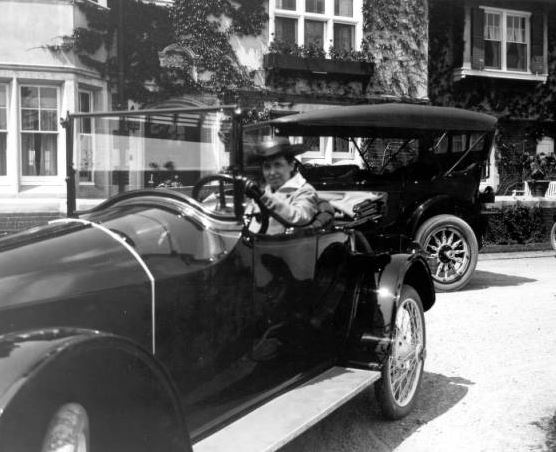
Alexandrine McEwen in front of Cranbrook House in her Scripps-Booth, 1916. Cranbrook Archives.

As the organization that is currently hosting the exhibition A Driving Force: Cranbrook and the Carit would make sense that we at the Center were drawn to this photo for its representation of a 1916 Scripps-Booth, the car designed by James Scripps Booth and produced by his automotive company. Instead, though, the woman behind the wheel is the real star of the image. Alexandrine McEwen and her sister, Katherine, were co-founders of the Detroit Society of Arts and Crafts (DSAC) and friends of George Booth. Alexandrine was a bookplate artist, painted miniatures, and also authored many of the early plays for the DSAC. After living for decades in Detroit, she and Katherine relocated to Dragoon, Arizona where they ran a dude ranch.

Leslie S. Edwards, Head Archivist, and Shoshana Resnikoff, Cranbrook Center for Collections and Research


Photo Friday: Folk Dancing

Harry Bertoia is served food by a costumed man at the Cranbrook Academy of Art folk dancing party. December, 1940. Cranbrook Archives.

Harry Bertoia is served food by a costumed man at the Cranbrook Academy of Art folk dancing party. December, 1940. Cranbrook Archives.

Cranbrook Academy of Art students may come to Michigan for their MFAs, but they seem to become masters of throwing great parties during their time here as well. One such shindig was the “Folk Dancing Party,” held in 1940 and shown here. Harry Bertoia, sculptor and furniture designer, sits in a suit while a costumed man serves him food. Lederhosen and hors d’oeuvres – a unique combination for a unique evening.

Shoshana Resnikoff, Collections Fellow

Photo Friday: Cranbrook’s Super Bowl

Ralph Rapson (left, holdign the football), plays football with fellow Cranbrook Academy of Art students. September, 1939. Richard P. Raseman/Cranbrook Archives

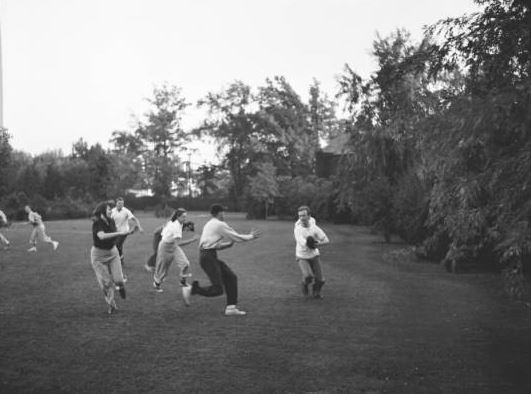
Ralph Rapson (right, holding the football), plays football with fellow Cranbrook Academy of Art students. September, 1939. Richard P. Raseman/Cranbrook Archives.

Okay, so “super bowl” might be overstating it. Still, this photo of Cranbrook Academy of Art students enjoying an afternoon game on campus should get you into an appropriately Cranbrook-y mood for the upcoming NFL Super Bowl. So far we’ve identified Ralph Rapson, noted mid-century architect and long-time head of the University of Minnesota School of Architecture, in the white shirt holding the football. If anyone identifies the other players, though, please let us know in the comments!

Photo Friday: Movie Magic

Cranbrook Academy of Art students participate in the filming of Jazz, CAA student Joe Munro's first experimental film. 1943, Cranbrook archives.

Cranbrook Academy of Art students participate in the filming of Jazz, Joe Munro’s first experimental film, 1943. Cranbrook archives.

Born and raised in Michigan, Joe Munro worked at Cranbrook as a photographer and teacher. Here he works on his first film, Jazz, gesticulating wildly at his actors while his crew, made up entirely of CAA students, looks on. Munro left Cranbrook shortly after this film was completed, joining the US military and serving in WWII as a wartime photographer.  With the end of the war he began a long career as a freelance photojournalist, working for LIFE, National Geographic, and Time Magazine. His archives are held by the Ohio Historical Society are definitely worth a look.

Create a website or blog at WordPress.com