A Registrar’s Perspective

Tawny Nelb Workshop

Framed Ralph Rapson drawing, The Ralph Rapson Collection, 1935-1954. Photographer, Gretchen Sawatski.

This past Monday I had the great fortune of taking part in an archival workshop lead by forty-year archives veteran Tawny Ryan Nelb of Nelb Archival Consulting, Inc. As a Registrar, I primarily work with three-dimensional objects (furniture, paintings, gates, etc.), so I was eager to learn that this workshop focused on architectural records, the sub-genres within that medium, and how to properly care for and store these records.

I reference architectural records quite frequently when I am trying to learn more about, or troubleshoot, a problem related to an object. In all honesty, I thought I knew the proper handling, usage, and storage of these records as this knowledge is vital to my job; but it was obvious that I really needed the refresher course in “Paper Management 101.”

Archives workshop at Cranbrook Center for Collections and Research

Tawny Ryan Nelb (third from left). Photographer, Justine Tobiasz.

Tawny’s discussion covered all areas of architectural records including paper mediums, drawing types, and then some. I have to admit though that I cringed when the conversation moved towards the exhibition processes for architectural records! Often, we loan architectural sketches, floorplans, and section drawings to other institutions that require us to frame the documents using a hinge system. A hinge, simply put, is a tab that is glued to a document using a reversible wheat paste that is then adhered to an acid-free backer board. To my dismay, this approach was used historically on tissue and tracing type papers records in our collections, which are likely to tear and off-gas inside their expensive frames, creating a microclimate of havoc. In a moment of panic my hand shot up in the middle of the lecture and I uttered, “But we have documents framed in our collection like this! What should we do?”

Thank goodness for archival specialists, because Tawny truly eased my conscience. She, in very kind words simply replied, “It’s ok. We can remove the tissue and tracing paper from their frames, disrupting the microclimate, and use archival paper and matting to resolve the issue.” My response, “what about those hinges?” And, again she calmed my nerves, “Leave the hinges, and store the objects in flat files, so there is no need to use the frames. Then, if these documents go on exhibition again, they are already hinged and ready to go.” In one word: genius. That is what I experienced at this workshop, shear genius. In all of the workshops I have been a part of, I have never been so glad to have attended an archives workshop in all of my life.

Gretchen Sawatski, Associate Registrar

Object in Focus: Viktor Schreckengost Correspondence

Viktor Schreckengost letter, 1938

Saarinen Family Papers, Cranbrook Archives

While doing research for the Cranbrook Archives’ upcoming exhibition Ephemera: The Stories that Letterhead Tells, I discovered a beautiful example of bold, colorful letterhead from 1938. The letterhead, designed by Viktor Schreckengost, was clearly influenced by the Bauhaus designs of the 1920s and 1930s which featured asymmetrical compositions and expressive typography. The content of the letter is of course also very interesting. A response to textile designer Loja Saarinen’s request to purchase the ceramic sculpture “Young Pegasus,” the letter shows a mutual respect between the two artists. The sculpture, which Schreckengost sold to Loja Saarinen, lived for many years in Saarinen House, and is now in the permanent collection of Cranbrook Art Museum.

As the saying goes, “curiosity killed the cat,” and as I knew nothing about Schreckengost, I set out to see what I could discover about him. Turns out that Schreckengost, who spent the majority of his life in Cleveland Heights, Ohio, was not only an industrial designer (think streamlined pedal cars and the Sears Spaceline bicycle), but was also a painter and ceramicist. The son of a commercial potter, Schreckengost dabbled in clay sculpture as a child, and went on to design mid-century modern dinnerware for American Limoges and Salem China. Perhaps his best-known ceramic work is the Jazz Bowl (1930-1931) that he created at Cowan Pottery in Rocky River, Ohio, for a commission from Eleanor Roosevelt.

Viktor Schreckengost letter, 1948

Cranbrook Art Museum Exhibition records, Cranbrook Archives

In 1948, then curator of Cranbrook Art Museum, Esther Sperry, was in the process of planning the Academy of Art’s Second Biennial Ceramics and Textile Exhibition and reached out to Schreckengost. The exhibition records yielded two more very interesting letterhead from Schreckengost. With simplified typography, the first reflects Schreckengost’s response to post-war graphic design and the promotion of “less is more” concept, while the second illustrates how Schreckengost constantly experimented with type and design elements. Both 1948 letters show his conscious effort to utilize negative space as an active element.

Viktor Schreckengost letter, 1948

Cranbrook Art Museum Exhibition records, Cranbrook Archives

The bottom line is that for me, these three objects in our collection are fascinating – in their design, in their content and how they, as cultural artifacts, reflect the changing world of design through their rich visual vocabulary.

Leslie S. Edwards, Head Archivist

Evening Post: Summer Exhibitions Are Almost Here!

Posting on a Thursday night is a rare activity for this blog, but it’s worth staying late in the office to help install the upcoming shows. Cranbrook Art Museum will kick off its summer exhibition season this Saturday with six all new exhibitions. Two of those are Center for Collections and Research projects, and we are so excited to show them off!

Two selections of ephemera from the exhibition highlight the variety of documents that fall under this important archival category. Cranbrook Archives.

We’ve already highlighted one exhibition on the blog, but it is worth mentioning again. Officially opened on April 22, Cranbrook Archives’ Ephemera: Fragments from Cranbrook’s Social Life went into hibernation with the rest of the museum during the changeover from the Academy of Art Graduate Degree Show in May. Re-opening along with the rest of the galleries, it presents an exciting opportunity to explore Cranbrook’s diverse history through the campus’ ephemera – the paper material (fliers, invitations, notices, tickets, etc.) that populate our daily life yet are so often discarded rather than saved. Called “the transient evidence of everyday life,” ephemera collections are ripe for exploration, which is what the Archives will be doing as it launches this first show in a series of exhibitions that mine the Archives’ rich collection of ephemera.

Films and objects come together in Cranbrook Goes to the Movies. Left: Tea urn and tray, Eliel Saarinen, 1934 (or earlier). Right: Still from Cranbrook Academy of Art Experimental Films, circa 1941. Cranbrook Art Museum/Cranbrook Archives.

The second Center exhibition opening at Cranbrook Art Museum on Saturday, June 21 features an under-explored medium in Cranbrook’s history: film. Cranbrook Goes to the Movies: Films and Their Objects, 1925-1975 takes Cranbrook Archives’ incredible collection of historic film as its jumping off point, using footage from multiple time periods and many distinct parts of Cranbrook’s community to provide a fresh look into the past. Incorporating objects that appear in films and remain within Cranbrook’s various collections, the show reunites the ephemeral with the physical to activate the historic film and provide context to objects that are still considered some of Cranbrook’s greatest treasures.

On loan to the exhibition from Cranbrook Institute of Science, this stuffed duck finds many of his friends in a 1960s film that details the attractions of the early Institute.  Shoshana Resnikoff/Cranbrook Center for Collections and Research

On loan to the exhibition from Cranbrook Institute of Science, this stuffed duck finds many of his friends in a 1960s film that details the attractions of the early Institute. Shoshana Resnikoff/Cranbrook Center for Collections and Research

We can’t show you the completed gallery, but enjoy this sneak peek into the installation. And be sure to visit Cranbrook Art Museum on opening weekend! Besides these two shows, CAM will be opening four other exhibitions that are sure to impress – Paul Evans: Crossing Boundaries and Crafting Modernism, Warhol on Vinyl: The Record Covers, 1949-1987+, Modern/Moderna:Amie Siegel and Terence Gower, and Culture Breakers: The Living Structures of Ken Isaacs. Also exciting is Sunday’s PNC Family Fun Celebration day, featuring live music, silk screening activities, and tours of the exhibitions!

Alright, enough blogging – back to putting the finishing touches on our shows!


Fashioning Architecture

In 1931, attendees at the Beaux-Arts Ball in New York came dressed to impress. An annual party thrown by the Society of Beaux-Arts Architects, the ball featured a different theme each year. 1931’s theme of “Fete Moderne — a Fantasie [sic] in Flame and Silver” was inspired by the New York skyline and the iconic skyscrapers that had recently come to define it. Fully committing to the theme, many guests came dressed as famous New York buildings. In this photo William Van Alen holds center court as the Chrysler Building (of which he was the architect) while other personified buildings crowd around him.

William Van Alen as the Chrysler Building, with other masquerading architects around him. On the far right is Joseph Freelander as the Museum of the City of New York.  Source: NY Times/untappedcities.com.

William Van Alen as the Chrysler Building, with other masquerading architects around him. On the far right is Joseph Freelander as the Museum of the City of New York. Source: NY Times/untappedcities.com.


Continue reading

Art in the Time of War: Cranbrook’s Monuments Men

Monuments Men, opening today in theaters, chronicles the efforts of men and women in the US military to protect and preserve Europe’s artistic and cultural patrimony during World War II. Directed by George Clooney, the film has brought to national attention the work of these non-traditional soldiers, arts and cultural professionals who recognized that while the world was tangled in a struggle that engulfed countries and cost thousands of lives, the art and artifacts prized for centuries by those communities were equally at risk.

With the renewed attention to the work of the Monuments, Fine Arts, and Archives Section (MFAA)—nicknamed the “Monuments Men”—has come the realization at museums across the country that many of their early directors and curators were active members of the MFAA during World War II.  At Cranbrook we’ve uncovered the stories of two Monuments Men who played a role in our own history.

Robert S. Davis at Cranbrook, 1942. Cranbrook Archives.

Richard S. Davis at Cranbrook, 1942. Cranbrook Archives.

Continue reading

West to East: Cranbrook School Chairs Return

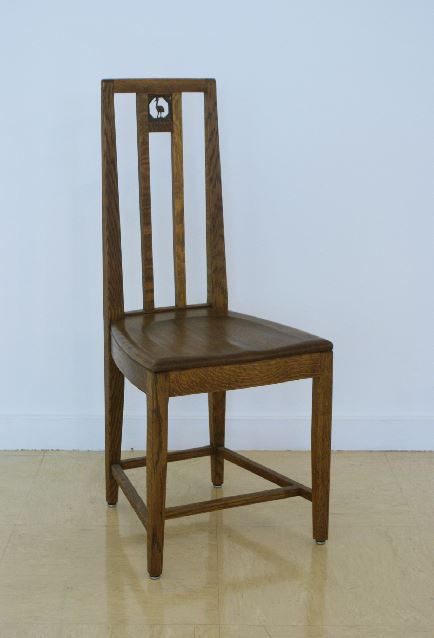
The scene feels like the opening shot in a movie: a man browses a flea market, aimlessly brushing his hands over knickknacks while he waits for something to catch his attention. A pair of chairs  jump out at him, their warm brown wood and right angles crying out for his attention.  He investigates them, noting their early 20th century construction and the curious metal design inset at the crest of the chairs.  They look familiar, he thinks, and the camera zooms out as he purchases them and takes them home.

Cranbrook School Dining Hall side chair, designed by Eliel Saarinen in 1928.

Cranbrook School Dining Hall side chair, designed by Eliel Saarinen in 1928. The chairs discovered in California are identical.

Continue reading

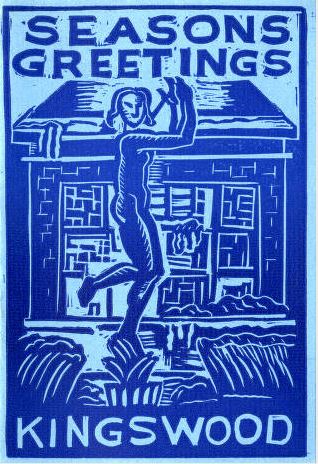
Not-a-Photo Friday: Season’s Greetings!

Kingswood Christmas Card, 1944. Cranbrook Archives.

Kingswood Christmas Card, 1944. Cranbrook Archives.

As the holiday season swings into full gear, we thought we’d highlight one of our favorite historic Cranbrook traditions: the Kingswood School Christmas card. From 1944, this card features a woodblock print of Carl Milles’s Diana sculpture, one of the hallmarks of Kingswood’s campus. The Kingswood students who made it also managed to capture the movement and dynamic geometry of Eliel Saarinen’s remarkable leaded windows at Kingswood, a not-insignificant feat.

“Neither Snow Nor Rain”: Cranbrook and the New Deal Post Office Murals

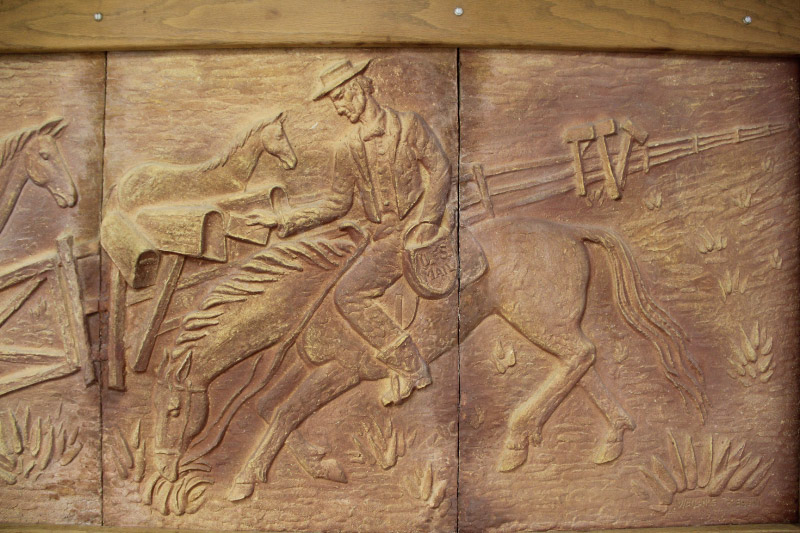
In 1940, the Columbus, Kansas post office received an imposing addition: a giant slab of terra-cotta.  Mounted on the wall, the bas-relief showed mail delivery in a rural community, the sort of neighborhood where the postman drops off the mail in a field of horses.  Crafted by Waylande Gregory as part of a New Deal art project funded first through the Public Works of Art Project (PWAP) and then the U.S. Treasury Section of Fine Arts, the post office mural (titled R.F.D.) represents not only an example of Gregory’s large scale sculptural installations but also a period of time when the American government invested heavily in the idea that public art installed in everyday environments could bolster the American economy and elevate the national discourse.

Waylande Gregory, R.F.D. (detail), Columbus, Kansas.  Charles Swaney/Living New Deal Project, University of California, Berkeley

Waylande Gregory, R.F.D. (detail), Columbus, Kansas. Charles Swaney/Living New Deal Project, University of California, Berkeley

Continue reading

Michigan Modern: The Model T has Left the Building

Sunday marked the last day of the exhibition Michigan Modern: Design That Shaped America at Cranbrook Art Museum.  This means that Monday saw the start of the museum staff’s busiest time—the five weeks in which we take down one exhibition and put up another.  Dismantling Michigan Modern is difficult; we need to say goodbye to objects we love and figure out the difficult process of getting them out the door.  And if there is one object in the entire exhibition that typifies the emotional drama of letting go as well as the physical challenge of moving giant historical artifacts, it is the Model T chassis.

Model T Chassis, The Henry Ford.  On view in Michigan Modern at Cranbrook Art Museum.  September 2013, Shell Hensleigh/Cranbrook Art Museum.

Model T Chassis, The Henry Ford. On view in Michigan Modern at Cranbrook Art Museum. September 2013, Shell Hensleigh/Cranbrook Art Museum.

Continue reading

Cartoons and Crusades: Booth, Herter, and the Making of a Tapestry

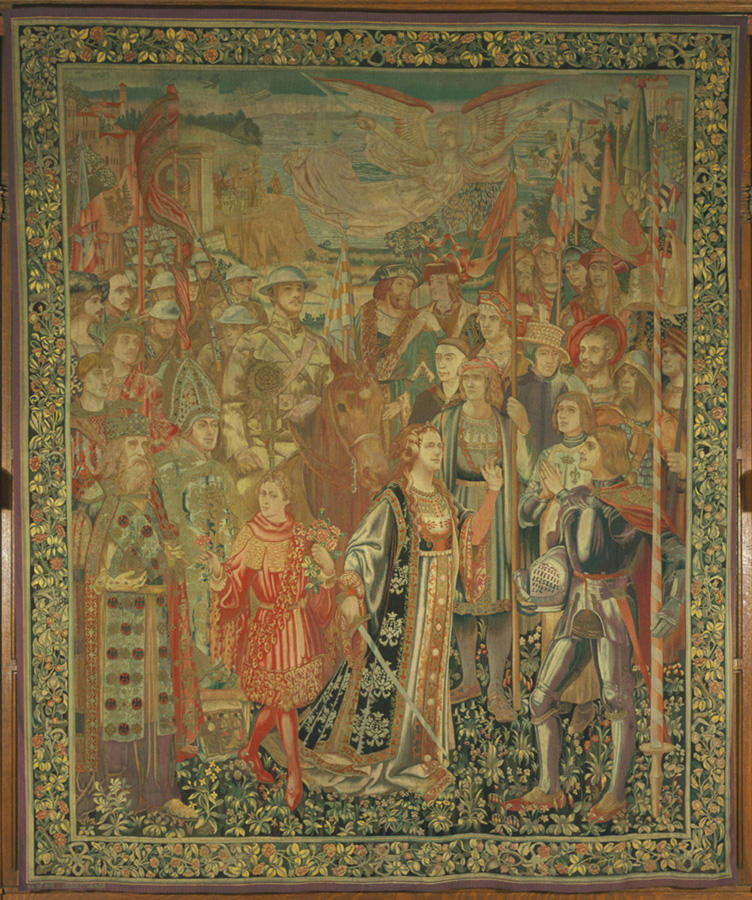
If you’ve ever visited the Cranbrook House library, you’ve probably noticed The Great Crusade, a large tapestry hanging on the south wall.  Many people associate tapestries with medieval times, when they were used to keep drafty castles warm in winter.  Woven wall hangings were also popular as decorations, especially as a sign of wealth since the extensive labor and pricy materials made tapestries more expensive to produce than paintings.  While most of the tapestries that adorn Cranbrook House are fifteenth-century Flemish, The Great Crusade is a toddler; though it utilizes a historic technique, it was designed and produced in the early twentieth century.

Herter Looms, The Great Crusade, 1920.  Cranbrook Art Museum.

Herter Looms, The Great Crusade, 1920. Cranbrook Art Museum.

Continue reading

Create a website or blog at WordPress.com