Photo Friday: Family Life at Thornlea

Henry Scripps Booth designed his home near Cranbrook just north of the Meeting House and Brookside School (another building on which he served as architect) in a thorny meadow. He called it “Thornlea” after its hardscrabble site. Built from 1925-1926, the house and its grounds hosted over sixty years of family gatherings, large and small. As is evidenced in Henry’s photograph albums, he, his wife Carolyn, and their five children celebrated holidays and entertained friends often. Equally represented are images of everyday life, such as this one:

Henry Scripps Booth can be seen soaking up the rays alongside the pool at Thornlea House in the summer of 1964. To his right are son David and grandson Miles. 

Henry Scripps Booth can be seen soaking up the rays alongside the pool at Thornlea House in the summer of 1964. To his right are son David and grandson Miles. Courtesy Cranbrook Archives, Henry Scripps Booth Papers.

With just ten official days left of summer, let’s take a moment to bask in similar memories of long hot sunny days.

See Thornlea for yourself and help us make new memories at the house on Saturday, September 21st, when you join us for A House Party at Cranbrook. Thornlea will be open for tours, live jazz at the piano, and cocktails on the patio prior to the evening’s live auction and dinner at Cranbrook House. Join us and support Cranbrook Archives and the Center for Collections and Research at our annual fundraiser, tickets and sponsorship opportunities are still available!


Deborah Rice, Head Archivist

The Day Cranbrook Went Bananas

You probably know Cranbrook Kingswood Upper School has a football team, and you might remember that the Detroit Lions held training camps here in the 1970s, but did you also know that Cranbrook Academy of Art is an undefeated intercollegiate football team?

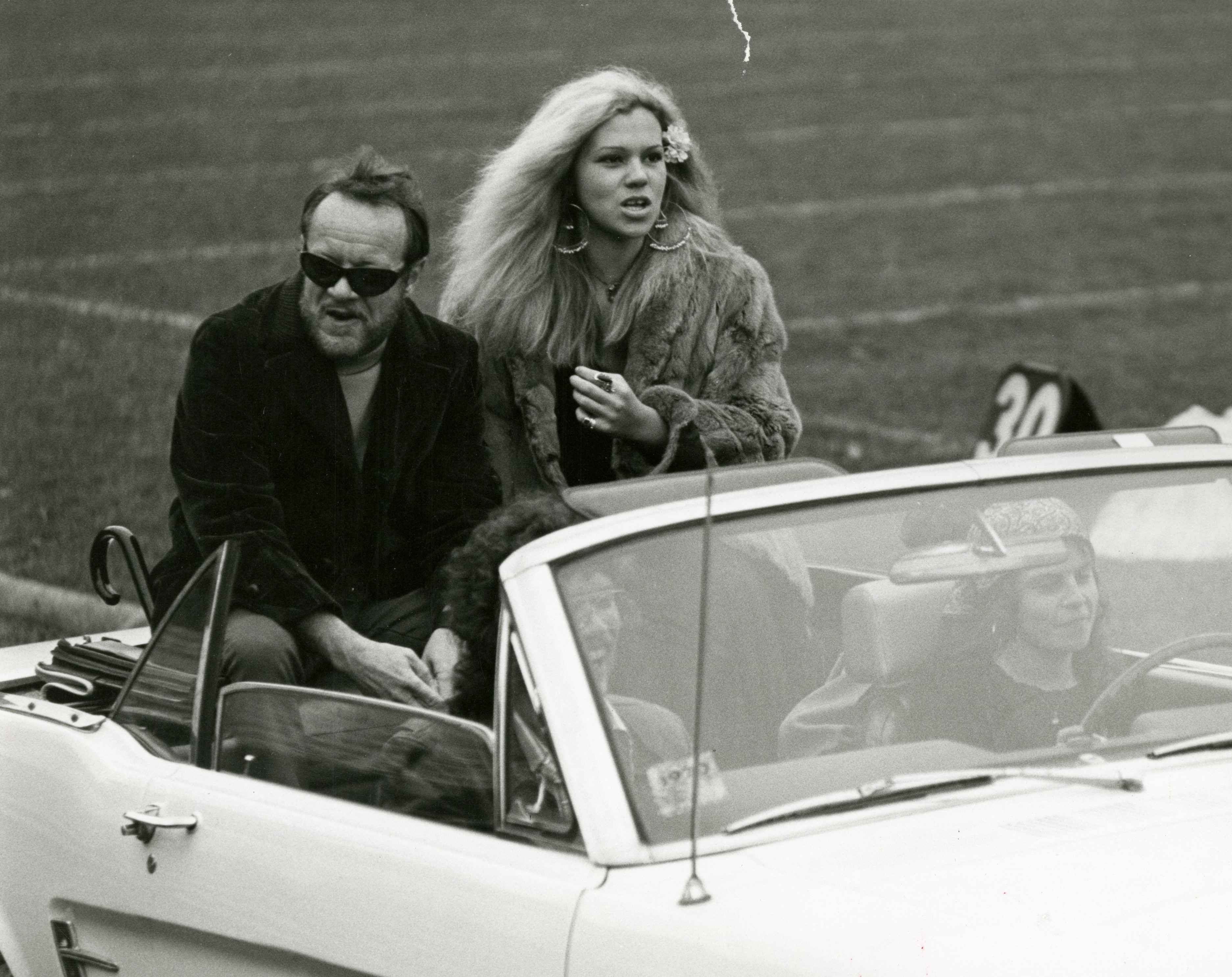
Homecoming Queen Barbara Tiso takes a convertible ride around the field with Academy President Wallace Mitchell.

Homecoming Queen Barbara Tiso takes a convertible ride around the field with Academy President Wallace Mitchell. Cranbrook Archives.

As The Cranbrook Magazine reported in the Winter 1971 issue, “Before winter zeroed in [the Academy] had a rousing football weekend similar in events, at least, to those at large universities that specialize in such things.” There was a bonfire pep rally, organized cheering sections, a Homecoming Queen, the game itself with a halftime show from both schools, and a victory banquet.

Sculpture head Michael Hall regarded the weekend as a conceptual art project, and said “as spectacle, pageant, formation and participation football is a direct parallel to art forms as disparate as the Baroque Mass and Alan Kaprow’s ‘Soapsuds Event’.”

The idea for a game began after conversations between Hall and a colleague at the School of the Art Institute of Chicago. The students at both schools accepted the challenge, and Cranbrook’s bucolic suburban setting (replete with Thompson Oval) seemed the idea location.

The game of flag football was covered by newspapers in Detroit and Chicago, with radio DJ’s in Detroit billing the game on Cranbrook School’s field as a season highlight. Cranbrook’s seventy-six male students were augmented with faculty and Nick Vettraino, groundskeeper. After an extensive (minor) injury list, only twenty players made the roster. I’ll let the Magazine coverage of the game speak for itself:

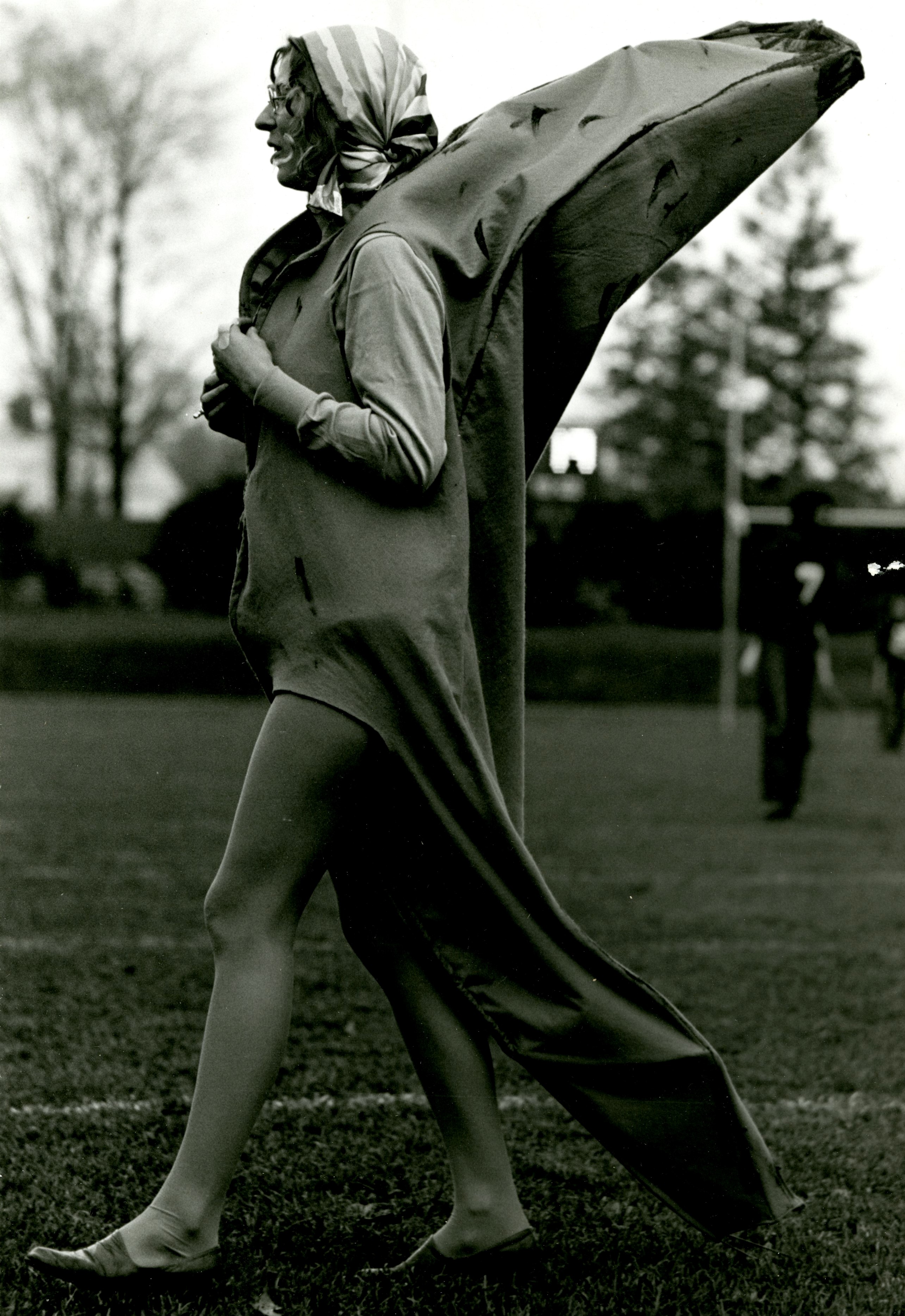
Emma Kay Szabados was a big hit as the Academy's mascot banana.

Emma Kay Szabados was a big hit as the Academy’s mascot banana. It is unclear why we were the bananas. Cranbrook Archives.

“Hog Butchers and Bananas were noticeably self-conscious when they trotted onto the field. But as the game progressed and the crowd of 300 cheered vociferously, players and spectators alike were caught up in the spirit of true athletic competition.

Cranbrook grabbed an early lead on the swift running of Nick Vettraino and the spectacular pass catching of Dick Ewen. But the Hog Butchers kept fighting back.

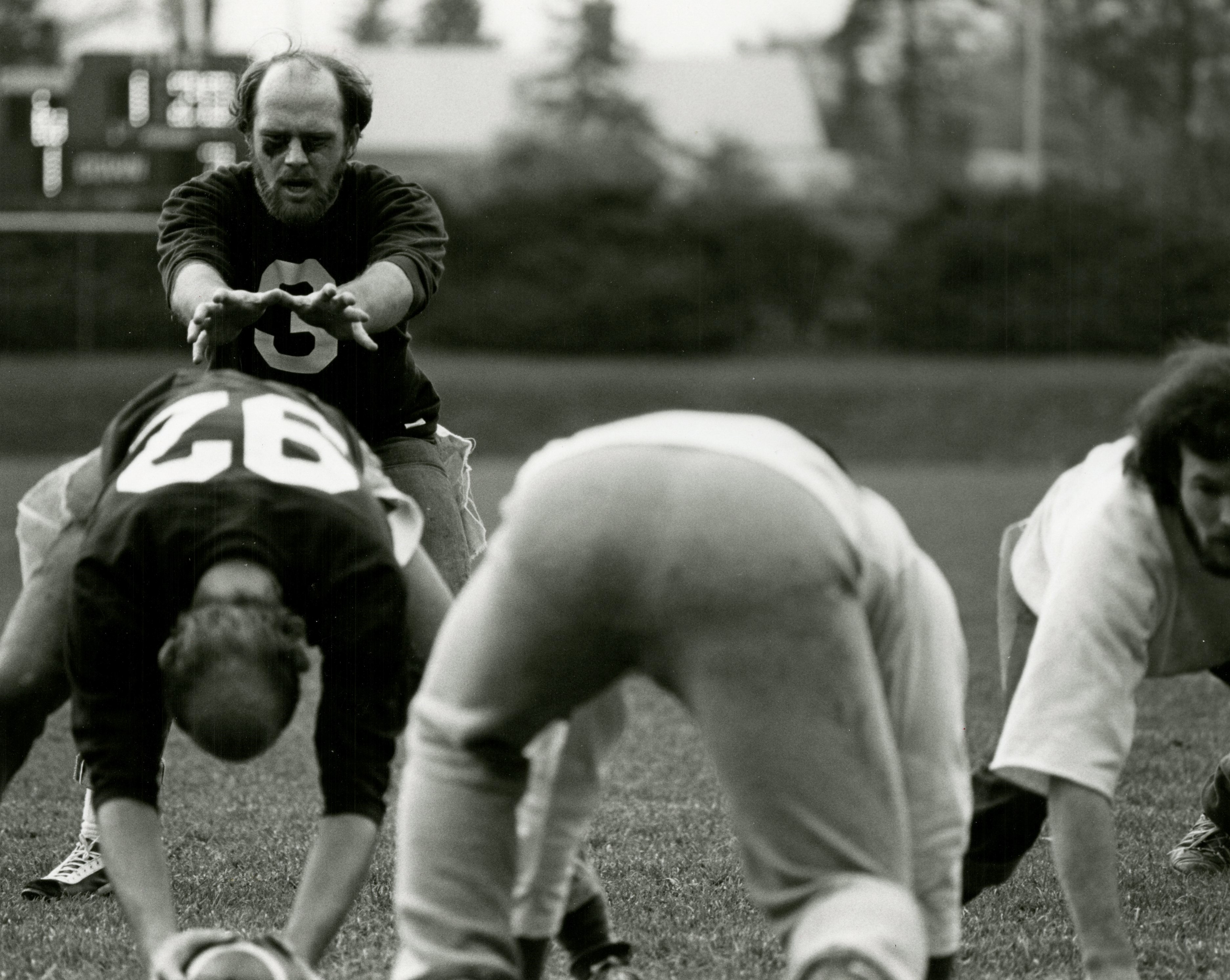
Quarterback George Sorrels used a “flexible formation from the pro set,” allegedly adapted from Detroit Lions plays by Coach Mel Baker. Cranbrook Archives.

“Cranbrook grabbed an early lead on the swift running of Nick Vettraino and the spectacular pass catching of Dick Ewen. But the Hog Butchers kept fighting back.

the pro-Bananas crowd flocked onto the field and hoisted heroes onto their shoulders.

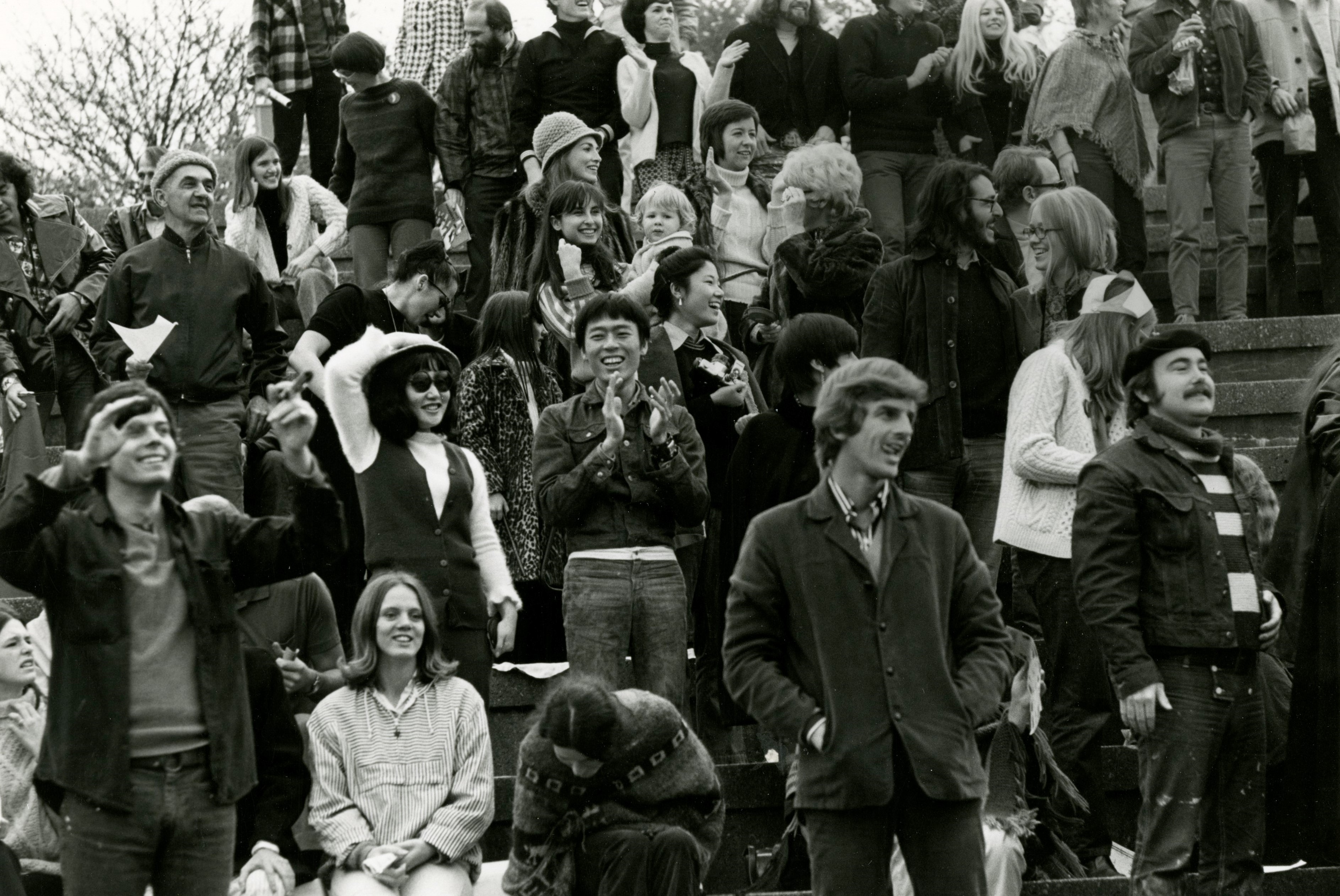
The crowd going wild as Cranbrook marches on to victory. Notice Gerhardt Knodel, Artist-in-Residence of the Fiber department (and future Director of Cranbrook Academy of Art) in the foreground. Cranbrook Archives.


“As darkness descended Cranbrook led 27-25 with time left for just one play. Chicago tried a field goal that would bring victory. The kick failed, and the pro-Bananas crowd flocked onto the field and hoisted heroes onto their shoulders.

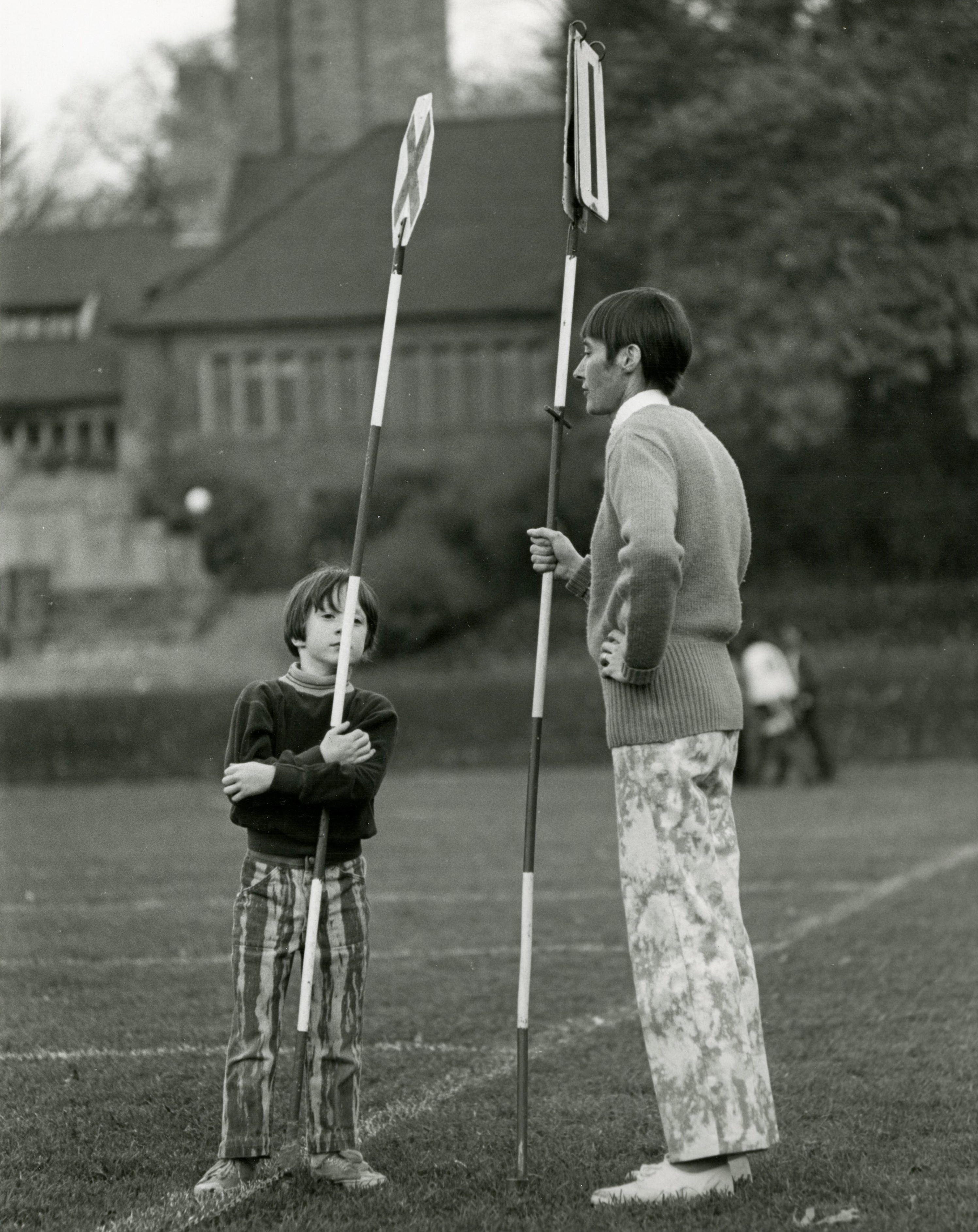
Patrick and Mary Mitchell, son and wife of Academy President Wallace Mitchell, manned the sideline markers.

Patrick and Mary Mitchell, son and wife of Academy President Wallace Mitchell, manned the sideline markers. Cranbrook Archives.

“Art or not, it was a helluva weekend. And after it was all over the campus was permeated with a camaraderie never seen before in Academy history.”

As the Upper School kicks off its season against U of D Jesuit tonight, I’d like to wish everyone a happy football season (Go Cranes!) and welcome Schools and Academy students back to campus. Perhaps we will see a rematch of the Bananas and the Hog Butchers on the gridiron soon? If so, there’s a new press box from which to call the game. I volunteer to provide color commentary!

Kevin Adkisson, Curatorial Associate

Photo Friday: Garnett’s Orange Grove

Florida, it seems, has always been a tourist destination. In 1911, Henry Wood Booth, Clara Gagnier Booth, and their granddaughter Grace Ellen Booth visited a tourist attraction known as Dr. Garnett’s Orange Grove in St. Augustine, Florida. It was the novelty of picking oranges in “rural” St. Augustine that attracted visitors. Dr. Garnett was ready to capture a memory of your visit, installing a photography studio in his orange grove. Lewis W. Blair was the onsite photographer at Garnett’s from 1910 to 1912.

From left: Grace Ellen Booth, Henry Wood Booth, Clara Gagnier Booth picking oranges at Garnett's Orange Grove in St. Augustine, Florida, 1911. Photo by Lewis W. Blair.

From left: Grace Ellen Booth, Henry Wood Booth, Clara Gagnier Booth picking oranges at Garnett’s Orange Grove in St. Augustine, Florida, 1911. Photo by Lewis W. Blair. Courtesy Cranbrook Archives.

This postcard was mailed to George and Ellen Booth March 14, 1911. The note read, “Just had lunch Mch 14. Grace, Gail, Ma and I went by boat this AM to north shore. Fran just learned that James is coming. We are all well today. Temp 68 – 83. H.W.B.”

Leslie S. Mio, Associate Registrar

The A-maize-ing Frank Lloyd Wright

Frank Lloyd Wright, architect of the Smith House, called it his “little gem.” Many of his apprentices considered it one of the best examples of Wright’s Usonian style. So it should come as no surprise that he liked to stop by and see the Smiths when he was in Detroit.

On a visit in 1953, a luncheon was organized by Mary Palmer, Elizabeth Affleck, and Sara Smith. The Smith House was to be the site of the event. Sara Smith recalled the event in her biography, Building a Dream: The Sara Smith Story by Kathryn Watterson.

“‘Mary called me and Elizabeth Affleck and we decided to have a luncheon at my house,’ Sara says. ‘I had just been to the store and I had bought a whole lot of corn on the cob and much more fish than I could possibly use in a week.'”

The luncheon also consisted of lamb and some salads, but it was Sara’s corn that was a hit. “‘[Wright] said that one of his favorite foods was corn on the cob, and he helped himself and came over here to the built-in lounge.'”

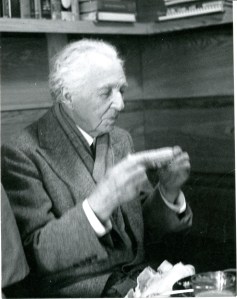
Frank Lloyd Wright lunches on corn-on-the-cob at Smith House.

Frank Lloyd Wright lunches on corn on the cob at Smith House in 1953. Courtesy Cranbrook Archives, Smith Family Papers.

The funny thing was, of all the people at the house for the luncheon, no one was sitting with Wright. “‘Frank Lloyd Wright was sitting toward the end of the lounge alone and no one came near him. No one was talking to him. Then he said, ‘Isn’t anyone going to sit with me?””

“‘So some people moved in. But they didn’t stay. They would go over and say a word or two and walk away. People just don’t seem to want to go up to a genius or a great person. I don’t know whether it’s fear of something else.'”

Sara Smith in her kitchen, August 19, 1976. Photo by Joyce Seid.

Sara Smith in her kitchen, August 19, 1976. Photo by Joyce Seid. Courtesy Cranbrook Archives, Smith Family Papers.

“‘At the time, I was in the kitchen taking care of the dishes and the thought came to me, ‘Sara, you’re doing a Mary-Martha.’ In the bible story, Martha was the one who was always staying in the kitchen mumbling and grumbling because Mary didn’t help her. Well, there I was in the kitchen pulling a Mary-Martha, and the thought came, ‘What are you doing in the kitchen? Get in there and talk to that man.’ So I did.””

Sara and Wright discussed a number of things, including shadows and how Wright used them to best position a house to take advantage of the sun’s energy. “‘It was very interesting,’ she says, ‘and I was so grateful that I had gone over to sit with him. While we were talking, I asked him, ‘Mr. Wright, what do you consider to be your greatest design you ever made?’ His replay was ‘Why, the next one.'”

Leslie S. Mio, Associate Registrar

Note: Public tours of Smith House are offered from May through November. For information about private and group tours, please contact the Center at 248.645.3307 or visit us online.

Welcome Deborah Rice, New Head Archivist!

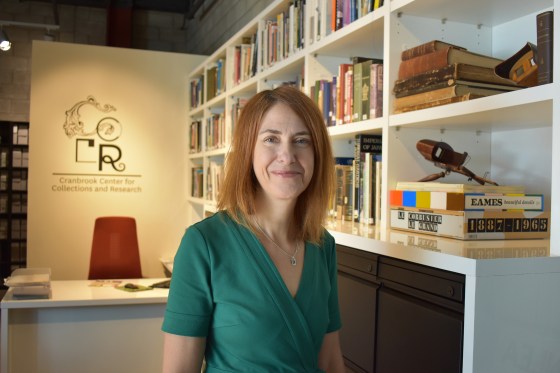
I am quite thrilled to announce that we have an outstanding new Head Archivist (and future Kitchen Sink blogger), Deborah Rice. Let me take this opportunity to introduce her to the readers of the Kitchen Sink Blog.

Deborah has over seventeen years of experience as a professional archivist. For the past fifteen years, she has been working in Detroit at Wayne State University with the Walter P. Reuther Library, Archives of Labor and Urban Affairs.  At Wayne she not only served as a Collection Archivist, Technical Services Archivist, and Audiovisual Archivist, but also the Interim Assistant Director—all of which are invaluable experience for her work here at Cranbrook. Prior to her work at Wayne, she was the Archivist for the Detroit Institute of Arts Research Library & Archives.

Deborah holds a BA in Art History from the University of Michigan and an MLIS degree (Master of Library and Information Services) and Archives Administration Certificate from Wayne State University. Equally important is what you will find to be her warm and engaging personality, and her sincere desire to engage audiences and help us make Cranbrook Archives a welcoming environment for our on-campus visitors and a digitally accessible resource for an even broader public worldwide.

In her first weeks here, Deborah has been off to a running start learning about Cranbrook history, getting a lay of the land and our extensive archival holdings, meeting with a potential donor in Lansing, and helping Cranbrook staff and our many outside researchers in our endless stream of research requests.

While there will be many opportunities to meet Deborah later this fall, her first official public event will be the Center’s gala fundraiser on Saturday, September 21: “A House Party at Cranbrook: History in the Making.”  The event, which focuses this year on the nearly 80-year journey of Cranbrook Archives, will include tours of three campus locations that have been, are, and hopefully will be important to the Archives future.  These include the current Reading Room where Deborah will be sharing with you some of the Archives’ hidden treasures.

We are grateful that Deborah made the decision to take the same journey that our founders made in 1904, traveling up Woodward Avenue from Detroit to Bloomfield Hills.  You can look forward to new blog posts from her very soon!

Greg Wittkopp, Director, Cranbrook Center for Collections and Research

High Island Mystery

In the Cranbrook Archives Digital Collections, there are images labeled “Cranbrook Institute of Science: House of David Colony. ” I always wondered what they were all about and finally investigated. It all starts with a little island four miles west of Beaver Island in Lake Michigan: High Island.

According to the Michigan Department of Natural Resources, “[High] island has an array of Michigan shoreline features and associated ecosystems that support a number of rare, threatened and endangered plant and bird species.” These include the endangered piping plover and the tern.

Robert T. Hatt (Cranbrook Institute of Science Director), Josselyn Van Tyne (University of Michigan / Cranbrook Institute of Science Trustee), and Ralph E. Morrill (University of Michigan) were on High Island on June 23, 1938, conducting bird and animal surveys. While there, they encountered the remnants of a once-thriving settlement. Hatt must have found it curious because he captured these images:

In a nutshell, High Island was home to a timber-cutting and potato farm operation run in 1912-1927 by the House of David, a religious sect based in Benton Harbor, Michigan. High Island was also home to several families of Odawa fishermen. Since 1940, the island has been uninhabited.

I checked Robert T. Hatt’s “Island life: a study of the land vertebrates of the islands of eastern Lake Michigan” (Bulletin No. 27, Cranbrook Institute of Science, 1948) which details the extensive study of the animals and birds of the island, but also remarks on the island’s history:

High Island is said to have been settled by the Mormons at the time Strang’s colony flourished on adjacent Beaver Island. More recently (1912-1928), the House of David . . . established a colony . . . here and developed the agricultural and forest resources. Most of the dwelling date from this period. At the time of our visit there were three Indian families in residence, and the men operated a commercial fishing boat. A Roman Catholic chapel was on the island and was in good condition, with the alter decorated . . .

Another interesting, and unexpected, find in Cranbrook Archives!

Leslie S. Mio, Associate Registrar

Note: The House of David has a storied history, one better written by others:

Michigan ’s Siberia: The House of David on High Island” by Clare E. Adkin Jr.

The Last Days of the House of David” by Adam Langer

The House of David by Christopher Siriano

Weaving Lesson: Saarinen’s Sermon on the Mount

While Kingswood alumnae will recognize Studio Loja Saarinen’s largest weaving at Cranbrook, The Festival of the May Queen, did you know there’s an even larger piece by the studio off campus?

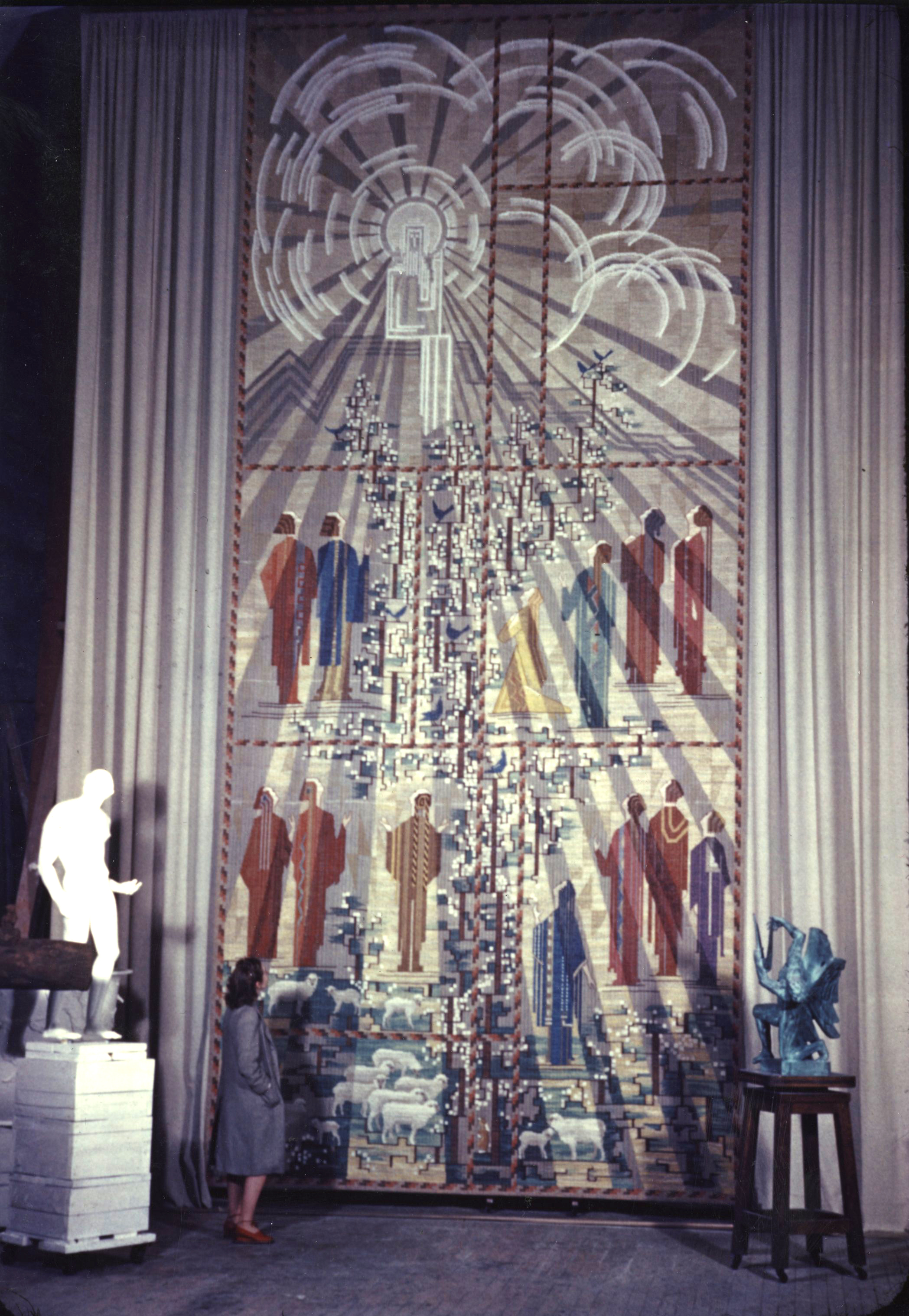
Ordered in connection with Eliel Saarinen’s commission for the Tabernacle Church of Christ in Columbus, Indiana (today the First Christian Church), the monumental Sermon on the Mount hanging was an artistic and technical triumph completed by Studio Loja Saarinen in 1941.

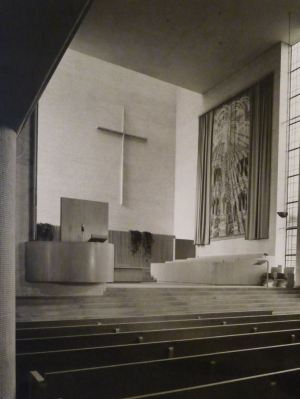
First Christian Church from Progressive Architecture

Interior view of First Christian Church, showing Studio Loja Saarinen’s The Sermon on the Mount hanging. 1942. Courtesy of Progressive Architecture.

The subject was chosen by the church, and according to their archives, the Sermon on the Mount was selected as a topic because it is “the ideal for human conduct.” The tapestry, they went on, would need to suggest “worship as well as obedience.”

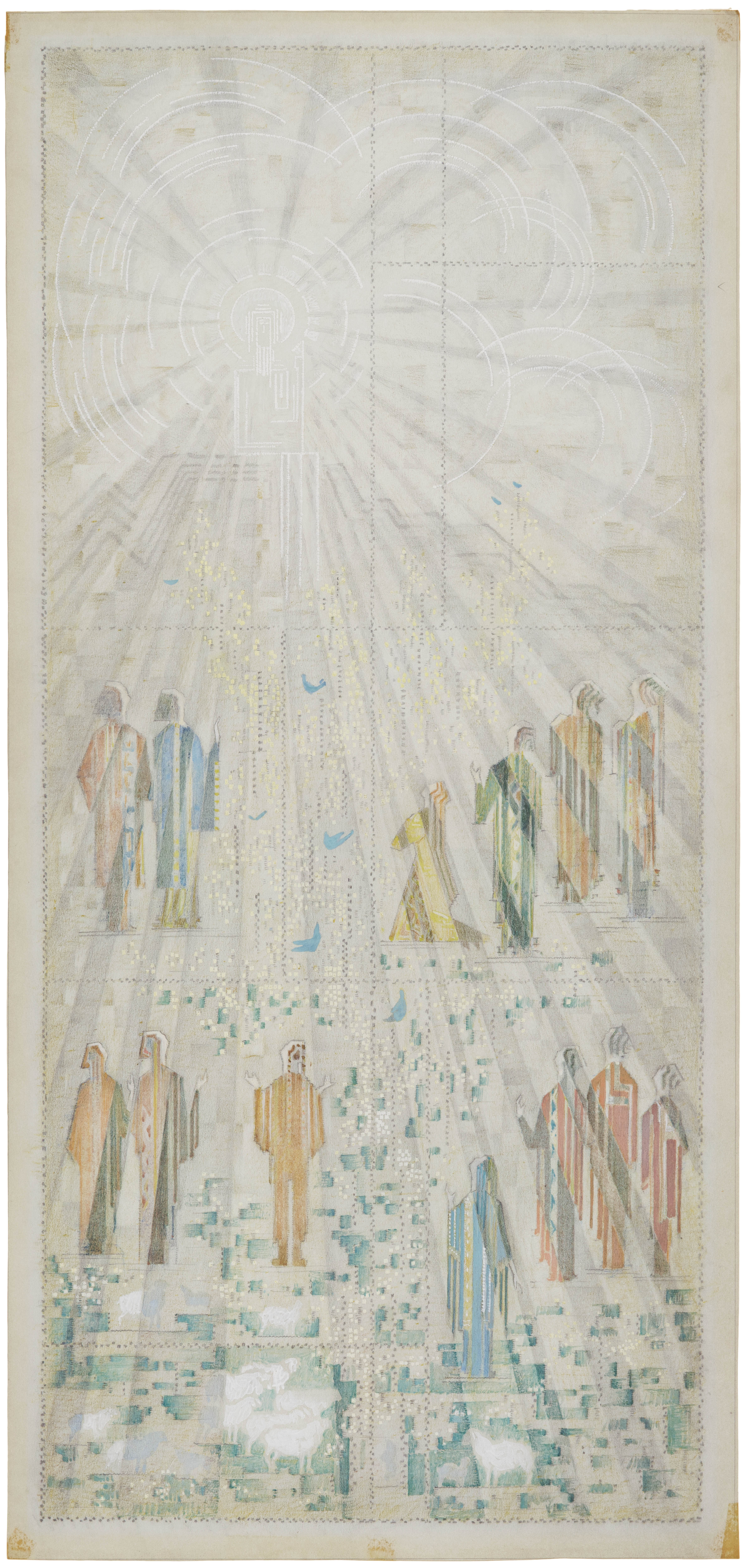
ccCAM2000.13 Sketch for the The Sermon on the Mount, 1941. Eliel Saarinen (attributed). Pencil, colored pencil, and gouache on paper. 26 7/8 x 11 7/8 inches. Courtesy of Cranbrook Art Museum. Gift of Robert Saarinen Swanson.

Eliel Saarinen likely produced the sketch of the hanging, an unsigned colored pencil and gouache drawing now in Cranbrook Art Museum. Interestingly, this is the only textile with a religious subject to come out of the Saarinen studio.

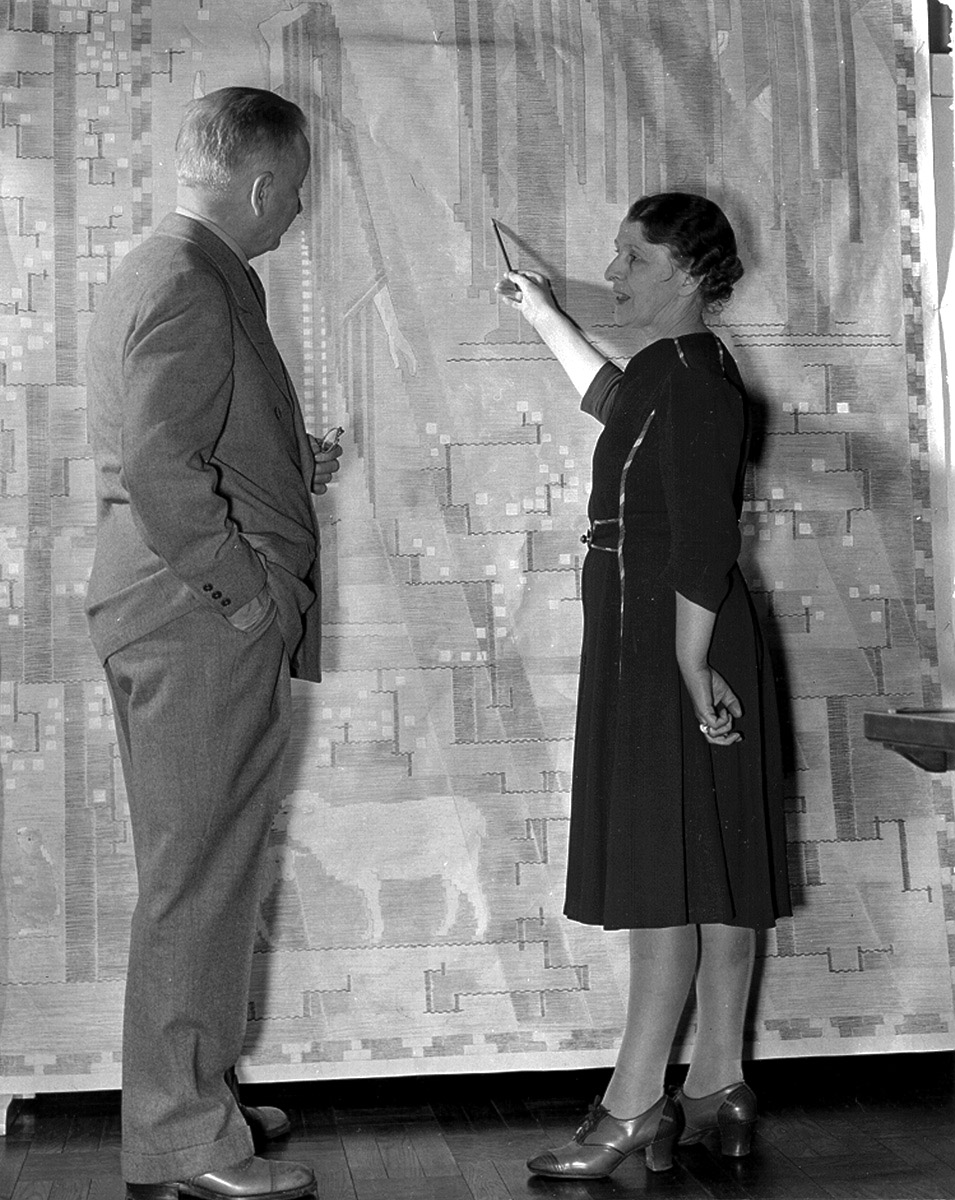
The small sketch was then enlarged onto full-size paper mock-ups, which allowed the Saarinens to review and edit the design and provided direction to the weavers at the loom.

CEC1198 Loja Saarinen showing Eliel a cartoon of their tapestry, The Sermon on the Mount, April 1941. Photo by Betty Truxell. Cranbrook Archives.

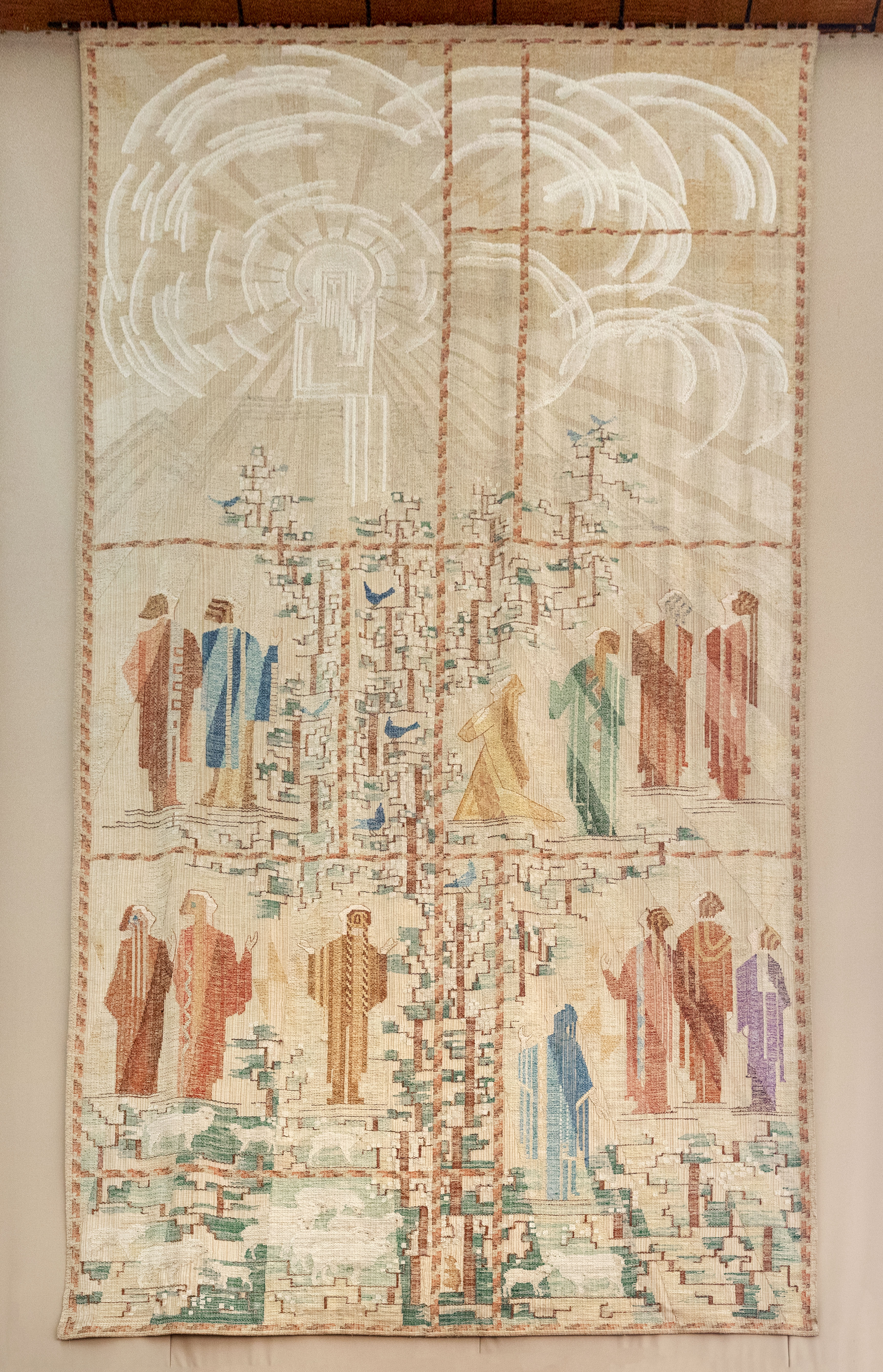
Thirteen patterned and colorfully-robed worshipers in two rows stand looking toward Christ, rendered in all white yarn on a cream background. Christ is surrounded by arcs and beams of white light that masterfully descend throughout the hanging, adding a rich depth to the composition.

Sermon On The Mount Tapestry_004The Sermon on the Mount Hanging. 1941. Loja & Eliel Saarinen (designers), Lillian Holm, Ruth Ingvarson (weavers). Wool and linen with supplemental wool weft; 12 x 27’. First Christian Church, Columbus, Indiana. Photo by Hadley Fruits.

Much like The Festival of the May Queen, the weaving is subdivided asymmetrically into rectangular shapes of varying dimensions by rhythmic bands of alternating rust, coral, and gold. These lines link into the scene’s landscape, which is made up of a series of highly stylized branches connecting green and white masses. These color-blocks sometimes read like meadows or hills; in other places, the green reads like flowering shrubs, climbing vines, or a branching tree. In the lower fields are sheep, as the tapestry moves up, birds rest within the branches.

Sermon On The Mount Tapestry large_006 Detail of The Sermon on the Mount showing the lambs, branches, and worshipers. Notice the rich variety of patterning and depth of color on the figures. Photo by Hadley Fruits.

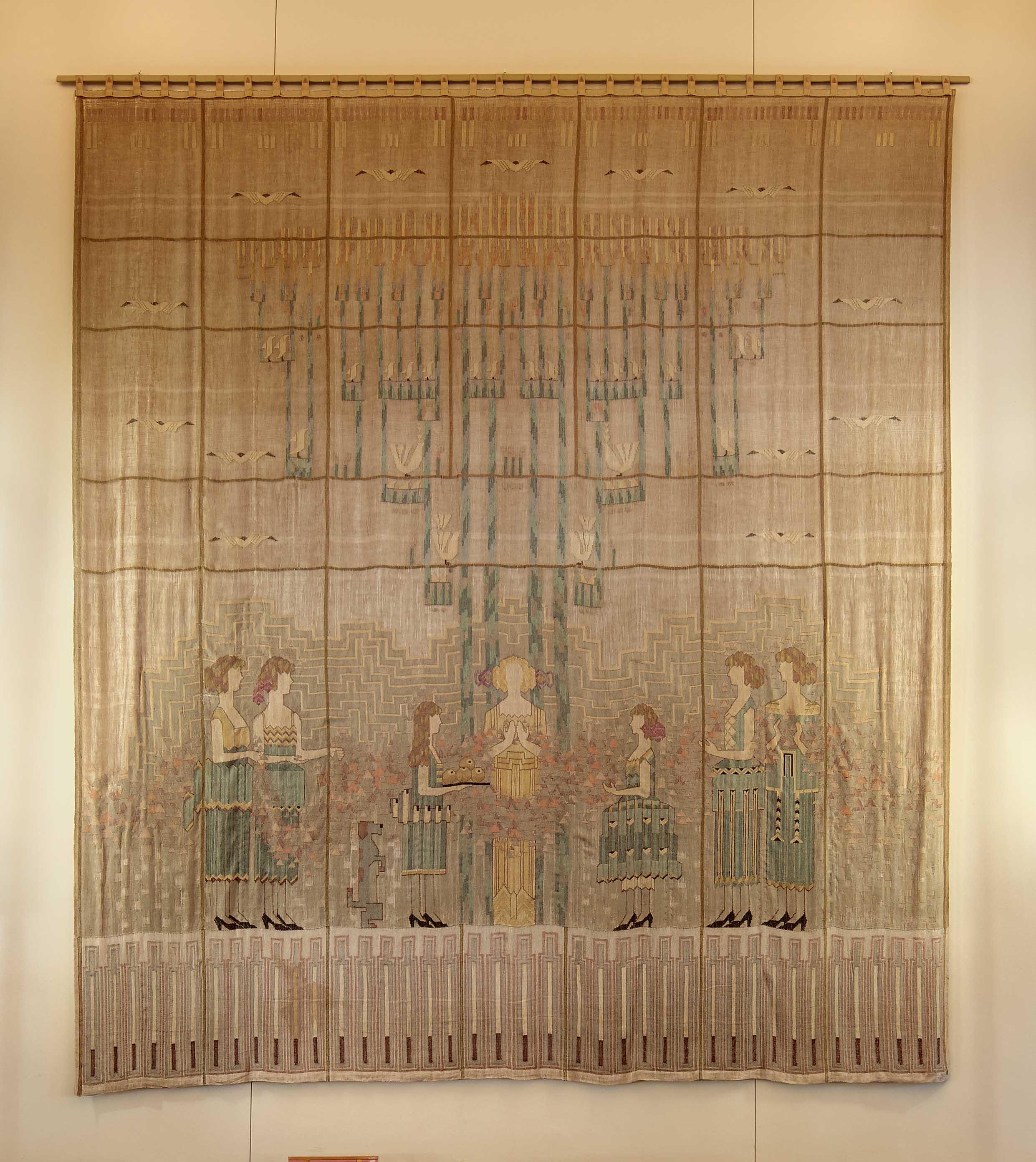
These climbing, abstract elements helps provide movement and energy to the tapestry, balancing the white radiance of the Christ-figure with the wonder of nature. The movement of the geometric green, rust, and white blocks courses between the worshipers, much like the swag of triangles (are they flowers, butterflies, or perhaps something more abstract?) that flow through the maiden’s hands in the Festival of the May Queen hanging at Kingswood.

Cranbrook_Kingswood_8-31-15-0025-dc2_TAPESTRYFestival of the May Queen hanging, 1932.
Loja & Eliel Saarinen (designers), Studio Loja Saarinen (production). Loose linen warp and weft of wool and synthetic yarns; 216 x 192.” Photo by James Haefner, Courtesy of Cranbrook Center for Collections and Research.

The Columbus tapestry was woven by two Swedish weavers who’d worked for Studio Loja Saarinen (intermittently) since 1929: Lillian Holm, who also taught at Kingswood from 1933 until 1966, and Ruth Ingvarson. After previous projects for Loja Saarinen had been met with less-than-thorough credit given to the weavers themselves, Holm and Ingvarson demanded acknowledgement from Loja Saarinen in the press materials, as well as on the weaving itself–supposedly, Holm wove her name into the tapestry in multiple places.

After Holm and Ingvarson had completed their work at the loom, Loja worked on the hanging for weeks, unrolling it section by section on a large table in her studio and accentuating the colors through the inlay of additional threads into the primary weave. This was possible because of the discontinuous weft, known as the Handarbetes Vanner (H.V.) technique after the Stockholm school where it was developed, used in all of Studio Loja Saarinen’s large hangings.

The hanging is labeled on the reverse, with an ink-signed piece of appliqued fabric label listing Eliel, Loja, Lillian, and Ruth and their roles. Everyone’s names were also included in the invitation to the hanging’s reveal at Cranbrook in the winter of 1942, where it was displayed in the forty-foot high studio of Carl Milles.

LojaSaarinen001The Sermon on the Mount on display in Carl Milles’ Cranbrook studio. February 1942. Saarinen Family Papers, Cranbrook Archives.

Cranbrook neighbor and diarist Kate Thompson Bromley described the event in February 1942:

“It had been months in the weaving…One of the biggest tapestries woven in this country, and probably as beautiful as any, for the colors are soft and rich. The large studio [Carl Milles’] was the only place with a high enough ceiling at Cranbrook to hang it. At the end of that huge room it was decorative and glowing. It must have been a great happiness to the weavers to see it in place, for as they could only judge the section on which they were working.”

Once installed in Indiana, the weaving completed the remarkable church by Eliel Saarinen. Protected by curtains meant to shield the hanging from light and smoke, The Sermon on the Mount hangs opposite a wooden organ screen, which itself reads like a tapestry. Outside, the building façade and its glass-illuminated bell tower take on the grid and rhythm of weaving. Even the meandering lines and subtle arcs of the stone architectural ornament relates back to the design of The Sermon on the Mount.

In all its beauty, The Sermon on the Mount served as a high-point on which Loja Saarinen was forced to close her studio. As she wrote to George Booth, she was being “forced into” retirement because of a number of pressures: declining commissions, her husband’s exit from the Academy’s presidency, World War II, and a shift in focus for the Academy Weaving Department away from pictorial handweaving. Studio Loja Saarinen closed in 1942.

You can learn more about Studio Loja Saarinen, her weavers, and her products; see where the works were woven on campus; and visit Kingswood’s weaving studio and dining hall on my upcoming Behind-the-Scenes: Studio Loja Saarinen, 1928-1942 tours August 22 and 29.  You can also experience the exhibition on any of our regular Saarinen House tours. If you find yourself in Indiana, see the Sermon on the Mount any Sunday at First Christian Church or through tours with Visit Columbus.

-Kevin Adkisson, Curatorial Associate

Special thanks to Cranbrook Academy of Art graduate Hadley Fruits (Photography, 1990) for the contemporary color photographs of The Sermon on the Mount and First Christian Church.

Finns and Hungarians, Part I

Mulling over the question of the Finnish-Hungarian language connection brought me somewhat circuitously to the Finnish and Hungarian people connection at Cranbrook, namely Géza Maróti and Zoltan Sepeshy. Early in Eliel Saarinen’s tenure, George Booth, interested in engaging a sculptor, took up Saarinen’s suggestion of Géza Maróti, already well known with works in the USA as well as Mexico and Finland. Maróti in turn suggested Zoltan Sepeshy because in his opinion Hungarians were better trained (in practically everything) than others.

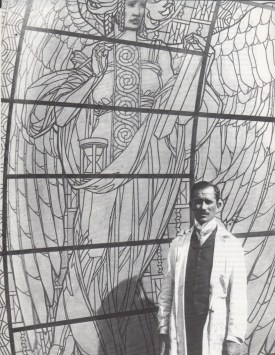
Geza Maroti with glass ceiling of the mexican national theater 1909 Hungarian National Gallery archives

Maróti with his design for the glass Dome ceiling of the Mexican National Theater, 1909. Courtesy of the Hungarian National Gallery Archives.

Sepeshy doesn’t make it to Cranbrook until 1931, so we’ll begin with Maróti. Two years younger than Saarinen and knowing him since early days at the Saarinen villa/studio at Hvitträsk in Finland, Géza Maróti was a natural suggestion for a sculptor to work at Cranbrook. The Saarinens and Marótis were good friends, with Géza writing to Loja Saarinen in German in beautiful, clear handwriting. He sent letters and rhymes to little boy Eero, too. All Saarinen had to do was utter the magic words “arts and crafts” and Booth was sold. George Booth does comment in February 1927 that he has no personal knowledge of Maróti, taking the Saarinens’ recommendation as enough and adding somewhat opaquely “but of course [I] realized their point of view was partly foreign.”

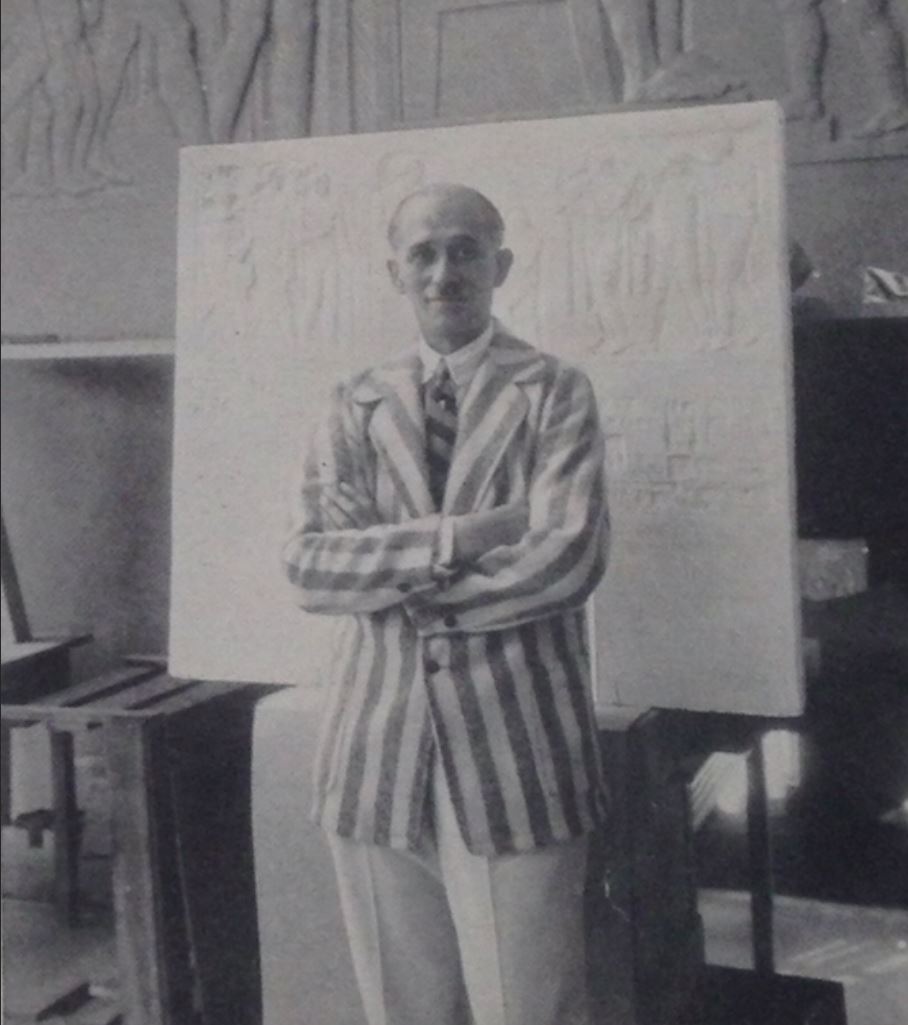
Geza Maroti in his Cranbrook Studio Cranbrook Archives

Maróti with his design for the Cranbrook School for Boys library overmantel behind him in his studio, 1927. Courtesy Cranbrook Archives.

Maróti was nevertheless a perfect fit for Cranbrook: he was another polymath like the Saarinens as architect, archaeologist, painter, designer, as well as sculptor. The Detroit News of March 1927 reported Professor Maróti’s conviction that “because architecture is the fundamental art the work of the sculptor and the painter is most valuable when it is architecturally conceived.” Professor Saarinen adds in the same article that it is one thing to model a figure, but “quite another thing to see that figure in relation to a building and to express that decoration architecturally rather than pictorially.” This in a nutshell is Maróti’s claim to fame.

At Cranbrook from early 1927 until early 1929, Maróti sculpts fireplaces, archways, and doors for Cranbrook School for Boys offering what the Bloomfield Hills Tatler of 1927 calls an “unforgettable visual education.” Most notable are the Galileo door at the base of the Cranbrook quadrangle tower, and the library doors.

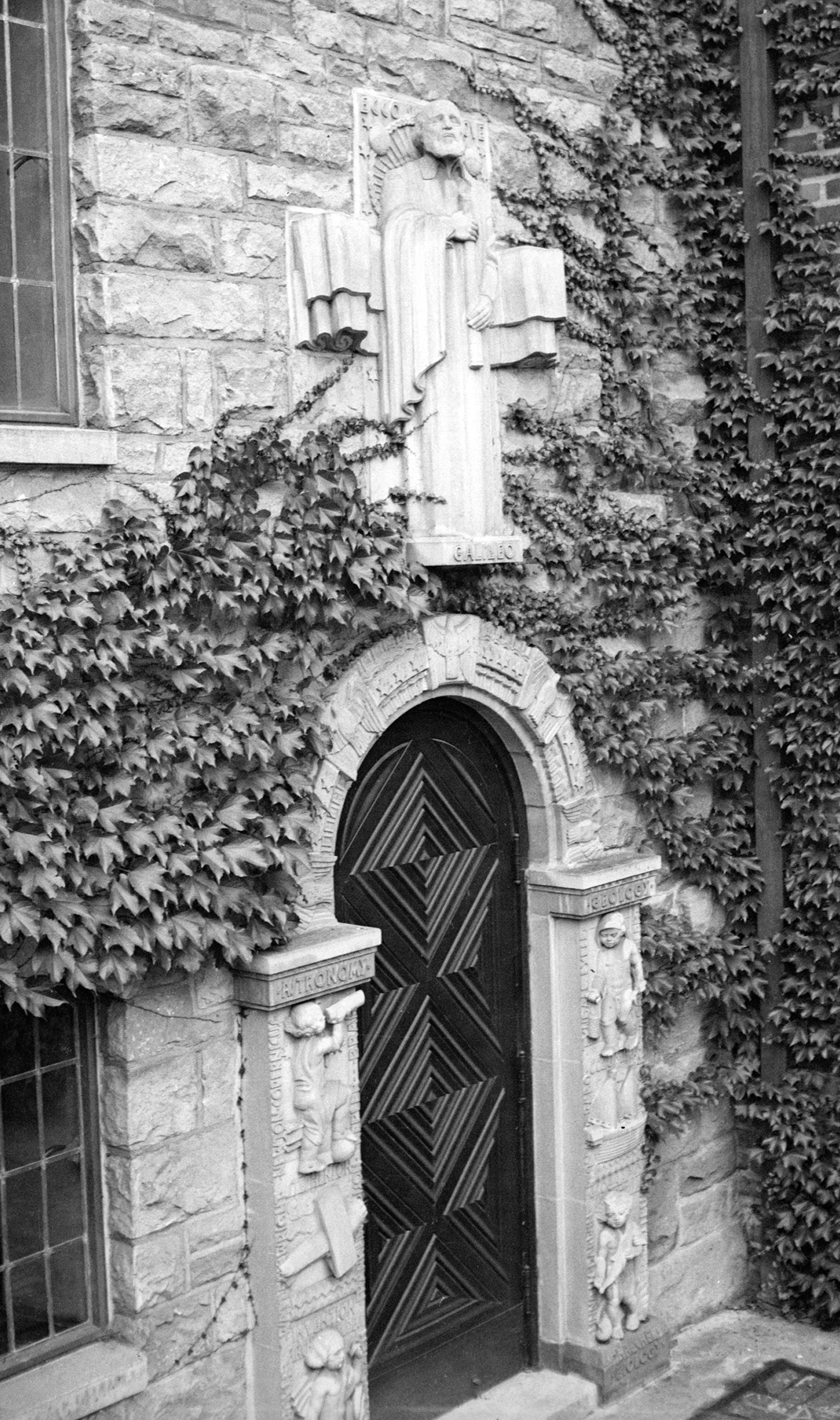
The Galileo door really is an education. The tower was supposed to house a telescope and what better icon to choose than the “father of modern physics” born, incidentally, in the same year as Shakespeare. Maróti’s Galileo is masterly, floating above the door, clutching a telescope and gazing firmly aloft. Behind his head, in case viewers don’t remember the controversy, are the words “Ecco Muove” or “Here: it moves.”

His doorway is surrounded by learned cherubs offering tribute to other scientific pioneers: Linnaeus, Pasteur, Darwin, Curie, Ohm, Newton, Copernicus amongst others.

3732

View of the “Galileo” door by Géza Maróti at Cranbrook School’s main academic building, now known as Hoey Hall. October 1936. Richard G. Askew, photographer. Copyright Cranbrook Archives.

The Library doors take another tack altogether with the fruits of learning unexpectedly represented by stylized gifts of the good Michigan earth such as squash, beans, cherries, pears, corn, and wheat carved in rich, burnished oak.

RH159-1

“Door of Knowledge” by Géza Maróti at entrance of Cranbrook School for Boys Library. c. 1985. Richard Hirneisen, photographer. Copyright Richard Hirneisen/Cranbrook Archives.

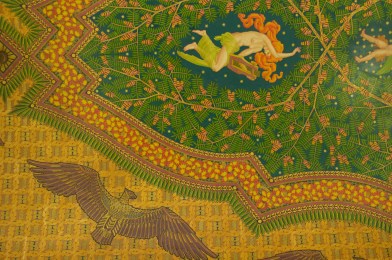
Maróti is also busy fitting in his work elsewhere with, among others, Albert Kahn’s Fisher building in Detroit. There you can see the Maróti sculpted allegorical renderings of peace, flight, and other industrial arts as well as his signature eagles, mosaics, and his painted frescoes. A riot of color.

Fisher Building Ceiling by Geza Maroti Jack P. Johnson Copyright 2010

Fisher Building lobby ceiling by Géza Maróti. Jack P. Johnson, photographer. Copyright Johnson 2010, Courtesy of Detroit Architecture Book blog.

Unfortunately for Cranbrook, Géza and Léopoldine Maróti are not their happiest tucked away in remote Bloomfield Hills, Michigan, feeling cut off and not “agile enough to remain even partially in contact with music, art and life.” This does not say much for those who stayed, but the Marótis decide they have to leave.

After some time in Chicago and New York they are back in Budapest by 1930, just in time for WWII which their family survives. More sculpture follows, but Moróti’s abiding preoccupation until his death in 1941 is a cultural history of Atlantis which remains unpublished.

The burning question of Finnish and Hungarian? Many years ago, 5000 years ago to be approximate, Finnish or Finnic and Hungarian or Ugric, both at that point Uralic languages, had a common ancestor, which linguists call proto-Uralic. After that point, they diverge, as is typical of language groups. So the simple answer is they are not much alike at all, are not mutually comprehensible.  Finnish has a few Swedish and German words but doesn’t resemble any other language. Finnish and Hungarian are as alike as English and Farsi.­­­­­­­­­­­ Luckily for Géza and his lovely wife Poldi, they spoke German.

–Lynette Mayman, Collections Interpreter

Editor’s Note: If you would like to read more about Maróti’s work at Cranbrook, check out a new essay by retired Cranbrook Schools faculty member Dr. Jeffrey Welch with photography by Academy alum P.D. Rearick. Dr. Welch’s essay is titled “The Gift of Knowledge: A Witty History Puzzle for Growing Youth,” and concerns Maróti’s fascinating, monumental fireplace overmantel in the historic Cranbrook School for Boys Library.

A Sculpture So Nice They Named it Twice

One of my many duties here at the Center for Collections and Research is to maintain the sculptures on the campus. This can mean finding conservators to repair works, contractors to clean them, or, in some cases, clean them myself. Recently, I was working on a sculpture in the gardens at Cranbrook House. I had seen the sculpture before but wondered about its backstory. Turns out it was a tale of two names.

The sculpture is Mario Korbel’s statue Atalanta, the Greek goddess of the hunt, travel, and adventure. It was commissioned by George Gough Booth in 1927 for one of the gardens at Cranbrook House, part of a series of work Korbel completed for the Booth house and gardens — including Dawn and Harmony in the gardens and Andante and Nocturne in the house.

Letter from Mario Korbel to George G. Booth, referencing both his works Atalanta and Andante. George Gough Booth Papers, Cranbrook Archives.

July 12, 1927 letter from Mario Korbel to George G. Booth, referencing both his works Atalanta and Andante. George Gough Booth Papers, Cranbrook Archives.

Booth, admiring the beauty of the clear, white marble of Atalanta, transferred the work into the collection of the Art Museum. It was part of the original art museum exhibition in 1930.

CISB509L.jpg

Atalanta (left) in the first Art Museum exhibition in 1930. Courtesy Cranbrook Archives.

Later, Booth wrote: “We have finally concluded that the figure will make a very important and striking center art element in connection with the new School for Girls at Cranbrook.” When the Kingswood dormitory was built, the sculpture was transferred to Kingswood and installed on the terrace.

Atalanta.jpg

Atalanta (right) adorns the terrace at the Kingswood School for Girls dormitory in this undated photo. Courtesy Cranbrook Archives.

In 1969, the sculpture was vandalized and smashed into many pieces (no one was ever implicated in the crime–or at least, their name isn’t in my file!). Those pieces were put back together, but when Atalanta was finally repaired, she was not as pristine. Henry Scripps Booth decided to rename her Ecolo. He also wrote a verse to explain the new name:

Ecolo, Goddess of Earth 

Who is this sweet maid who stoops protectively to save the earth from man’s pernicious tread? 

It is the blithe spirit of Ecology by whom all life and natural things are fed.

CEC472 (2).jpg

Ecolo in her new home in the Herb Garden at Cranbrook House.

Ecolo, or the sculpture-formerly-known-as-Atalanta, now greets visitors in the Herb Garden at Cranbrook House.

– Leslie S. Mio, Associate Registrar

Milles: “Please do not knock”

A research request put me in search of Carl Milles this week. In the process of research, I noticed again a short letter written by Milles to Richard Raseman, Executive Secretary and Vice President of the Cranbrook Academy of Art from 1932-1943, which demonstrates a wonderful sense of humor:

Milles letter 1981-05 24-23

Letter from Carl Milles to Richard Rasemen, September 12, 1938: “Richard, Please Print in your shop following, [Please do not enter without knocking/please do not knock]. Big letter, thick bristol paper. I need 6 such prints. Carl.” Cranbrook Foundation Records, Copyright Cranbrook Archives.

While Cranbrook Archives does not have a discrete collection of Milles’ papers, there are many letters written by him to his friends and colleagues within several collections. For those minds that become curious to know more about Milles (who served as Head of the Department of Sculpture from 1931 to 1951), we have a subject guide to help in finding his handwritten treasures hiding within our collections. Milles’ letters show a great sensitivity to the recipient of his writing and his descriptions of the ups and downs of circumstance reveal a man of great warmth and fortitude.

COM3286-1

View of various sculptures in side Carl Milles’ studio at Cranbrook Academy of Art, c. 1940. Harvey Croze, photographer. Copyright Cranbrook Archives.

I am often inclined to read the letters of an artist or historical figure alongside a study of their work in the world–what a person writes and how they write it provides a wonderful glimpse into a person, and enhances an understanding of the context of their work and deeds.

Cranbrook has many offerings for things to do this summer–through the Center for Collections and Research, Cranbrook House and Gardens, Cranbrook Art Museum, and the Institute of Science. There is something for everyone, and while you are here you can use this guide to walk and view the Milles sculptures on the Academy’s campus.

– Laura MacNewman, Associate Archivist

Create a website or blog at WordPress.com