In a grassy meadow (once called “Frisbee Valley”) at the bottom of Suicide Hill is a line of boulders – a sculpture colloquially known as Snake Rock. Actually titled “Lucifer Landing (Real Snake in Imaginary Garden)” or Lucifer Landing for short, the sculpture was designed by American artist Richard Nonas using thirty-nine boulders which zigzag in a serpentine line. One could describe the boulder with the sharp-angled end as resembling the head of a snake, while the rest of the boulders (relatively the same height as each other) taper to the tail section, which appear like rattles. While some think the boulders, which weigh a collective seventy tons!, were found on Cranbrook’s grounds, they were actually acquired in Clarkston, Michigan and represent a cross-section of the type of rocks deposited by the glaciers in Oakland County.
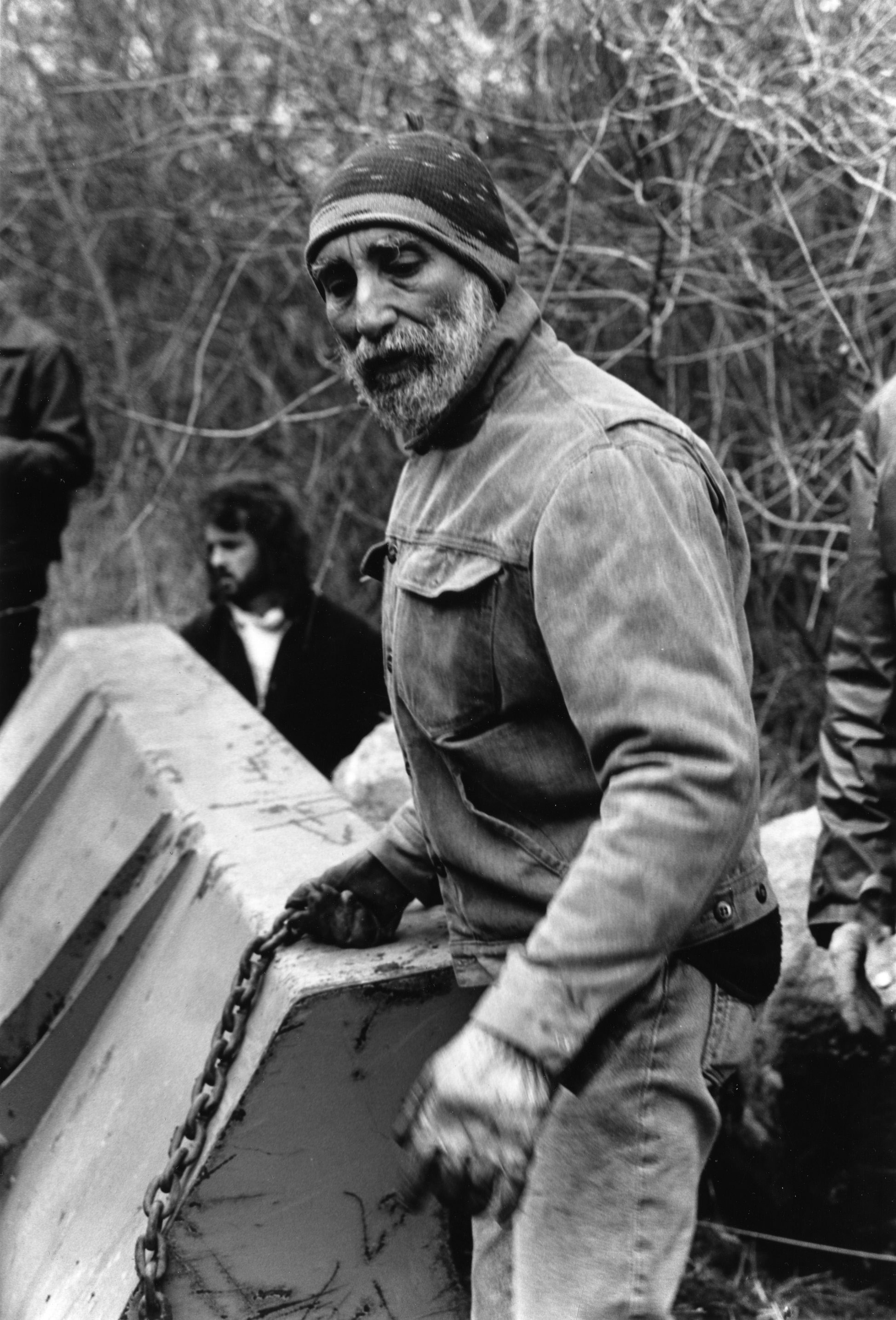
Richard Nonas, 1989. Courtesy Cranbrook Archives, Jane Knirr photographer.
Nonas was invited by Cranbrook Academy of Art’s Head of Sculpture, Michael Hall, to join other major artists like Alice Aycock, Mark DiSuvero, Dennis Oppenheim, and Robert Stackhouse in exhibiting temporary sculpture installations across campus. Funded by the Academy of Art Women’s Committee and Gilbert and Lila Silverman, Lucifer Landing was installed in 1989 – the first sculpture to be placed on campus since the 1970s. Twenty Academy of Art students helped put the boulders in place.
Trained as an archaeologist, Nonas was known for sitting abstract works in wood, stone, or metal directly on the ground. He said “it amused me to place something at Cranbrook that [Eliel] Saarinen might have seen as a child in Finland. There are prehistoric stone monuments near his boyhood home.” While working on the sculpture, Nonas developed a great respect for Cranbrook’s sense of place, and wanted to construct a small form that changed as you walked by and around it – a “sculpture that activates its space, that confuses you a little, keeps you involved in it as you walk past it.” A form that looked almost natural but really couldn’t be.
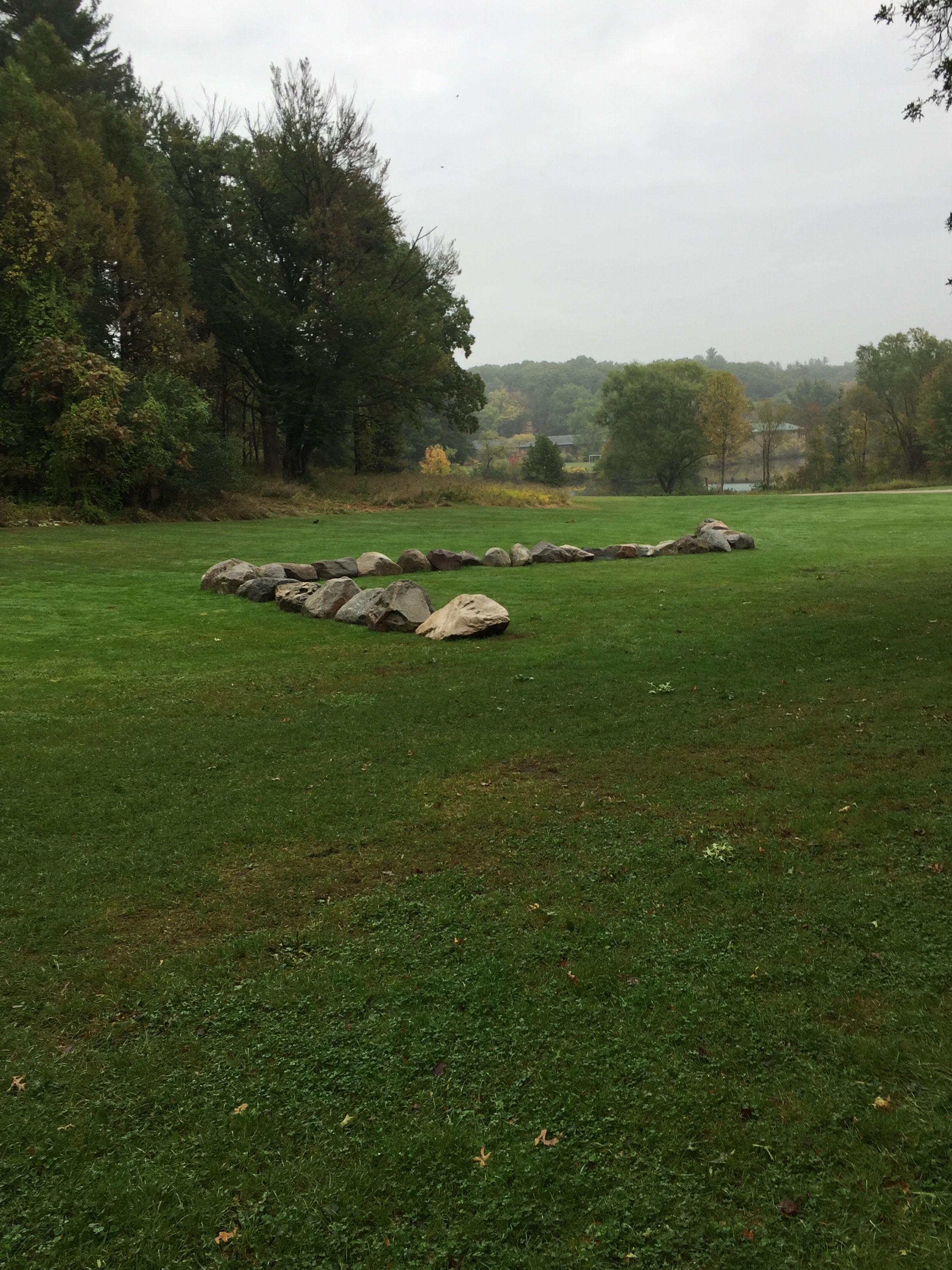
Lucifer Landing, October 2017. Photograph by the author.
The sculpture’s title suggests the relationship between man and not-man, man and nature, and nature as it was before man. Nonas described how Lucifer, the rebel angel who was expelled from heaven, came to Cranbrook and left an intrusive mark in the Cranbrook landscape, creating an “itch he [Saarinen] couldn’t scratch.”
NOTE: For an excellent article “A Mark of Place: Lucifer Landing Past, Present and Future” on the mistaken dismantling of the sculpture in February 1999, see The Crane-Clarion’s June 1999 issue. Cranbrook Kingswood senior and associate editor Erica Friedman discussed the Cranbrook landscape and how we must face the “problem of destruction passing for progress” – a topic many Americans, including those at Cranbrook, continue to face today.
– Leslie S. Edwards, Head Archivist
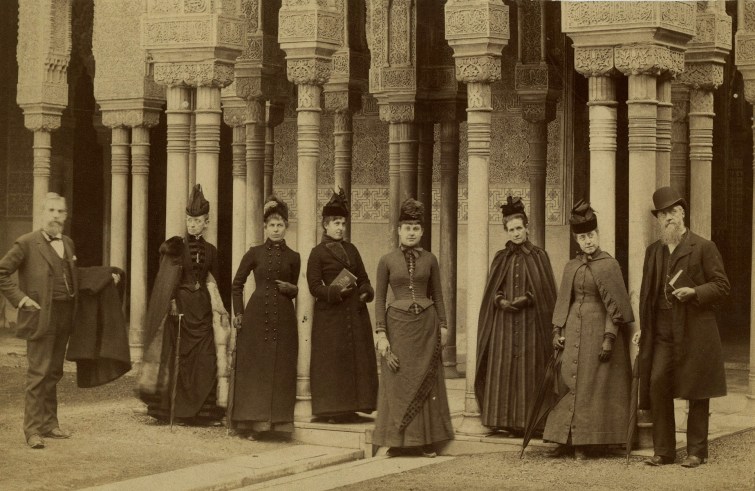
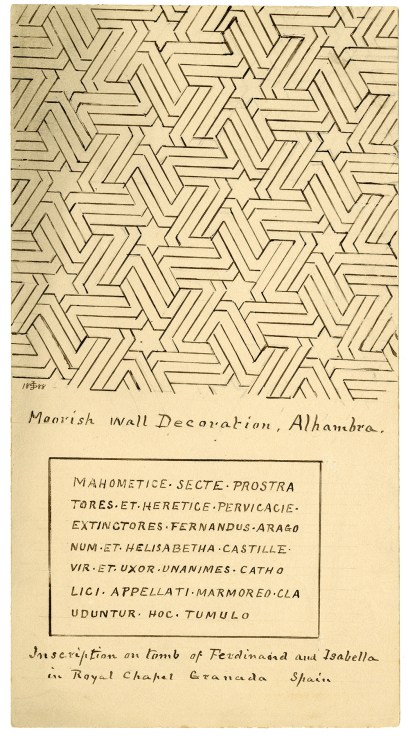





 George G. Booth created the Still Room as a part of his office suites in 1918. It was as a place to take a noonday rest. In old English country houses, the Still Room was a place where medicines were prepared, herbs and flowers were infused in water or oils, and where home-brewed beers and wines were made. As Henry Scripps Booth recalled in another letter, “We started applying the term to the small room at the south end of the wing although Mr. Booth had no intention of making whiskey, beer or wine, but on using it as a quiet place for reading, conversation and taking undisturbed naps.”


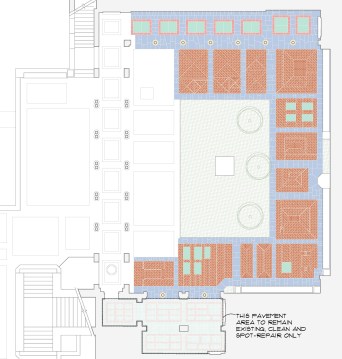
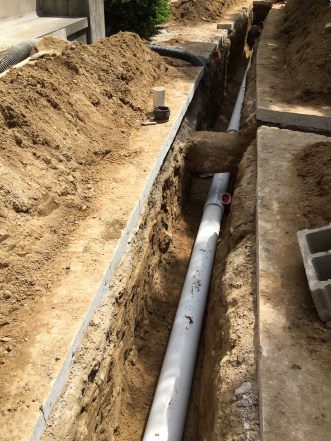
 Once the demolition was complete, the contractor replaced the underground storm drain, which was originally clay piping, with new PVC piping. Clay piping is brittle and therefore susceptible to intruding tree roots which lead to leaks and clogs. The PVC piping will last much longer and minimize maintenance work. Once the PVC piping was installed, soil was filled in and compacted and the trenches were capped with concrete.
  The next activity was demolishing the concrete bridge. All the existing limestone newel posts and railings were in good condition, so they were set aside to be reinstalled. The masonry wall, below the bridge, was also disassembled because many of the bricks were extremely fragile and showed
  After a summer of careful work, the masonry wall and arches have been rebuilt to their original beauty.
 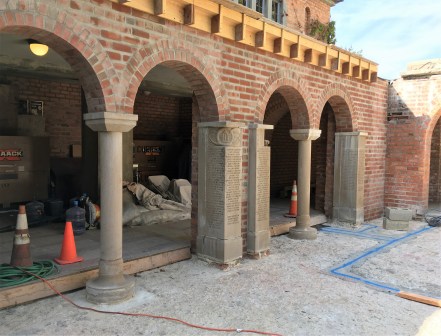 The concrete bridge has been layered with waterproofing, reinforcing, and heating pipes, and is ready to be poured back with concrete. The flat paving areas are being prepared for their final layer of brick and stone.
  Look forward to a final update here on the Blog once the project is complete! As always, many thanks to the contractors who are working hard on this beautiful restoration.
 Cranbrook Kitchen Sink