Dispatch for the Archives: the Joys of Processing

Although we live in an age of technology, databases, and the digital representation of collections, one of the most interesting and rewarding jobs for an archivist (at least this one!) is still the processing of a collection.  What does this encompass? It is the way in which an archivist takes the paper records of an individual, group, or institution and sifts through them, weeding out duplicates, sorting, organizing, and  rehousing in acid-free folders and boxes, all to make it accessible for you, the user!.  To some this may seem a tedious task (and it certainly can be depending on the nature of the collection) but the rewards are usually worth it.  Finding that one gem that tells a new story, or that group of documents that sheds new light on an old story—this is the stuff archivists dream of!

I am currently processing the Swanson Associates Records that document the partnership between architect J. Robert F. Swanson and interior designer and textile artist Pipsan Saarinen Swanson.  Right now I am looking at the project files that relate to the firm’s architectural commissions from 1926 to 1977.  So, as a sneak preview (the collection is not yet open for research), here a couple of interesting discoveries:

 

Continue reading

“In the Twenty-Ninth Century Mode”: Crandemonium Returns

The theme of the first Crandemonium Ball was the Court of Crandemonium. It prompted this newspaper article declaring that the party was in the "twenty ninth century mode." 1934, Cranbrook Archives.

The theme of the first Crandemonium Ball was the Court of Crandemonium. It prompted this newspaper article declaring that the party was in the “twenty ninth century mode.” 1934, Cranbrook Archives.

Since we already upset tradition by posting a “Photo Thursday,” we thought we’d skip today’s Photo Friday and instead focus on a subject near and dear to our hearts—Crandemonium!  A costume ball thrown at various intervals during the Saarinens’ tenure at the Cranbrook Academy of Art, Crandemonium was a no-holds-barred party.  From the painted backdrops to the fantastical mythology, Crandemonium had it all.  Academy of Art students were essential to the party, competing to design the interiors and often appearing in the most outlandish costumes of all. This year the Museum Committee has resurrected the beloved Crandemonium party for their yearly fundraiser, happening this Saturday at the Cranbrook Art Museum.  Just in time, enjoy the Crandemonium ephemera from the past!

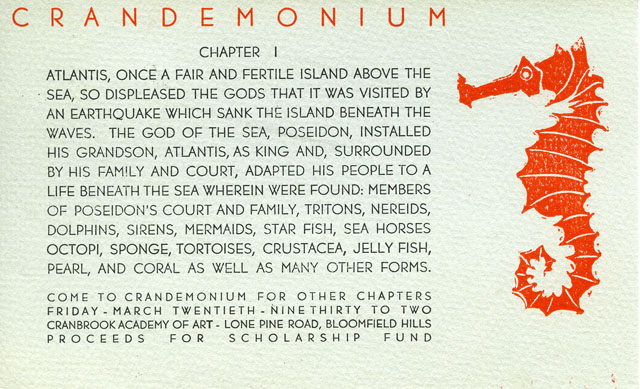
An intriguing invitation to 1936's Atlantis-themed Crandemonium, this card featured the first part of the story of Atlantis. The invitee would presumably learn the remaining chapters upon attending the party. 1936, Cranbrook Archives.

An intriguing invitation to 1936’s Atlantis-themed Crandemonium, this card featured the first part of the story of Atlantis. The invitee would presumably learn the remaining chapters upon attending the party. 1936, Cranbrook Archives.

The 1936 Atlantis Crandemonium theme led to some amazing promotional material. 1936, Cranbrook Archives.

The 1936 Atlantis Crandemonium theme led to some amazing promotional material. 1936, Cranbrook Archives.


Not-Quite Photo Friday: Happy Halloween!

Halloween at Brookside.  Cranbrook Archives, 1935.

Halloween at Brookside. Cranbrook Archives, 1935.

Please excuse the not-quite Photo Friday post – we couldn’t resist!  Brookside students have long enjoyed celebrating Halloween.  Here, three students and stuffed animal guests enjoy a ghoulish meal in the dining room.  Especially charming?  The jack-o-lantern with a top hat, because only the classiest of pumpkins dress for mealtime.

Photo Friday: Dinner at the Saarinens’

Loja Saarinen sets the table for guests.  Saarinen House, 1930-1940.  Cranbrook Archives.

Loja Saarinen sets the table for guests. Saarinen House, 1935-1940. Cranbrook Archives.

Loja and Eliel Saarinen were masterful entertainers.  That tradition continues every spring, when Cranbrook Art Museum opens up the house for tours.  Though the museum avoids serving food or drinks in the house (it is accessioned into the museum’s collection as a single historical object, after all), visitors get to experience the house as the Saarinens designed it between 1935 and 1940.  Every autumn the tour season ends and we pack up the house to hibernate for winter, opening it up again come spring.  To celebrate the closing of another great tour season (it finishes at the end of October, so get in while you can!), we wanted to showcase one of the most social environments in the house—the dining room.

Here, Loja Saarinen prepares the table for guests.  The round placemats were decorated by the Saarinen’s son, Eero Saarinen, when he was just a boy.  The table is at its smallest size—the outer rim of the table actually pulls out, allowing donut-shaped leaves to expand the table yet retain its circular shape. The swing door to the butler’s pantry is open, showing off the home’s state-of-the-art Frigidaire icebox.  Truly a modern home for a modern family!

Architecture in Detail

It’s always a great day when a new discovery is made. Yesterday Craig, one of our campus architects and project managers, asked me if I knew anything about a pixie-like relief that is located on a Mankato stone column at Kingswood School.  I remember seeing a photo of it years ago but never had reason to look into its origin until now.  As luck would have it, I was able to use my super-sleuthing skills to locate the original drawing of the figure by none other than Eliel Saarinen!  The full-scale detail drawing illustrates the whimsical quality of the figure and even shows the level of intended relief–note the red lines across the figure.  Breen Stone and Marble Company of Kasota, Minnesota was awarded the contract for the stonework at Kingswood School.

IMG_1310

Detail of stone column, Kingswood School. Rendered by Eliel Saarinen, March 1931.

~Leslie S. Edwards, Head Archivist

Photo Friday: Spot the Schust

Kingswood graduation, class of 1934.  Cranbrook Archives.

Kingswood graduation, class of 1934. Cranbrook Archives.

Graduating from Kingswood required a very different sort of dress code in 1934.  Glamorous to modern eyes, these matching outfits were probably just as irritating to the senior girls as polyester caps and gowns are for Cranbrook seniors today.   Bonus: somewhere in this photo is a young Florence Schust.  Schust became better known as Florence Knoll after her marriage to Hans Knoll, and it was through her husband’s furniture company that she revolutionized modern interiors and furnishings.  Can you spot her?  The Center for Collections and Research staff votes for the serious-faced young woman in the front row, four in from the left.

Shoshana Resnikoff, Collections Fellow

Michigan Modern: The Model T has Left the Building

Sunday marked the last day of the exhibition Michigan Modern: Design That Shaped America at Cranbrook Art Museum.  This means that Monday saw the start of the museum staff’s busiest time—the five weeks in which we take down one exhibition and put up another.  Dismantling Michigan Modern is difficult; we need to say goodbye to objects we love and figure out the difficult process of getting them out the door.  And if there is one object in the entire exhibition that typifies the emotional drama of letting go as well as the physical challenge of moving giant historical artifacts, it is the Model T chassis.

Model T Chassis, The Henry Ford.  On view in Michigan Modern at Cranbrook Art Museum.  September 2013, Shell Hensleigh/Cranbrook Art Museum.

Model T Chassis, The Henry Ford. On view in Michigan Modern at Cranbrook Art Museum. September 2013, Shell Hensleigh/Cranbrook Art Museum.

Continue reading

Five Things in Four Years: A Cranbrook Goodbye*

I’m not a hugely sentimental person, but I am a nostalgic one (I swear, there’s a difference). As I leave Cranbrook after four years here to embark on the next phase of my career, I can’t help but think about all the different places on campus I will miss. Here are my top five:

Cranbrook House, 1925.  Cranbrook Archives.

Cranbrook House, 1925. Cranbrook Archives.

Continue reading

Rocks That Teach: Cranbrook Institute of Science and the Sanilac Petroglyphs

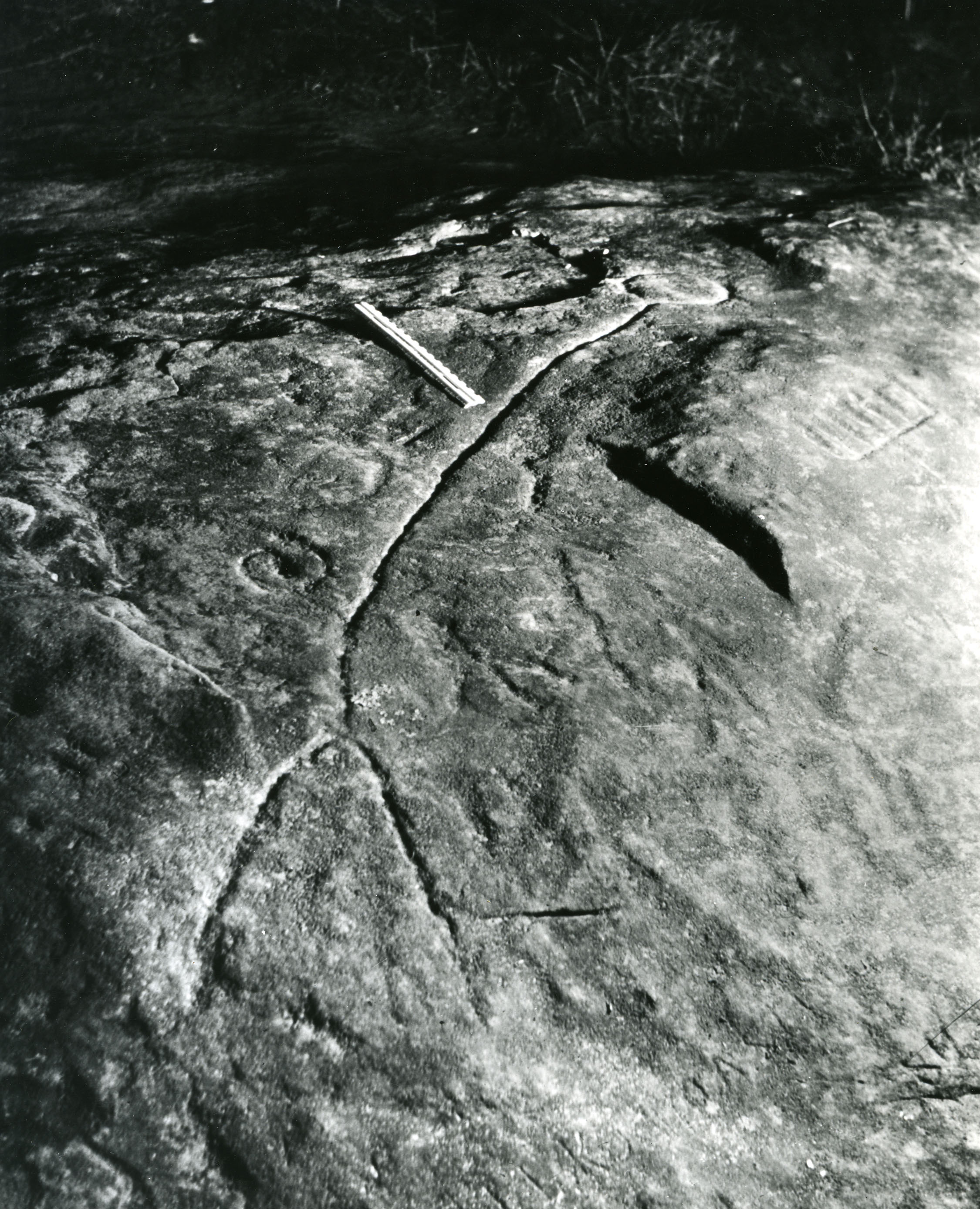
Some say there are no coincidences in life, and in my many years of genealogical and historical research, I have found that perhaps a better word for these types of experiences is serendipity.  Often I find myself researching a certain topic and “by chance” I run into an expert standing next to me in line at the grocery store.  The other day just such a happenstance occurred.  I was invited to a lunch and who should sit next to me but Stacy Tchorzynski, an Archaeologist for Michigan’s State Historic Preservation Office and Department of Natural Resources.  She asked me if the Cranbrook Archives had any materials on the Sanilac Petroglyphs and we launched into a discussion about the importance of documenting and preserving Michigan’s only known prehistoric rock carvings.  Located in an historic state park covering 240 acres, the petroglyphs, which were carved into very soft sandstone, have eroded over time and weather exposure.   In addition, 19th and 20th century vandalism and graffiti have further degraded the carvings.

SanilacPetroglyphs_01

Sanilac Petroglyphs, Cass City, MI, 1945. Cranbrook Archives.

Cranbrook has had a long interest in the petroglyphs—in the 1940s, the director of Cranbrook Institute of Science (Dr. Robert Hatt) worked with the DNR and University of Michigan’s Museum of Anthropology to develop a preservation plan for the rock carvings.  In fact, Hatt’s 1942 report even suggested that the site would make an “excellent State Park” and that the main group of petroglyphs should be fenced off.  In 1958, the Institute of Science published a monograph on the petroglyphs followed in 1965 by a collaborative meeting between the Institute, the Michigan Archeological Society, and the Sanilac County Historical Society.   This meeting resulted in the acquisition of the 80-acre site by the Michigan Archeological Society.

SanilacPetroglyphs_02

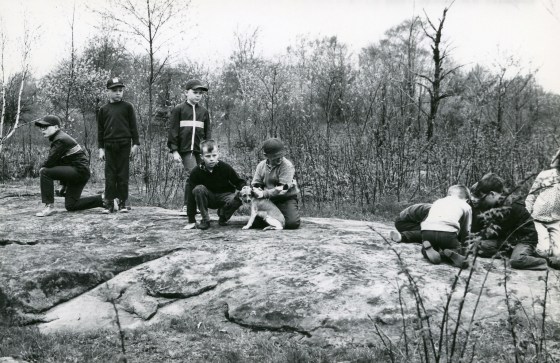
Cranbrook Institute of Science Educational Field Trip at the Sanilac Petroglyphs in Cass City, MI, circa 1968. Cranbrook Archives.

The site of the Sanilac Petroglyphs is also an important ceremonial site for the Anishinabek – the petroglyphs are very powerful places of learning and spirituality for them and are referred to as “rocks that teach.” 

Through the 1960s and 1970s, Cranbrook Institute of Science sponsored field trips to the site for its members.   Drawings of the petroglyphs, part of the collection of the Institute of Science, will soon be on display as part of the exhibition My Brain Is in My Inkstand: Drawing as Thinking and Process at the Cranbrook Art Museum.

~Leslie S. Edwards, Head Archivist

Photo Friday: Cranbrook’s Contractor

Wermuth House, Fort Wayne, Indiana.  Designed by Eliel and Eero Saarinen, 1941. Cranbrook Archives.

Wermuth House, Fort Wayne, Indiana. Designed by Eliel and Eero Saarinen, 1941. Cranbrook Archives.

This distinctly modern house was designed by the architecture firm Saarinen, Swanson & Saarinen for a man whose introduction to Cranbrook happened in a somewhat old-fashioned way—the construction of Christ Church Cranbrook, George Booth’s ecclesiastical ode to the British Arts and Crafts Movement.

In 1923, Albert Charles (A.C.) Wermuth was contracted by the architect Bertram Goodhue to oversee construction of the Trinity English Lutheran Church in Fort Wayne, Indiana.  Goodhue was so impressed with his construction work that he contracted with Wermuth again for the upcoming Christ Church Cranbrook commission in 1924.  Goodhue died before construction on the church could begin in 1925, but the firm Goodhue & Associates retained Wermuth as general contractor for the project.

When Christ Church Cranbrook was completed in 1927, the Booths immediately snatched up A.C. Wermuth for more Cranbrook projects—the building of the Cranbrook School campus and an addition to Brookside.  Thus began a decades-long professional relationship between Wermuth and Cranbrook, with Wermuth serving as general contractor for Kingswood, the Cranbrook Academy of Art, and the Cranbrook Institute of Science.  Wermuth also did private work for the Booth children as they built their own homes in the area.  Eliel and Eero Saarinen used Wermuth for their non-Cranbrook projects as well; he served as contractor on the First Christian Church in Columbus, Indiana, as well as on other Saarinen buildings.

With professional connections like these, it seems only fitting that Wermuth turned to the Saarinens when it was time for him to build his own house in Fort Wayne. While the Wermuth House, which was completed in 1941, was built under the names of both Eliel and Eero, the design of the house speaks a bit more to the son than the father.  A Saarinen, Swanson, & Saarinen project, however, Wermuth ended up with a home for his family that expressed many of the same modernist ideals that he himself helped bring to life as the general contractor for Cranbrook.

Shoshana Resnikoff, Collections Fellow, and Robbie Terman, Archivist

Create a website or blog at WordPress.com