Hugh Ferriss: Visionary Illustrator

I came across Hugh Ferriss’s book The Metropolis of Tomorrow while assisting Judy Dyki, Director of the Cranbrook Academy of Art Library, in curating an exhibit of some of our rare and special collection books for the Bloomfield Township Public Library.  Ferriss (1889-1962) was a degreed architect, but he was most sought after for his architectural renderings of buildings. He developed an idiosyncratic style, often depicting buildings at night, seemingly enveloped in a kind of mist, with streetlights and the rays of the moon serving as illumination. I find Ferriss’s work intriguing because his drawings were so different from the typical architectural renderings of the 1920s to 1950s. The gothic yet futurist sensibility displayed in his work has influenced contemporary filmmakers like Tim Burton and Christopher Nolan. Ferriss has several connections to Cranbrook, the first being the drawing of the Detroit News Building that is in the collection of the Cranbrook Art Museum.

Hugh Ferriss in his studio, ca ? Photographer Stadler. Courtesy Creative Commons.

Hugh Ferriss in his studio, ca 1925. Photo by Stadler, New York. Courtesy Creative Commons.

The history of the Detroit News Building drawing is an interesting one. The J.L. Hudson Company, in honor of the company’s 46th anniversary and the opening of the new Detroit Institute of Arts building in 1927, commissioned Hugh Ferriss to create a series of architectural renderings of Detroit buildings, both extant and proposed, that contributed to Detroit’s rapidly changing skyline.  Twenty-two of these drawings where exhibited in the windows of Hudson’s downtown store in August 1927. Among these were two renderings of Eliel Saarinen’s proposed plan for a new Detroit Civic Center complex.  Also included was this drawing of the Detroit News Building. The Detroit News building, which opened in 1917, was commissioned by George Gough Booth, and designed by architect Albert Kahn.
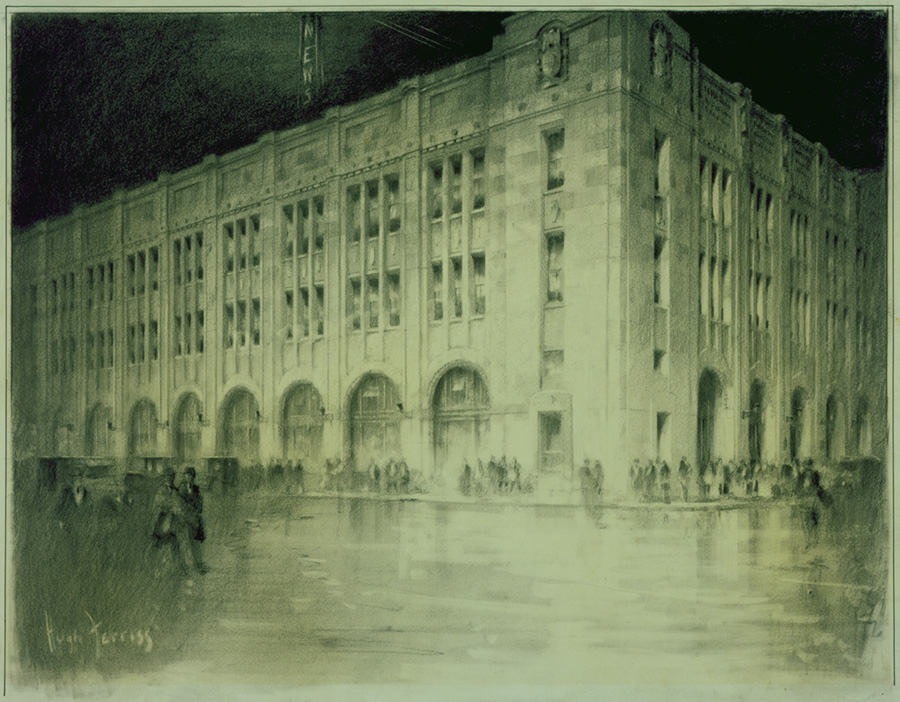
Drawing of the Detroit News Building. Courtesy Cranbrook Art Museum (CAM1955.400)

Drawing of the Detroit News Building. Courtesy Cranbrook Art Museum. (CAM1955.400)

Booth, president of the Detroit News (and Cranbrook’s founder) purchased the drawing of the Detroit News Building directly from J.L. Hudson’s in October 1927 for the Academy of Art collections. (Accessions Book No. 1, Cranbrook Academy of Art).  To coinicide with the exhibition, J.L. Hudson Co. published a commemorative booklet entitled For a Greater Detroit, which contained Ferriss’s drawings and included editorials by various community leaders that discussed Detroit’s future. A copy of this booklet can be found in the Edsel Ford Office Papers at the Benson Ford Research Center. Ferriss’s drawing was transferred from the Academy of Art to the Art Museum in 1955, and is considered one of the museum’s “One Hundred Treasures”.

Stay tuned for a forthcoming blog post about Hugh Ferriss’s further connections to Cranbrook

Mary Beth Kreiner, Librarian, Cranbrook Academy of Art Library

Editor’s note: For additional information about the work of Hugh Ferriss, check out the Avery Architectural and Fine Arts Library at Columbia University.

Anne Morrow Lindbergh: The Cranbrook Connection

The Archives has in its collection photographs of a sculpture modeled by Anne Morrow Lindbergh. How did Lindbergh come to study at Cranbrook? In April 1942, Charles Lindbergh, at the invitation of Henry Ford, came to metro-Detroit as a technical consultant to assist with retrofitting the Willow Run plant from auto manufacturing to bomber production. In July, the Lindberghs moved to Bloomfield Hills and signed a one-year lease for a furnished home then owned by Kathleen Belknap. Originally known as “Stonelea,” the home, designed by Albert Kahn in 1923, is located at the corner of Cranbrook Road and Woodward Avenue and is now known as Lyon House. The Lindberghs were quickly welcomed to the neighborhood by Carolyn Farr Booth (wife of Henry Scripps Booth). During the summer of 1943, Anne enrolled at the Cranbrook Academy of Art where she studied modeling and sculpture with sculptor Janet DeCoux, and art history with Ernst Scheyer. Since Charles was away much of the time, Anne asked Janet and her partner, Eliza Miller, to move in with her to help raise her four children. Thus began a friendship among the three women that lasted until the end of Mrs. Lindbergh’s life. (Approximately fifty letters, 1944-1952, from Anne Morrow Lindbergh to DeCoux can be found in the Janet De Coux Papers at the Smithsonian’s Archives of American Art.)

Anne Morrow Lindbergh

Anne Morrow Lindbergh, 1943. Cranbrook Archives.

At the Academy, Anne was treated not as the wife of a celebrity or even as a grieving mother, but as any other student. In her diaries (published in “War Within and Without”) Anne wrote of the freedom she experienced at Cranbrook “where people take me on faith.” Work in the studio, exhibitions at the Art Museum, and parties with music and conversation about art, books, and writing allowed Anne the freedom to “give my true self as I have never done in a group of people before.” She developed social courage and friendships with Janet and Eliza, Carl and Olga Milles, Ernst Scheyer, and neighbors like Kate Thompson Bromley. Her work as a sculptor taught her to see the world through a different lens – she learned how to sketch the human figure and transpose her ideas into her sculpture and it both surprised and excited her that she could actually see beauty in a sculpture, especially one made of her own hands. She was inspired by the natural beauty of Cranbrook, cross-country skiing on the grounds, and writing in her brown trailer in the woods. (Anne wrote her novella “The Steep Ascent” while at Cranbrook.) She relished the time with her children, and often walked them down the hill to Brookside School. Dinners with the Saarinens were exhilarating where they talked of “cities of the future.”

AnneLindbergh021

Anne Morrow Lindbergh picnicking at the Greek Theatre at Cranbrook, Jun 1944. Copyright The Detroit News.

In August 1943, Kathleen Belknap decided to sell the home, then known as Belwood, and the Lindberghs moved into a home at 411 Goodhue Road, behind Christ Church Cranbrook, for the next year. The two years spent at Cranbrook forever changed Anne spiritually. She discovered self-confidence, and that people liked her for who she was. After the Lindberghs returned to the east coast in 1944, Anne missed her Cranbrook friends and the life she had discovered here and wrote that she felt “only half alive since I left Cranbrook.” The Lindbergh family continued to return to the Detroit area to visit Charles’ mother Evangeline at her Grosse Pointe residence until she passed away in 1954. In January 1974, at the request of the Class of 1974, Kingswood School headmaster Wilfred Hemmer invited Anne to be the school’s forty-fourth commencement speaker.

Leslie S. Edwards, Head Archivist

Illumination!

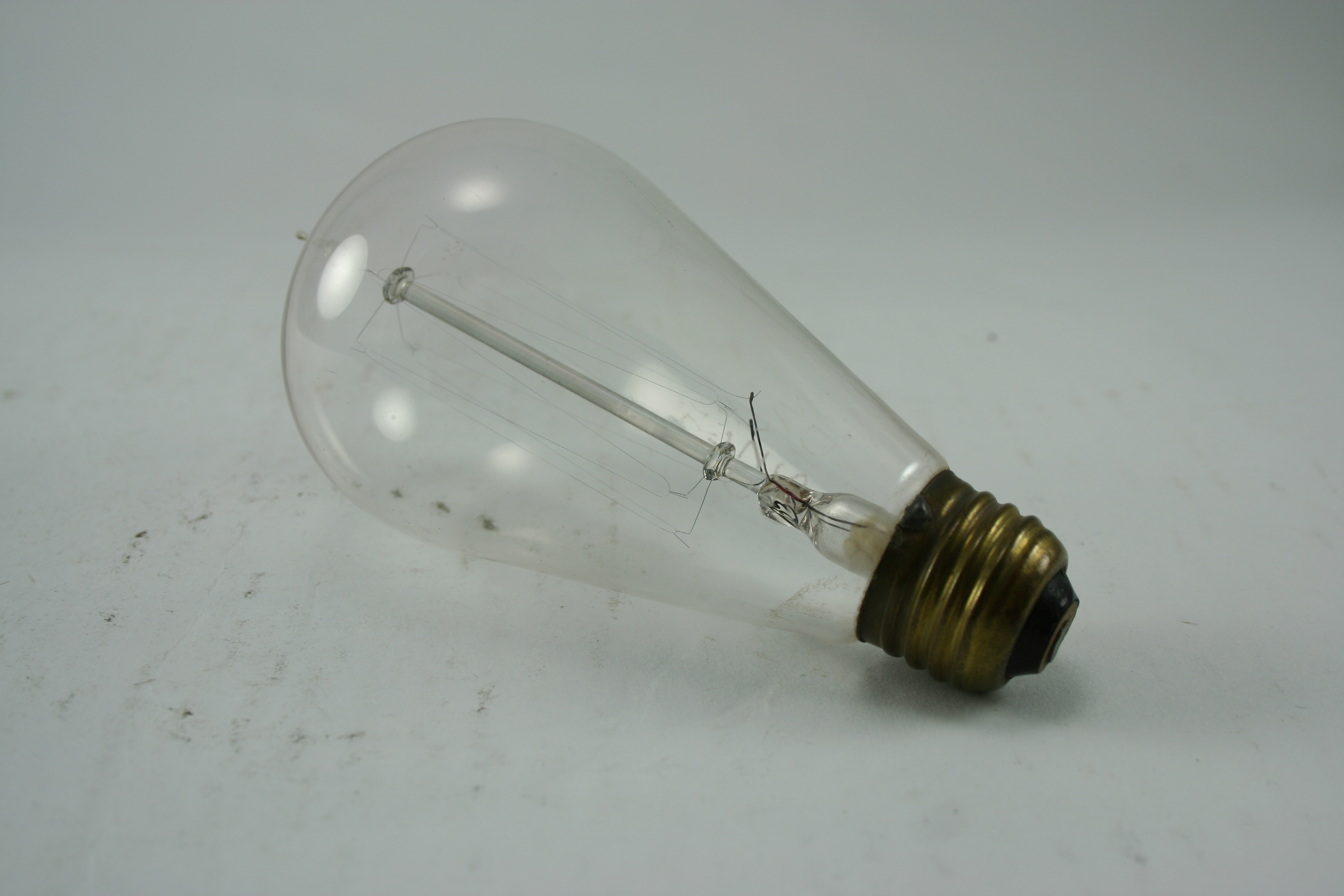
Glass etched Edison bulb from 1920, found in Cranbrook House.

Glass-etched Edison bulb from 1920, Cranbrook Cultural Properties Collection..

While browsing the historical writings of Henry Scripps Booth recently, I came upon the answer to a question that Collections Fellow, Stefanie Dlugosz, had posed late last year. As she prepared the Center for Collections and Research’s Holiday Tables exhibit (“Illuminate the Seasons” was the theme), which highlighted the early use of electricity in Cranbrook House, Stefanie had wondered what the source of electricity was, in 1908, for a relatively isolated place like Cranbrook. Efforts by several people could not turn up an answer. Until now.

“Although Caldwell’s electric fixtures had been installed about December 1, we still had to use candles and oil lamps for light because the private Edison line being installed from Highland Park to Cranbrook House was incomplete.”  This was recorded during the 1980’s in Henry’s unpublished History (which relates the history of Cranbrook Educational Community and the Booth family between 1800 and 1987).

As the bill from Albert Kahn shows, George G. Booth spent $1863.48, around $49,000 in today’s dollars, on lighting fixtures in Cranbrook House. The order is itemized, room by room, on seven pages of legal-sized paper, in Booth’s papers.

Albert Kahn’s bill to George Booth for Cranbrook House lighting fixtures provided by Edward.F. Caldwell Co.  Papers of George and Ellen Booth 14:23

George Gough Booth Papers, courtesy Cranbrook Archives.

Read the original blog for more information on the Caldwell lighting fixtures at Cranbrook House.

— Cheri Gay, Archivist

Lighting Up Cranbrook House: Edward F. Caldwell & Co.

HT_2014_1

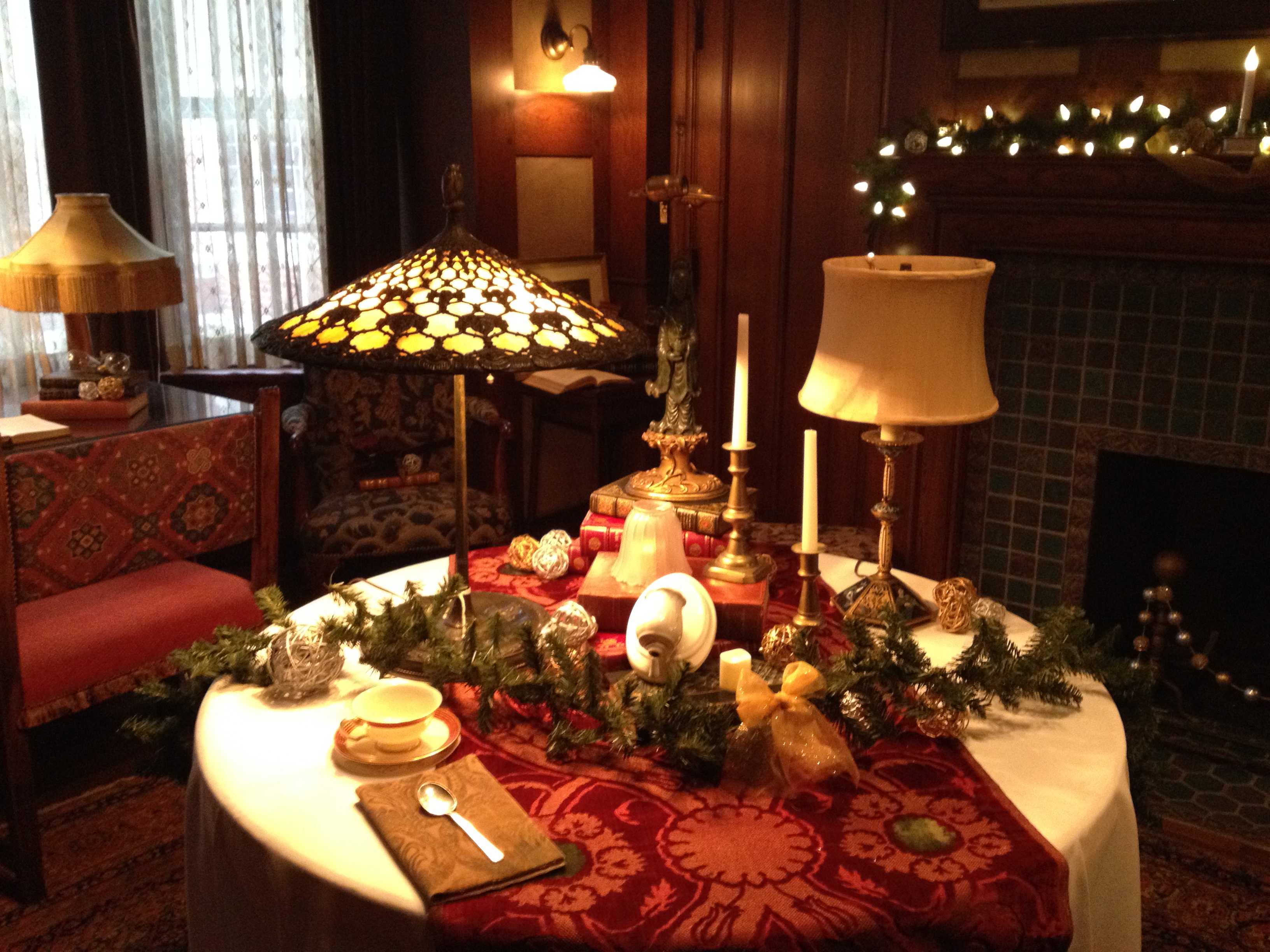
Holiday Tables, 2014. Stefanie Dlugosz, photographer.

This past weekend the Center for Collections and Research put on a display for Holiday Tables at Cranbrook House, organized by the Cranbrook House and Gardens Auxiliary.  Associate Registrar Gretchen Sawatzki and I put together a display highlighting the electric lighting original to the home, focused on lamps and lighting by the Edward F. Caldwell & Company.

Cranbrook House was designed and built in 1908, and George Gough Booth always had the intention of having electric lighting throughout the home. Within the city of Detroit there had been an interest in electricity, and by 1906 there were two power plants on the Detroit River owned and operated by the Detroit Edison Company. However, with Cranbrook House being roughly 20 miles to downtown Detroit, this was an achievement. The Booth’s interest in innovation propelled them to always be ahead of their time by investing in the newly available widespread utility for their home.

HT_2014_2

Holiday Tables, 2014. Stefanie Dlugosz, photographer.

HT_2014_3

Holiday Tables, 2014. Stefanie Dlugosz, photographer.

In the first half of the twentieth century Edward F. Caldwell & Company was America’s premier design and manufacturer for electric light fixtures. The New York firm founded in 1895 created designed and works with several prominent clients at the time including the Frick, Morgan, and Carnegie families. Much of their work was done in tandem with architectural commissions, and therefore clients like Booth were able to provide input and alter details to customize their lighting choices. Booth provided his own ideas about a few pieces for the home, but overall selected most of the pieces directly from their catalogues. During the construction and design of Cranbrook House, George G. Booth was actively involved in conversations with Albert Kahn, the architect, and many of the vendors providing goods and products for the home. Booth was enthusiastically involved in providing input on the design elements of the home, and the lighting was no different. Many of the Edward F. Caldwell & Co. catalogues can be found online through the Cooper-Hewitt Museum Library, Smithsonian Institution Libraries

Stefanie Dlugosz, Collections Fellow, Center for Collections and Research


Happy Belated Birthday to Our Founder!

September 24th marked the 150th birthday of Cranbrook’s founder, George Gough Booth. Born in Toronto, Mr. Booth had an early interest in art and architecture. In 1881 his family moved to Detroit and he put his artistic talents to work by purchasing half of an interest in an ornamental ironworks firm. The business was successful and used many of Booth’s product designs.

George Gough Booth, ca 1876.  W. E. Lindop, photographer.  Cranbrook Archives

George Gough Booth, ca 1876. W. E. Lindop, photographer. Cranbrook Archives

In 1887 Booth married Ellen Warren Scripps, daughter of Detroit News founder James Scripps. The following year he sold his share in the ironworks business and joined the News staff as its business manager. The News blossomed under Booth’s direction, becoming one of the leading metropolitan dailies in the nation. In 1906, Booth became president of the newspaper, succeeding his father-in-law.

In 1904 George and Ellen Booth purchased a run-down 174 acre farm in Bloomfield Hills and named it Cranbrook after Booth’s ancestral town in England. Booth called upon his long-time friend, and noted Detroit architect, Albert Kahn, to prepare working drawings for the building of Cranbrook House. Kahn responded with an English Arts and Crafts inspired design the Booths moved into their new home in 1908.

In 1922, believing their country estate could serve a larger public purpose, the Booths shifted their focus toward building the six institutions at Cranbrook: Brookside School, Christ Church Cranbrook, Cranbrook School (for boys), Cranbrook Academy of Art, Cranbrook Institute of Science, and Kingswood School (for girls). George Booth was a visionary, and with his wife Ellen, set new standards for generosity, leaving us a legacy we are proud to be a part of. Happy belated birthday George!

“We were unwilling to go through life with our aims centered mainly in the pursuit of wealth and with a devotion wholly to the ordinary opportunities for social satisfaction.  We were not willing to leave all of the more enduring joys for our children or the joy of work in so good a cause entirely to our friends after we had passed on; rather did we wish, in our day, to do what we could and give tangible expression now to our other accomplishments by adventures into a still more enduring phase of life.  We wished to see our dreams come true while we were, to the best of our ability, helping to carry on the work of creation.”  (George Gough Booth, Address at Founders Day, October 28, 1927)

Gina Tecos, Archivist

Create a website or blog at WordPress.com