A Registrar’s Perspective

Tawny Nelb Workshop

Framed Ralph Rapson drawing, The Ralph Rapson Collection, 1935-1954. Photographer, Gretchen Sawatski.

This past Monday I had the great fortune of taking part in an archival workshop lead by forty-year archives veteran Tawny Ryan Nelb of Nelb Archival Consulting, Inc. As a Registrar, I primarily work with three-dimensional objects (furniture, paintings, gates, etc.), so I was eager to learn that this workshop focused on architectural records, the sub-genres within that medium, and how to properly care for and store these records.

I reference architectural records quite frequently when I am trying to learn more about, or troubleshoot, a problem related to an object. In all honesty, I thought I knew the proper handling, usage, and storage of these records as this knowledge is vital to my job; but it was obvious that I really needed the refresher course in “Paper Management 101.”

Archives workshop at Cranbrook Center for Collections and Research

Tawny Ryan Nelb (third from left). Photographer, Justine Tobiasz.

Tawny’s discussion covered all areas of architectural records including paper mediums, drawing types, and then some. I have to admit though that I cringed when the conversation moved towards the exhibition processes for architectural records! Often, we loan architectural sketches, floorplans, and section drawings to other institutions that require us to frame the documents using a hinge system. A hinge, simply put, is a tab that is glued to a document using a reversible wheat paste that is then adhered to an acid-free backer board. To my dismay, this approach was used historically on tissue and tracing type papers records in our collections, which are likely to tear and off-gas inside their expensive frames, creating a microclimate of havoc. In a moment of panic my hand shot up in the middle of the lecture and I uttered, “But we have documents framed in our collection like this! What should we do?”

Thank goodness for archival specialists, because Tawny truly eased my conscience. She, in very kind words simply replied, “It’s ok. We can remove the tissue and tracing paper from their frames, disrupting the microclimate, and use archival paper and matting to resolve the issue.” My response, “what about those hinges?” And, again she calmed my nerves, “Leave the hinges, and store the objects in flat files, so there is no need to use the frames. Then, if these documents go on exhibition again, they are already hinged and ready to go.” In one word: genius. That is what I experienced at this workshop, shear genius. In all of the workshops I have been a part of, I have never been so glad to have attended an archives workshop in all of my life.

Gretchen Sawatski, Associate Registrar

Photo Friday: Happy Birthday Ralph Rapson!

New Moon by Ralph Rapson

Plan for Rapson’s New Moon Homes, Alma, Michigan, 1945. (Project not realized) Cranbrook Archives

In honor of Ralph Rapson’s 100th birthday, (September 13th) today’s Photo Friday features images from the Ralph Rapson Collection (1935-1954). Rapson studied architecture under Eliel Saarinen at the Cranbrook Academy of Art from 1938-1940.  He worked in the Saarinen office until 1941 when he moved to Chicago and taught at the New Bauhaus with Lazlo Moholy-Nagy.  In 1954, he relocated to Minneapolis where he established the University of Minnesota’s School of Architecture.  One of the country’s leading modernist architects, Rapson created hundreds of sketches and is perhaps best known for his whimsical illustrations of people and transportation.

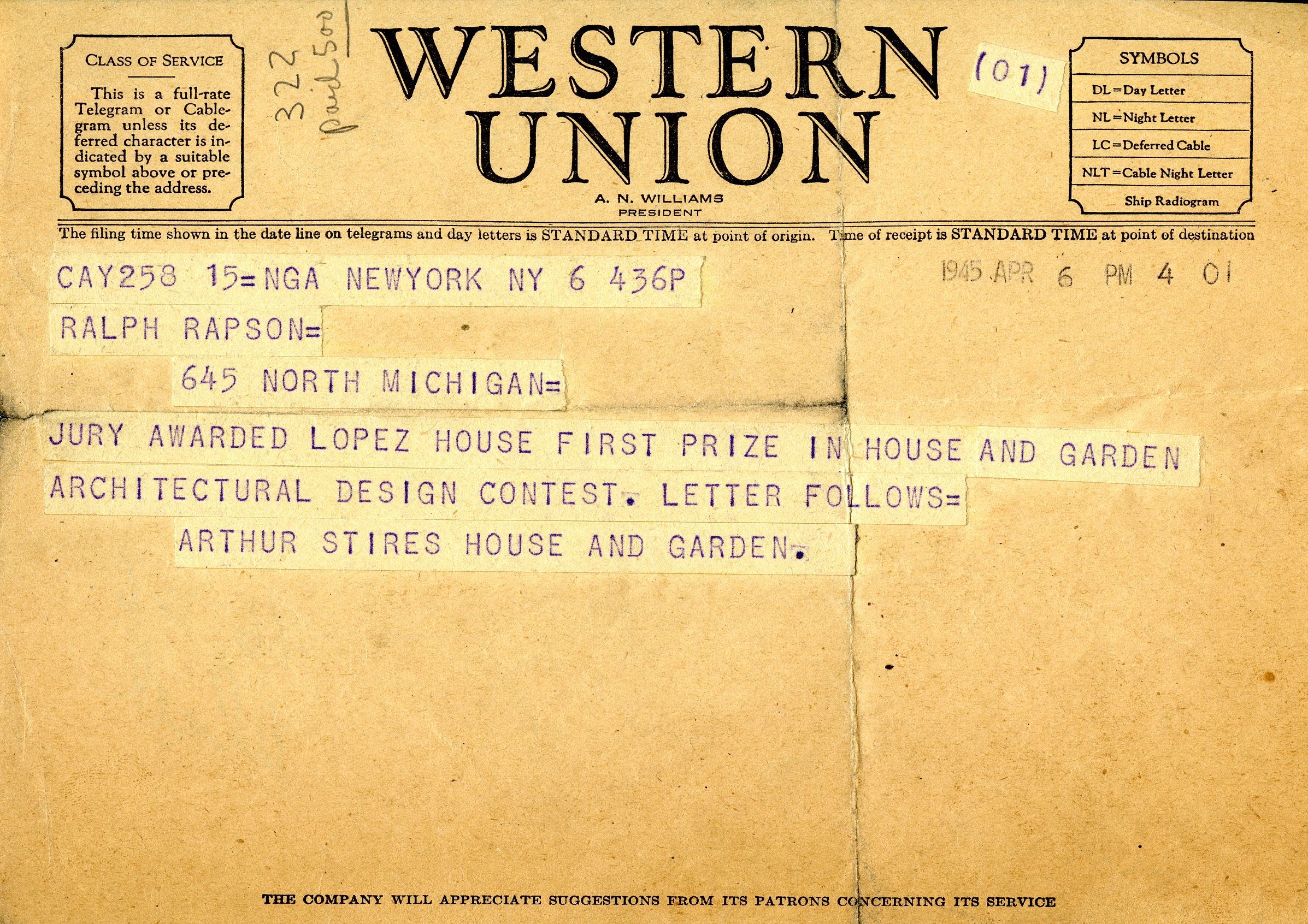
Ralph Rapson telegram

Telegram announcing Ralph Rapson’s first prize win for the “Lopez House” in the House and Garden Architectural Design Contest, 1945. Cranbrook Archives

Leslie S. Edwards, Head Archivist, and Gina Tecos, Archivist

Fashioning Architecture

In 1931, attendees at the Beaux-Arts Ball in New York came dressed to impress. An annual party thrown by the Society of Beaux-Arts Architects, the ball featured a different theme each year. 1931’s theme of “Fete Moderne — a Fantasie [sic] in Flame and Silver” was inspired by the New York skyline and the iconic skyscrapers that had recently come to define it. Fully committing to the theme, many guests came dressed as famous New York buildings. In this photo William Van Alen holds center court as the Chrysler Building (of which he was the architect) while other personified buildings crowd around him.

William Van Alen as the Chrysler Building, with other masquerading architects around him. On the far right is Joseph Freelander as the Museum of the City of New York.  Source: NY Times/untappedcities.com.

William Van Alen as the Chrysler Building, with other masquerading architects around him. On the far right is Joseph Freelander as the Museum of the City of New York. Source: NY Times/untappedcities.com.


Continue reading

Photo Friday: Cranbrook’s Contractor

Wermuth House, Fort Wayne, Indiana.  Designed by Eliel and Eero Saarinen, 1941. Cranbrook Archives.

Wermuth House, Fort Wayne, Indiana. Designed by Eliel and Eero Saarinen, 1941. Cranbrook Archives.

This distinctly modern house was designed by the architecture firm Saarinen, Swanson & Saarinen for a man whose introduction to Cranbrook happened in a somewhat old-fashioned way—the construction of Christ Church Cranbrook, George Booth’s ecclesiastical ode to the British Arts and Crafts Movement.

In 1923, Albert Charles (A.C.) Wermuth was contracted by the architect Bertram Goodhue to oversee construction of the Trinity English Lutheran Church in Fort Wayne, Indiana.  Goodhue was so impressed with his construction work that he contracted with Wermuth again for the upcoming Christ Church Cranbrook commission in 1924.  Goodhue died before construction on the church could begin in 1925, but the firm Goodhue & Associates retained Wermuth as general contractor for the project.

When Christ Church Cranbrook was completed in 1927, the Booths immediately snatched up A.C. Wermuth for more Cranbrook projects—the building of the Cranbrook School campus and an addition to Brookside.  Thus began a decades-long professional relationship between Wermuth and Cranbrook, with Wermuth serving as general contractor for Kingswood, the Cranbrook Academy of Art, and the Cranbrook Institute of Science.  Wermuth also did private work for the Booth children as they built their own homes in the area.  Eliel and Eero Saarinen used Wermuth for their non-Cranbrook projects as well; he served as contractor on the First Christian Church in Columbus, Indiana, as well as on other Saarinen buildings.

With professional connections like these, it seems only fitting that Wermuth turned to the Saarinens when it was time for him to build his own house in Fort Wayne. While the Wermuth House, which was completed in 1941, was built under the names of both Eliel and Eero, the design of the house speaks a bit more to the son than the father.  A Saarinen, Swanson, & Saarinen project, however, Wermuth ended up with a home for his family that expressed many of the same modernist ideals that he himself helped bring to life as the general contractor for Cranbrook.

Shoshana Resnikoff, Collections Fellow, and Robbie Terman, Archivist

Dispatch from the Archives: “Gatescapes,” Old and New

On October 5, Cranbrook Archives will be opening its second exhibition in the From the Archives series.  From the Archives: Forging Cranbrook’s Gatescape explores the long-lasting significance of gates to Cranbrook’s campus.  Points of transition and transformation, the gates have also long stood as a public display of Cranbrook’s dedication to art and design.

George Gough Booth sketch for a gate.  George Gough Booth Papers, Cranbrook Archives.

George Gough Booth sketch for a gate. George Gough Booth Papers, Cranbrook Archives.

Cranbrook’s love of gates originates with its founding father, George Gough Booth.  Booth, who came from a family of copper and tin metal workers, received early training at the Red Foundry in Ontario, Canada.  This, in part, led to his 1884 purchase of Barnum Wire and Iron Works in Windsor, Ontario with partner Fred Evans.  Booth wrote, “I conceived the idea of creating a new type of industry – selling with my pencil and not so much out of a catalogue – making special designs for fences, signs, bank counter railings…”   One of the earliest gates at Cranbrook designed by George Booth (and fabricated by Detroit Architectural Iron Works in 1916) is the first public gate located at the entrance to the Greek Theatre.

    Greek Theatre gates, designed by George Booth and produced by the Detroit Architectural Iron Works. 1916.

Greek Theatre gates, designed by George Booth and produced by the Detroit Architectural Iron Works. 1916.

Since Booth’s inception of Cranbrook, the community has steadily expanded the campus’ “gatescape.”  The most recent gates installed on campus are the “Valley Way” entrance gates (2012), designed by Architect-in-Residence William Massie.  Located at what was formerly known as the Vaughan Road Entrance, the gates were part of a project which widened the roadway to improve vehicular and pedestrian safety.  Working with Brian Oltrogge, Massie designed an abstraction of geometric triangles, a reference to Eliel Saarinen’s Kingswood gates.   The new gates were fabricated of laser-cut and bent steel.  The hand-bent “infill” was bolted to the steel frame and welded by Jody Cooper, Academy of Art alumni (Architecture Department 2012).

Closeup of Valley Way entrance gates, designed by Cranbrook Academy of Art Architect-in-Residence William Massie. The gates were completed in 2012.

Closeup of Valley Way entrance gates, designed by Cranbrook Academy of Art Architect-in-Residence William Massie. The gates were completed in 2012.

In conjunction with the exhibition opening, I’m going to be leading a walking and bus tour of the gates on Saturday, October 5.  We’ll be exploring all aspects of the gates, from their history in situ to the designers and makers who produced them.  Be sure to sign up here to join us, and get ready to delve deep into Cranbrook’s “gatescape”!

Leslie S. Edwards, Head Archivist

Old Words, New Sounds: Oral Histories from the Cranbrook Archives

For the past nine months I have been working on a project to breathe new life into an oral history initiative at Cranbrook that began as early as 1964 as a collaborative project between Cranbrook School and the Cranbrook Foundation. These oral histories give us an intimate view of life here at Cranbrook over the past half century with interviewees spanning across the entire community. They range from Dr. Lee Dice at the Institute of Science, to Cranbrook Academy of Art painter Zoltan Sepheshy, as well as interviews with members of the Vettraino family, whose time living on the grounds spanned several generations. These interviews give us the kind of glimpse into the past of Cranbrook that is difficult to find anywhere else.

Cranbrook’s oral histories are found in the archives in analogue sound formats, namely on magnetic tapes. In order to preserve these interviews and provide access to a wider audience, the Archives is implementing a plan to digitize all of the content. Each oral history is digitized in real time and then transcribed, with each hour of audio taking anywhere from 8 to 10 hours to transcribe, depending on sound quality.

One of the latest gems to be uncovered is a recording of a conversation with brother and sister James and Doris Smith who worked as model makers and production designers from the mid-1940s for many of the artists and architects associated with Cranbrook. James began working with the firm of Saarinen, Swanson, and Saarinen in 1943, while Doris joined them in 1946. Both had their hands on many of the largest projects, such as creating the models for the General Motors Technical Center, and their insight into the daily work and life in the office is unmatched and cannot be forgotten.

In the following clip you can listen to James Smith discuss events and the atmosphere that surrounded the winning entry from Eero Saarinen & Associates for the Gateway Arch in the Jefferson National Expansion Memorial in St. Louis, Missouri–better known as the St. Louis Arch.

Image

Construction of TWA model at Eero Saarinen & Associates taken by Claude de Forest, 1957.Cranbrook Archives.

Justine Tobiasz– Archives Assistant

Photo Friday: Planning a Planetarium

Workmen spray down the McMath Planetarium dome, which is under construction. 1955. Cranbrook Archives.

Workmen spray down the McMath Planetarium dome while under construction at the Cranbrook Institute of Science.  1955. Cranbrook Archives.

The workmen who built the McMath Planetarium at the Cranbrook Institute of Science in the 1950s must have been circus performers as well as skilled craftsmen.  Here they balance on plywood platforms, managing a high-pressure hose as they perch above the nearly-completed dome.   The planetarium, which opened in 1955, has now been expanded into the Acheson Planetarium and includes research resources as well as visitor viewing opportunities.


Photo Friday: Graduate Degree Exhibition

walter hickey thesis

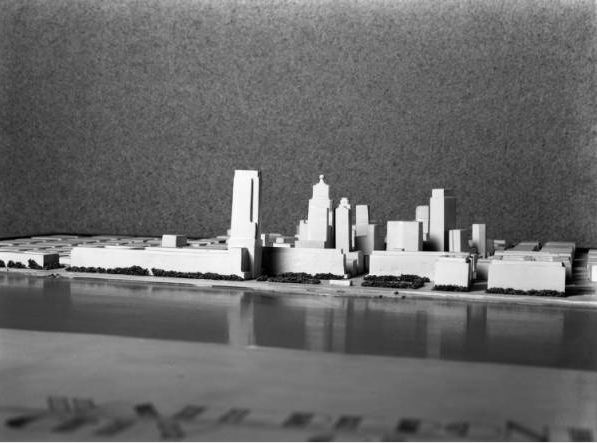
Cranbrook Academy of Art student Walter Hickey’s model for a proposed development for the Detroit waterfront, 1935. Cranbrook Archives.

You know it’s April at the Cranbrook Art Museum when the building is overrun by graduate students from the Academy of Art, frantically putting together their final projects for the Graduate Degree Exhibition.  While the degree show (opening this year on April 22 and running until May 12) is a longtime tradition at Cranbrook (staged in some iteration since 1940!),  graduate theses date back to 1943— the first year the Academy was accredited as a degree-granting institution.   In 1935 Walter Hickey created this model as part of a larger project to redesign the Detroit waterfront helmed by Cranbrook Academy of Art director and famed architect Eliel Saarinen.

Create a website or blog at WordPress.com