Photo Friday: Seeing the Unseen

Dr. Harold Edgerton

Dr. Harold E. Edgerton giving a lecture at Cranbrook Institute of Science, Jan 1950. Cranbrook Archives.

A Fellow of the American Academy of Arts and Sciences, who was awarded the National Medal of Science, and won an Oscar  – the subject of today’s Photo Friday has quite the list of accomplishments! Dr. Harold E. Edgerton gave a lecture at Cranbrook Institute of Science in 1950 called “Seeing the Unseen”. Edgerton advanced the development of strobes – using them to freeze objects in motion to capture on film. Utilizing short duration electronic flash, Edgerton developed techniques for photographing athletic events, bullets, and drops and splashes. Many of his photographs were published in Time magazine.  In 1937, one of Edgerton’s milk-drop photographs was included in the first photography exhibition at the Museum of Modern Art.

In 1952, the National Geographic Society invited Edgerton to join Jacques Cousteau on an underwater exploration. Edgerton built underwater cameras and flashes for Cousteau, and also developed sonar technology that enabled him to search for the ancient Greek city of Helike (submerged around 373 B.C.) and locate an H-bomb off the coast of Spain.

Gina Tecos, Archivist


Photo Friday: Happy Birthday Ralph Rapson!

New Moon by Ralph Rapson

Plan for Rapson’s New Moon Homes, Alma, Michigan, 1945. (Project not realized) Cranbrook Archives

In honor of Ralph Rapson’s 100th birthday, (September 13th) today’s Photo Friday features images from the Ralph Rapson Collection (1935-1954). Rapson studied architecture under Eliel Saarinen at the Cranbrook Academy of Art from 1938-1940.  He worked in the Saarinen office until 1941 when he moved to Chicago and taught at the New Bauhaus with Lazlo Moholy-Nagy.  In 1954, he relocated to Minneapolis where he established the University of Minnesota’s School of Architecture.  One of the country’s leading modernist architects, Rapson created hundreds of sketches and is perhaps best known for his whimsical illustrations of people and transportation.

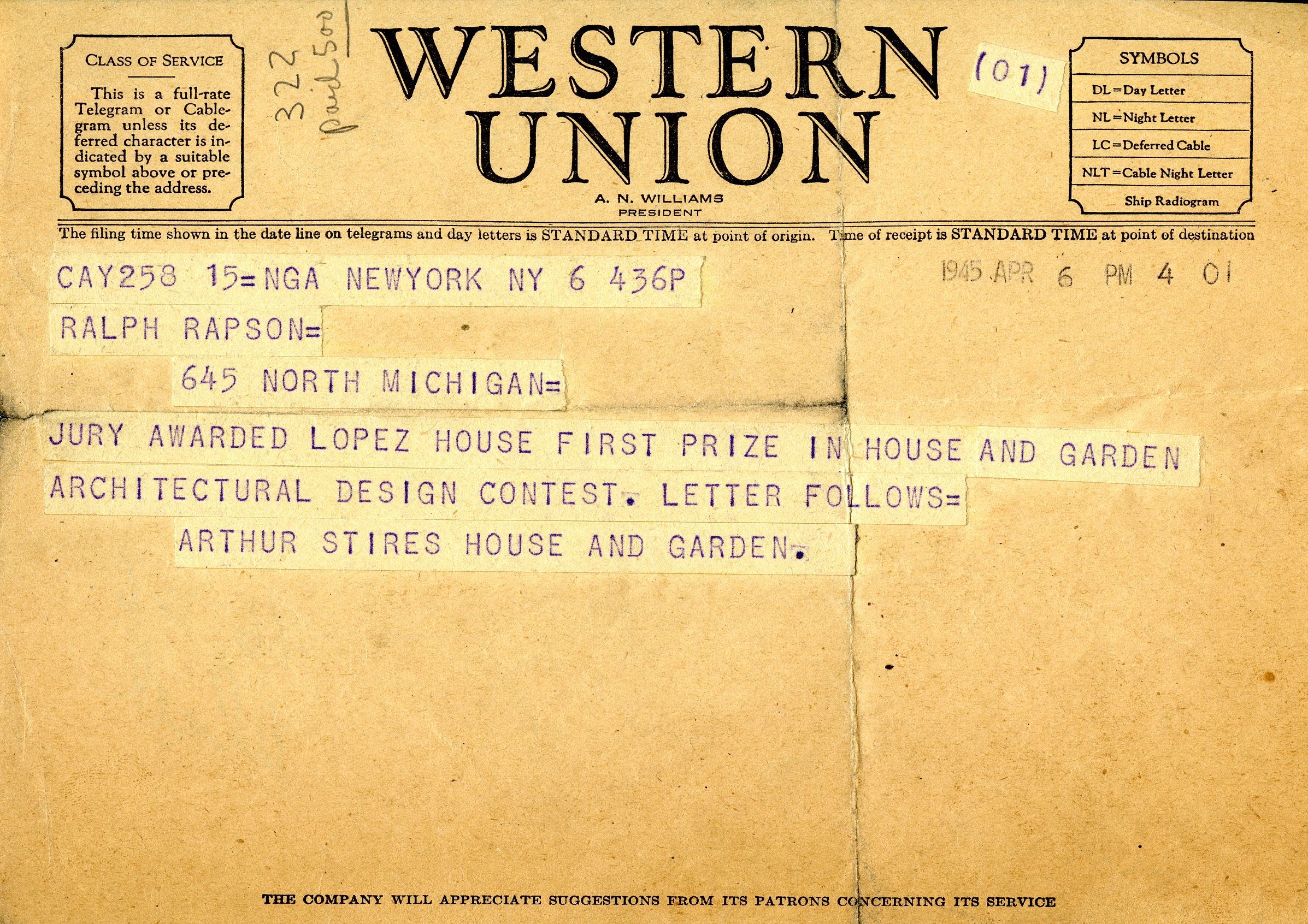
Ralph Rapson telegram

Telegram announcing Ralph Rapson’s first prize win for the “Lopez House” in the House and Garden Architectural Design Contest, 1945. Cranbrook Archives

Leslie S. Edwards, Head Archivist, and Gina Tecos, Archivist

Photo Friday: Back to School in 1912

Stock certificate for the Bloomfield Hills Seminary issued in 1912/Courtesy Cranbrook Archives.

Stock certificate for the Bloomfield Hills Seminary issued in 1912. Cranbrook Archives.

In early June of 1912 a small group of Bloomfield Hills residents assembled at the home of William T. Barbour (president of Detroit Stove Works) to discuss the formation of a small local private school. After general discussion, it was moved by George Gough Booth to establish a corporation with capital of $5,000.00 in order to establish the school. According to meeting minutes, the objectives were to “give the young people of Bloomfield Hills, and those from nearby towns, the opportunity to study in the country; to offer a course of study that will fit them for life as well as for college.” With these objectives in place, the Bloomfield Hills Seminary was incorporated in August.

Often referred to as the precursor to Brookside School, the Seminary was located on five acres at the corner of Woodward Avenue and Lone Pine, in a historic house built in 1820 by Ezra Parke. Booth, who had purchased the property in 1910, offered use of the house and added a five-class-room addition with the caveat that the property would revert back to him should the school ever close.

Mary Eade, who had been the principal of the Detroit Seminary for Girls, became the principal and taught grammar and upper level courses, including History of Art. Elizabeth K. Seward (granddaughter of William Henry Seward of the Alaska purchase fame) taught intermediate classes including French, and Winifred Eastman was responsible for the elementary age children. The coeducational day school used the Montessori method of instruction.

In 1916, the trustees voted to change the name of the school to the Bloomfield Hills School. At its peak, there were eight teachers and fifty-one students enrolled. Due in part to the resignation of Mary Eade (who resigned to do war work) and the construction of new schools in Birmingham and Pontiac, the school closed in 1918 after six years. The property reverted back to Booth who purchased all of the stock certificates back from the trustees, and later became known as the Lone Pine Inn and Tea House, but that’s another story!

Leslie S. Edwards, Head Archivist and, Gina Tecos, Archivist

Photo Friday: Ciao Cranbrook!

Italian workers at Cranbrook

Italian laborers at Cranbrook, ca 1906/Cranbrook Archives

For many Americans, Labor Day’s most popular meaning is a “last hurrah to summer,” but its national significance is much greater than that. In 1894, Grover Cleveland designated the first Monday in September as a national holiday paying tribute to the contributions and achievements of the working force in America. The Italian laborers pictured here arrived at Cranbrook in 1905. Hired by George Booth, men with the last names of Angelosanto, DiPonio, Roselli, Soave, and Vettraino built roads and stone walls, dug ponds, contoured the land, planted, and cared for the property. In 1955 the Cranbrook Foundation Board of Trustees dedicated a plaza north of the Brookside School in appreciation of groundskeeper Michael Vettraino’s 50 years of service to the Cranbrook community. In his speech at the “Piazza Vettraino” dedication, Henry S. Booth said, “We acknowledge a debt to his native Italy, his affection for the world of growing things, his quest for beauty, his tireless hands and feet, and the part he has played as one of the many founders of Cranbrook today.”

Click here to listen to a clip from our oral history collection of Dominick Vettraino speaking about the work the Italians did on the grounds of Cranbrook.

Gina Tecos, Archivist

Photo Friday: Learning by Living and Observing

BS1930s001

Brookside School, ca 1928. The photograph was taken by Arnold Studio, a local Birmingham studio who took most of the early photographs of Brookside School. Cranbrook Archives.

In the 1930s, Brookside School children spent part of their time applying what they learned in the classroom to conditions from real life. Here, children were learning by “living and observing” the daily routines at a pretend store. The “Greenfield Sausage” package on the front of the table was from Hammond Standish & Company meat packing business of Detroit. The company was founded by George H. Hammond, who built Detroit’s first skyscraper—the “Hammond Building.” Hammond also patented the first refrigerated boxcar, and by the mid-1880s, Hammond Standish & Company was using 800 refrigerated boxcars to deliver meat to the Atlantic seaboard each week.

Gina Tecos, Archivist

Create a website or blog at WordPress.com