Dispatch from the Archives: “Gatescapes,” Old and New

On October 5, Cranbrook Archives will be opening its second exhibition in the From the Archives series.  From the Archives: Forging Cranbrook’s Gatescape explores the long-lasting significance of gates to Cranbrook’s campus.  Points of transition and transformation, the gates have also long stood as a public display of Cranbrook’s dedication to art and design.

George Gough Booth sketch for a gate.  George Gough Booth Papers, Cranbrook Archives.

George Gough Booth sketch for a gate. George Gough Booth Papers, Cranbrook Archives.

Cranbrook’s love of gates originates with its founding father, George Gough Booth.  Booth, who came from a family of copper and tin metal workers, received early training at the Red Foundry in Ontario, Canada.  This, in part, led to his 1884 purchase of Barnum Wire and Iron Works in Windsor, Ontario with partner Fred Evans.  Booth wrote, “I conceived the idea of creating a new type of industry – selling with my pencil and not so much out of a catalogue – making special designs for fences, signs, bank counter railings…”   One of the earliest gates at Cranbrook designed by George Booth (and fabricated by Detroit Architectural Iron Works in 1916) is the first public gate located at the entrance to the Greek Theatre.

    Greek Theatre gates, designed by George Booth and produced by the Detroit Architectural Iron Works. 1916.

Greek Theatre gates, designed by George Booth and produced by the Detroit Architectural Iron Works. 1916.

Since Booth’s inception of Cranbrook, the community has steadily expanded the campus’ “gatescape.”  The most recent gates installed on campus are the “Valley Way” entrance gates (2012), designed by Architect-in-Residence William Massie.  Located at what was formerly known as the Vaughan Road Entrance, the gates were part of a project which widened the roadway to improve vehicular and pedestrian safety.  Working with Brian Oltrogge, Massie designed an abstraction of geometric triangles, a reference to Eliel Saarinen’s Kingswood gates.   The new gates were fabricated of laser-cut and bent steel.  The hand-bent “infill” was bolted to the steel frame and welded by Jody Cooper, Academy of Art alumni (Architecture Department 2012).

Closeup of Valley Way entrance gates, designed by Cranbrook Academy of Art Architect-in-Residence William Massie. The gates were completed in 2012.

Closeup of Valley Way entrance gates, designed by Cranbrook Academy of Art Architect-in-Residence William Massie. The gates were completed in 2012.

In conjunction with the exhibition opening, I’m going to be leading a walking and bus tour of the gates on Saturday, October 5.  We’ll be exploring all aspects of the gates, from their history in situ to the designers and makers who produced them.  Be sure to sign up here to join us, and get ready to delve deep into Cranbrook’s “gatescape”!

Leslie S. Edwards, Head Archivist

Photo Friday: Back to School

As the schools are busy preparing for the return of students to campus next week, we thought it would be fun to post a student-related photo.  This one, taken in May 1959, shows girls from Kingswood School about to board the bus.  Today, buses are used to transport students between the campuses, but in 1959, the boys (Cranbrook) and girls (Kingswood) schools were not co-ed.  So, what were the buses used for?  Turns out that Kingswood owned two buses that made transportation “possible for day students not only from the north end of Detroit, but also from Birmingham, Pontiac, and Bloomfield Hills.”  Who knew?

~Leslie S. Edwards, Head Archivist

Kingswood students board the bus. Cranbrook Archives.

Kingswood students board the bus. Cranbrook Archives.

Finland Visited: Part One

I’m recently back from a fantastic vacation to Helsinki, Finland with my daughter.  We took a boat tour around the archipelago (did you know there are 315 islands surrounding the Helsinki harbor?), swam in the 1952 Olympics swimming stadium (where we had our first sauna experience), and visited the famed Temppeliaukio Church (rock church), a Lutheran church in the Töölö neighborhood of Helsinki.

Temppeliaukio Church

Temppeliaukio Church

Designed by brothers Timo and Tuomo Suomalainen, the church, which was carved out of the granite bedrock, has a strong connection with nature – exactly what the brothers intended.  When you walk through the door, the cool air of the belowground atmosphere wraps around you.  The interior walls were left rough-hewn, and metal and glass were chosen carefully to complement the rock.  The interior is lit by natural light streaming through 180 vertical window panes that connect the dome and the wall. Quite astounding was the copper dome ceiling – a Google search tells me that it is over 13 miles of copper strips!

And how could an inquisitive archivist from Cranbrook go to Finland without doing a little research relative to the Saarinens?  Naturally we visited the Saarinen’s home, Hvittrask, where we were warmly welcomed by the curator, Pepita Ehrnrooth-Jokinen, who showed us around the current exhibition, “Home as a Work of Art,” by Sirkkaliisa and Jari Jetsonen.  (By the way, the Jetsonens visited Cranbrook and the Archives a couple of summers ago on their research tour of U.S. homes designed by Eliel and/or Eero Saarinen.)

For me, however, one of the highlights of my trip was visiting Bobäcks skola (elementary school), not far from Hvittrask.  What’s so great about visiting a school you might ask? Well, it just so happens that in the 1930s, when Studio Loja Saarinen was weaving the famed May Queen Tapestry for Kingswood School for Girls, they also wove a smaller sample.  In 1952, Loja Saarienn donated this piece to Bobäcks.  And there it hung for nearly sixty years without anyone realizing the importance of it.  Fast forward to 2010, when the nearby village association determined to save the faded and worn tapestry by having it restored.  However, they also felt a responsibility to give the school a replacement in order to continue to provide students, teachers and parents alike the opportunity to experience such a fantastic tapestry.

Enter artist Ann (known as Annsi) Jonasson who had been teaching woodworking classes to adults in the school for years.  Annsi, a weaver with her own home studio in the community, was commissioned to undertake the monumental task of creating a replica of the Saarinen tapestry!  Annsi took on the responsibility and dedicated many months to studying the tapestry, meticulously counting threads and spaces in order to plot the pattern on graph paper for the copy to be as accurate as possible.  The original fabric was made of linen, wool, and silk threads in a variety of shades- nearly 170 different colors.  Annsi studied the colors from the backside which were less faded, and then tried to replicate the threads.

May Queen tapestry sample

A detail of the May Queen tapestry sample showing the dog’s head. Note the spaces that were not woven, and the combinations of thread colors – sometimes a linen yarn twisted with a thread from embroidery yarn – that were used to match the original colors.

Fortunately, Annsi said she has never thrown away anything useful, so she used her own personal collection to match the colors and textures.  Over the years, her collection had grown thanks to the transfer of yarns and threads from friends, acquaintances, and the inheritance of yarns from her mother and grandmother.

Annsi, a most kind and welcoming woman, is proud of her work and rightly so – though you probably can’t tell from the photographs here, the replica is stunning.

Annsi and the replica

Annsi and the May Queen tapestry sample replica.

We have to give thanks that a contemporary weaver cared enough to dedicate many months of her life and literally weave part of herself into a tapestry that connects to us here at Cranbrook.  Soon she will donate to the Cranbrook Archives a copy of her research, which will help keep the Finnish-Cranbrook connection alive.

Oh, and by the way, did you know that the May Queen tapestry sample is the only known Studio Loja Saarinen work in Finland?

~Leslie S. Edwards, Head Archivist

Guernsey Cows and George Booth

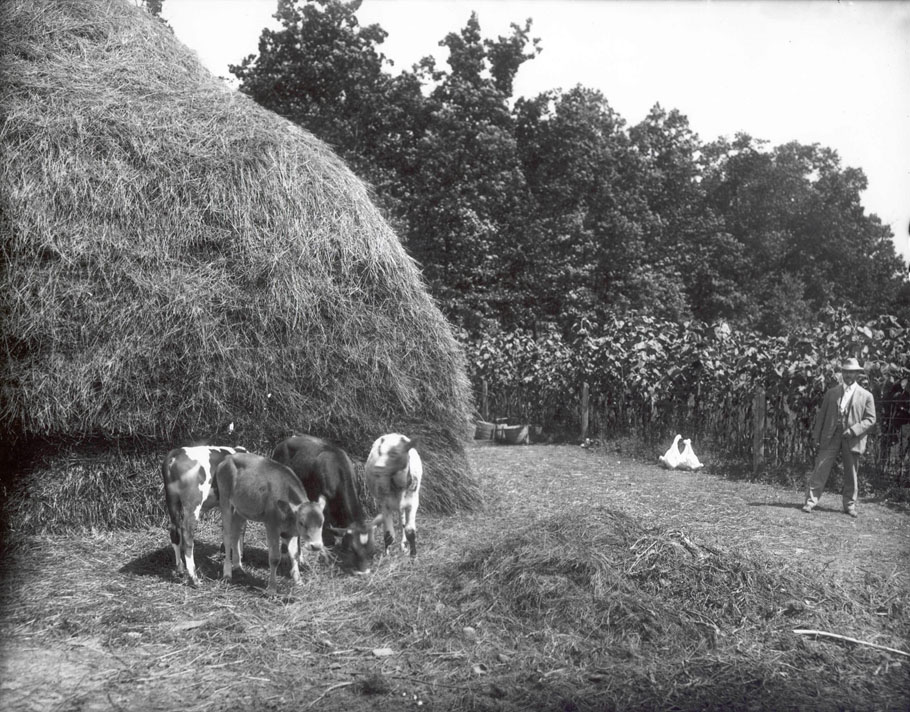
When most people hear the word “Cranbrook,” they think of Eliel Saarinen, modernist design, art and science, or private education.  Some even think of our sister schools in England, British Columbia or Australia.  But how many people think of farm animals named “Daisy Lovelace” or “Nellie of Cranbrook?”  When the Booths purchased the old Alexander farm in 1904, one could see rolling farmland covered with hay fields and orchards.  Indeed, George Booth soon became a gentleman farmer.

George Booth (right)

George Booth (right)

In fact, Cranbrook boasted TWO working farms, originally called Farm Group #1 and #2, situated on the grounds of what are now the campuses of Kingswood School and Cranbrook School respectively. Farm Group #1 (1904) was designed no, not by Saarinen, but by that other architect, Albert Kahn! – one of Kahn’s earliest commissions for George Booth. Farm Group #2 (1917) was designed by Canadian architect Marcus Burrowes and his partner Dalton Wells, recommended to Booth by Kahn who was getting mighty busy with his industrial projects. When the footprint for Cranbrook School for Boys was developed, George Booth asked Eliel Saarinen to follow the plan for Farm Group #2. Today’s Hoey Hall is on the site of the old silo. The only remaining evidence of the farm buildings is the orignal farmhouse designed by Burrowes and Wells.

~Leslie S. Edwards, Head Archivist

Dispatch from the Archives: All Things Modernism

Mid-century Modernism has taken over my life!  I eat, sleep, and even dream Modernism these days.  In my role as Head Archivist, I wear many hats – the most recent being to assist the Michigan Modern curatorial team by locating all the cool “stuff” in our Archives related to the upcoming exhibition, which will be opening at the Cranbrook Art Museum on June 14, 2013.  This includes photographs, of course, but the most fun for me is finding correspondence, articles, and ephemera that when put together create a mosaic of a time or place. Continue reading

Create a website or blog at WordPress.com