With thousands of years of recorded history to draw from, every day of the year has some distinction as an anniversary. Today, the 27th of September, is the 958th anniversary of the day William, Duke of Normandy, set sail to conquer England, the 560th anniversary of the birth of Cosimo de’ Medici, founder of the de facto ruling family of Renaissance Florence, and the 100th anniversary of the wedding of Henry Scripps Booth to Carolyn Elizabeth Farr. Here at Cranbrook, it is this last anniversary that holds top billing on our calendars.
Carolyn Elizabeth Farr, on her wedding day. Courtesy of Cranbrook Archives, Cranbrook Center for Collections and Research.
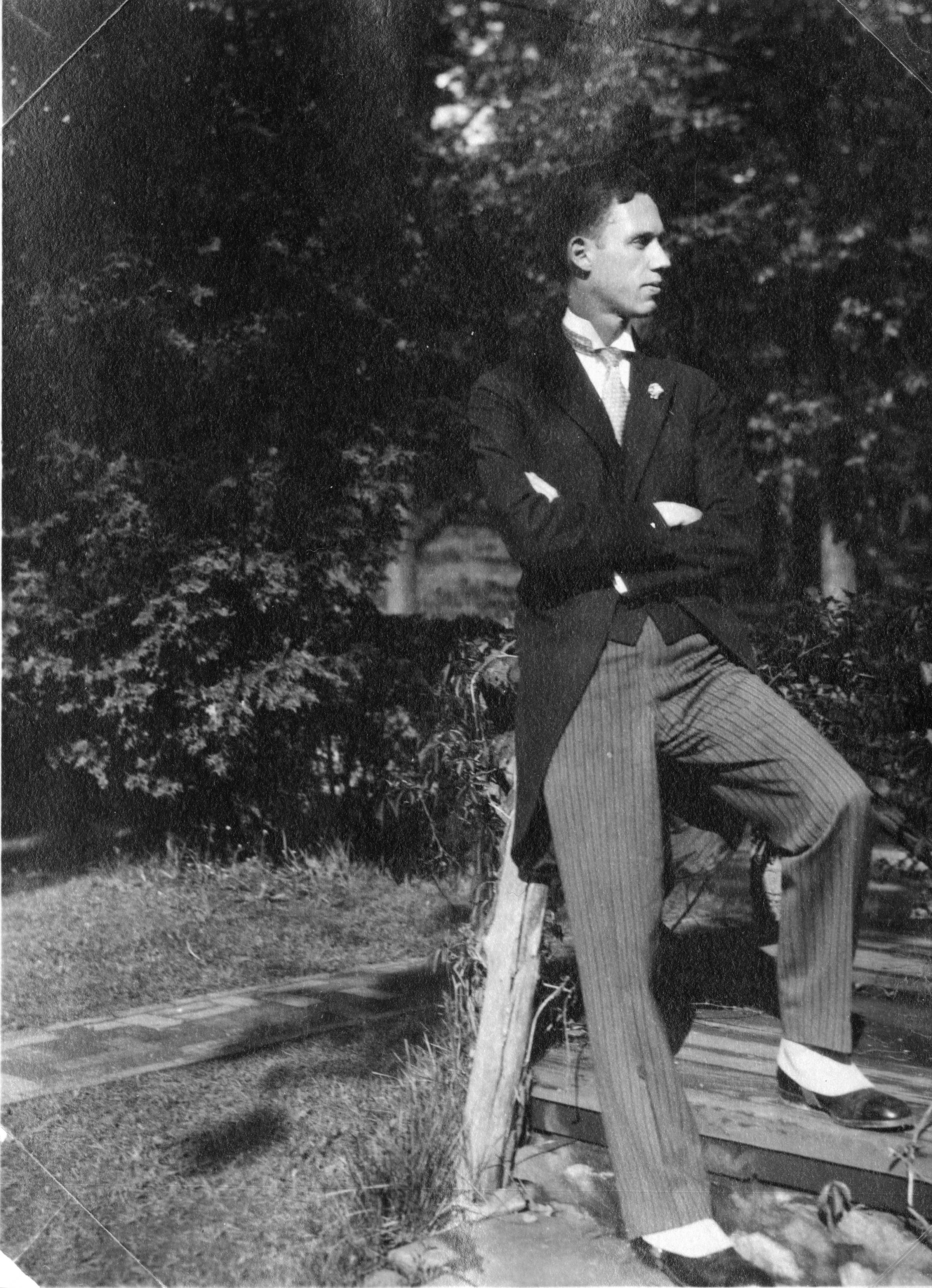
Henry Scripps Booth, on his wedding day. He later joked that it was the last time that he would ever wear a waistcoat. Courtesy of Cranbrook Archives, Cranbrook Center for Collections and Research.
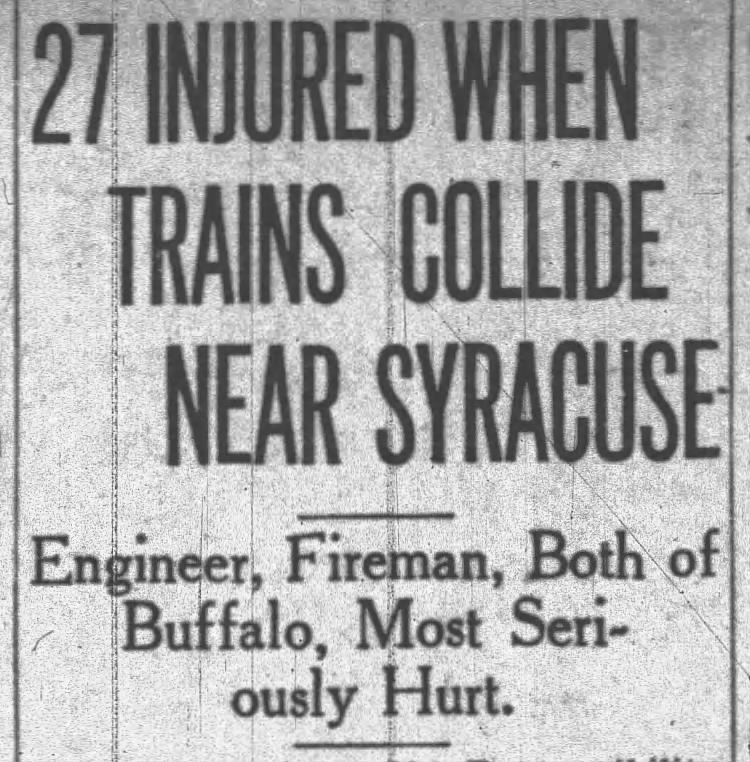
Henry Booth, youngest son of Cranbrook’s founders, George and Ellen Booth, and Carolyn Farr, daughter of shipbuilding magnate Merton Elmer Farr and Emma Rothe, first announced their engagement on June 29th, 1925. Neither of them believed in long engagements, it appears, as they were married just three months later, at the First Congregational Church in Detroit. The wedding had some competition for most memorable event of the year for Carolyn Farr. On August 30th, while on her way home from a shopping trip to New York City to complete her trousseau, Carolyn’s train crashed into the back of another train which had made an accidental stop on the westbound line near Syracuse.
Clipping from Buffalo Courier, August 31, 1924, page 56
Fortunately, no one was killed in the crash. Some members of a Boy Scouts troop riding at the back of the rear train actually slept through the collision and had to be shaken awake by their bemused troop leaders. Though she escaped serious injury, the crash left Carolyn with cuts on her nose and mouth, which may have still been painful on her wedding day, though they are invisible in her wedding photos.
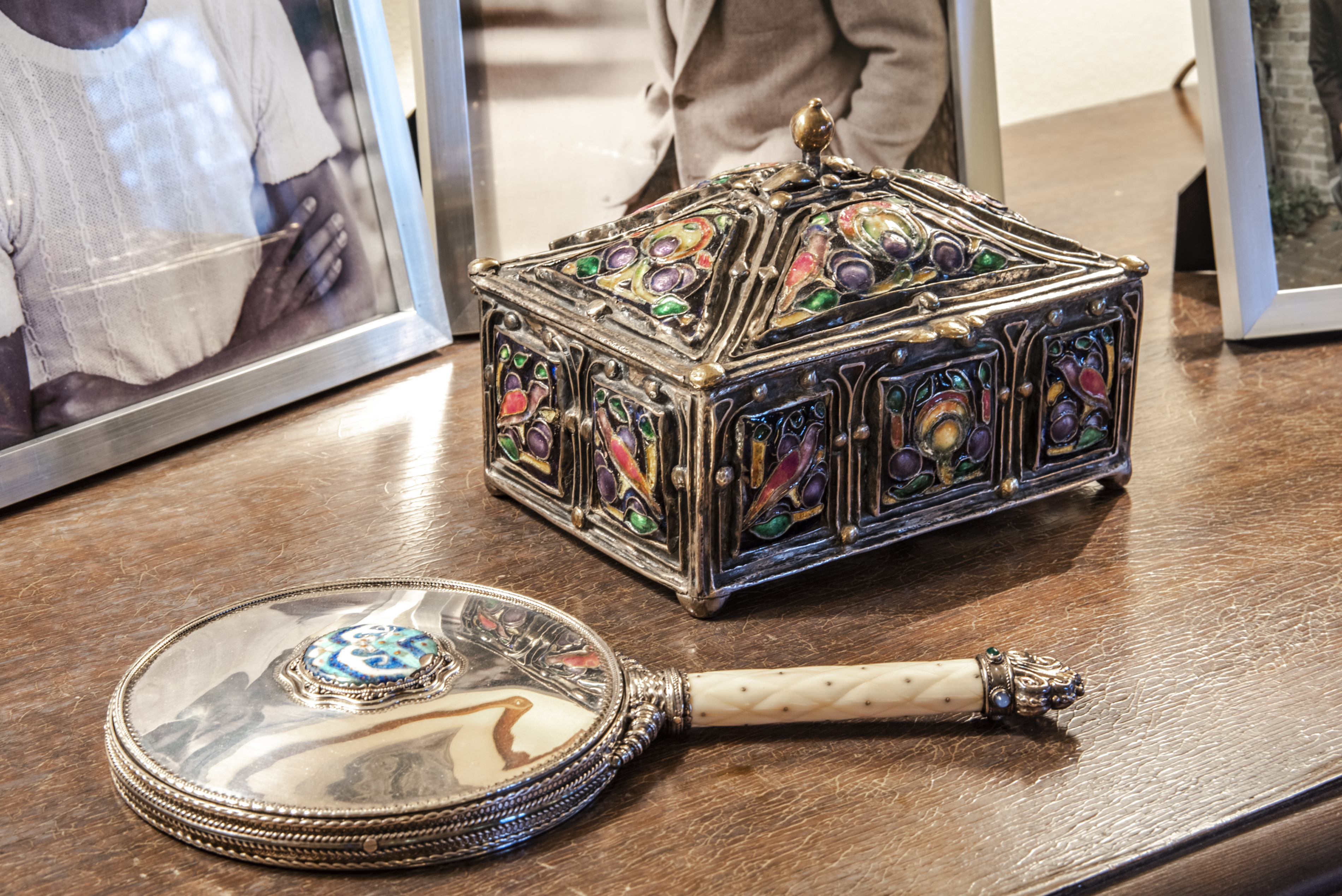
Both of Henry’s sisters were married at Cranbrook House itself, Grace Booth in the living room and Florence Booth in the library. Although Henry was not married at Cranbrook, the wedding was still very much a Cranbrook event in one way, because it featured an Arts and Crafts artwork. The ring was carried down the aisle by Carolyn’s nephew, Henry Gerhauser, in a silver and enamel box made by the noted Boston-based artist Elizabeth Copeland.
Carolyn Farr and ring bearer Henry Gerhauser holding the Copeland box. Detroit Free Press, October 5th, 1924.
Enameled silver casket, Elizabeth E. Copeland, circa 1922. Courtesy of Cranbrook Center for Collections and Research.
Enameling, like tapestry weaving and illumination, was a medieval art form revived by the Arts and Crafts movement in England in the nineteenth century. In the twentieth century, enameling evolved out of the medievalist styles that characterized its revival to become a primary medium of both Art Nouveau and Art Deco decorative art and jewelry.
Elizabeth Copeland was the foremost enamel artist of the American Arts and Crafts movement. Born in Revere, Massachusetts in 1866, she did not begin her artistic training until she was in her early thirties. Like many women artists, she was expected to balance her own work with domestic labor. Copeland had to commute daily to attend the Cowles Art School in Boston, and she studied her design patterns while carrying out household chores. So great was her talent, however, that within just a few years her enamels and silver work were already enjoying critical acclaim, including a feature in Craftsman magazine in 1903. Her work is now in many museum collections, including the Metropolitan Museum of Art, the Art Institute of Chicago, and the Museum of Fine Arts, Boston.
As an artist, Copeland embraced the Arts and Crafts movement’s ideals. Eschewing a machine-like precision in her work, her silver work proudly exhibits subtle variations and inconsistencies that distinguish them as truly hand-crafted objects. Her enamel work embraces the fluidity of the medium, allowing different colors to flow into one another within each metal embrasure shaped to contain the liquid medium. Unlike most women artists of her time, Copeland was able to support herself independently through the sale of her work, during a career of more than three decades. She exhibited her work at many venues, including the Detroit Society of Arts and Crafts, where Henry Scripps Booth purchased the silver box that would hold the ring for his wedding, two years later.
Henry Scripps Booth with his first child, Stephen Farr Booth, in Brookside Cottage, February 17th, 1925. Note the Copeland box on the mantelpiece. Courtesy of Cranbrook Archives, Cranbrook Center for Collections and Research.
The Copeland Box in Thornlea with a hand mirror by Arthur Nevill Kirk. Photography by Tryst Red, 2021. Courtesy of Cranbrook Center for Collections and Research.
After the wedding, the new couple moved into Brookside Cottage, the little stone house just west of Kingswood School, where they lived for two years until Thornlea House was completed. The Copeland box became a fixture of their new home, where they lived together from 1927 until Carolyn’s death in 1984. During her lifetime, the ring box spent many years on a table in Carolyn’s own bedroom, as a memento of a milestone occasion which we are celebrating again, one hundred years down the line.
— Mariam Hale, 2023-2025 Collections Fellow, Cranbrook Center for Collections and Research
In 1759, British forces led by General James Wolfe defeated the French in a pivotal battle outside besieged Quebec. General Wolfe’s death from injuries sustained on the battlefield, just moments after victory was declared, made him a hero to the British public. The victory at Quebec turned the tide in the Seven Years War for the British, securing Britain’s rule of their new North American territories and paving the way for the eventual creation of Canada and the USA. But what does the Battle of Quebec have to do with Cranbrook?
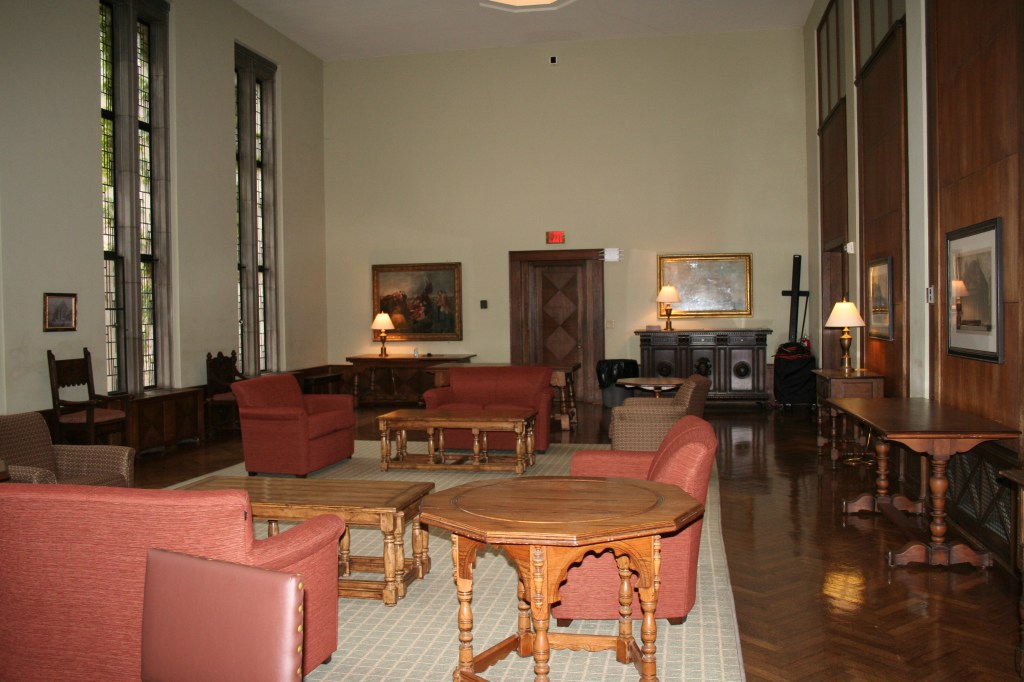
In October 1928, George Booth bought three paintings from a Boston gallery, including one depicting the battle, The Death of General Wolfe, attributed to Benjamin West. He gave all three paintings to Cranbrook School for Boys, where they still hang today, on the walls of Page Hall Commons. Cranbrook’s The Death of General Wolfe is a studio copy of a famous work depicting the end of the Battle of Quebec. The painting represents a turning point both in American history, and in the history of art.
The artist, Benjamin West, was born in Springfield, Pennsylvania, in 1732. Like many artists living in the North American colonies, he was acutely conscious of the shortage of opportunities for training and patronage on this side of the Atlantic. At 31, he left America for Europe, where he embarked on a study tour of Italy, before settling in England. There, he quickly established himself as an artist of skill and imagination. West attracted clients to his studio by deliberately playing up his background as an émigré from the still largely unknown North American continent, even claiming to have had his first lessons in painting from Native American artists. His talent and social charms quickly won him support from colleagues and patrons alike, but it was the triumph of The Death of General Wolfe that made him a national celebrity.
Self Portrait, Unknown 18th century artist, after Benjamin West, circa 1776. National Gallery of Art, Andrew W. Mellon Collection, Washington, D.C.
In 1771, twelve years after the Battle of Quebec, West exhibited a monumental canvas depicting Wolfe’s death on the battlefield at the Royal Academy of Art’s summer exhibition in London. At its debut, West’s painting was lambasted by critics for his then unconventional choice to portray all the subjects of his work in accurate, contemporary dress, rather than classical draperies. However, critical disputes were drowned by popular acclaim.
The painting’s dramatization of an already thrilling moment in recent British history captured the public’s sentiments, while fellow artists praised West’s dynamic composition, effective use of classic postures and gestures, and brilliant color. Joshua Reynolds, the first President of the Royal Academy, who had advised West against his choice to include contemporary dress, confessed that he had been wrong. West’s balance of realistic costumes and props with compositional techniques borrowed from the Italian Renaissance set a new standard for verisimilitude and expressiveness in British history painting.
The Death of General Wolfe, Benjamin West, 1770. National Gallery of Canada, Ottawa. Gift of the 2nd Duke of Westminster to the Canadian War Memorials, 1918; Transfer from the Canadian War Memorials, 1921.
At the center of the eight foot wide canvas, General Wolfe lies dying in the arms of his officers. From the far left, a messenger approaches bearing news of the French surrender, while in the background, windblown clouds and smoke open up to reveal a patch of blue sky, signaling the imminent arrival of good news. Though all accounts of the general’s death place just three men with him, West has ringed Wolfe with fellow soldiers, whose gestures direct our attention to the dying man, and express mingled grief and awe. Wolfe’s own pose echoes that of the dead Christ in the Virgin Mary’s lap in Michaelangelo’s Pieta (1499). His upturned face is illuminated by the sun breaking through the clouds. It is a profoundly unsubtle portrait of a patriotic martyr.
At the left of the group, two figures speak to the specifically North American character of the battlefield. The figure in the green coat, who points over his shoulder at the approaching messenger, is Sir William Johnson, an English immigrant to the North American colonies who established close personal relationships with the Mohawk, and was appointed by their leadership to represent their interests to the British government. Johnson’s negotiations were critical to the British alliance with four Iroquois peoples, who fought alongside the British against the French in the Seven Years War. The unknown Native American man who sits beside Johnson represents the Iroquois contribution to the British war effort. His pensive posture as he watches the dying general is based on two major art historical precedents; the “Belvedere Torso”, a fragment of Roman sculpture at the Vatican Museums in Rome, and Melancholia, an allegorical depiction of melancholy, by Albrecht Dürer. The pose reflects two of the many views of Native American people then current in British society – they were both recognized as valiant military allies, and romanticized as tragic representatives of a culture fated to disappear in the face of inevitable British conquest and the expansion of their colonized territories.
Melencolia I, Albrecht Dürer, 1514. Metropolitan Museum of Art, New York. Harris Brisbane Dick Fund, 1943.
The triumph of The Death of General Wolfe, like the real victory it depicts, is a watershed moment in history – that is, in the history of British historical subject art. Over the next hundred years, history painting would evolve from a genre reserved for the walls of palaces, and confined by the conventions royal aggrandizement and allegory, to a popular genre of narrative art, characterized by dual commitments to historical accuracy and psychological drama. Though West was not the first to introduce modern dress into historical scenes (nor even the first to portray the death of Wolfe in this manner), the extraordinary merits of his work turned the tide in favor of realism and emotionally driven narrative for the genre as a whole.
And When Did You Last See Your Father?, William Frederick Yeames, 1878. Walker Art Gallery, Liverpool. A fictionalized depiction of the interrogation of the young son of a Royalist sympathizer by a Parliamentarian, Yeames’s work epitomizes the 19th century turn towards envisioning history through the lens of individual experiences.
West went on to be appointed court historical painter under George III, and became the second president of the Royal Academy of Art, succeeding Joshua Reynolds in 1792. Though he never resettled in America, West lent his support to many young American artists visiting England, fostering the growth of American art up to the Revolution and beyond.
The Death of General Wolfe Comes to Cranbrook
The version of The Death of General Wolfe at Cranbrook is one of at least seven copies of the painting produced in West’s lifetime. Several were painted by West himself, others by studio assistants. We do not know the exact provenance of this painting. The technique reveals it to be the work of a less experienced artist, perhaps a junior studio assistant. The painting lacks the exacting finish that characterized West’s work and was demanded of all artists at this period. In the original work, not a single brushstroke is visible, while in the Cranbrook copy, the artist has not learned to conceal the work of their brush.
The panel is about half as large as the original, slightly taller and narrower in its dimensions. To adapt the painting to a differently proportioned canvas, the artist was forced to compress the space between some of its figures. Many features of the battle in the background, such as press of boats along the river’s edge on the right of the canvas, were omitted altogether. A key figure, the messenger bearing news of victory, is crammed into the left-hand margin, and partially cut off by the frame. The missing details raise the possibility that this work was painted from a print, rather than from close study of the original or a copy by West himself.
Print of The Death of General Wolfe, William Boydell and Rowlands Woollett, after Benjamin West, 1 January 1776. National Maritime Museum, Greenwich, London.
George Booth paid the Vose Gallery $3,000 for this painting – twice as much as he paid for either of the other two paintings, and a remarkable price for a work that is almost certainly not from the artist’s own hand. (The other works were The Clipper Midnight, by Samuel Walters, and a portrait of Washington Irving by John Vanderlyn.) Why was it so important to the Booths that Cranbrook have some version of West’s masterpiece?
Six months before George Booth bought the painting, another version of The Death of General Wolfe was presented to the University of Michigan at Ann Arbor, by William L. Clements. Clements, a noted collector of American artifacts and documents, bought the painting to ornament the library of Americana that he had just given to the university, the William L. Clements library. The painting at Ann Arbor is a full-scale replica of the original work, painted by Benjamin West in 1775 for the Prince Regent of Waldeck, a region in Germany. The library, with its new painting in place, opened to the public in June of 1928, when visitors packed the rooms to see the collection. The Booths may well have been in attendance, and would certainly have been aware of the well-publicized gift. Perhaps it was Clements’s generosity that inspired George Booth to seek out a Death of General Wolfe for the Cranbrook campus as well.
The Death of General Wolfe, Benjamin West, 1776. William L. Clements Library. Courtesy of the University of Michigan.
By giving the painting to the school, George Booth probably hoped that it would add something to the students’ education there. In the most straightforward sense, the painting depicts a critical moment in the history of the United States, Canada, Great Britain, and the First Nations. It also represents a turning point in the history of art, and in the life of one artist in particular. Benjamin West rose from American obscurity to the highest eminence in British art, thanks to his talent, effort, and amiable personality, but it was this painting that secured him national recognition. Throughout his career, he sought to help younger artists to success, teaching many American artists in his own studio. General Wolfe was a hero of his own nation and time, but to an art lover and sometime pacifist like George Booth, Benjamin West may well have seemed like the true exemplar of a life well spent, and an ideal role model for the students of Cranbrook School.
— Mariam Hale, 2023-2025 Collections Fellow, Cranbrook Center for Collections and Research
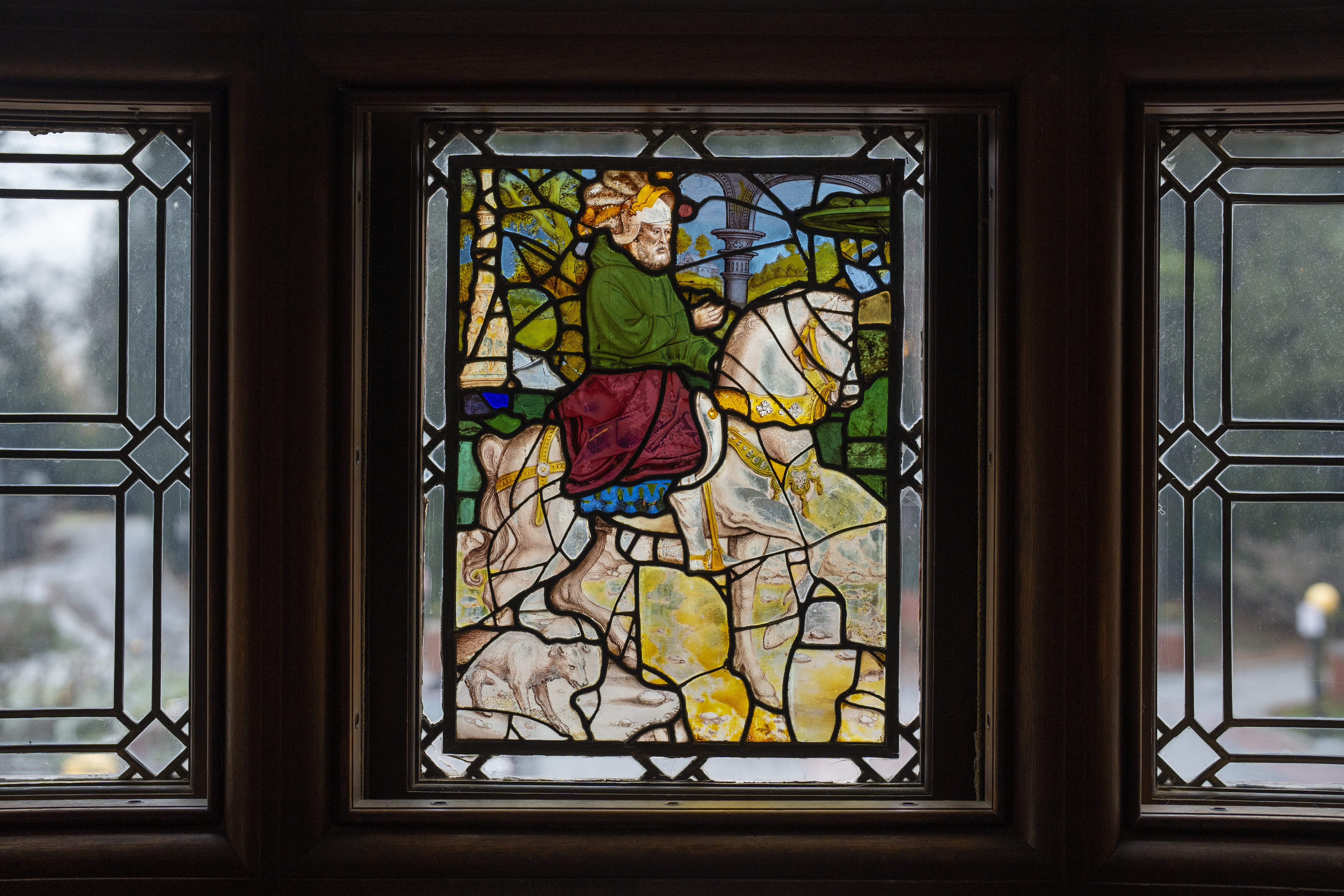
When you take the time to look, the windows of Cranbrook House are surprisingly varied. Some are leaded casement windows straight out of an Elizabethan manor house, others are modern sash windows, fitted with plate glass. A few rooms in the house enjoy a special distinction – their windows are fitted with inset panels of stained glass.
These stained-glass panels were a later addition to Cranbrook House. When first completed in 1908, the windows were all clear glass. It was only while pondering extending the house, in the latter half of the 1910s, that George Booth began purchasing stained-glass panels for his home. The most prominent stained-glass work in Cranbrook House is the 16th-century Flemish panel, depicting a man on horseback, placed in the main window over the staircase in the Reception Hall.
It was not part of the original design for the window, but added in 1922. That panel, and several others scattered throughout the house, were purchased from Thomas & Drake, an English firm specializing in historic glass.
Others, like the heraldic roundel in the library’s east window, were purchased by the Booths in Lucerne, Switzerland. There was some debate as to their final destination. George Booth wrote, in a letter to his son Henry, in March 1922:
They do not make an imposing collection but I think they are good and that everyone will like them – I did think I would let the [Detroit] museum [of Art] buy them at cost if they wished to begin to accumulate some historical glass, but your mother and Florence say no – they are to be put into the windows at Cranbrook but we will see.
(George Gough Booth to Henry Scripps Booth, 26 March 1922. Cranbrook Archives, George Gough Booth Papers.)
In the event, Ellen and Florence won out, and at least a few of the Swiss purchases made their way into the windows of Cranbrook House.
For this May’s upcoming A House Party at Cranbrook: Celebrating the Legacy of Music, we are celebrating the music and spirit of the 1950s. Naturally, that means digging into our closets for our best mid-century modern outfits, and more importantly, our dancing shoes. Seventy-five years ago, guests invited to a Cranbrook party could head down to Hudson’s department store on Woodward Avenue for a full evening’s attire. That is, unless they, like Loja Saarinen, preferred to design and sew their own clothes! This year, we may be deprived of Hudson’s and its record-breaking 705 changing rooms, but we do not lack sources of inspiration for a fifties night at Cranbrook.
Cranbrook Academy of Art: Packard Motor Competition, 1950. Cranbrook Archives, Cranbrook Center for Collections and Research.
Eliel and Loja Saarinen at the front entrance of Saarinen House, Cranbrook Academy of Art, circa 1950. Cranbrook Archives, Cranbrook Center for Collections and Research.
The 1950s was an exciting time for snappy dressers, even those not as artistically gifted as Loja Saarinen. While Cranbrook-trained designers like Ruth Adler Schnee and Florence Knoll were transforming the look of the modern American interior, American clothing was undergoing a revolution of its own. The 1950s can be seen as the dawn of the modern fashion era, defined by an extraordinarily diverse range of stylish modes of dress, and a new emphasis on comfort and adaptability. The introduction of novel synthetic fabrics like orlon and spandex, and a new prominence for sports and lounge wear anticipated the rise of current athleisure apparel. The cocktail dress reached its zenith in this decade, as did the requisite accessories: shoes, handbag, and a trunkful of costume jewelry.
Handbag, used by Elizabeth Parke Firestone. From the Collections of The Henry Ford. Gift of Elizabeth Willis Leatherman.
Christian Dior Dress, Worn by Elizabeth Parke Firestone, circa 1956. From the Collections of The Henry Ford. Gift of Elizabeth Willis Leatherman.
Many designers, including Christian Dior himself, continued to embrace the sloping shoulders and hourglass shapes of the “New Look,” inaugurated in the late forties. However, no single silhouette dominated the womenswear scene. Waistlines and hemlines rose and fell according to the whims of individual designers, dresses and coats billowed outward or narrowed to follow the line of the body, and the range of possibilities for fashionable dressers expanded rapidly in all directions.
Claire McCardell, “Popover” Dress, circa 1956. RISD Museum.
Cristóbal Balenciaga, Chemise dress, circa 1957. RISD Museum.
The one common and consistent demand for women’s clothing then was elegance; truly casual clothing was not yet a part of the upper or middle-class woman’s wardrobe. Whether in a cocktail dress, playsuit, full-skirted evening gown, or daring slacks, women were still expected to present a polished exterior. Menswear, on the other hand, trended towards greater informality and comfort across the decade.
Attendees at a Cranbrook Academy of Art weavers’ party, 1959. Cranbrook Archives, Cranbrook Center for Collections and Research.
The structure of the modern suit gradually loosened, while ties, worn short and wide at the start of the decade, narrowed and lengthened, and soft knit ties became an accepted part of a business wardrobe. Boxy, straight cut and swing jackets, for men and women alike, allowed for complete freedom of movement, and leant a jaunty sway to an outfit’s profile. A new pop of color enlivened men’s suits, in the form of a bright shirt, tie, belt, or a contrasting waistcoat. For the more daring, a colorful velvet smoking jacket might be just the thing for an evening party.
Youth culture drove much of the sartorial transformation, particularly in casual dress; Elvis Presley, Marlon Brando, and James Dean modelled the classic white t-shirt and jeans for the first time on the big screen in this decade, and James Dean’s short career in Hollywood left a lasting fashion legacy in the form of his distinctive red nylon golf jacket, in Rebel Without a Cause.
Theatrical poster for Rebel Without a Cause, 1955. Warner Brothers Pictures Distributing Corporation. Image via Wikimedia Commons.
In fact, it would be hard to find better – or more entertaining – fashion inspiration than in the films of the 1950s. Throughout the decade, star actresses like Audrey Hepburn, Grace Kelly, and Dorothy Dandridge modelled iconic looks, both onscreen and off.
Dorothy Dandridge photographed for LIFE Magazine in 1955. Image via Harper’s Bazaar.
Eight-time Oscar-winning costume designer Edith Head (the inspiration for superhero costumier Edna “E” Mode in The Incredibles (2004)), created some of the 1950’s most iconic looks, for men and women alike. Her designs reflect the breadth of possibilities for glamorous women’s dress in the period, from Grace Kelly’s full tulle skirts, inspired by ballet tutus, to Kim Novak’s sleekly severe suits in Vertigo (1958). True couture also made appearances on screen, as Hepburn was dressed by M. Hubert de Givenchy himself for Sabrina (1954) and Funny Face (1957), the latter a cinematic send-up of the fashion industry itself.
Audrey Hepburn alights from a TWA plane in Los Angeles on September 5, 1953. Los Angeles Herald Examiner Photo Collection, Los Angeles Public Library.
Publicity photo of Audrey Hepburn and William Holden in the motion picture Sabrina, 1954. Paramount Pictures, Inc. Billy Rose Theatre Collection, Los Angeles Public Library.
Menswear in these classic films receives less attention on Pinterest boards today, but it too evinced a witty, modern spirit and a widening range of options. There’s a new, comfort driven sensibility behind Gregory Peck’s lightweight, loosely-cut suits in Roman Holiday, joy and humor in Fred Astaire’s dance number in Funny Face, in which his white duster coat’s scarlet lining transforms it into a matador’s cape, and there is nothing uptight or understated about Cary Grant’s polka-dotted scarf and striped sweater in To Catch a Thief.
The glamorous costumes of the big screen set a high bar for fifties fashion, but even Audrey Hepburn had a more ordinary go-to look: the capris, sweater, and ballet flats ensemble that she was photographed in time and time again. The ease with which the stars of the fifties wore their exquisite clothes reminds us, in our own era, not to take our own wardrobe too seriously. Not even for A House Party at Cranbrook!
Join the Center in your 1950s-inspired finery on May 18 to help us celebrate the legacy of music at Cranbrook with a garden gala at Thornlea House and enjoy musical stylings from the era. Head to our website to learn more and purchase your tickets to A House Party at Cranbrook: Celebrating the Legacy of Music!
– Mariam Hale, 2023-2025 Collections Fellow, Cranbrook Center for Collections and Research
From 1908 to 1919, the room we now call the Old Country Office was George Booth’s personal workspace in Cranbrook House, where he carried on managing his newspapers and met with the many farm employees, contractors, and artists involved in the operation and transformation of the estate. A side door leads directly into the entry vestibule, allowing outdoor workmen to come inside without tracking mud onto the hall carpeting.
George Booth’s tastes shaped the whole of Cranbrook House, but here in his own office we see a concentrated expression of his personal preferences in interior design. Yet, because it was also the space where George interacted with employees and colleagues, the office speaks not only to what George liked, but also to how he wished to be perceived.
George Booth’s office, photographed in 1910. Cranbrook Archives.
The office’s dark tones and simple, solid materials reflect the serious and businesslike side of George’s personality. The exposed timbers, wood paneling, and prominent fireplace all demonstrate George’s enthusiasm for historic English homes, and his pride in his own English heritage. Its furnishings – books, prints, and statuary – speak to his desire, despite his working-class background and his position as a newspaper manager, to be seen primarily as a sophisticated art lover.
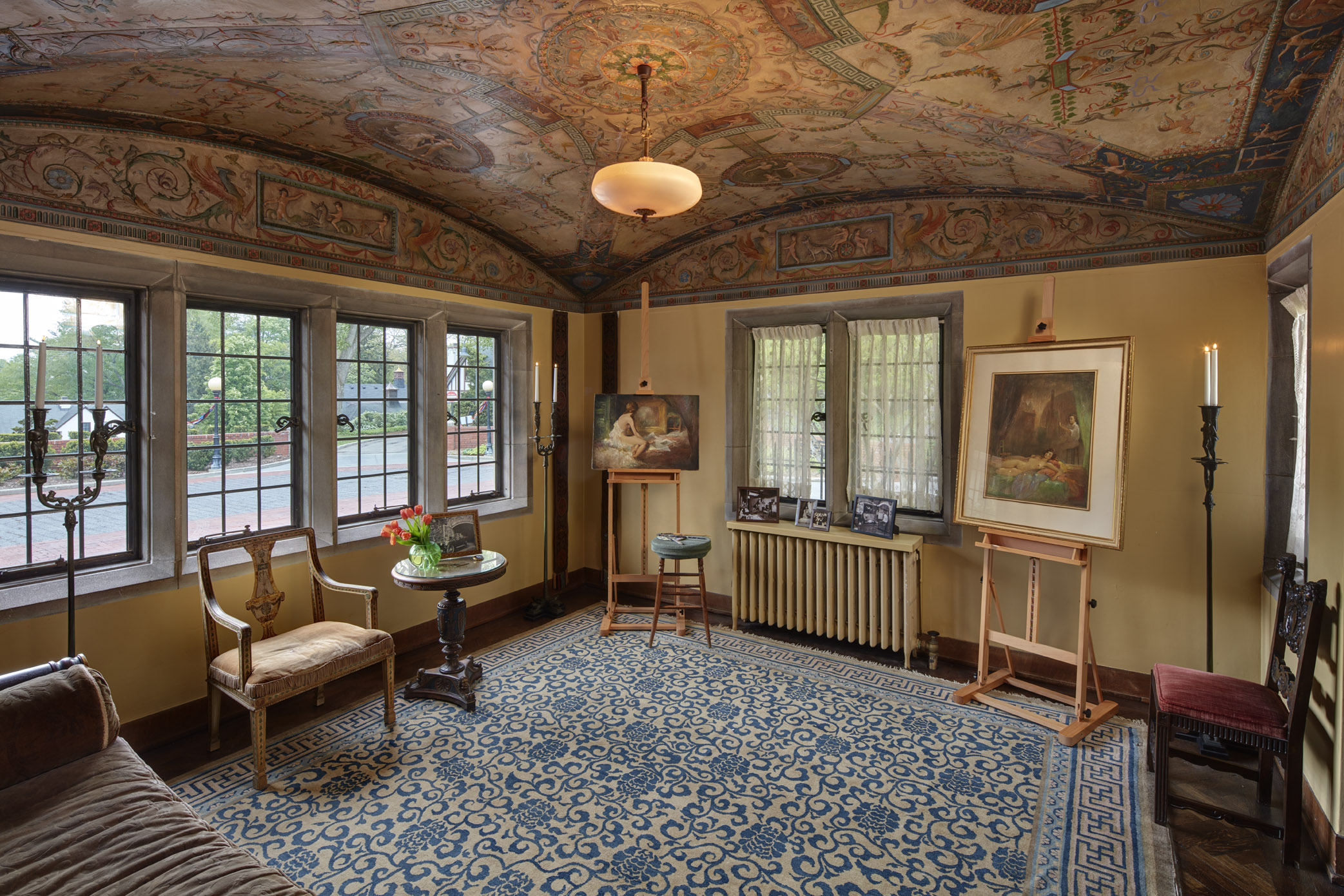
How different an impression of George’s personality we might form from the exuberant colors and rich textures of the Still Room! That space, wholly set aside for private relaxation, with its rainbow ceiling, walls hung with gold fabric, and violet velvet sofa (sadly faded now), reveals George’s inner aesthete. Yet both rooms, the luxurious Still Room and the somber office, tell us something about his character – specifically, how highly he valued the arts.
The Still Room at Cranbrook House, Summer 2023. Photograph by Jim Haefner.
In England in the 19th-century, a new school of thought about domestic design arose, which argued that the houses we live in do not just shelter us – they also shape us, emotionally, morally, and intellectually. Having a beautiful home with well-made furnishings could elevate the spirit, encourage thoughtfulness. Collectively, a community that dwelt surrounded by art would be a better society than one that lived without it. This ideal was embraced by the Arts and Crafts movement from its early days, and taken up by the Booths.
The mantelpiece in George’s Old Country Office, Cranbrook House. Photograph by Daniel Smith, CAA Architecture ’21.
George Booth once wrote, “A life without beauty is only half lived.” In his office, we can see how important it was to him to always be within reach of some great work of art or craftsmanship, even in the most ordinary moments of daily life. This same principle shaped the greater Cranbrook campus, for the benefit of all its community members.
— Mariam Hale, 2023-2025 Collections Fellow, Cranbrook Center for Collections and Research
George G. Booth’s “Old Country Office” at Cranbrook House. Photograph by Kevin Adkisson.
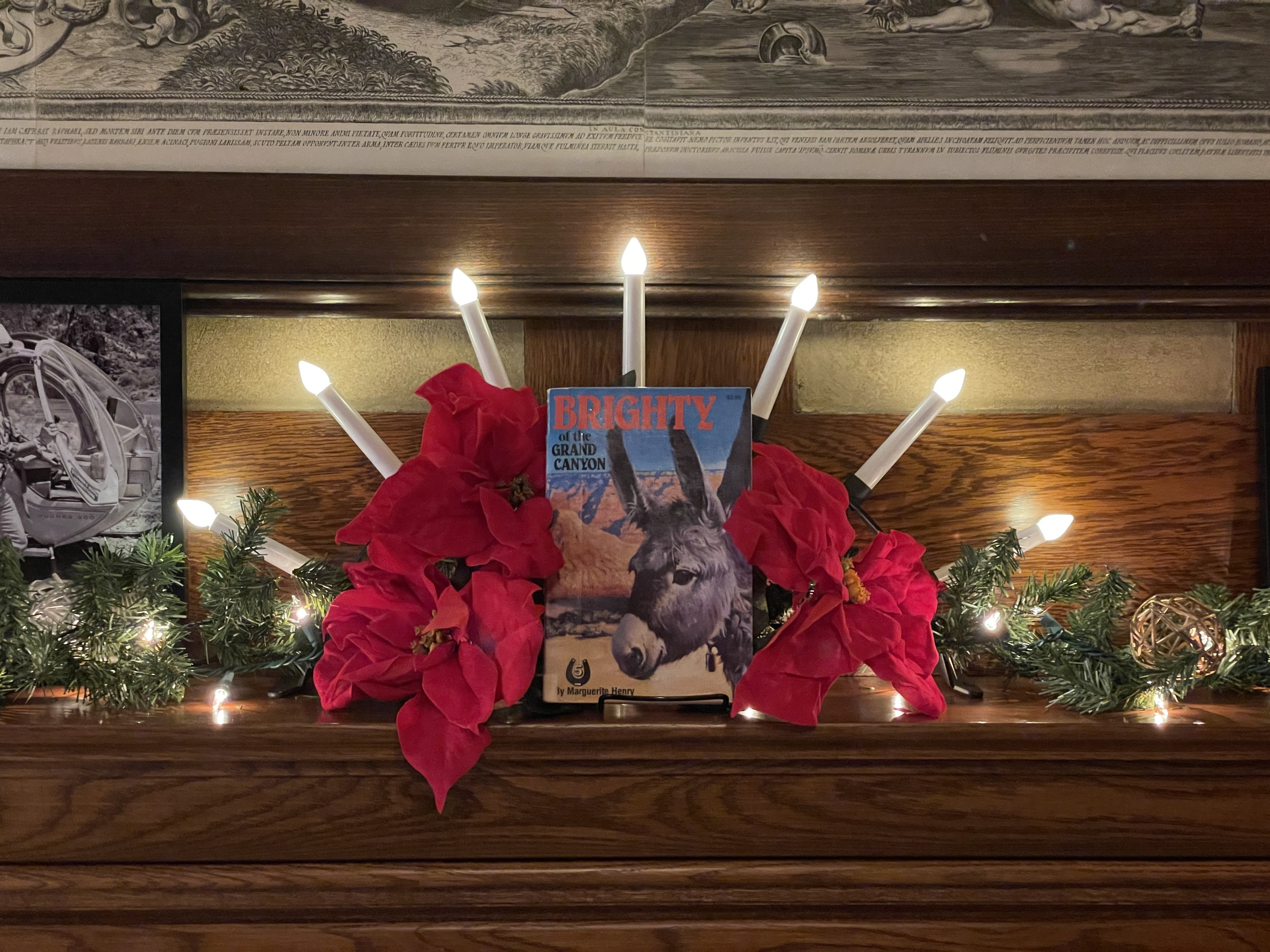
Every year at Christmas, the Center for Collections and Research decorates George Booth’s office in Cranbrook House with a special display. This year, our Christmas display is all about Brighty of the Grand Canyon, a movie produced by Stephen Booth, a grandson of Cranbrook’s cofounders. Brighty was a real donkey who inspired first a children’s novel, then a feature film.
In the late 1800s, there were hundreds of half-wild donkeys in the Grand Canyon, brought there by prospectors and then lost or abandoned. Brighty was one of them.
Photograph by Kevin Adkisson.
Brighty lived in the Grand Canyon from 1892 to 1922. In the winter, he roamed the warm depths of the canyon. A sociable animal, he liked the company of prospectors, hunters, and hikers, but if anyone loaded a heavy pack on his back he would soon make his escape. Every summer, he returned to the North Rim to stay with the McKee family who rented cabins to tourists. He would carry water, give children rides, and visit each cabin in turn for attention and treats—his favorite food was flapjacks and honey.
In 1953, the author Marguerite Henry learned about Brighty, and immediately decided to base her next novel on him. In search of more stories about the adventurous donkey, she travelled to the Grand Canyon herself, where she interviewed locals who had known him, hiked in the canyon, and even sampled the creek water and tasted the plants that Brighty would have eaten! She adopted her own donkey, Jiggs, to learn from him how the real Brighty might have behaved. In Brighty of the Grand Canyon, a free-spirited donkey helps solve a murder mystery and protects his human friends from a dangerous bandit.
This is the 1963 edition of the novel, the same year that the Booths bought a copy to read on their family road trip. Photograph by Kevin Adkisson.
Stephen Booth and his wife Betty bought a copy of the book to read to their children, Douglas, Charles, and George. They all loved the story, especially Stephen, who had his own film production company, and decided to make a movie about Brighty.
Filming began in 1965, with Marguerite Henry’s own pet donkey, Jiggs, starring as Brighty. Filmed on location at the Grand Canyon and in the Dixie National Forest in Utah, the actors and crew spent weeks living in the canyon. A tiny helicopter and an airplane with a camera mounted on the front were used for aerial shots, and for flying special visitors, like Stephen’s parents, Henry and Carolyn Booth, down into the canyon.
Norman Foster, the film’s director, reviews the script with Jiggs the Donkey. Stephen Farr Booth Papers, Cranbrook Archives
The movie premiered on November 22, 1966, just down the road in Birmingham, doubling as a fundraiser for Kingswood School for Girls. As the star of the movie, Jiggs himself came along to the premiere. Afterward, he participated in the Festival of Gifts at Christ Church Cranbrook, an annual Christmas tradition that began in 1928 and continues today.
From left to right: Betty Booth, Stephen Booth, Marguerite Henry, and Jiggs greet children at the film’s premiere. Stephen Farr Booth Papers, Cranbrook Archives.
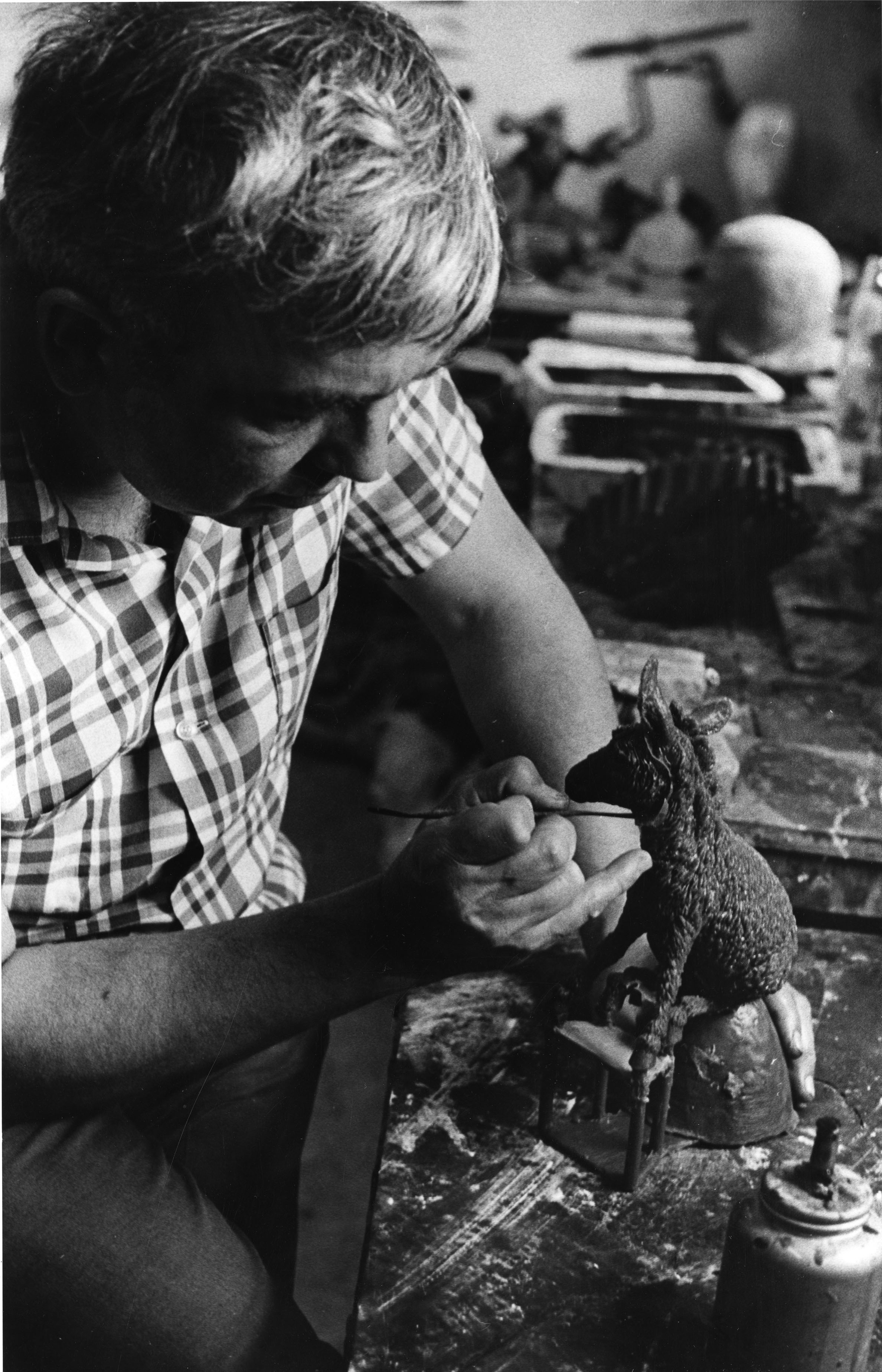
While Brighty was visiting Bloomfield Hills, he also posed for a series of sculptures by Peter Jepsen. They were modelled here at Cranbrook, on the second floor of Thornlea Studio. We still have one of the sixty Brighty figurines that Stephen Booth had made to give as presents to people who had helped in the making of the movie. Our Brighty was given to Stephen’s parents, Henry and Carolyn, to thank them for their support.
Photograph by Kevin Adkisson.
Peter Jepsen at work on Brighty in Thornlea Studio. Stephen Farr Booth Papers, Cranbrook Archives.
Stephen also commissioned Jepsen to make a life-size sculpture of Brighty. In 1968, Stephen gave that version to the Park Rangers at the Grand Canyon as a Christmas present. You can still see Jepsen’s Brighty at the visitor’s lodge on the North Rim of the Canyon, close to where the real Brighty spent his summers, more than a hundred years ago.
Peter Jepsen poses with his sculpture at the lodge on the North Rim of the Grand Canyon. Stephen Farr Booth Papers, Cranbrook Archives.
— Mariam Hale, Collections Fellow, Cranbrook Center for Collections and Research
Ed. Note (July 17, 2025): It appears the Dragon Bravo wildfire has severly damaged the original Brighty statue at the the lodge on the North Rim of the Grand Canyon. https://www.facebook.com/share/p/1CDkSfoutX/
Please know that the Cranbrook Center for Collections and Research will do everything it can to support efforts to restore or replace Brighty,














 Cranbrook Kitchen Sink