Christ Church Cranbrook Groundbreaking Centennial

July 5th, 2025, marks one hundred years since the groundbreaking for Christ Church Cranbrook. As we mark this milestone in Cranbrook’s history, I believe it is important to reflect on George Gough Booth’s long discernment of this generous gift to the community.

From the beginning, there were always places of worship at Cranbrook. The story that leads us through these spaces to the establishment of Christ Church Cranbrook is especially meaningful to me.

Rev. Dr. S. S. Marquis, D.D. with the first spade of earth, July 5, 1925. Courtesy of Cranbrook Archives, Cranbrook Center for Collections and Research.

After George and Ellen Booth purchased ‘The Farm’ in January 1904, his father, Henry Wood Booth, was the first family member to live on the country estate. The elder Booth stayed for the month of May with Frank Brose, the farmer, and his family. On May 15, 1904, the first worship service at Cranbrook took place under a tent, on the site upon which the Altar of Atonement now sits, with Henry as lay preacher. He continued in this ministry, also offering Sunday School, at the same spot until 1909. This was the first act of service offered to the Bloomfield Hills community at Cranbrook.

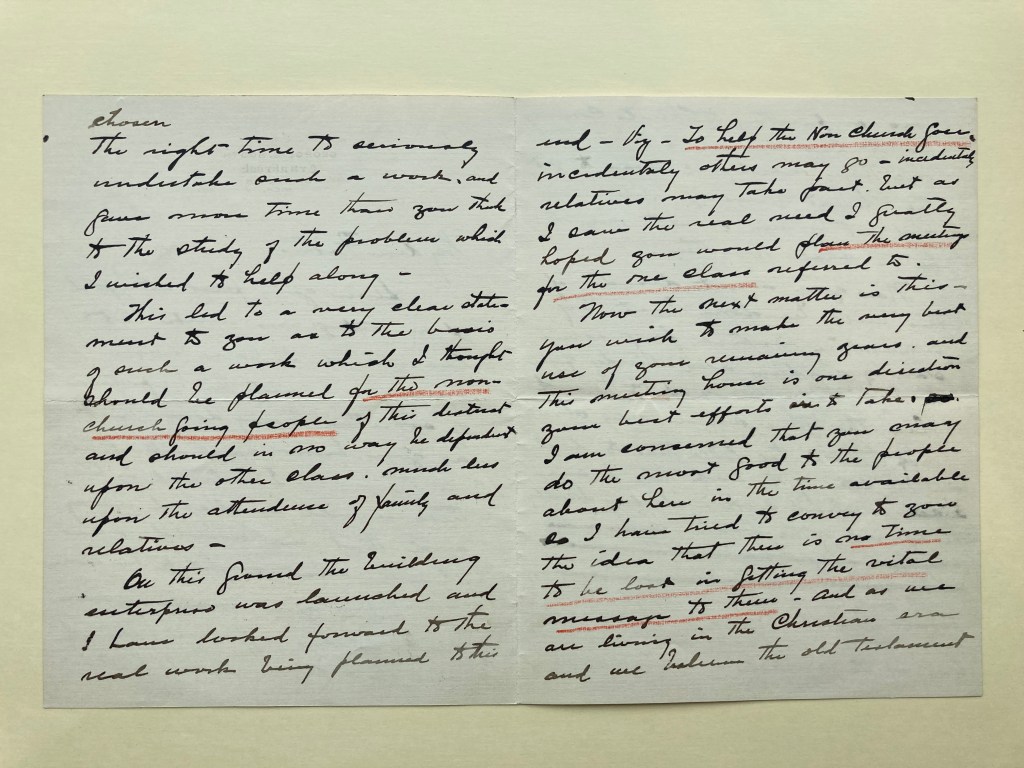
Letter from George Gough Booth to Henry Wood Booth, August 24, 1918. Courtesy of Cranbrook Archives, Cranbrook Center for Collections and Research.

In 1914, George and Ellen considered building a chapel at the site on which the Kingswood flagpole now sits, but the project was rejected, most likely due to the outbreak of World War I. As the war ended, a permanent place of worship and Sunday School was established with the building of the Meeting House.

The letter, above, preserves the dignity with which George writes of the Meeting House “building enterprise” to honor and give freedom to his father’s calling to share the Christ message with the non-church goers in the district. From this letter, we can learn and understand why George built the Meeting House for worship and Bible study through his father’s ministry.

Decoration of the Meeting House by Katherine McEwen, 1918. Laura MacNewman, photographer.

In the letter from George to his father, we also learn that he is prudent in observing the religious character of Bloomfield residents. During the years in which the Meeting House was used for religious services (1918-1926), Mr. Booth would reflect on the visiting clergy and service attendees (both of which came from diverse denominations), from which he would eventually discern the denomination of “Cranbrook church.”

Continue reading

The Art of Simplicity: Bonawit’s Grisaille

The clerestory windows designed by G. Owen Bonawit in the nave of Christ Church seem to be one of the least described elements of the church’s artwork. The work was negotiated and subcontracted through architect Oscar H. Murray at Bertram Grosvenor Goodhue Associates rather than commissioned directly through George G. Booth. Consequently, there are few documentary vestiges of the artist’s process in our records.

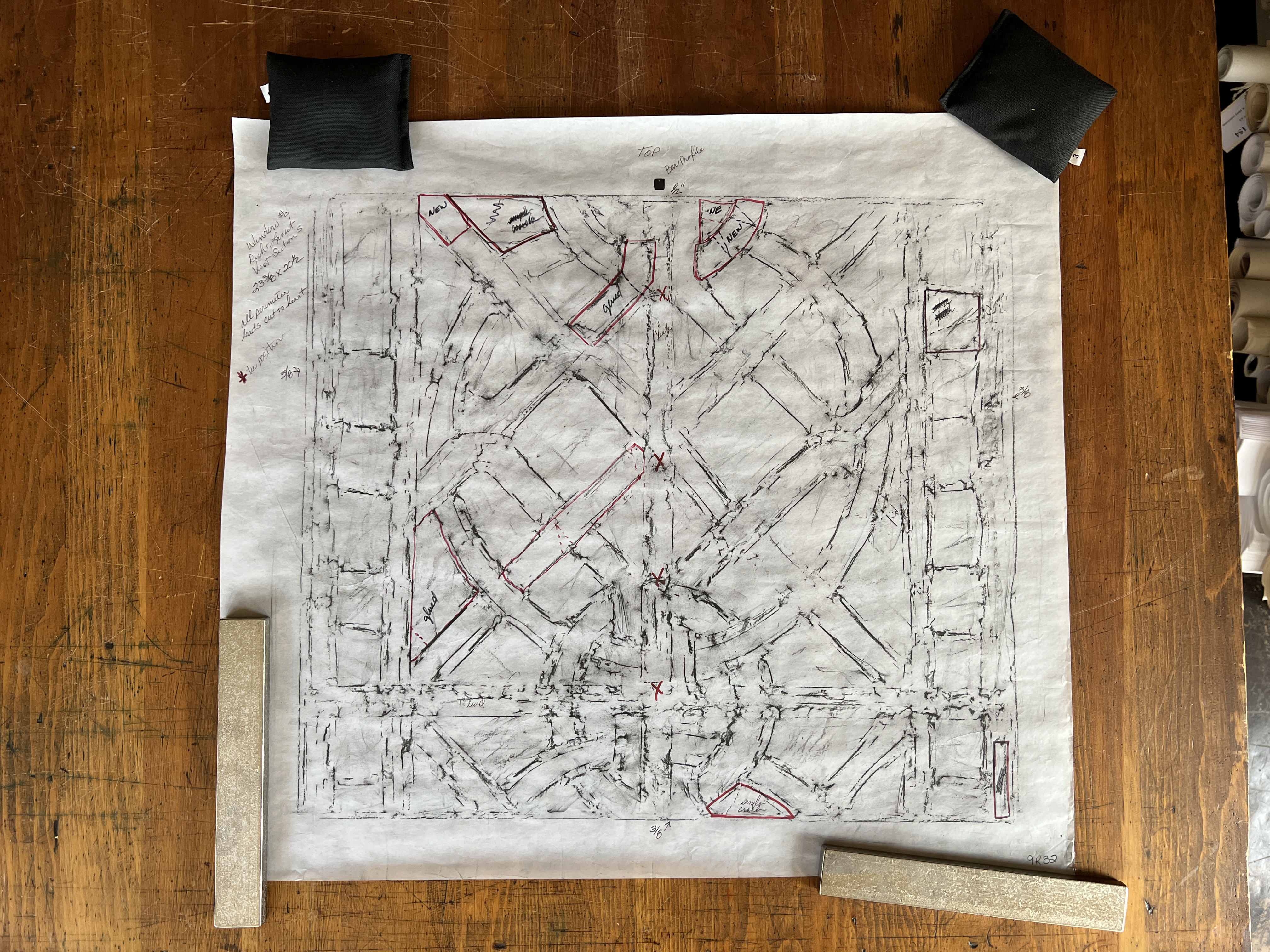
The windows can be studied through other materials held by the Archives, including architectural drawings, photographs, and the records of a window restoration project which commenced in 1993. In 1995, the Thompson Art Glass company made rubbings of the window for the purposes of identifying their care and preservation needs.

There are seventeen grisaille clerestory windows in the nave and chancel at Christ Church, which were analyzed as part of this stained-glass restoration project. They are made of clear antique glass upon which minute floral detail is painted and accentuated by the addition of small amounts of colored glass. In the chancel, there are two lancets and tracery of nine panels supported by T-bars including one ventilator panel. In the nave, they are comprised of three lancets and tracery with eight panels, with ventilator panels making up the bottom row.

Detail from Architectural drawing of Christ Church Cranbrook, North Elevation. April 30, 1925. Drawn by J.E.M./Oscar H. Murray, Bertram Grosvenor Goodhue Architects. [AD.10.33]. Courtesy of Cranbrook Archives.

Grisaille, literally meaning ‘to grey,’ is a type of stained glass that is mostly monochromatic, with a silver or grey tone being painted onto the finished glass. The purpose of the plainness of grisaille is twofold: they let more light into the space both literally and metaphorically in that they were intended to limit distraction from meditation.

The grisaille stained glass style is thought to have originated in French Cistercian abbeys after a prohibition on colored glass issued by St. Bernard of Clairvaux in 1134 in accordance with their charism of simplicity. St. Bernard, the master of paradox, also banned the use of figurative decoration according to the First Commandment of no graven images. Under his guidance, the Cistercians seek the face of God, a theological anomaly that produces an exquisite spiritual discipline and religious practice through which the monk contemplates holiness by virtue of continually recognizing the poverty of their thoughts and feelings when weighed down by seeking to satisfy worldly desire. The style often employs natural or geometric patterns, much like a labyrinth.

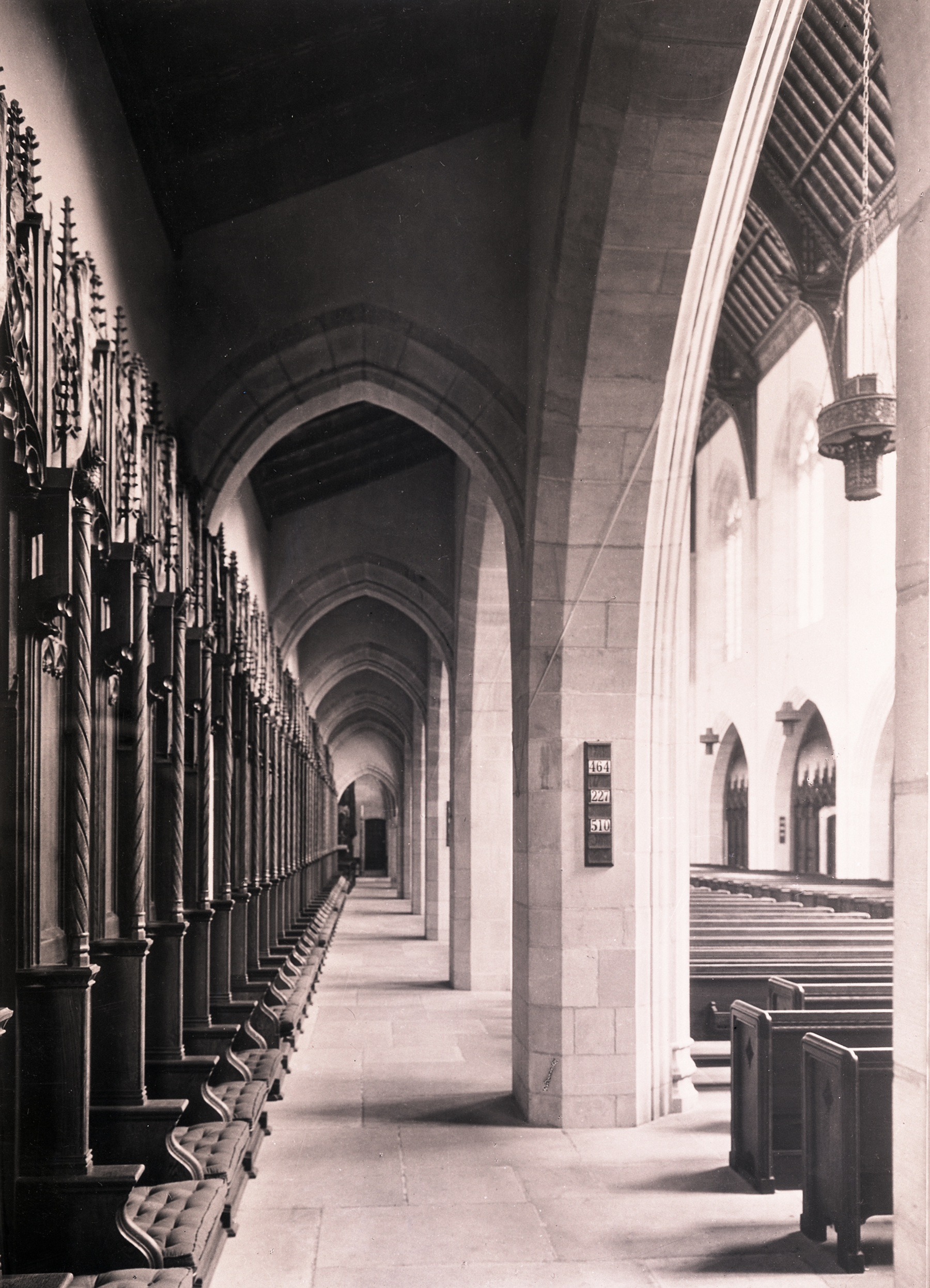
The windows can best be observed by sitting in the aisle stalls of the nave, which are in themselves an unusual feature otherwise only found in Oxford college chapels. The walls of the nave were originally intended to display memorials and artwork, but the latter idea was revised due to the objection that it would bring a museum feel to a house of worship.

Aisle stalls in left side of sanctuary. June 23, 1946. Photographer, Harvey Croze. Courtesy of Cranbrook Archives.

Added in 1930, the aisle stalls offer a fine perspective from which to observe the grisaille, and Bonawit’s elegant craftmanship brings with it a history of monastic inspired light. Since a life without beauty is only half lived, the artistic eclecticism of Christ Church offers all those who enter the opportunity to embrace the other half both in its resplendency and in its simplicity.

Laura MacNewman, Associate Archivist, Cranbrook Center for Collections and Research

Create a website or blog at WordPress.com