Dinosaurs and Doodles

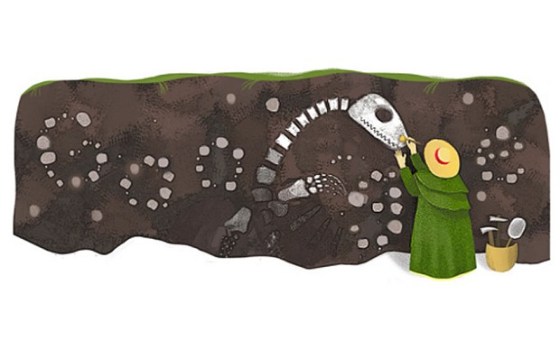
Google Doodle honoring Mary Anning's 215th birthday. Google.com.

Google Doodle honoring Mary Anning’s 215th birthday. Google.com.

If you find yourself on Google’s homepage today, you will likely run into a Google Doodle featuring a little-known 19th century Englishwoman named Mary Anning. Born in 1799, Anning was barred by her gender and social class from access to Britain’s community of leading scientists and palaeontologists, yet nonetheless she slowly became known in scientific circles throughout Europe and the United States. Anning’s discoveries include the first icthyosaur to come to scientific attention in England, as well as a partial skeleton of an unknown marine reptile that would later earn the title of plesiosaurus. The Google Doodle celebrates her 215th birthday and helps to give Anning the credit and attention that she so richly deserves, even centuries after her death.

There aren’t many connections between a 19th century female English palaeontologist and Cranbrook, but the timing of her 215th birthday is an ideal opportunity to mention Cranbrook Institute of Science’s current special exhibition Dinosaurs – The Lost World. Featuring more than fifty full-scale dinosaur skeletons and skeleton casts, Dinosaurs tells a story of prehistoric life that would not have been possible without the contributions of early amateur palaeontologists like Mary Anning. The exhibition closes on June 29, so be sure to visit and get a glimpse into the world that Mary and her colleagues discovered!

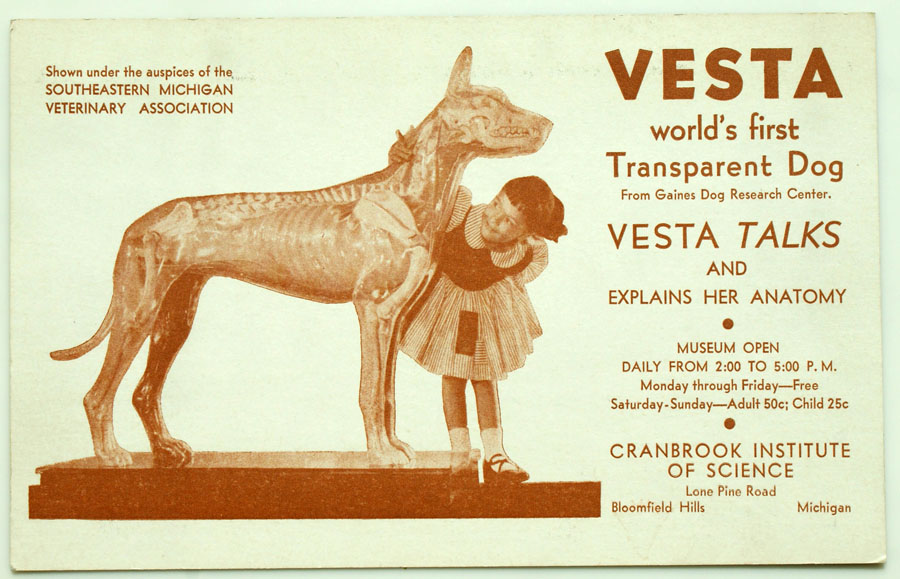
 

Photo Friday: Art by Degrees

Young women take in the Annual Exhibition of Student Work at the Cranbrook Art Museum. The central painting is Untitled (1957) by student Frank Okada. June 1957. Harvey Croze/Cranbrook Archives.

Visitors take in the Annual Exhibition of Student Work at Cranbrook Art Museum. The central painting is Untitled (1957) by student Frank Okada. June 1957. Harvey Croze/Cranbrook Archives.

It’s that time of year again—the Graduate Degree Exhibition is up and running at Cranbrook Art Museum! Staged in some form or another since 1940, the Graduate Degree Exhibition is a celebration of work produced by Cranbrook’s graduating class of MFA students. This photograph from 1957’s Annual Exhibition of Student Work (an earlier name for the Graduate Degree Exhibition) shows a painting by Academy of Art graduate Frank Okada that might be familiar to eagle-eyed museum visitors—it was featured in the 2013 exhibition What to Paint and Why: Modern Painters at Cranbrook, 1936-1974.

For more information about the 2014 Graduate Degree Exhibition, check out Cranbrook Art Museum’s website. And be sure to check out the show while you still can—it closes May 11!

The Transparent Dog Talks

Vesta, the transparent dog

Exhibition Card, Cranbrook Institute of Science Records, 1955. Cranbrook Archives.

While preparing for an exhibition, it is inevitable that we stumble upon cool, unusual objects in our collection. I love the discovery of the unique stories associated with them.  This image announces an Institute of Science exhibition that featured Vesta, the talking dog.  Vesta (named after the Roman goddess and guardian of the home) was a transparent plastic model created in 1954 for the Gaines Dog Research Center by the Deutsches Museum in Germany. Vesta was then flown to Cleveland, where a team of experts installed an intricate sound system which enabled her to tell interesting facts about herself as parts of her anatomy lit up.   She was part of an educational and scientific traveling exhibition to help dog owners better understand their pets. Continue reading

Cranbrook and the Car, Part 4: On the Road Again

A Driving Force: Cranbrook and the Car may have closed to the public, but we’re not done with it yet here at the Center for Collections and Research. As Cranbrook Art Museum switches out exhibitions (and gets ready to install the yearly Graduate Degree Exhibition, a show everyone must check out), staff of both the Center and the Museum are busy dismantling cases, assessing the condition of objects as they come down from the display, and preparing spaces to hold new and exciting displays of art and design.

While A Driving Force: Cranbrook and the Car was not a huge show, it did have one very sizable object: the 1914 Scripps-Booth Rocket Cyclecar. In the collection of the Detroit Historical Museum, the Rocket came to us from the Owls Head Transportation Museum where it had been on loan for a number of years (if you missed it, read more about the move here). Now, nine months after going on view, it was time to return it home. This morning our registrar Roberta Frey Gilboe and associate registrar Gretchen Sawatzki helped to wheel the Rocket out onto Cranbrook Art Museum’s loading dock and send it back to the Detroit Historical Museum.

Museum objects need to be preserved in as best condition as possible, which means that driving the Rocket is pretty much out of the question. Even if we wanted to drive it out the building, though, that would be impossible – the car is not in working condition. Instead, we hired a car transporter to pick up the Rocket and drive it the twenty-something miles down to DHM. The following videos (filmed by Gretchen) give a sense of what is involved in moving a vehicle of this size and age. In the first video, Roberta and our truck driver roll the Rocket out into the dock and onto a lift. In the second, the three of them (Roberta, driver, and Rocket) ride the lift up to meet the bed of the truck. In the final video, they roll the Rocket onto the truck. As you can see, moving objects (especially ones as large and as complicated as antique cars) is a complex task. With a team of talented professionals, though, and given enough time, we can safely transport objects from space to space and make room for the new and exciting exhibitions to come.

<p><a href=”http://vimeo.com/90781705″>Video 1: The Rocket Starts Rolling</a> from <a href=”http://vimeo.com/user21903363″>Cranbrook Kitchen Sink</a> on <a href=”https://vimeo.com”>Vimeo</a&gt;.</p>

<p><a href=”http://vimeo.com/90781706″>Video 2:The Rocket Rises</a> from <a href=”http://vimeo.com/user21903363″>Cranbrook Kitchen Sink</a> on <a href=”https://vimeo.com”>Vimeo</a&gt;.</p>

<p><a href=”http://vimeo.com/90781707″>Video 3: The Rocket Rolls into Place</a> from <a href=”http://vimeo.com/user21903363″>Cranbrook Kitchen Sink</a> on <a href=”https://vimeo.com”>Vimeo</a&gt;.</p>


– Shoshana Resnikoff, Collections Fellow

Photo Friday: Cage at Cranbrook

Limited edition postcard featuring CAA student Jim Poole wearing a Cage Bag as a mask on Cranbrook's campus, 1974. Courtesy Stephen Milanowski.

Limited edition postcard featuring CAA student Jim Poole wearing a Cage Bag as a mask on Cranbrook’s campus, 1974. Courtesy Stephen Milanowski.

In 1974, artist-composer John Cage traveled to Cranbrook for the opening of the museum exhibition Music-Mushrooms-Manuscripts. His visit prompted an incredible spate of creative production among CAA students, including this postcard. Part of a limited edition set created as part of Cage’s visit, the card features CAA student Jim Poole wearing a “Cage Bag” as a mask. The Cage bags (paper bags featuring silk-screened images of John Cage’s face) were made to be used in a performance of Cage’s compositions held on campus.

If this all seems confusing, don’t worry – you can get some clarity on this amazing, confusing, and exciting time period by visiting Cranbrook Art Museum on Sunday, March 23. Shelley Selim, the 2013-2015 Jeanne and Ralph Graham Fellow, will be lecturing on John Cage’s visit to Cranbrook as well as discussing Mushroom Book and Sounds of Venice, two Cage works currently on display in the Cranbrook Art Museum exhibition My Brain Is in My Inkstand: Drawing as Thinking and Process. The lecture starts at 4 pm, and immediately following will be a performance of Sounds of Venice by Detroit musician and composer Joel Peterson (check out his amazing gallery/restaurant/performance space Trinosophes, across from Eastern Market). For more information, check out Cranbrook Art Museum’s website. You can also read more about the Cage visit in Shelley’s amazing blog entry, hosted hereon our sister blog Cranbrook Sightings. And if you haven’t yet seen My Brain Is in My Inkstand, be sure to catch it soon–the exhibition closes on March 30!

Art in the Time of War: Cranbrook’s Monuments Men

Monuments Men, opening today in theaters, chronicles the efforts of men and women in the US military to protect and preserve Europe’s artistic and cultural patrimony during World War II. Directed by George Clooney, the film has brought to national attention the work of these non-traditional soldiers, arts and cultural professionals who recognized that while the world was tangled in a struggle that engulfed countries and cost thousands of lives, the art and artifacts prized for centuries by those communities were equally at risk.

With the renewed attention to the work of the Monuments, Fine Arts, and Archives Section (MFAA)—nicknamed the “Monuments Men”—has come the realization at museums across the country that many of their early directors and curators were active members of the MFAA during World War II.  At Cranbrook we’ve uncovered the stories of two Monuments Men who played a role in our own history.

Robert S. Davis at Cranbrook, 1942. Cranbrook Archives.

Richard S. Davis at Cranbrook, 1942. Cranbrook Archives.

Continue reading

Michigan Modern: The Model T has Left the Building

Sunday marked the last day of the exhibition Michigan Modern: Design That Shaped America at Cranbrook Art Museum.  This means that Monday saw the start of the museum staff’s busiest time—the five weeks in which we take down one exhibition and put up another.  Dismantling Michigan Modern is difficult; we need to say goodbye to objects we love and figure out the difficult process of getting them out the door.  And if there is one object in the entire exhibition that typifies the emotional drama of letting go as well as the physical challenge of moving giant historical artifacts, it is the Model T chassis.

Model T Chassis, The Henry Ford.  On view in Michigan Modern at Cranbrook Art Museum.  September 2013, Shell Hensleigh/Cranbrook Art Museum.

Model T Chassis, The Henry Ford. On view in Michigan Modern at Cranbrook Art Museum. September 2013, Shell Hensleigh/Cranbrook Art Museum.

Continue reading

Dispatch from the Archives: “Gatescapes,” Old and New

On October 5, Cranbrook Archives will be opening its second exhibition in the From the Archives series.  From the Archives: Forging Cranbrook’s Gatescape explores the long-lasting significance of gates to Cranbrook’s campus.  Points of transition and transformation, the gates have also long stood as a public display of Cranbrook’s dedication to art and design.

George Gough Booth sketch for a gate.  George Gough Booth Papers, Cranbrook Archives.

George Gough Booth sketch for a gate. George Gough Booth Papers, Cranbrook Archives.

Cranbrook’s love of gates originates with its founding father, George Gough Booth.  Booth, who came from a family of copper and tin metal workers, received early training at the Red Foundry in Ontario, Canada.  This, in part, led to his 1884 purchase of Barnum Wire and Iron Works in Windsor, Ontario with partner Fred Evans.  Booth wrote, “I conceived the idea of creating a new type of industry – selling with my pencil and not so much out of a catalogue – making special designs for fences, signs, bank counter railings…”   One of the earliest gates at Cranbrook designed by George Booth (and fabricated by Detroit Architectural Iron Works in 1916) is the first public gate located at the entrance to the Greek Theatre.

    Greek Theatre gates, designed by George Booth and produced by the Detroit Architectural Iron Works. 1916.

Greek Theatre gates, designed by George Booth and produced by the Detroit Architectural Iron Works. 1916.

Since Booth’s inception of Cranbrook, the community has steadily expanded the campus’ “gatescape.”  The most recent gates installed on campus are the “Valley Way” entrance gates (2012), designed by Architect-in-Residence William Massie.  Located at what was formerly known as the Vaughan Road Entrance, the gates were part of a project which widened the roadway to improve vehicular and pedestrian safety.  Working with Brian Oltrogge, Massie designed an abstraction of geometric triangles, a reference to Eliel Saarinen’s Kingswood gates.   The new gates were fabricated of laser-cut and bent steel.  The hand-bent “infill” was bolted to the steel frame and welded by Jody Cooper, Academy of Art alumni (Architecture Department 2012).

Closeup of Valley Way entrance gates, designed by Cranbrook Academy of Art Architect-in-Residence William Massie. The gates were completed in 2012.

Closeup of Valley Way entrance gates, designed by Cranbrook Academy of Art Architect-in-Residence William Massie. The gates were completed in 2012.

In conjunction with the exhibition opening, I’m going to be leading a walking and bus tour of the gates on Saturday, October 5.  We’ll be exploring all aspects of the gates, from their history in situ to the designers and makers who produced them.  Be sure to sign up here to join us, and get ready to delve deep into Cranbrook’s “gatescape”!

Leslie S. Edwards, Head Archivist

Photo Friday: Cranbrook’s Gatescape

Image

Close-up of the peacock for which Cranbrook School’s Peacock Gates are named. Designed and installed in 1927, restored in 2013. Cranbrook Archives.

Doors, entryways, gates – Cranbrook’s campus was designed with an eye towards points of transition.  Since its foundation 108 years ago, Cranbrook has maintained a long tradition of gate design and fabrication.  This close-up of a stylized peacock comes from Cranbrook School’s famous Peacock Gates; designed by Eliel Saarinen, they were produced by the metalsmith Oscar Bach in 1927.  Recently, a long restoration process culminated with their re-installation on the Cranbrook School campus.   This gate and many others are the subject of the second exhibition in the From the Archives series.  Drawing from the rich collection of the Cranbrook Archives, From the Archives: Forging Cranbrook’s Gatescape explores the history, design, and formation of Cranbrook’s historic and contemporary “gatescape.”

Experiencing the gates from within the walls of the Art Museum is nothing compared to seeing them in person.  With that in mind, Leslie S. Edwards, Head Archivist and exhibition curator, will be leading a walking and bus tour of the gates on Sunday, October 5.   The tour will take participants  to some of Leslie’s favorite gates, from beloved classics to the newest installations on campus.   More information on the exhibition and walking tour is available here.  Be sure to check it out, and get ready to see Cranbrook’s gates in a whole new light!

Cranbrook and the Car, Part 3: Suzanne Vanderbilt

If AMC’s long-running television show Mad Men has taught us anything, it is that it is hard being a woman in a man’s world.  And while Peggy Olsen’s struggle to be taken seriously as an advertising professional in the 1960s is fictional, many talented, driven, and creative women found themselves fighting a similar battle in their own professions in the 1960s and 1970s.

Suzanne Vanderbilt was one such woman, and her work as a designer at General Motors is highlighted in A Driving Force: Cranbrook and the Car, now open in the lower galleries of the Cranbrook Art Museum.  A Cranbrook Academy of Art graduate, Vanderbilt was an active member of the “Damsels of Design,” the young women hired by Harley Earl to work on the interiors of vehicles for General Motors in the 1950s and 1960s.

1998-02 Vanderbilt in car, c1950s (2)

Suzanne Vanderbilt in her Corvette, mid 1950s. Suzanne Vanderbilt Papers, Cranbrook Archives.

Though the assembling of these women into a charming and attractive group of “damsels” was a PR ploy, the fact remains that these women designers did real work for GM, re-thinking car interiors at the exact moment that the auto industry began recognizing women as significant consumers of their products.  Women have historically made the majority of household purchasing decisions, and as cars increasingly became associated with domestic American life it became clear that women would have a greater role in buying them.  Recognizing this trend, GM acknowledged that its design, engineering, and marketing of cars would have to shift.  And who better to understand the female consumer than women themselves?

Continue reading

Create a website or blog at WordPress.com